Independent comparisons. We may earn from shop links. Our editors compare products independently. Some links go to shops, and we may earn a commission. More info
Top pick: GDWD TPE coving trim, 3 m Best value: Lifuncren quadrant trim – About £16.99 for a stated 8 m, about £2.12 a metre, with 4.1 from 198 reviews. The listing prints three materials. Updated 22.10.2026.
Coving is the moulding at the join of wall and ceiling. In the UK you buy it as paper-faced gypsum plaster, polystyrene foam, or polyurethane, often called duropolymer. Those three are not the same job as a peel-and-stick quadrant or U-trim. A settlement crack or a cable at the ceiling needs a real cove. A narrow tape bead only covers a small gap. You judge a length by whether the profile hides the crack you have, whether the material suits the room's moisture, and whether the adhesive is one the maker allows for that material.
The millimetre figure is the girth across the face, not the drop down the wall. For a 100 mm plaster cove, published guide lines are 67 mm down the wall and 67 mm across the ceiling. Tape is fixed only to a clean, dry, sound surface. The [coving buying guide](/hub/diy-supplies/coving/sub/coving-buying-guide) sets out material, size and fixing. England's dwelling fire guidance treats a cove as a cover mould, not as a ceiling lining.
Coving is the moulding at the join of wall and ceiling. In the UK you buy it as paper-faced gypsum plaster, polystyrene foam, or polyurethane, often called duropolymer.
Coving is the moulding at the join of wall and ceiling. In the UK you buy it as paper-faced gypsum plaster, polystyrene foam, or polyurethane, often called duropolymer. Those three are not the same job as a peel-and-stick quadrant or U-trim. A settlement crack or a cable at the ceiling needs a real cove. A narrow tape bead only covers a small gap. You judge a length by whether the profile hides the crack you have, whether the material suits the room's moisture, and whether the adhesive is one the maker allows for that material.
The millimetre figure is the girth across the face, not the drop down the wall. For a 100 mm plaster cove, published guide lines are 67 mm down the wall and 67 mm across the ceiling. Tape is fixed only to a clean, dry, sound surface. The [coving buying guide](/hub/diy-supplies/coving/sub/coving-buying-guide) sets out material, size and fixing. England's dwelling fire guidance treats a cove as a cover mould, not as a ceiling lining.
Coving is the moulding at the join of wall and ceiling. In the UK you buy it as paper-faced gypsum plaster, polystyrene foam, or polyurethane, often called duropolymer. Those three are not the same job as a peel-and-stick quadrant or U-trim. A settlement crack or a cable at the ceiling needs a real cove. A narrow tape bead only covers a small gap. You judge a length by whether the profile hides the crack you have, whether the material suits the room's moisture, and whether the adhesive is one the maker allows for that material.
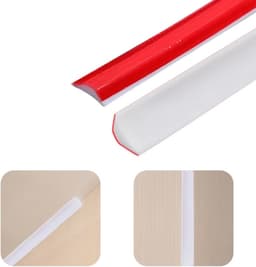
GDWD's 42 mm × 30 mm TPE moulding is the widest section in this set, listed at about £21.99 with a highlight that says white 3 m and a weight of 940 g. The unit-count field is 1.0 count, not a metre figure, so the length you can quote is the highlight. The star line is 5.0 from one rating, and the stored file has no UK review text. Bullets claim a waterproof, moisture-resistant trim for kitchens, bathrooms, and utility rooms, and they suggest a hairdryer if the adhesive is cold. Nothing in the file shows whether that larger profile stays on the wall, or whether you can paint it. The section is the reason to look at it, and the single rating is the reason it does not lead this comparison. Buy it only when you already need something near 42 × 30 mm and you accept that the evidence is one star.
This GDWD listing is the same 42 mm × 30 mm TPE profile as the 3 m highlight, at about £37.39, model White-5m, and a stated weight of 1.53 kg. The highlight says white 5 m, while the unit count is again 1.0 count, and the main image URL matches the shorter file. It is also 5.0 from one rating, with no review text to read. The bullets repeat a waterproof claim, name kitchens, bathrooms, and utility rooms, and mention a hairdryer when the adhesive is cold. You pay more for the longer highlight, not for a second set of reviews. A 5.0 from one rating does not outrank 4.2 from 182 or 4.0 from 423. Leave it unless the gap is already in this 42 mm class and the 3 m highlight is short for the room.
Pros
42 × 30 mm TPE with a white 5 m highlight
Weight listed at 1.53 kg
Same peel-and-stick and cold-weather hairdryer notes as the shorter highlight
Rooms named include kitchen, bathroom, and utility
Cons
About £37.39, the highest price in this set
5.0 from one rating and no review text
Unit count is 1.0 count
Same main image as the 3 m listing
Best for: A longer run of the 42 × 30 mm profile when the 3 m highlight is short and you accept the same single rating.
Less suitable: A small gap, a tight budget, or any job where you want written UK reviews before you pay.
How is this GDWD listing different from the 3 m highlight?
This file is about £37.39, model White-5m, weight 1.53 kg, and the highlight says white 5 m. The section is still 42 mm × 30 mm TPE. The unit count is 1.0 count.
What rooms does the listing name?
The item highlight names kitchen, bathroom, and living room. The bullets also name utility rooms and a waterproof claim. There is no review text in the stored file.
Can you paint this GDWD moulding?
The page asks whether it can be painted. The stored file does not answer that. There is no review text, only 5.0 from 1 rating.
Conwang lists a 15 mm × 15 mm silicone U-trim, 5 m, at about £15.99, and the pack includes an adhesion promoter and gloves. Across 182 UK reviews people cut it with scissors and press it onto laminate-to-door gaps, kitchen tile edges, ceiling joints, and a bath edge when they added extra silicone. Those reviews also say to cut it long and not stretch it, or the strip pulls back. The adhesive still fails for some buyers: the red backing can pull the glue off with it, and the supplied wipes were bone dry or strongly scented in more than one account. A dimensions field prints 5 × 5 × 1 cm, which is not the 5 m size line. It is the silicone alternative when you want a 15 mm section and the promoter. It is dearer per metre than the 6 m TPE quadrant, so it is not best value in this set.
Pros
15 × 15 mm silicone U-trim, 5 m, at about £15.99
4.2 from 182 UK reviews
Adhesion promoter and gloves are in the pack
Used on tiles, floors, ceiling joints, and a bath edge when the surface was prepared
Cons
Tape still lifts, and the backing can take the glue with it
Dimensions field says 5 × 5 × 1 cm
About £3.20 a metre against a cheaper known 6 m roll
The page asks about paint and does not answer
Best for: A gap near 15 mm on tile, laminate, or a bath edge, if you will use the promoter and avoid stretching the strip.
Less suitable: You want the lowest knowable price for 6 m, or a quadrant the listing actually names as a quadrant.
The included-components line lists an adhesion promoter, gloves, and the moulding trim. The size field is 5 m and the section bullet is 15 mm by 15 mm.
How do you fix the Conwang strip?
The listing says clean and dry the surface, wear the gloves, apply the promoter, then press both sides. It also says a hairdryer for 30 seconds if the adhesive is weak in the cold.
Can you paint the Conwang strip?
The page asks whether it can be painted. The stored file does not answer that.
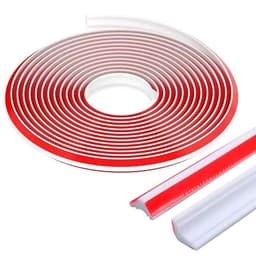
Lifuncren is an 8 m quadrant at about £16.99, with a 15 mm × 15 mm section, a 20 mm bevel, and a 15 mm gap-fill figure. The title says PVC, a bullet says silicone, and the material field says synthetic rubber, so the page never settles what arrived in the packet. Across 198 reviews it is easy to cut, and some buyers report a tidy line on a floor edge, a bath, a conservatory, or ceiling tiles when they used the prep wipes and did not stretch the strip. Others found the length on the floor the next morning, a bone-dry activator wipe, or a red backing that peeled the adhesive away. One review says it is not actually white except in the thicker parts, and another says it is too small to stand in for a skirting board. It is best value here for a knowable 8 m, about £2.12 a metre, only if you can accept a listing that prints three materials.
Pros
8 m stated in the title at about £16.99
15 mm gap fill and a 20 mm bevel on the bullet
4.1 from 198 reviews
About £2.12 a metre when the 8 m length is the one that arrives
Cons
Title, bullet, and spec name three different materials
Adhesive fails, including a dry activator wipe
Red backing can pull the glue off
Too small to replace a skirting board
Best for: A long run near a 15 mm gap when you have checked the packet, because the listing itself does not name one material.
Less suitable: You need a single stated material, a proved paint finish, or a bead that has already stayed up without extra glue.
Gkhlg is the about £5.09 quadrant in this set, and the file will not tell you how much trim that price buys. The unit count is 1.0 metre, the dimensions field is 3 m long, and the title offers 1 m or 3 m. The title and the included-components line say silicone, while the material bullet says TPE. Behind 4.1 there are five reviews, and the file contains three texts. One buyer used a 3 m roll as a temporary kitchen-floor edge and quoted £10.99, which is not this £5.09 line. Another found the backing tape damaged on arrival and replaced it with stronger tape. A price per metre is not stated, because the length is not one figure. The low shelf price is only useful once you know which length and which material will turn up.
Pros
About £5.09 shelf price, the lowest in this set
Quadrant profile aimed at bath, shower, and worktop edges
Peel-and-stick after cutting, in the short review texts
Cons
Length fields say 1 m and 3 m
Silicone and TPE are both printed
4.1 from five reviews, three texts in the file
Damaged backing tape in one of those texts
Best for: A short temporary edge only after you have confirmed the length on the packet you received.
Less suitable: You need a price per metre, a single material, or a review sample you can actually read.
The unit count is 1.0 metre, the dimensions field is 3 m long, and the title offers 1 m or 3 m. The stored file does not settle one length, so a price per metre is not stated.
Is the Gkhlg trim silicone or TPE?
The title and the included-components line say silicone. The material bullet says TPE. Both stay on the listing.
Can you paint the Gkhlg trim?
The page asks whether it can be painted and whether it is mould resistant. The stored file does not answer either question.
The sokey listing is a 12 mm × 9 mm TPE quadrant, sold as 6 m for about £11.69, and it carries 4.0 from 423 amazon.co.uk reviews. Reviewers cut it with scissors and use it on ceiling lines, hallway corners, and the edge of new flooring at doors. The page caps the gap at 12 mm, and more than one review says that section was too small for the crack in front of them. Adhesive is the complaint that keeps returning: in the first 50 UK review blocks, stick appears 18 times, often because the tape lifted after cleaning. Corners sometimes needed superglue, and one reviewer found the smell strong and the white slightly transparent on a light wall. It is the top pick when the gap is within that 12 mm. It is still a tape bead, so a settlement crack wants a merchant cove instead.
Pros
6 m of 12 × 9 mm TPE at about £11.69
4.0 from 423 amazon.co.uk reviews
Cuts with scissors and flexes on 89–90° corners
Listing states a 12 mm maximum gap fill
Cons
Tape lifts, including after the surface was cleaned
12 × 9 mm is too small for a wider crack
Corners sometimes need extra glue
The page asks about paint and does not answer
Best for: A small ceiling or floor gap within the stated 12 mm, when you want a known 6 m length and the largest review sample in this set.
Less suitable: A settlement crack, a 100 mm plaster cove, or a finish you need to paint.
Woobroo is a 19 mm × 13 mm TPE quarter round, 6 m, at about £16.99, with a maximum gap fill of 13 mm on the listing. The star line is 4.0 from 10 reviews, and the stored file holds four UK texts, so six ratings have no words here. One text says the strip was very sticky on a wall-to-ceiling line. Another reports a neat finish only after Tec7 was used as a base, and two households say it does not stick on its own. The page calls it water resistant and names bathrooms, then says it is not suitable for damp, dirty, uneven, or flaking surfaces. At this price it costs more than the 6 m sokey roll and rests on a much smaller sample. Treat the 19 mm face as a size option, not as proof it will stay up.
Pros
19 × 13 mm TPE quarter round with a stated 6 m
Maximum gap fill listed as 13 mm
One UK review reports a sticky hold on a wall-to-ceiling line
Material and length fields agree
Cons
4.0 from 10 reviews, with four texts in the file
Does not stick on its own in more than one of those texts
One finish depended on adding Tec7
Water-resistant claim sits next to a ban on damp surfaces
Best for: A 13 mm gap on a clean, dry, sound corner when you accept a 10-review sample and may add a separate adhesive.
Less suitable: You want a three-figure review count, or you are sticking onto a surface that is already damp or flaking.
The title is 19 mm × 13 mm and the unit count is 6.0 metres. The maximum gap fill is 13 mm.
Where does the listing say not to stick it?
The listing says it is not suitable for damp, dirty, uneven, or flaking surfaces. It does claim water resistance and names kitchens and bathrooms.
Can you paint the Woobroo strip?
The page asks whether it can be painted. The stored file does not answer that.
How we compared
Shelf prices and stars are the amazon.co.uk figures stored on 19 October 2026 for these seven self-adhesive trims. This is not a laboratory test, a fire test, or a ranking of plaster cove. Stars, review-sample size, whether material and length agree, a knowable price per metre, and peel in the review notes make the score. Each published total is out of 100 and is shown on the card divided by 10. The highest score is the top pick. Best value is a different listing: the other roll in the top value band, a stated 8 m with 198 reviews. A 5.0 from one rating cannot lead.
1
Amazon stars
40%
amazon.co.uk stars divided by 5, then scaled to 40 points and rounded. A 5.0 from one rating scores the star points and still sits in the lowest sample band.
2
Review sample
20%
20 points at 150 reviews or more, 8 points from 10 to 49 reviews, and 2 points under 10 reviews. A thin sample cannot lead on stars alone.
3
Spec agreement
20%
20 points when material and length agree, 16 when the length agrees and a dimensions field conflicts, 14 when the length is only an item highlight, and 8 when material or length fields disagree.
4
Price per metre
15%
15 points for a knowable price under £2.20 a metre, 10 points under £3.50 a metre, 6 points when the length is unknown or the metre price is higher, and 4 points on the dearest highlight.
5
Adhesion notes
5%
Peel in the stored reviews is the remaining check, weighted at 5 so these criteria sum to 100. The desk score subtracted up to 6. The card scores stay the published totals.
Independent review
Last updated: 22.10.2026
9 sources checked
Coving buying guide
Buy the job before the word coving. A settlement crack or a cable at the ceiling needs a rigid cove. A peel-and-stick bead only covers a small gap. Plaster, polystyrene, and polyurethane are not the same fixing, and none of them is the same as the seven tape listings on this page.
What is coving?
Coving is the moulding at the join of wall and ceiling. In the UK the rigid versions are paper-faced gypsum plaster, polystyrene foam, or polyurethane, often sold as duropolymer. A peel-and-stick quadrant or U-trim is a different job. The seven amazon.co.uk listings on this page are flexible trims, about 9–42 mm in section, not a 100 mm plaster cove. Prices below are the stored amazon.co.uk figures of 19 October 2026.
Start with the crack.
Best for
A small ceiling, floor, or bath-edge gap that a 9–42 mm self-adhesive trim can actually hide
A buyer who will read whether the material and the length agree before paying
Not ideal for
A 100 mm plaster or polymer cove, ornate cornice, or a crack that is still moving
A finish you need to paint, or a damp room that would rely on gypsum cove adhesive
Mistakes to avoid
1
A 12 mm bead on a cracked ceiling
A tape quadrant hides a small gap. A settlement crack or a cable at the ceiling needs a real cove. Reading the girth as the drop down the wall gives the wrong size.
2
One adhesive for every material
Plaster uses cove adhesive on keyed paint. Polystyrene needs a solvent-free adhesive, because solvent can melt it. Tape needs a clean, dry, sound surface. Gypsum cove adhesive is not for a room that stays damp.
3
Trusting 5.0 from one rating
Both GDWD listings are 5.0 from one rating, with no review text in the file. That does not outrank 4.0 from 423 or 4.2 from 182. A listing that prints two lengths or three materials has not settled the spec.
What to weigh up
Job, size and material
High
The first check is the job. A settlement crack or a cable at the ceiling needs a rigid cove, such as a 100 mm plaster length whose guide lines are 67 mm down the wall and 67 mm across the ceiling. A 12 × 9 mm tape bead only covers a small gap. The millimetre name is the girth across the face, not the wall drop. Plaster is heavy and crisp, and the Gyproc Cove 100 sheet cites EN 14209:2017 and reaction to fire A2-s1, d0. Polystyrene is light and dents, and solvent adhesive can melt it.
Fixing, evidence and value
High
Fixing follows the material. Plaster uses cove adhesive on keyed paint, supported until set: about 40 minutes working time, about 2 hours to a hard set, paint after about 24 hours, and about 1 kg per 4 linear metres. That adhesive is not for repeated moisture. Polystyrene wants a solvent-free adhesive and water-based paint. Tape wants a clean, dry, sound surface, cut long and not stretched. Reviews in this set often say the tape lifted. Then read the sample.
Which option suits you?
Three typical situations, each with a recommendation from this comparison.
📏
Small dry gap
You have a ceiling line, a hallway corner, or a floor edge within about 12 mm, and you want a stated 6 m. The sokey TPE quadrant is the top pick at about £11.69, with 4.0 from 423 reviews. Reviews still report the tape lifting after cleaning. It is not a 100 mm plaster cove.
You want more than 6 m and a 15 mm gap fill at a knowable price per metre. The Lifuncren quadrant is best value at about £16.99 for a stated 8 m, with 4.1 from 198 reviews. The title says PVC, a bullet says silicone, and the specification says synthetic rubber. Check the packet before you rely on one material.
You are finishing a bath edge, a tile line, or a laminate gap near 15 mm, and you will use a promoter. The Conwang silicone U-trim is about £15.99 for 5 m, with 4.2 from 182 reviews, and the pack includes promoter and gloves. Do not stretch the strip. It is dearer per metre than the 6 m and 8 m quadrants.
The top pick is the sokey 12 × 9 mm TPE quadrant at about £11.69. It scores 8.1. The listing states 6 m and a 12 mm maximum gap, with 4.0 from 423 amazon.co.uk reviews. Reviewers cut it for ceiling lines and floor edges. Peel after cleaning is the repeated complaint, and the section is too small for a wide crack. It is a tape bead, not a 100 mm plaster cove.
How much does coving cost on amazon.co.uk?
The seven amazon.co.uk trims stored for 19 October 2026 run from about £5.09 to about £37.39. Mid-range rows are about £11.69 for 6 m, about £15.99 for 5 m, and about £16.99 for 6 m or 8 m. The 42 × 30 mm highlights are about £21.99 and about £37.39. The £5.09 row does not settle 1 m or 3 m, so a price per metre is not stated. These are stored prices, not a live check.
What should you check before you buy coving?
Check the job before the word coving. A settlement crack needs a real cove. A tape bead only covers a small gap. Then check the girth, the stated length, and whether the material fields agree with the title. One 8 m listing prints three materials. One cheap row prints 1 m and 3 m. Prefer a readable review count. A 5.0 from one rating does not outrank 4.0 from 423. The pages ask about paint and do not answer.
Is peel-and-stick coving the same as plaster cove?
No. Plaster cove is a paper-faced gypsum length. A 100 mm profile has guide lines of 67 mm down the wall and 67 mm across the ceiling, and a data sheet cites EN 14209 and reaction to fire A2-s1, d0. The listings here are flexible trims about 9–42 mm in section. They are not that plaster length, and a waterproof line on the tape is not an A2 class. Cove adhesive is not for a room that stays damp.
Can you paint these coving strips?
The stored amazon.co.uk pages ask whether the strips can be painted and do not answer. Do not assume a TPE, silicone, or mixed-material bead will take emulsion. For polystyrene cove bought from a merchant, the usual note is water-based paint and no solvent adhesive, because solvent can melt the foam. That is a different product from these seven tape listings. If the finish has to be painted, use a material whose maker states that it can.
Is polystyrene coving allowed in a UK home?
Polystyrene coving is not banned by the sources used here. England's Approved Document B, volume 1 (2019), paragraphs 4.3 and 4.6, says that for Requirement B2 a wall or ceiling does not include cover moulds. A cove is a cover mould in that sentence. A polystyrene tile that covers ceiling area is a lining and is a different question. Sheet foam is compared separately on polystyrene sheets. Do not use solvent adhesive on polystyrene.
How do you fit coving?
Rigid cove and a peel-and-stick bead are different jobs. Plaster uses cove adhesive on keyed paint, supported until set, with about 40 minutes of working time and paint after about 24 hours. Polystyrene wants a solvent-free adhesive. Tape wants a clean, dry, sound surface, cut long and not stretched. Steps for both, and when a plasterer should take over, are in how to fit coving. Do not use one adhesive for plaster, foam, and polyurethane.
Our verdict
The top pick is the sokey TPE quadrant at about £11.69. It scores 8.1, the highest here: 12 × 9 mm, a stated 6 m, and 4.0 from 423 reviews. Peel after cleaning is the deduction, and the section is too small for a wide crack. Best value is the Lifuncren quadrant at about £16.99 for a stated 8 m, about £2.12 a metre, with 4.1 from 198 reviews. The listing prints PVC, silicone and synthetic rubber, so the packet has to match the job. Gkhlg at about £5.09 does not take a badge: the file says both 1 m and 3 m, and there are five reviews. The two GDWD 42 × 30 mm listings are 5.0 from one rating each, with no review text in the file.
Peter F. is the editor for DIY & tools at productscompared.co.uk. Comparisons in this category are checked against amazon.co.uk listings, review evidence and public UK sources.
Updated: 22.10.2026
9 sources checked
Guides to coving trims
Guides on what to look for, how to use a product, and common mistakes.
This page contains affiliate links to amazon.co.uk (tag pcuk26-21). If you buy through them, we may earn a commission at no extra cost to you. Prices, stars and review counts are the amazon.co.uk figures already stored for this set. This is not a laboratory test.