Independent comparisons. We may earn from shop links. Our editors compare products independently. Some links go to shops, and we may earn a commission. More info
Top pick: Kaaeiccr 10 m orange fish tape Best value: Afeld Elektro 10 m nylon pull wire – £4.88 for 10 m of 3 mm nylon, 4.4 from 339 ratings. The head can detach, so it stays below the polyester tape on score. Updated 22.10.2026.
A cable pulling aid is the tool that reaches a route you cannot push a cable along by hand. In a UK house that route is usually conduit, trunking, a ceiling void, or a short underground duct. The category covers coiled nylon and polyester draw wires, coated steel lines, reel fish tapes, fibreglass duct rodders, mesh pulling socks, back-box threading grips, and automatic threaders.
Match the type to the route before the length. Conduit and trunking suit a fish tape or draw wire. Open voids suit sectional rods, a different tool. A long buried duct suits a continuous fibreglass rodder. Packet length is the line on the reel. Bends and existing cables stop you earlier. A 3 mm nylon or polyester line takes a tight bend and coil-sets in an open void. Coated steel pushes harder and is still metal. Keep the head slimmer than the bend. A pulling sock grips a cable only after a cord is through, and it does not find the route. How to choose is set out in the [cable pulling aid buying guide](/hub/diy-supplies/cable-pulling-aid/sub/cable-pulling-aid-buying-guide).
A cable pulling aid is the tool that reaches a route you cannot push a cable along by hand. In a UK house that route is usually conduit, trunking, a ceiling void, or a short underground duct.
A cable pulling aid is the tool that reaches a route you cannot push a cable along by hand. In a UK house that route is usually conduit, trunking, a ceiling void, or a short underground duct. The category covers coiled nylon and polyester draw wires, coated steel lines, reel fish tapes, fibreglass duct rodders, mesh pulling socks, back-box threading grips, and automatic threaders.
Match the type to the route before the length. Conduit and trunking suit a fish tape or draw wire. Open voids suit sectional rods, a different tool. A long buried duct suits a continuous fibreglass rodder. Packet length is the line on the reel. Bends and existing cables stop you earlier. A 3 mm nylon or polyester line takes a tight bend and coil-sets in an open void. Coated steel pushes harder and is still metal. Keep the head slimmer than the bend. A pulling sock grips a cable only after a cord is through, and it does not find the route. How to choose is set out in the [cable pulling aid buying guide](/hub/diy-supplies/cable-pulling-aid/sub/cable-pulling-aid-buying-guide).
A cable pulling aid is the tool that reaches a route you cannot push a cable along by hand. In a UK house that route is usually conduit, trunking, a ceiling void, or a short underground duct. The category covers coiled nylon and polyester draw wires, coated steel lines, reel fish tapes, fibreglass duct rodders, mesh pulling socks, back-box threading grips, and automatic threaders. Match the type to the route before the length. Conduit and trunking suit a fish tape or draw wire. Open voids suit sectional rods, a different tool. A long buried duct suits a continuous fibreglass rodder.
The Kaaeiccr ZZ-GWCXQ is an orange 10 m puller at £6.99. A bullet says a flexible 4.0 mm body, while the title only says 10 m. The listing shows 5.0 from 2 ratings, and the one UK review in the saved listing says the flexible design looks helpful without describing a finished pull. Number of items is 3, and included components name a 10 m fish tape with guide springs. Listed weight is 160 g. Five stars from two ratings do not outrank a tape with hundreds of reviews that describe a real push. It stays a low-spend orange coil with almost no job evidence in this file.
Pros
10 m at £6.99
A bullet states a 4.0 mm flexible body
Guide springs named in included components
Listed weight 160 g
Cons
5.0 from only 2 ratings
The only UK review does not describe a finished pull
Diameter sits in a bullet, not the title
Best for: A cheap 10 m spare you will judge on the first conduit, not on the stars.
Less suitable: Anyone choosing on a 5.0 score, or a route that needs a documented push.
The Longzhuo GST4343 is an automatic cable threader at £32.99 and 550 g, with 5.0 from 2 ratings. The listing allows single-core cable from 3 mm to 8 mm and says it is not for stranded or twisted wires. Included components list one magnetic wire puller, and a drill is not listed. The route field is metal conduit. The UK review in the saved listing says the buyer had not fully tested it and had handed it to an electrician, so this file has no finished pull. At this price, two ratings and an unfinished review are not enough to prefer it over a nylon line that hundreds of people have actually used. The single-core limit is the clearest fact on the page.
Pros
Stated for single-core cable from 3 mm to 8 mm
Magnetic wire puller included
Listed weight 550 g
Clear exclusion of stranded wire
Cons
5.0 from only 2 ratings
The UK review is not a finished pull
£32.99 with no stated length of its own
Best for: Metal conduit and single-core cable, if you accept an almost untested listing.
Less suitable: Stranded cable, or anyone who wants review evidence of a completed pull.
The OBLUESKY CQX-06M is a 6 m by 4.0 mm polyester draw wire at £12.99, with 4.5 from 993 ratings on amazon.co.uk. UK reviews call it well built and strong enough to push, including car-audio and camera runs. The seller limits it to small ducts and not thick cable, so a short conduit is the job the page actually describes. Reviewers who tried a stud-wall void say it is too bendy and keeps its coil. At 150 g it is light to carry, and the pack lists two cable ties for the joint. The 4 mm body is the stiffer polyester option next to the 3 mm nylon lines here. It is the top pick for a small empty duct with a large review sample, and a poor match for a hollow wall or a run longer than 6 m.
Pros
6 m x 4.0 mm polyester, model CQX-06M
4.5 from 993 amazon.co.uk ratings
UK reviews cite car-audio and camera pulls
Two cable ties listed in the pack
Listed weight 150 g
Cons
Seller limits it to small ducts, not thick cable
Too bendy for stud-wall voids and keeps its coil
6 m is short for a long conduit or a buried duct
Best for: A short small-duct run where you want a polyester line and a large review sample.
Less suitable: Hollow walls, ceiling voids, and any route that needs more than 6 m.
The Boloest CJS-crpr10m is a 10 m by 3 mm line of 12-strand steel with a plastic coat and a spring pulley head, listed at £8.99. The star line is 4.5 from 8 ratings, and only two of the review blocks are marked United Kingdom, so the sample is thin. The metal core should push harder than the nylon Afeld line of the same length, and it remains conductive under the coat. That matters near cables you have not proved dead. The bullets list two steel cable tighteners, while the included-components field says no, so the box contents are not settled. Listed weight is 220 g. Treat the 4.5 as unstable until more UK reviews describe a finished pull.
Pros
10 m x 3 mm plastic-coated steel
Spring pulley head in the listing
A harder push than a nylon coil of the same length
£8.99
Cons
4.5 from only 8 ratings
Included components disagree with the bullets on tighteners
The steel core is still metal near a live cable
Best for: A 10 m conduit push where nylon has been too soft, after you isolate.
Less suitable: A live circuit, a hollow wall, or a buyer who needs a large UK review sample.
The Afeld Elektro pull wire, model A018-VAR from Proelektro, is 10 m of 3 mm nylon at £4.88, with 4.4 from 339 ratings. The listing gives an eyelet of 8 x 2.5 mm and a finder head, which is a slim joint for a tight bend. UK buyers used it in solid and flexible conduit in a camper, on a basic wall pull, and for a rear dash-cam cable. One UK review says the end came off on first use, and other reviews say the eye detached. It is also described as too soft to push in a larger tube. A dimensions row of 1 x 1 x 1 cm is not a usable packed size, so use the 10 m by 3 mm title. It is the best value draw wire here when the bend is tight and you can tape the joint.
Pros
£4.88 for 10 m x 3 mm nylon
4.4 from 339 ratings
Eyelet 8 x 2.5 mm and a finder head
UK reviews cite camper conduit, a wall pull, and a dash-cam run
Cons
End or eye came off in UK reviews
Too soft to push in a larger tube
Dimensions row of 1 x 1 x 1 cm is not usable
Best for: A tight conduit or a short vehicle run where a flexible nylon line is enough.
Less suitable: A large empty tube, a ceiling void, or a pull where a lost tip would be hard to retrieve.
The QZATACAEN CQX-15M listing describes a 15 m by 3.0 mm coated polyester line at £13.99, with a spring guide and two cable ties. The seller limits it to ducts under 5 cm and says it is not for ceiling or floor cavities. The star line is 4.4 from 314 ratings, yet many reviews, including a UK review about fibreglass splinters, describe rods, magnets, and hooks that are not in the bullets. Those stars are a weak guide to the polyester tape the title names. If the line resists, the listing says to change the angle rather than drag hard. Listed weight is 160 g. Buy it only if the live page still shows the 15 m tape, and treat the rod-shaped reviews as a different object.
Pros
Listing states 15 m x 3.0 mm coated polyester
Spring guide and two cable ties in the bullets
Seller states a ducts-under-5 cm limit
Listed weight 160 g
Cons
Many reviews describe rods, magnets, and hooks
A UK review mentions fibreglass splinters the bullets do not
Not sold for ceiling or floor cavities
Best for: A short duct under 5 cm, if the page you open still matches the polyester bullets.
Less suitable: A ceiling void, a thick cable, or anyone treating the 314 ratings as a rod kit.
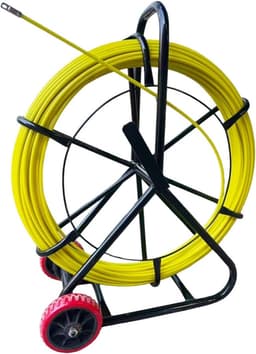
The Ribowri listing is an 8 mm by 100 m fibreglass duct rodder on a wheeled stand at £140.80, with 4.4 from 27 ratings and a listed weight of 11 kg. UK reviews cite 17 m of underground duct for data cable, under-floor cables, and kitchen spotlight wiring, so the frame has done real runs well short of the packet length. The title says 8 mm, while some UK reviews describe 6 mm, so the diameter is not settled. The listing includes a brake, and one UK reviewer says the unit they received has no brake and the reel can run out as you pay off rod. The head is a crimped eye. It is the only wheeled rodder here, and it is worth considering for a long duct only after you check the brake and the rod you were sent.
Pros
Only wheeled 100 m rodder in this set
UK reviews cite a 17 m underground data pull and under-floor work
Fibreglass rod with a crimped eye
A stand for paying out a long rod
Cons
One UK review says the brake was missing
Listed as 8 mm and described as 6 mm in some reviews
£140.80 and 11 kg, with 27 ratings
Best for: A long duct or under-floor run a 10 m coil cannot reach, after you confirm the brake.
Less suitable: A short conduit, a ceiling void, or a burial design the tool does not certify.
The IRSCorp set, model JS-XWT0016-2, is galvanised mesh pulling socks from 4–6 mm up to 18–25 mm, listed at £9.99 with 4.3 from 104 ratings. It grips a cable once a draw cord is already through the duct, and it does not find the route. The listing bands run blue 4–6 mm, black 6–9 mm, red 9–12 mm, green 12–15 mm, white 15–18 mm, and yellow 18–25 mm. UK reviews warn that the draw-cord loops are large and can jam a small duct unless you tape them down. At 30 g the set sits easily beside a fish tape. Match the band to the cable’s outside diameter, or the mesh slips or bunches.
Pros
Six size bands from 4–6 mm to 18–25 mm
Galvanised steel mesh with an eye loop
4.3 from 104 ratings
£9.99 for the set
Cons
Does not push or find a route
Large loops can jam a small duct
You still need a draw cord or a rod
Best for: Pulling a cable after a cord is already through, if you tape the loop flat.
Less suitable: Anyone who still needs to find the route, or a duct too tight for the loop.
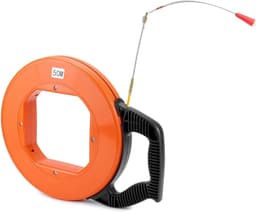
The QWORK WD11097 is a 50 m reel at £26.98, with 4 mm in the title and a fibreglass claim on the listing. The star line is 3.9 from 39 ratings. A UK review says it is twisted wire, not fibreglass, so the non-conductive wording is not settled. One UK reviewer struggled to keep pushing after about 30 m in 30 mm conduit with gradual bends. Another says the end broke off after a jam and was left in the pipe. The reel weighs 1.67 kg and the head is described as removable. It is a long-reel option only if you accept the material dispute and the chance of a tip left in the duct.
Pros
50 m reel at £26.98
Title states 4 mm
Removable head in the listing
Lighter than the 11 kg wheeled rodder
Cons
A UK review says twisted wire, not fibreglass
A tip broke off and stayed in the pipe in one UK review
A push stalled near 30 m in 30 mm conduit in one UK review
Best for: A straight protection pipe where about 30 m of push is enough and you can check the material that arrives.
Less suitable: A job that needs confirmed non-conductive fibreglass, or a duct with tight bends.
The Piaeny XJY pull-cord kit is a 10 m by 4.0 mm retractable line of nylon and stainless steel with a rounded rotating head, listed at £7.99. The star line is 3.8 from 6 ratings. A UK review says it stays in tight loops and springs back, so it would not fish a ceiling for downlighters. Another UK review used it across a car roof lining for a rear camera and mentions a metal loop, a rounded end, and two metal rings. A UK review also says the pack has no instructions and points back to the listing. A dimensions row of 6 x 8 x 2 cm is the packed case, not the 10 m line. The car-roof pull shows it can work where you can guide the head by hand, and the ceiling note shows what coil memory does in an open void.
Pros
10 m x 4.0 mm with a rounded rotating head
One UK review finished a car-roof camera pull
Retractable case
£7.99
Cons
Stays coiled and springs back in a ceiling, in a UK review
3.8 from only 6 ratings
No instructions in the pack, in a UK review
Best for: A short lined route, such as a car roof, where you can guide the head by hand.
Less suitable: Downlighters in an open ceiling void, or a long conduit.
The XMXKEJIAZ listing is an orange 15 m by 3.0 mm puller at £6.99, with a rotating joint. The saved listing has no customer-review line and no review text, so there is no UK account of a finished pull. Included components name one puller and two tighteners, and the bullets also mention two guide springs. The seller names curved conduits, wall cavities, ceilings, floor pipes, and cable trays for network and low-voltage cable, which is a wider route list than the polyester tapes that warn against cavities. Listed weight is 80 g. A dimensions row prints 1500 x 0.3 x 0.3 cm, which reads as the uncoiled line rather than the packed size. At this price you are buying the specification on the page, not a reviewed sample.
Pros
15 m x 3.0 mm at £6.99
Rotating joint listed
Two tighteners named in included components
Listed weight 80 g
Cons
No customer reviews in the saved listing
Material is not stated
The seller’s route list includes cavities that coiled tapes here fail
Best for: A spare 15 m line if you accept buying with no review text.
Less suitable: A hollow wall, or anyone who wants UK reviews of a finished pull.
The Whychstore tool is a short aluminium-alloy threading grip, 10 x 8 x 8 cm and 214 g, listed at £5.17. It is not a fish tape. The listing says it holds 3–6 mm cable and 86/118 mm back boxes for one-person pulling, with a sawtooth anti-slip grip. The saved listing has no customer-review line and no review text. The model code and the colour line add little you can check on the bench. Use it as a hand grip at a back box after the cable is already in reach. It will not find a route through a wall, a conduit, or a duct.
Pros
Aimed at 86/118 mm back boxes
Stated for 3–6 mm cable
Aluminium alloy, listed at 214 g
£5.17
Cons
No reviews in the saved listing
Does not fish a conduit or a void
Colour and model lines are not useful specs
Best for: One-person work at a back box when the cable is already within reach.
Less suitable: Any job that still needs a draw wire, rods, or a duct rodder.
No. The listing is a short aluminium threading aid with an anti-slip grip, 10 x 8 x 8 cm and 214 g.
What does it claim to hold?
Cables of 3–6 mm, and 86/118 mm back boxes, for one-person pulling.
Are there reviews?
The saved listing has no customer-review line and no review text.
How we compared
Scores rank the twelve amazon.co.uk listings in this comparison. They are not a lab pull, a voltage test, or a market share. The star line is worth 30, review depth 25, job evidence in the UK review texts 25, listing clarity 12, and price within the same type 8. A listing with fewer than 10 ratings loses 6, because the star line is too thin. The highest score is the top pick. The best price against a real review sample, among tools that find a route, is best value.
1
Star line
30%
Amazon stars divided by five, then scaled to 30. A listing with no rating in the saved listing scores 0 on this block. The displayed score is not the star average.
2
Review depth
25%
None scores 0. One to nine ratings score 5, ten to 39 score 12, 40 to 199 score 18, and 200 or more score 25. A thin sample cannot outrank a deep one.
3
Job evidence
25%
UK review texts in this file: a finished pull, the same object as the title, and repeated failures. Reviews of a different object stay inside this block.
4
Listing clarity
12%
Title, diameter, material, and included parts should agree. A junk dimensions row, or a material claim a UK review contradicts, costs points here.
5
Price in type
8%
A lower shelf price among the same type scores higher, without ignoring a head that pulls off. A cheap sock still does not find the route.
Independent review
Last updated: 22.10.2026
8 sources checked
Cable pulling aid buying guide
Buy the route before the metre count. A cable pulling aid has to reach a path you cannot push a cable along by hand. Conduit suits a draw wire. A ceiling void does not. A long duct suits a rodder. In this amazon.co.uk set the top pick is the OBLUESKY 6 m polyester tape at £12.99, with 4.5 from 993 ratings, limited by the seller to small ducts. Best value among tools that find a route is the Afeld Elektro 10 m nylon line at £4.88, with 4.4 from 339 ratings, and a head that can come off.
What is a cable pulling aid?
A cable pulling aid is the tool that gets a cable along a route you cannot push by hand. On a UK job that route is conduit, trunking, a ceiling void, or an underground duct. The shelves mix short nylon and polyester draw wires, coated steel lines, reel fish tapes, a wheeled fibreglass duct rodder, galvanised pulling socks, a small back-box threading grip, and an automatic threader. A householder adding one cable, and an electrician who wants a cheap spare, are the usual buyers.
Best for
A householder with one known empty conduit
A tradesperson who needs a frame for a long duct
Not ideal for
A stud wall or an open ceiling void
Anyone who still needs to find the route and only has a sock
Mistakes to avoid
1
A coil in a ceiling void
Nylon and polyester lines keep their coil. UK reviews say they spring back in a stud wall and will not fish downlighters. Sectional rods are the tool for that void, and they are not a clean kit in this set.
2
Trusting fibreglass or a brake against a UK review
The QWORK listing says fibreglass. A UK review says twisted wire. The Ribowri listing includes a brake. A UK reviewer says the unit they received has no brake. Neither claim is settled.
3
A sock with no draw cord, or forcing a jam
A pulling sock grips a cable only after a cord is through. Forcing a stuck tip until it snaps off can leave the end in the pipe. Draw the line back and change the angle.
What to weigh up
Route, length and diameter
High
The first check is the route, not the longest number on the packet. Conduit and trunking suit a fish tape or a draw wire. An open ceiling or a stud wall suits sectional rods, and a coil that keeps its memory will spring back there. A long buried duct suits a continuous fibreglass rodder on a frame. Packet length is only the line on the reel. Bends and cables already in the duct stop a push earlier. In this set, a UK review of a 50 m reel struggled after about 30 m in 30 mm conduit.
Head, evidence and price
High
The head is the part that jams or comes off. Spring tips, eyes, and cable-tie clamps need to stay slimmer than the bend. UK reviews in this set include an end that came off on first use, an eye that detached, and a tip left in the pipe after a jam. Tape the joint if the loop is bulky. A pulling sock is not a way to find the route. It grips the cable only after a cord is through, and the band has to match the outside diameter or it slips. Large sock loops can jam a small duct.
Which option suits you?
Three typical situations, each with a recommendation from this comparison.
🏠
One empty conduit
You have a known empty duct and you want the listing with a large review sample. The OBLUESKY 6 m polyester tape at £12.99 scores 8.5, with 4.5 from 993 ratings. The seller limits it to small ducts, and 6 m will not reach a long run.
You want a route-finding line at the lowest price that still has a real review sample. The Afeld Elektro 10 m nylon wire is £4.88, score 8.2, with 4.4 from 339 ratings. UK reviews say the end or the eye can come off, so tape the joint.
A 10 m coil will not do this job. The Ribowri listing is a 100 m fibreglass rodder on a wheeled stand at £140.80, score 6.1, with 4.4 from 27 ratings. Confirm the brake and the diameter. A UK review says the brake was missing.
The top pick is the OBLUESKY 6 m by 4.0 mm polyester draw wire at £12.99. It scores 8.5. The amazon.co.uk line is 4.5 from 993 ratings, and UK reviews describe a push, including car-audio and camera runs. The seller limits it to small ducts, not thick cable. A 5.0 from two ratings on a thinner listing does not outrank that sample. It is a poor match for a hollow wall or a run longer than 6 m.
How much does a cable pulling aid cost?
In this set the nylon and polyester coils run from £4.88 to £13.99. A 50 m reel is £26.98 and an automatic threader is £32.99. The wheeled 100 m rodder is £140.80. A pulling sock set is £9.99 and does not find the route. Trade reels from other shops are context only and are not these twelve listings. Prices are the amazon.co.uk figures stored for this comparison, not a live check.
What should you check before you buy a cable pulling aid?
Start with the route. Conduit suits a draw wire. An open void suits rods, which are mostly outside this set. A long buried duct suits a fibreglass rodder. Then check length against bends, diameter against the duct, and whether the head stays on. Prefer a title, the bullets, and UK reviews that describe the same object. Stars alone are not that check. A coated steel line is still metal, so isolate before it goes near a cable.
Can a fish tape cross a hollow wall?
A coiled nylon or polyester line is a poor tool for a stud wall. UK reviews of short tapes say they stay in their coil and spring back in a ceiling void. Sectional rods are the usual tool for that void, and they are not a clean kit in this twelve. Push, attach, and where you stop are on the how to use a cable pulling aid page.
Is a pulling sock a fish tape?
No. A pulling sock is a mesh grip. You still need a draw cord or a rod in the duct. The IRSCorp set covers bands from 4–6 mm to 18–25 mm at £9.99. UK reviews say the loops are large and can jam a small duct unless you tape them flat. Match the band to the cable’s outside diameter, or the mesh slips.
Is a fibreglass claim on the listing enough?
No. A UK review of the QWORK 50 m reel says it is twisted wire, not fibreglass, so the non-conductive wording is not settled. A UK review of the Ribowri 100 m rodder says the brake was missing, and some reviews describe 6 mm where the title says 8 mm. Many reviews on the 15 m polyester listing describe rods, magnets, and hooks that are not in the bullets. Read the object the reviews describe, not only the star line.
When should you call an electrician?
Call an electrician for a new circuit, a consumer unit, or a bath or shower room. In England and Wales those jobs are notifiable under Part P. Scotland and Northern Ireland do not use England’s Approved Document P. Also call if you cannot prove a circuit dead, if the job means digging near services, or if the pull is heavy armoured cable. Isolate before a metal aid goes near cables.
Does lubricant replace a draw wire?
No. Lubricant cuts friction once the cable is moving. It does not find the route. You still need a draw wire, rods, or a duct rodder, and a sock only after a cord is through. Gel for the cable jacket is a different product, covered in the cable lubricant comparison. Do not treat washing-up liquid as a tested substitute, and do not read a non-conductive bullet as a voltage rating.
Our verdict
The top pick is the OBLUESKY 6 m by 4.0 mm polyester draw wire at £12.99. It scores 8.5, from 4.5 and 993 ratings, and UK reviews describe a real push. The seller limits it to small ducts, and it is a poor match for a hollow wall. Best value is the Afeld Elektro 10 m nylon line at £4.88, score 8.2, with 4.4 from 339 ratings. The eye can detach, so tape the joint. A sock, a grip, or an unreviewed coil does not outrank either listing.
Peter F. is the editor for DIY & tools at productscompared.co.uk. Comparisons in this category are checked against amazon.co.uk listings, review evidence and public UK sources.
Updated: 22.10.2026
8 sources checked
Guides to cable pulling aids
Guides on what to look for, how to use a product, and common mistakes.
This page contains affiliate links to amazon.co.uk (tag pcuk26-21). If you buy through them, we may earn a commission at no extra cost to you. Prices, stars and review counts are the amazon.co.uk figures already stored for this set. This is not a laboratory test.