Independent comparisons. We may earn from shop links. More info

Duct rodder for underground cable

Updated: 23 October 2026

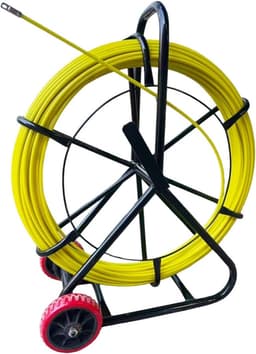
The duct under the lawn is longer than a coil you can carry up a ladder, and a 15 m fish tape stops short of the far end. A duct rodder for underground cable pays a fibreglass rod from a wheeled frame, pushes the duct, and brings a rope back. It does not certify the burial. In this set that frame is the Ribowri. The twelve rows are on the [cable pulling aid comparison](/hub/diy-supplies/cable-pulling-aid). We did not lab-test the tools. A qualifying purchase can earn a commission at no extra cost to you.

The duct under the lawn is longer than a coil you can carry up a ladder, and a 15 m fish tape stops short of the far end.

Our top picks

On this page

When a short fish tape is the wrong tool

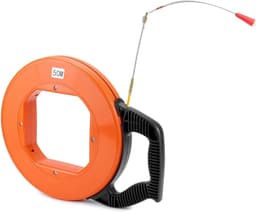
A short fish tape is the wrong tool when the duct is longer than the coil. The nylon and polyester lines here are mostly 6 m to 15 m. A garden or a duct between buildings is past that length. If you can cover the run from both ends, stay with the fish tape in the cable pulling aid buying guide. The long tools are a 50 m QWORK reel and the 100 m rodder. The QWORK listing says fibreglass and a UK review says twisted wire, so do not buy it as a confirmed cobra.

The 100 m listing, including the brake and diameter

The only wheeled rodder here is the Ribowri, listed at £140.80 and about 11 kg, as 8 mm by 100 m. One UK review describes about 17 m of underground duct, far short of 100 m. Another says the unit has no brake. Some reviews say 6 mm rather than 8 mm. If the reel you unpack will not lock, a free-running rod is the hazard. A 6 mm rod threads a tighter duct. An 8 mm rod pushes straighter. If you need a brake you can trust today, hire is the comparison that matters.

How a cobra-type reel is fed

Feed the reel by hand and push the rod in. At a blockage, draw back about a metre. Do not stab. If it still stops, try the other end, then lock the reel. Those steps do not repair a unit with no brake. A short coil is a different sequence, on how to use a fish tape. The rod brings a rope back, and you pull the cable on that rope. If you meet a cable you cannot name, or the frame runs away, stop.

Buried duct rules that the tool does not cover

A duct rodder does not choose the burial. IET Wiring Matters, July 2024, points to BS 7671:2018+A2:2022 Regulation 522.8.10. An unarmoured cable needs a duct of equivalent protection. The article discusses BS EN 61386-24, with N450 as the usual minimum they describe and N750 for some jobs, and it says to seal the duct. Before you dig, locate underground cables. The Health and Safety Executive expects a trained user on the locator. Check with the service owner before a duct that may hold power or telecoms. Part P, in England and Wales, is a separate stop for a new circuit or a bath or shower room. Scotland does not use England's Approved Document P.

Common questions

Do I need a duct rodder or a 15 m fish tape?
You need a 15 m fish tape when both ends are within that length. You need a duct rodder when the underground duct is longer than the coil. The tape does not become a cobra because you push harder. At £140.80 and about 11 kg, the rodder is the worse buy for a single room.
Does 100 m mean the rod will push 100 m?
No. On the Ribowri listing, 100 m is the length stored on the reel. One UK review describes about 17 m of underground duct, well short of the carton. Bends, silt, and cable already in the duct stop a push earlier. Plan a second end you can try, and do not stab the blockage.
What should a brake do if a review says there isn't one?
A brake should lock the reel so it cannot run. On a Ritelite Cobra you release it anti-clockwise and set it again when you stop. The Ribowri listing claims a brake, and a UK review says there isn't one. If the reel you unpack cannot be locked, you lack that control.
Is the rod 6 mm or 8 mm?
The listing says 8 mm and 100 m. Some UK reviews say 6 mm. Measure the rod in the box. A 6 mm rod threads a tighter duct. An 8 mm rod pushes straighter. Decide from the measured diameter if the duct is already tight.
Can I pull the cable on the rod, or do I pull a rope first?
Pull a rope first. The rodder gets a slim line through and brings a rope back, and you then pull the cable on that rope. Pulling the cable on the rod tip builds a head that jams. The IRSCorp sock comes after the cord is through. Spare loops can jam a small duct, so keep the tail short.
What burial rules apply to the duct, separate from the tool?
The duct has its own rules, and the rodder does not meet them for you. IET Wiring Matters, July 2024, points to BS 7671 Regulation 522.8.10: an unarmoured cable needs equivalent protection. N450 and N750 are impact duties in that article, not a label on any cheap duct. Seal the duct. Locating cables before you dig needs a trained user.
When do I stop and call someone who rods ducts for a living?
Stop when you cannot identify the duct, when the jacket is damaged, when the reel has no brake, or when the rod meets a cable you cannot name. Check with the service owner before a duct that may hold power or telecoms. In England and Wales a new circuit or a bath or shower room is Part P work. That Approved Document does not apply in Scotland.

Related pages

Sources

Public sources and the amazon.co.uk listings compared on this page. Retrieved 22.10.2026.

  1. IET Part P FAQ, England and Wales (retrieved 22.10.2026)
  2. GOV.UK, third-party certification for domestic electrical work (retrieved 22.10.2026)
  3. IET Wiring Matters, buried conduits and ducts (retrieved 22.10.2026)
  4. HSE, underground services and cables (retrieved 22.10.2026)
  5. Ritelite Cobra rodding manual (retrieved 22.10.2026)
  6. Electrical Contractor Magazine, fish tape materials (retrieved 22.10.2026)
  7. Screwfix fish tape category (retrieved 22.10.2026)
  8. amazon.co.uk best sellers, cable insertion and extraction tools (retrieved 22.10.2026)