Independent comparisons. We may earn from shop links. More info

Cable pulling aid: which tool matches the route

Updated: 23 October 2026

You are holding a coil of cable that will not go any further by hand, and the shop name cable pulling aid covers four different tools. A draw wire or fish tape pushes a conduit. Sectional cable rods steer a ceiling or a stud wall. A duct rodder pays out a long fibreglass rod. A pulling sock only grips the cable after something else has found the way. This page is the route-first decision. The [cable pulling aid comparison](/hub/diy-supplies/cable-pulling-aid) holds the twelve amazon.co.uk rows. We did not lab-test the tools. A qualifying purchase can earn a commission at no extra cost to you.

You are holding a coil of cable that will not go any further by hand, and the shop name cable pulling aid covers four different tools. A draw wire or fish tape pushes a conduit.

Our top picks

On this page

Which cable pulling aid matches the route

Start with the hole you can describe. If you can name a tube, such as 20 mm conduit or trunking, a fish tape or draw wire is the cable pulling aid that matches. A ceiling or a stud wall is a different shape. Read fish tape versus cable rods before you buy another coil. A buried duct is a third job, on the duct rodder for underground cable page. A pulling sock grips a cable and does not search the duct.

Length, diameter, and material

The length on the packet is the line on the reel, not the distance you will push. A 6 m line is enough when both ends are close. A 10 m nylon line is the usual length for one room. Anything under a lawn needs the frame. Three millimetres flexes through a tight bend. Four millimetres pushes straighter and can plug a busy duct. One UK reviewer suggested 3 mm under 35 mm of conduit, as a rule of thumb. Coated steel pushes harder and is still metal. A non-conductive bullet is not a voltage rating. Isolate, and prove the circuit dead.

What this amazon.co.uk set actually contains

Two listings disagree with the reviews attached to them. The QWORK page says fibreglass. A UK review says the reel is twisted wire. The QZATACAEN bullets describe a 15 m coated polyester tape, while many reviews, including one about fibreglass splinters, describe rods, magnets, and hooks. A star line of 4.4 from 314 ratings is not evidence of a rod kit. A 5.0 from two ratings, on the Kaaeiccr tape and the Longzhuo threader, is too small a sample to crown. Screwfix prices for steel and nylon tapes are other listings, not a test of these twelve.

What not to buy for this job

Leave the sock if no cord is through. Leave a coiled tape for a ceiling of downlighter holes. Leave steel if you cannot prove the circuit dead. The Longzhuo threader allows single-core cable from 3 mm to 8 mm, not stranded wire, and the UK review is not a finished pull. Part P, in England and Wales, stops a new circuit, a consumer-unit change, or work in a bath, shower, pool, or sauna room. Scotland and Northern Ireland do not use England's Approved Document P. Armoured cable is a different trade from a 3 mm nylon line.

Common questions

Draw wire, rods, or a duct rodder?
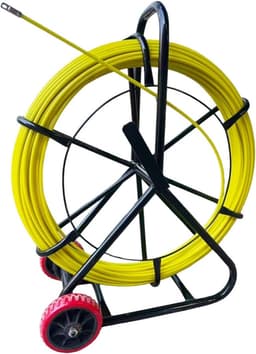
Use a draw wire or fish tape when you can name the conduit and the run fits a 6 m to 15 m coil. Use sectional rods for a ceiling, stud wall, or floor void with no tube. Use a duct rodder when a coil cannot reach, which here means the wheeled 100 m frame. A sock grips the cable only after the cord is through.
How long a line do I need, versus how far it will push?
Buy longer than the straight-line distance, then expect bends to steal metres. A UK review of a 50 m reel stalled near 30 m in 30 mm conduit. A UK review of a 100 m rodder cleared 17 m of underground duct. Both are single jobs. A 10 m nylon line is the sensible first buy for one room.
Should I choose 3 mm or 4 mm?
Choose 3 mm when the conduit is tight, already holds cable, or turns sharply. Choose 4 mm when the duct is empty enough for a stiffer push and you stay inside a tube. Four millimetres in a busy small duct is how the head becomes a plug. Neither diameter stands straight in an open ceiling.
Nylon, polyester, coated steel, or bare steel?
Nylon and polyester are the coils when you want flex in a proved-dead conduit. Polyester at 4 mm is the stiffer short tape here. Coated steel pushes harder and is still metal under the plastic. Bare steel is the conductive trade tape. A non-conductive bullet on these pages is not a 1,000 V rating.
When is a pulling sock the right buy?
Buy a sock when a draw cord or rod is already through. The IRSCorp bands run from 4–6 mm to 18–25 mm at £9.99, with 4.3 from 104 ratings. Match the band to the cable's outside diameter and tape the loop flat. UK reviews say a large loop can jam a small duct.
Does non-conductive mean I can fish a live circuit?
No. None of these twelve listings states a working voltage. Ideal's Volt-Guard figure of up to 1,000 V belongs to that product, not to a polyester bullet here. Isolate and prove dead before a metal tape, a coated-steel line, or a wet lubricant goes near cable. If you cannot prove the circuit dead, stop.
Which listings disagree with their own reviews?
The QWORK 50 m reel is listed as fibreglass, and a UK review says it is twisted wire. A review on that reel says the tip broke off and stayed in the pipe. The QZATACAEN bullets describe coated polyester, while many attached reviews describe rods. The Ribowri listing includes a brake, and one UK review says the unit received had none.

Related pages

Sources

Public sources and the amazon.co.uk listings compared on this page. Retrieved 22.10.2026.

  1. IET Part P FAQ, England and Wales (retrieved 22.10.2026)
  2. GOV.UK, third-party certification for domestic electrical work (retrieved 22.10.2026)
  3. IET Wiring Matters, buried conduits and ducts (retrieved 22.10.2026)
  4. HSE, underground services and cables (retrieved 22.10.2026)
  5. Ritelite Cobra rodding manual (retrieved 22.10.2026)
  6. Electrical Contractor Magazine, fish tape materials (retrieved 22.10.2026)
  7. Screwfix fish tape category (retrieved 22.10.2026)
  8. amazon.co.uk best sellers, cable insertion and extraction tools (retrieved 22.10.2026)