Independent comparisons. We may earn from shop links. More info

Coving buying guide: gap, girth and the right glue

Updated: 23 October 2026

You are under a ceiling line in a British room, and the search has mixed plaster, foam, polymer, and a peel-and-stick bead. This coving buying guide sorts the job before you spend: what the gap actually is, what the millimetre on the label measures, and which adhesive that material allows. A settlement crack or a cable needs a real cove. A 12 mm tape only covers a small gap. The seven rows on the [Coving comparison](/hub/diy-supplies/coving) are flexible trims of about 9–42 mm, not 100 mm plaster. Figures are GBP from amazon.co.uk and the merchant pages stored for 19 October 2026. This is not a lab test. A qualifying purchase can earn a commission at no extra cost to you.

You are under a ceiling line in a British room, and the search has mixed plaster, foam, polymer, and a peel-and-stick bead.

Our top picks

Conwang Conwang silicone U-trim

Best overall

Conwang Conwang silicone U-trim
7.6/10about £15.99
Lifuncren Lifuncren quadrant trim

Best value

Lifuncren Lifuncren quadrant trim
7.0/10about £16.99
On this page

What you are actually buying

UK merchants sell coving as paper-faced gypsum plaster, polystyrene foam, or polyurethane, often labelled polymer or duropolymer. Those three are rigid lengths you mitre and glue. The amazon.co.uk rows are a different object: self-adhesive TPE, silicone, or a listing that contradicts itself. If the line is a hairline, a small bead can cover it. If it is a settlement crack, or you are hiding a cable, the British Gypsum example is Gyproc Cove 100, a 3000 mm C profile. A 12 mm tape on that crack leaves the crack in sight. Robert Price listed that length, 100 mm × 3 m, at £12.98 including VAT. That is a merchant price for plaster, not an amazon.co.uk tape.

Read the millimetre as the girth

The number in a cove's name is the girth across the face, not the drop down the wall. DIY Doctor makes that point with the common 125 mm and 85 mm names. For Gyproc Cove 100 the guide lines are 67 mm down the wall and 67 mm across the ceiling. Those marks are for that product. An older sheet lists Cove 127 with 83 mm lines, so the 67 mm figures stay on Cove 100. On a tape the millimetre is the section. sokey states 12 mm of gap fill and Lifuncren 15 mm. GDWD is 42 mm × 30 mm and prints no separate gap-fill figure. Measure the gap, then match a number that means the same kind of measurement.
Conwang Conwang silicone U-trim

Testsieger

Conwang Conwang silicone U-trim
7.6/10about £15.99

Material and the adhesive that goes with it

Plaster cove is heavy and crisp. Gyproc cove uses Gyproc Cove Adhesive: key the paint, keep wallpaper off the glue line, and allow about 1 kg for 4 linear metres. Working time is about 40 minutes, a hard set about 2 hours, and paint after about 24 hours. It is not for repeated moisture. Polystyrene dents, and solvent adhesive can melt it. The Wickes Arthouse 100 mm × 2 m length was from £6.50, with a solvent warning and water-based paint. Polymer, including duropolymer, is the light rigid option for a damp room. Toolstation's Pro Cove Lite, a 6-pack of 2 m at £32.29, is a pack price. The three-way split is on polystyrene or plaster coving. Tape wants a clean, dry, sound surface. One tube does not fix plaster, foam, and polyurethane.

What the price and the rating can tell you

sokey is about £11.69 for 6 m, Conwang about £15.99 for 5 m, and Lifuncren about £16.99 for 8 m. Gkhlg is about £5.09, and the file says both 1 m and 3 m, so a price per metre is not stated. Lifuncren prints PVC, silicone, and synthetic rubber. Gkhlg prints silicone and TPE. Stars need a count. sokey is 4.0 from 423 reviews. Both GDWD rows are 5.0 from one rating with no review text. That single rating is not a larger sample. This guide does not name a top pick.

Which job you are buying

If the line is a settlement crack or a cable, buy a rigid cove and the adhesive that material allows. If the gap is a hairline inside the fill a tape states, you are buying a bead. If the room steams, gypsum cove adhesive is the wrong bag.

Common questions

Is coving the same thing as a self-adhesive quadrant?
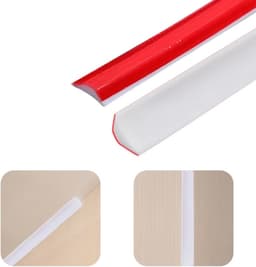
Coving, in the way UK merchants use the word, is a rigid moulding at the wall-to-ceiling join: plaster, polystyrene, or polymer. A self-adhesive quadrant or U-trim is a flexible bead, often 12–42 mm, also sold for skirting and floor edges. The seven amazon.co.uk listings in this comparison are that bead. They can tidy a small gap. They do not replace a 3 m plaster cove when the job is a crack or a cable.
What does the millimetre in the name actually measure?
On a rigid cove it is the girth across the face, not the drop down the wall. For Gyproc Cove 100 the sheet's guide lines are 67 mm on the wall and 67 mm on the ceiling. On a tape listing the millimetre is the section, and sometimes a stated gap fill, such as 12 mm on sokey or 15 mm on Lifuncren. Measure your gap, and do not treat a 100 mm name as a 100 mm drop.
When is plaster the right material, and when is polymer or polystyrene?
Choose plaster when you want the crisp gypsum profile and you will use its own adhesive in a dry room. Choose polystyrene when the job is light and cheaper and you will keep solvents away from the foam and the paint. Choose polymer when you want a light rigid profile that merchant guides treat as the moisture-tolerant one. The tape strips are a fourth job, for a small gap, not a vote in that three-way choice.
Will a 12 mm tape hide a cracked ceiling?
It covers a gap up to the fill the listing states. sokey's maximum is 12 mm, Lifuncren's is 15 mm, and Woobroo's is 13 mm. A settlement crack, or a cable you want buried in a proper cove, is the job Gyproc Cove 100 is described for, at 3000 mm with 67 mm guide lines. If the crack is still moving, that is a plasterer, not a thicker bead.
Is polystyrene coving banned under fire rules?
Polystyrene coving is not banned by the cover-mould sentence in Approved Document B. That sentence takes narrow cover moulds out of the wall-and-ceiling lining definition for Requirement B2. It does not award a fire class to foam or to TPE tape, and it does not approve a polystyrene ceiling tile. The A2-s1, d0 declaration belongs to the Gyproc Cove 100 sheet, not to every white moulding in the search results.

Related pages

Sources

Public UK sources and the amazon.co.uk listings compared on this page. Updated 22.10.2026.

  1. British Gypsum: Gyproc Cove 100 data sheet (retrieved 22.10.2026)
  2. British Gypsum: Gyproc Cove Adhesive data sheet (retrieved 22.10.2026)
  3. British Gypsum: Cove Adhesive installation guidance (retrieved 22.10.2026)
  4. Approved Document B volume 1, 2019, dwellings (retrieved 22.10.2026)
  5. Toolstation: How to fit coving (retrieved 22.10.2026)
  6. Wickes: How to put up coving (retrieved 22.10.2026)
  7. Wickes: Arthouse polystyrene coving 100 mm × 2 m (retrieved 22.10.2026)
  8. DIY Doctor: Coving (retrieved 22.10.2026)
  9. The Coving & Cornice Warehouse: Choosing your material (retrieved 22.10.2026)