Independent comparisons. We may earn from shop links. Our editors compare products independently. Some links go to shops, and we may earn a commission. More info
Top pick: GEYA GYL9 40 A – Highest score among listings with an amazon.co.uk review line: about £59.99, 4.8 from 7 reviews, and the only IEC/EN 61008.1 line in the set. Score 96. Smooth DC and BS EN 62423 are not stated. Best value: DIHOOL 4-pole 63 A – The only listing that scores at least 70 and has at least 50 reviews: about £69.88, 4.3 from 77 reviews, 4-pole 63 A 30 mA. Score 86. It is also the highest price in the set. Updated October 2026.
A Type B RCD trips on alternating residual current, pulsating direct current and smooth direct current. In the UK you specify one where an inverter, a charger or an industrial load can push direct current onto the earth path. A Type B miniature circuit breaker is a different product: that B is a magnetic trip curve.
The [Type B RCD buying guide](/hub/electrical-equipment/type-b-rcd/sub/type-b-rcd-buying-guide) sets the checks out in order. Two poles switch line and neutral on single-phase 230 V. Four poles suit three-phase and neutral near 400 V, and a charging point must disconnect every live conductor. Rated current, commonly 40 A or 63 A, is load current, not sensitivity. Additional protection for people is not more than 30 mA. An RCCB does not provide overload protection; an RCBO does. Look for BS EN 61008-1 or BS EN 61009-1, plus BS EN 62423 for the Type B waveform. Do not put Type B downstream of Type AC, Type A or Type F unless that upstream maker allows it. The test button does not prove smooth direct current.
A Type B RCD trips on alternating residual current, pulsating direct current and smooth direct current.
A Type B RCD trips on alternating residual current, pulsating direct current and smooth direct current. In the UK you specify one where an inverter, a charger or an industrial load can push direct current onto the earth path. A Type B miniature circuit breaker is a different product: that B is a magnetic trip curve.
The [Type B RCD buying guide](/hub/electrical-equipment/type-b-rcd/sub/type-b-rcd-buying-guide) sets the checks out in order. Two poles switch line and neutral on single-phase 230 V. Four poles suit three-phase and neutral near 400 V, and a charging point must disconnect every live conductor. Rated current, commonly 40 A or 63 A, is load current, not sensitivity. Additional protection for people is not more than 30 mA. An RCCB does not provide overload protection; an RCBO does. Look for BS EN 61008-1 or BS EN 61009-1, plus BS EN 62423 for the Type B waveform. Do not put Type B downstream of Type AC, Type A or Type F unless that upstream maker allows it. The test button does not prove smooth direct current.
A Type B RCD trips on alternating residual current, pulsating direct current and smooth direct current. In the UK you specify one where an inverter, a charger or an industrial load can push direct current onto the earth path. A Type B miniature circuit breaker is a different product: that B is a magnetic trip curve. The Type B RCD buying guide sets the checks out in order. Two poles switch line and neutral on single-phase 230 V.
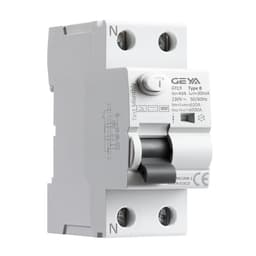
The GEYA GYL9-2P-40A-0.03A-Type B is a 2-pole 40 A 30 mA RCCB at £59.99, and it is the only listing in this set that prints IEC/EN 61008.1. The bullets add a 6 kA line, 35 mm DIN-rail mounting and RoHS 2.0, at a stated weight of 240 g. Across 7 amazon.co.uk reviews the score is 4.8. A German review says the device fitted and worked, and a Spanish review says it was bought to alter a board for EV charging because Type B covers more waveforms and cost less than known brands. None of those seven texts is clearly from the UK, and one Spanish title says poor quality while the body says the opposite. The page does not state smooth DC and does not name BS EN 62423, so the 61008.1 line is an RCCB standard rather than a Type B waveform certificate. It is the top pick here when the design really is 2-pole 40 A at 30 mA and you can live with a seven-review file.
Pros
2-pole 40 A 30 mA RCCB on a 35 mm DIN rail
Only listing in this set that states IEC/EN 61008.1
4.8 from 7 amazon.co.uk reviews
6 kA coordination line and RoHS 2.0 in the bullets
Cons
No review in the capture is clearly from the UK
Smooth DC and BS EN 62423 are not stated
One Spanish title contradicts its own body
The family text also lists Type A, Type AC and other milliamp ratings
Best for: You need a 2-pole 40 A 30 mA RCCB and want a stated IEC/EN 61008.1 line before the installer fits it.
Less suitable: You need 4-pole, 63 A, a printed smooth-DC claim, or a UK review of this exact board.
IEC/EN 61008.1. The capture does not mention BS EN 62423.
What ratings does this ASIN show?
2-pole, 40 A, 0.03 A (30 mA), a 6 kA line in the bullets, and 35 mm DIN-rail mounting.
What do the reviews cover?
4.8 from 7 reviews. The capture has a German note that it worked and a Spanish note that it was bought for an EV board. No review is clearly from the UK.
The DIHOOL DHO-TNID-B-4P-63A-30MA is a 4-pole 63 A 30 mA unit at £69.88, with 4.3 from 77 amazon.co.uk reviews, the largest sample in this set. A UK buyer says a 3P+N device was installed and tested. German reviews mention a PV system still working after about six months, a heat pump that specified this type, and one Benning IT 130 check described as within expected values. The same UK note says there is no slot for a generic busbar, only a finger busbar or cables, with neutral on the left and the test button between N and phase. A German review reports a measured trip at 338 mA, another says the test button failed after the first function test, and a Swedish review says ordinary breakers arrived instead. The specification table says 230 V while the description says AC 415 V at 50 Hz, and the page prints CE without a BS EN number. Smooth DC is not stated. It carries the best-value mark here only because it is the only listing with at least 50 reviews, though £69.88 is also the highest price in the set.
Pros
4-pole 63 A 30 mA with a 35 mm DIN rail in the box
4.3 from 77 reviews, including a UK note of a 3P+N install
Eight crimp terminals and a stated 2-year warranty
Reviews mention PV, a heat pump and a pool
Cons
UK review: no generic busbar slot, neutral on the left
Table says 230 V and the description says 415 V
German report of a trip at 338 mA, and a failed test button
No BS EN number, and smooth DC is not stated
Best for: You have a 4-pole 63 A 30 mA job and will check busbar style and the 230 V versus 415 V lines with the installer.
Less suitable: You need a 2-pole device, a generic busbar, or a listing that states BS EN 61008-1.
The specification table says 230 V. The description says AC 415 V at 50 Hz for 3P+N. Those lines disagree.
Will a generic busbar fit?
The description says phase rails are possible. A UK review says there is no slot for a generic busbar, only a finger busbar or cables, with neutral on the left.
EcoLivzen’s 2-pole 63 A 30 mA unit is listed at £43.36 and is one of three pages here that say the device detects smooth DC fault currents and mixed frequencies. The bullets also name EV charging piles, solar inverters, a 6 kA break and ABS construction, at a stated weight of 204 g. Mounting is described only as fitting a standard distribution board, with no DIN-rail width. The capture has no star line, no review text and no British or IEC standard. The model string reads like a generated code rather than a catalogue part you can check against a datasheet. You are buying a smooth-DC sentence at a £40-band price, with no confirmed waveform test and no UK install in the file.
Pros
2-pole 63 A 30 mA at £43.36
Listing states smooth DC and mixed frequencies
EV charging and solar inverters named in the use line
6 kA break stated, one unit in the box
Cons
No amazon.co.uk review line in the capture
No BS EN or IEC standard named
DIN-rail width is not stated
Model code is not a recognisable catalogue number
Best for: You already have a 2-pole 63 A 30 mA design and want a listing that at least uses the words smooth DC, knowing the standard is missing.
Less suitable: You need a stated BS EN 62423 line, a DIN-rail width, or any customer review before you order.
Vootnifig lists a 2-pole 63 A 30 mA RCCB/RCD at £44.48 for EV charging piles and photovoltaic systems, and the bullets say it detects smooth DC fault currents. The page also states a 6 kA break, ABS construction and a weight of 204 g, with one Type B circuit breaker in the box. DIN-rail width, voltage and module size are all absent from the capture. There is no star line and no review text. No BS EN or IEC number is printed, so the smooth-DC sentence stays a listing claim. It sits about a pound above EcoLivzen with the same missing standard and the same empty review file.
Pros
2-pole 63 A 30 mA at £44.48
Listing calls the unit an RCCB/RCD and states smooth DC
EV charging piles and photovoltaic systems named
6 kA line and a single unit in the included field
Cons
No customer-review line in the capture
No standard number on the page
DIN rail, voltage and module width are absent
204 g and an ABS line are the only build details
Best for: You are comparing 2-pole 63 A titles that mention smooth DC and EV or solar, and you will not order until a datasheet appears.
Less suitable: You need mounting dimensions, a review, or a named British standard on the listing itself.
ZMdooreasy’s title is a 2-pole 63 A 30 mA RCD at £44.64, written for an EV charger and ground-fault protection, with a 6 kA interrupting-capacity line. Unlike EcoLivzen and Vootnifig, this listing does not say smooth DC. Voltage, weight, country of origin, DIN rail and included parts are all absent, and the model code does not read like a catalogue number. The capture has no customer-review line. A Type B label without a smooth-DC sentence and without BS EN 62423 does not tell you which residual currents the device is claimed to see. At this price you still need the installer to match a datasheet the listing does not provide.
Pros
2-pole 63 A 30 mA at £44.64
Specification field says circuit breaker type RCD
Title names an EV charger and 30 mA earth-fault protection
6 kA interrupting capacity is stated
Cons
Smooth DC is not stated
No review line, voltage, weight or country of origin
Mounting and the contents of the box are absent
No BS EN 61008-1 or 62423 line
Best for: You are checking whether an EV title at this price actually says smooth DC, and you will stop when it does not.
Less suitable: You need a smooth-DC claim, a DIN-rail note, or any amazon.co.uk review before the device goes on a charger circuit.
Opatiny lists a 4-pole device at £43.02, with a title that says 40 A and 30 mA and a bullet that also says up to 63 A. The page states 400 V, a 35 mm DIN rail, a red and white indicator, flame-retardant PC and a weight of 387 g, and it says the unit detects smooth DC. It also uses the word RCBO and claims short-circuit and overload protection, without a BS EN 61009-1 line in the capture. There is no review line and no standard number. The 40 A versus 63 A clash is unresolved, so you cannot treat either figure as the settled nameplate. It is the cheaper 4-pole option in this set, and that price does not repair the two device names on the listing.
Pros
4-pole, 30 mA, 400 V stated, at £43.02
35 mm DIN rail and a red/white indicator claimed
Listing says it detects smooth DC
EV, solar and frequency converters named in the use line
Cons
Title says 40 A and a bullet also says up to 63 A
RCBO and overload are claimed with no BS EN 61009-1 line
No review line and no standard number
Breaking capacity is absent from the capture
Best for: You need a 4-pole 30 mA title that mentions smooth DC and 400 V, and you will resolve 40 A versus 63 A before anyone fits it.
Less suitable: You need one rated current, a proven RCBO, or a customer review of the device.
Hosrivae is the lowest price in the set at £39.94 for a stated 2-pole 63 A 30 mA device with a 6 kA line and a weight of 204 g. The title uses both RCBO and RCCB, and it names EV charger protection and home solar. Smooth DC is not stated, DIN rail is not described, and no BS EN 61008-1 or 61009-1 line appears. The capture has no star rating and no review text. A title that claims two device forms does not tell you whether overload protection is included. The price is why it shows up in a shortlist, and the missing standard is why it stays off a charger circuit until the installer has a datasheet.
Pros
Lowest price in this set at £39.94
2-pole 63 A 30 mA and a 6 kA line stated
Title names EV charger protection and home solar
Stated weight 204 g
Cons
Title says both RCBO and RCCB
Smooth DC is not stated
No DIN-rail description and no standard number
No customer-review line in the capture
Best for: You want the cheapest 2-pole 63 A title in this capture only as a reminder to ask which device form the installer actually specified.
Less suitable: You need a single device form, a smooth-DC claim, or any review before the unit is fitted.
The title uses both words. The capture does not name BS EN 61008-1 or BS EN 61009-1.
What ratings are stated?
2-pole, 63 A, 30 mA, and a 6 kA breaking-capacity line. Weight is 204 g.
Does the listing describe mounting?
No. DIN rail and customer reviews are absent from the capture.
How we compared
Seven Type B RCD listings on amazon.co.uk were compared from the pages captured on 19 October 2026. This is not a laboratory test. A printed standard, a smooth-DC sentence or a 6 kA line is a listing claim. The top pick is the highest score among listings that have an amazon.co.uk review line. The best value is the only listing that scores at least 70 and has at least 50 reviews, and it is also the highest price in the set. Scores use the published star rating and review count. They are not a waveform test.
1
Waveform class and standard
30%
Whether the listing states smooth direct current, and whether it names BS EN 61008-1 or 61009-1 plus BS EN 62423. An IEC/EN 61008.1 line is the RCCB standard, not the Type B waveform standard by itself.
2
Residual current
20%
Additional protection for people is not more than 30 mA. 100 mA and 300 mA are mainly fire protection. Every listing in this set states 30 mA.
3
Poles and device form
15%
Two poles for single-phase 230 V, four poles for three-phase and neutral. An RCCB does not provide overload protection. A title that says both RCBO and RCCB is not a settled device form.
4
Rated current
15%
40 A or 63 A is load current, not sensitivity. A listing that prints both figures is unresolved until a datasheet picks one.
5
Review evidence
20%
The amazon.co.uk star rating and review count, including whether any review is clearly from the UK. No review line scores as no customer evidence. This is not a laboratory test.
Independent review
Last updated: October 2026
8 sources checked
Type B RCD buying guide
Start with waveform class, then residual current, then poles and rated current, then the standard printed on the listing. Price comes after those four. The notes below follow that order for these seven amazon.co.uk listings, captured on 19 October 2026. None of the scores is a laboratory test. A title near £40 with no standard is not a UK trade Type B RCCB.
What is a Type B RCD?
A Type B residual current device trips on alternating residual current, on pulsating direct current and on smooth direct current of either polarity. UK designers specify that class where an inverter, some chargers or some industrial loads can push direct current onto the earth path. Shoppers are usually covering an electric vehicle charging point, a solar inverter or a heat pump. A Type B miniature circuit breaker is not this product.
Best for
Householders buying for a charger or a heat pump who need the right question for the installer
Electricians matching poles, amps and a stated standard to Section 722 or an inverter manual
Not ideal for
Anyone treating a Type B miniature circuit breaker as this residual-current device
A buyer who uses the test button as proof of smooth-direct-current performance
Mistakes to avoid
1
Buying a curve-B miniature circuit breaker
On a miniature circuit breaker, B is a magnetic trip curve. A Type B RCD is a residual-current class that includes smooth direct current. Search results mix the two. Match the title to RCCB or RCBO, poles, amps and milliamps before you treat it as this device.
2
Reading 63 A as more sensitive than 40 A
Rated current is the load the device can carry. Residual current is the sensitivity. Every listing in this set states 30 mA. A higher amp rating does not trip earlier. Overload protection stays with an MCB or a fuse unless the device is an RCBO.
3
Putting Type A upstream of Type B
Do not fit Type AC upstream of Type A, Type F or Type B, or Type A or Type F upstream of Type B, unless that upstream maker allows it. A Type A or Type F unit upstream of Type B can be blinded.
What to weigh up
Waveform class and stated standard
High
BS 7671 Regulation 531.3.3 picks the RCD type from the residual current the load produces. Type AC sees sinusoidal alternating residual current only. Type A adds pulsating direct current and is specified up to 6 mA of smooth direct current. Type F adds composite residual current, with a 10 mA smooth-direct-current note. Type B adds smooth direct current of either polarity and residual alternating current up to 1 kHz.
Poles, rated current and residual current
High
Poles follow the supply. Two poles switch line and neutral on single-phase 230 V. Four poles suit three-phase and neutral near 400 V. A charging point must disconnect all live conductors. In this set the 2-pole listings are one 40 A RCCB and four 63 A titles. The 4-pole listings are a 63 A unit and a 40 A title that also says up to 63 A. Treat that clash as unresolved until a datasheet agrees with one figure.
Rated current is load current. 63 A is not more sensitive than 40 A.
Which option suits you?
Three typical situations, each with a recommendation from this comparison.
🏠
A charger or heat pump at home
You need the right question for the installer: poles, amps, 30 mA, and whether the equipment already has DC protection. If the design is 2-pole 40 A 30 mA, the GEYA GYL9 40 A is the listing that states IEC/EN 61008.1. It does not state BS EN 62423.
You are matching a 4-pole 63 A 30 mA device to Section 722 or an inverter manual, including whatever sits upstream. The DIHOOL 4-pole 63 A has 4.3 from 77 reviews and a UK note of a 3P+N install. The 230 V and 415 V lines disagree, and no BS EN number is printed.
You already have a 2-pole 63 A 30 mA design and you are checking which £40 titles even use the words smooth DC. The EcoLivzen 2-pole 63 A does. It has no stated standard, no DIN-rail width and no review line in the capture.
A Type B RCD trips on alternating residual current, pulsating direct current and smooth direct current of either polarity. Type AC sees only sinusoidal alternating residual current. Type A adds pulsating direct current and is specified up to 6 mA of smooth direct current. Type F adds composite residual current, with a 10 mA note. Choose Type B when smooth direct current can exceed those limits, unless the equipment already includes that protection. A Type B miniature circuit breaker is a different product: that B is a trip curve.
Which Type B RCD is the top pick in this set?
The top pick in this set is the GEYA GYL9 40 A, a 2-pole 40 A 30 mA RCCB at about £59.99, with 4.8 from 7 amazon.co.uk reviews and a score of 96. It is the only listing that states IEC/EN 61008.1. The capture does not name BS EN 62423 or smooth direct current, and none of the seven reviews is clearly from the UK. The score is not a laboratory test. It fits a design that is already 2-pole, 40 A and 30 mA.
Which listing is best value?
The best value mark goes to the DIHOOL 4-pole 63 A at about £69.88, with 4.3 from 77 reviews and a score of 86. It is the only listing with at least 50 reviews that also scores at least 70, so it takes the mark even though it is the highest price in the set. A UK review describes a 3P+N install and says a generic busbar will not fit. The table says 230 V and the description says 415 V. No BS EN number is printed.
How much does a Type B RCD cost?
On amazon.co.uk on 19 October 2026 the seven listings run from about £39.94 to about £69.88. Five titles sit near £40 to £45 and have no review line. Two sit near £60 to £70 and have reviews. UK trade prices checked on 21 October 2026 are separate: a Hager 40 A 2-pole 30 mA Type B at £221.84, and a Verso Type B RCCB at £250 excluding VAT. Do not treat a £40 title as those trade parts.
Does every EV charger need a separate Type B RCD?
Not every charging point needs a separate Type B RCD. Regulation 722.531.3.101 gives each charging point its own Type A, Type F or Type B device not exceeding 30 mA, unless the circuit uses electrical separation. Without DC protection in the charger, that device is Type B and may sit inside the charger. If the charger already includes that protection, often an RDC-DD to BS IEC 62955, Type A or Type F is allowed. The Type B RCD for an EV charger page covers that exception.
Is 63 A more sensitive than 40 A?
No. Rated current is the load the device can carry. In this set that figure is 40 A or 63 A. Residual current is the sensitivity, and every listing here states 30 mA. A higher amp rating is not a more sensitive trip. Overload protection stays with an MCB or a fuse unless the device is an RCBO. One 4-pole listing prints both 40 A and up to 63 A, so those two figures are not a settled nameplate.
Does the test button prove smooth DC protection?
No. The test button checks that the mechanism moves. It does not prove the device trips on smooth direct current. That check is an instrument test to BS EN 62423. The IET asks that clients be told to use the button every six months. The HSE treats an RCD as secondary protection: not more than 30 mA where people need additional protection, test the button regularly, and do not bypass a trip. A dead test button is a reason to call a competent person.
Who should install a Type B RCD?
In England, GOV.UK lists a new circuit and a replacement consumer unit as notifiable unless a competent-person scheme installer self-certifies. Scotland and Northern Ireland use their own building rules. Call a professional for a new circuit or a consumer-unit change, a dead test button, repeated tripping, outdoor PME charging design, and three-phase selectivity. A Type B device does not solve PME or open-PEN risk outdoors. For other residual-current devices, see the RCD comparison.
Our verdict
In this set of seven amazon.co.uk listings, the top pick is the GEYA GYL9 40 A at about £59.99, with 4.8 from 7 reviews and a score of 96. It is the only listing that states IEC/EN 61008.1. Smooth direct current and BS EN 62423 are not stated. The best value is the DIHOOL 4-pole 63 A at about £69.88, with 4.3 from 77 reviews and a score of 86, because it is the only listing with at least 50 reviews that also scores at least 70. That price is also the highest in the set. Neither score is a laboratory test. A title near £40 is not a UK trade Type B RCCB, and a new circuit is work for a competent person.
Best overall
GEYA GYL9 40 A
Highest score among listings with an amazon.co.uk review line: about £59.99, 4.8 from 7 reviews, and the only IEC/EN 61008.1 line in the set. Score 96. Smooth DC and BS EN 62423 are not stated.
The only listing that scores at least 70 and has at least 50 reviews: about £69.88, 4.3 from 77 reviews, 4-pole 63 A 30 mA. Score 86. It is also the highest price in the set.
Type B RCDsResidual current devicesamazon.co.uk listings
Peter F. is the editor for DIY & tools at productscompared.co.uk. Comparisons in this category are checked against amazon.co.uk listings, review evidence and public UK sources.
Updated: October 2026
8 sources checked
Guides to Type B RCDs
Guides on what to look for, how to use a product, and common mistakes.
Public sources are listed below. amazon.co.uk prices in this comparison were captured on 19 October 2026. UK trade prices were checked on 21 October 2026.
This page contains affiliate links to amazon.co.uk. If you buy through them, we may earn a commission at no extra cost to you. Prices, stars and review counts are from the UK listings captured on 19 October 2026. We did not laboratory-test these devices.