Independent comparisons. We may earn from shop links. More info

Type A vs type B RCD

Updated: October 2026

You already have a Type A device in the consumer unit, and the note for a new inverter, charger or heat pump says Type B. A type A vs type B RCD decision is which residual waveform that load can put on the earth path, and whether a weaker device sits upstream of it. The [Type B RCD comparison](/hub/electrical-equipment/type-b-rcd) lists the devices. The Products Compared editorial team used public notes from the IET, BEAMA, Doepke, Hager and Terasaki, not a laboratory test, on 22 October 2026. A qualifying purchase can earn a commission at no extra cost to you.

You already have a Type A device in the consumer unit, and the note for a new inverter, charger or heat pump says Type B.

Our top picks

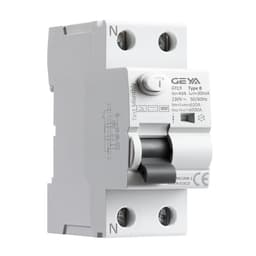
GEYA GEYA GYL9 40 A

Best overall

GEYA GEYA GYL9 40 A
9.6/10about £59.99
DIHOOL DIHOOL 4-pole 63 A

Best value

DIHOOL DIHOOL 4-pole 63 A
8.6/10about £69.88
On this page

What each type is for

Type AC sees sinusoidal alternating residual current only, and any direct current can impair it. Type A adds pulsating direct current. Doepke’s selection note says a Type A device still functions with smooth DC present up to 6 mA, and that it does not detect that smooth DC. Six milliamps is immunity, not the 30 mA trip. Type F adds composite residual current, and smooth DC above 10 mA can impair it. Type B sees smooth direct current of either polarity and also covers Type A and Type F currents. The IET’s 2019 article reserves Type B for smooth DC above the Type A limit. A basic Type B claim reaches 1 kHz and is not a 20 kHz Type B+ device.

Blinding is a saturated core

Blinding means the device stops seeing a fault it was built to clear. The IET explains it as a saturated sensing core: smooth DC magnetises the core, the alternating residual current no longer produces a trip signal, and an AC earth fault on a socket can stay on. Six milliamps does not replace the trip current. A 30 mA Type A device keeps working with smooth DC up to 6 mA and will not open because of that current. Above 6 mA the immunity is used up. Eight milliamps on a Type A main switch can hide an alternating fault on another circuit sharing that switch.
GEYA GEYA GYL9 40 A

Testsieger

GEYA GEYA GYL9 40 A
9.6/10about £59.99

What may sit upstream

Do not fit Type A or Type F upstream of Type B unless the manufacturer of that upstream device declares the arrangement. Type AC is already the wrong device upstream of Type A, Type F or Type B. DC the Type B unit has not tripped on can still reach an older Type A core. Type B trips on smooth DC at up to twice the residual rating, 60 mA on a 30 mA device, so smooth DC below 60 mA can pass and still exceed the 6 mA that impairs Type A upstream. Terasaki’s note about several chargers does not waive the rule for one circuit.

When Type A is the better match

Type A is the better match when leakage stays inside what Type A sees. Ordinary sockets produce alternating and pulsating current, not continuous smooth DC above 6 mA. Hager’s EV page prefers Type A where the charger already includes a 6 mA RDC-DD, because Type B costs more. That is not a claim that Type A is safer if the charger can push smooth DC above 6 mA. A wallbox is on type B RCD for an EV charger. Choose Type B, with no weaker device upstream unless the maker allows it, when smooth DC can exceed 6 mA.

A Type B breaker is not this comparison

On a miniature circuit breaker, B is a magnetic trip curve that opens on overload and short circuit. It does not measure earth leakage, and it has no 30 mA residual rating. A curve-B breaker can still be right for a lighting circuit and ignore smooth DC from an inverter. When the manual names a residual current device, the type B RCD buying guide covers poles, rated current and the printed standard. Leave the curve-B breaker on the overcurrent job.

Common questions

What does a Type A RCD detect that Type AC does not?
Type AC detects sinusoidal alternating residual current only. Type A adds pulsating direct current and does not detect smooth DC. Doepke says it can keep working with up to 6 mA of smooth DC present. Above 6 mA, Type B is the class meant to see smooth DC.
Is 6 mA a trip setting or an immunity level?
Six milliamps is Type A immunity to smooth DC, not the trip current. Additional protection remains 30 mA. Above 6 mA, BEAMA says Type A can be impaired. A Type B smooth-DC trip is up to 60 mA on a 30 mA device.
Can a Type A RCD be blinded by DC from a Type B circuit?
Yes, if Type A sits upstream. A 30 mA Type B unit trips on smooth DC only at up to 60 mA, so current below that can pass and saturate the Type A core. BEAMA says not to fit Type A upstream of Type B unless that manufacturer declares the arrangement.
Is a Type F RCD enough for a charger?
Type F is enough only when the maker asks for it and smooth DC stays inside what Type F tolerates. BEAMA says smooth DC above 10 mA can impair Type F. Without a 6 mA limit in the charger, Type F does not stand in for Type B.
Does a Type B RCD replace Type A on ordinary sockets?
Keep Type A on ordinary sockets when leakage is alternating and pulsating. Type B detects those waveforms as well, and the extra cost is smooth DC those sockets do not produce. Use Type B where the manual says smooth DC can exceed 6 mA.
Is a Type B breaker in the consumer unit this device?
On a miniature circuit breaker, B is the magnetic trip curve for overload and short circuit. On an RCD, B is the waveform class that includes smooth direct current. The breaker has no 30 mA residual rating, so it sits outside this comparison.

Related pages

Sources

Public sources are listed below. amazon.co.uk prices in this comparison were captured on 19 October 2026. UK trade prices were checked on 21 October 2026.

  1. IET: Which RCD Type? (September 2019) (retrieved 19 October 2026)
  2. IET: RCDs for EVSE (May 2024) (retrieved 19 October 2026)
  3. IET: RCD testing, BS 7671:2018+A2:2022 (July 2022) (retrieved 19 October 2026)
  4. HSE: electrically powered equipment (retrieved 19 October 2026)
  5. BEAMA: RCD selection for EV charging installations (retrieved 19 October 2026)
  6. Doepke UK: Type B RCCBs (retrieved 19 October 2026)
  7. Heat Pump Association: RCD guidance (March 2025) (retrieved 19 October 2026)
  8. GOV.UK: building work, replacements and repairs (retrieved 19 October 2026)