Independent comparisons. We may earn from shop links. More info

Type B RCD for an EV charger

Updated: October 2026

You have been told to buy a type B RCD for an EV charger before the wallbox goes on the drive, and a 30 mA unit with “EV” in the title is already in the basket. That instruction is only half the rule. Regulation 722.531.3.101 gives each charging point its own Type A, Type F or Type B device not exceeding 30 mA, unless the circuit uses electrical separation. Type B applies when the charger has no DC residual protection of its own. The [Type B RCD comparison](/hub/electrical-equipment/type-b-rcd) lines up poles, current and price.

You have been told to buy a type B RCD for an EV charger before the wallbox goes on the drive, and a 30 mA unit with “EV” in the title is already in the basket. That instruction is only half the rule.

Our top picks

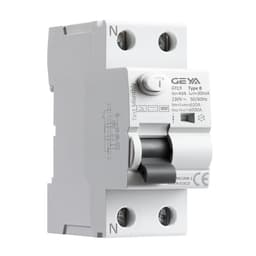
GEYA GEYA GYL9 40 A

Best overall

GEYA GEYA GYL9 40 A
9.6/10about £59.99
DIHOOL DIHOOL 4-pole 63 A

Best value

DIHOOL DIHOOL 4-pole 63 A
8.6/10about £69.88
On this page

When the charger needs a Type B RCD

A separate Type B device is for the charger that does not disconnect smooth DC residual current itself. The IET’s May 2024 note reserves Type B for that case alone. BEAMA allows Type B, Type A plus an RDC-DD, or Type F plus an RDC-DD. The charging-point device must not exceed 30 mA. Shape and price are in the type B RCD buying guide.

When a Type A RCD is allowed

Type A is allowed when the charger detects smooth DC and disconnects it at 6 mA. An RDC-DD does that detection, often to BS IEC 62955. It is not a second Type B RCD, and it does not replace the 30 mA device. A datasheet line that reads “6 mA RDC-DD” lets the electrician specify Type A at not more than 30 mA. The IET allows that device inside the charger, so the consumer unit may gain no Type B module.
GEYA GEYA GYL9 40 A

Testsieger

GEYA GEYA GYL9 40 A
9.6/10about £59.99

All live conductors, including neutral

The charger’s residual-current device has to switch every live conductor, and on a single-phase supply that includes the neutral. Hager is clear that a single-pole RCBO fails that test even when the faceplate says 30 mA, because the neutral stays connected. Two-pole switching suits a 230 V charge point. Four-pole switching suits three-phase and neutral. That device should protect the charger only, so a car fault does not drop the house. A quote for a single-pole 32 A RCBO “because it says 30 mA” is the moment to stop.

Do not leave a Type A device upstream of Type B

Smooth DC can blind a Type A device upstream of Type B. Type A is specified only to about 6 mA of smooth DC. Past that, the core can stay magnetised and miss an alternating fault. BEAMA says not to put Type A or Type F upstream of Type B. Waveforms for any load are in type B versus type A RCD. A Type A 30 mA main switch, plus Type B for a charger with no RDC-DD, is the layout that fails. Where the charger’s 6 mA RDC-DD already disconnects the DC, you are not adding Type B behind that switch.

A title that says EV is not the decision

“EV” on an amazon.co.uk title is not the design. GEYA at £59.99 states IEC/EN 61008.1, not the Type B waveform standard on its own. None of that proves your charger lacks a 6 mA RDC-DD. Once a separate Type B device is specified, the best type B RCD page compares a top pick and a best value. The top pick is the wrong spend if the wallbox already has a 6 mA RDC-DD.

Common questions

Does every home charger need an external Type B RCD?
No. External Type B is the route only when the charger has no DC residual protection. With a 6 mA RDC-DD, Regulation 722.531.3.101 still wants a device not exceeding 30 mA, usually Type A or Type F, and it may sit inside the wallbox. The electrician specifies which case this is. An “EV” title does not.
What is a 6 mA RDC-DD?
A 6 mA RDC-DD detects smooth DC residual current and causes a disconnection. BEAMA treats Type A or Type F plus that detector as alternatives to Type B. It does not replace the 30 mA device, and it does not excuse a Type A switch upstream of a separate Type B unit.
Can the RCD sit inside the wallbox?
Yes. The IET allows the residual-current device inside the charging equipment, so the consumer unit may gain no Type B module. The electrician still confirms the type, 30 mA or below, and disconnection of every live conductor, including neutral.
Why is a single-pole RCBO the wrong device?
Hager requires every live conductor, including neutral, to switch, so a single-pole RCBO is the wrong shape even at 30 mA. A single-phase point needs line and neutral. The electrician specifies the poles, including four poles on three-phase. A 63 A figure is load current, not a reason to leave the neutral closed.
Is 100 mA enough for a charger?
No. Regulation 722.531.3.101 caps the charging-point device at 30 mA. 100 mA and 300 mA are mainly fire protection. The Health and Safety Executive treats 30 mA as reducing one class of injury, not as a complete safe system.
Does a Type B RCD fix the earthing on a driveway charger?
No. Type B detects residual current. It does not correct PME or open-PEN earthing on an outdoor charge point, and this page does not design that protection. The electrician specifies earthing separately, whether the charger needs Type B, Type A, or a 6 mA RDC-DD. Buying Type B because the cable crosses the drive leaves that question open.

Related pages

Sources

Public sources are listed below. amazon.co.uk prices in this comparison were captured on 19 October 2026. UK trade prices were checked on 21 October 2026.

  1. IET: Which RCD Type? (September 2019) (retrieved 19 October 2026)
  2. IET: RCDs for EVSE (May 2024) (retrieved 19 October 2026)
  3. IET: RCD testing, BS 7671:2018+A2:2022 (July 2022) (retrieved 19 October 2026)
  4. HSE: electrically powered equipment (retrieved 19 October 2026)
  5. BEAMA: RCD selection for EV charging installations (retrieved 19 October 2026)
  6. Doepke UK: Type B RCCBs (retrieved 19 October 2026)
  7. Heat Pump Association: RCD guidance (March 2025) (retrieved 19 October 2026)
  8. GOV.UK: building work, replacements and repairs (retrieved 19 October 2026)