Independent comparisons. We may earn from shop links. More info

Type B RCD buying guide

Updated: October 2026

An installer has written “Type B” on a note, and the amazon.co.uk results mix residual-current devices with ordinary breakers that use the same letter. This type B RCD buying guide is the order checklist: the waveform class the equipment maker asks for, then poles, rated current and residual current, then whether the title is an RCCB or an RCBO. The seven kept listings sit on the [Type B RCD comparison](/hub/electrical-equipment/type-b-rcd). Prices are amazon.co.uk shelf figures captured on 19 October 2026. This is not a laboratory test.

An installer has written “Type B” on a note, and the amazon.co.uk results mix residual-current devices with ordinary breakers that use the same letter.

Our top picks

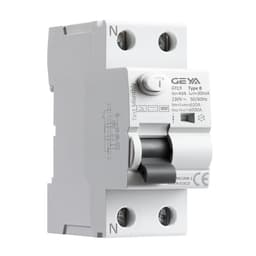
GEYA GEYA GYL9 40 A

Best overall

GEYA GEYA GYL9 40 A
9.6/10about £59.99
DIHOOL DIHOOL 4-pole 63 A

Best value

DIHOOL DIHOOL 4-pole 63 A
8.6/10about £69.88
On this page

Type B RCD or Type B MCB

The letter B on a miniature circuit breaker is a magnetic trip curve. The letter B on a residual current device is a waveform class. A curve-B breaker opens on overload and short-circuit current. It does not measure leakage to earth, and it has no 30 mA residual rating. The IET’s 2019 article, Which RCD Type?, says you ask the maker which residual-current class the load needs. What 6 mA of smooth DC means is on type A vs type B RCD.

Poles, amps and milliamps

Two-pole switches line and neutral on a single-phase 230 V circuit. Four-pole suits three-phase and neutral near 400 V. In this set the 2-pole rows are the GEYA at 40 A and four 63 A titles. The 4-pole rows are the DIHOOL at 63 A and the Opatiny, whose title says 40 A. Rated current is the load the device can carry. 63 A is not more sensitive than 40 A. Sensitivity is the residual current, and additional protection for people is not more than 30 mA. Opatiny’s title says 40 A and one bullet also says up to 63 A. The capture does not resolve that clash.
GEYA GEYA GYL9 40 A

Testsieger

GEYA GEYA GYL9 40 A
9.6/10about £59.99

RCCB, RCBO and the standard line

An RCCB detects residual current. Overload protection stays with a separate MCB or fuse. An RCBO combines both and is associated with BS EN 61009-1. Hosrivae’s title uses both RCBO and RCCB, which does not settle the form. A 6 kA bullet on an RCCB is short-circuit coordination, not an overload trip. Only GEYA states a standard, IEC/EN 61008.1, and the capture does not mention BS EN 62423. DIHOOL prints CE only. Its table says 230 V while the description says AC 415 V.

What the price bands are buying

On 19 October 2026 the listings with no review line sat at about £40 to £45. GEYA was £59.99 with 4.8 from 7 reviews. DIHOOL was £69.88 with 4.3 from 77 reviews. One supplier listed a Hager 40 A 2-pole 30 mA Type B at £221.84, and a Verso Type B RCCB at £250 excluding VAT. GEYA’s 61008.1 line is the only standard in this set, and it still is not BS EN 62423.

Before you check out

Confirm poles, rated current and residual current against the design, then look for BS EN 61008-1 or BS EN 61009-1, and for BS EN 62423. Doepke says you do not place Type AC, Type A or Type F upstream of Type B unless the maker of that upstream device allows it. If the load is a wallbox, use the type B RCD for an EV charger page before you assume an external Type B device is required.

Common questions

Is a Type B MCB the same thing?
No. A Type B miniature circuit breaker uses B as a magnetic trip curve for overload and short circuit. A Type B RCD uses B as a residual-current waveform class that includes smooth direct current. A curve-B breaker has no 30 mA residual rating.
Do I need 30 mA or 100 mA?
Where people need additional protection, the figure used in UK practice is not more than 30 mA. 100 mA and 300 mA are mainly fire protection. Doepke notes that a 30 mA device is not time-delayed, and that standing leakage near 10 mA makes nuisance trips likely.
Is a two-pole or a four-pole device the one to order?
Two-pole switches line and neutral on single-phase 230 V. Four-pole suits three-phase and neutral near 400 V. A single-pole device leaves neutral connected, which is the wrong shape for a charging point. DIHOOL’s page states both 230 V and 415 V, so you resolve that line before you pay.
Does 63 A protect you more than 40 A?
63 A and 40 A are rated load current. The residual sensitivity on every kept listing in this set is 30 mA. A 63 A device can carry a larger load. It does not see a smaller earth fault.
What standard should be printed?
Look for BS EN 61008-1 on an RCCB or BS EN 61009-1 on an RCBO, and BS EN 62423 for Type B performance. In this capture only GEYA states a standard, and it is IEC/EN 61008.1. That line does not name 62423.
Can this RCCB replace the MCB?
An RCCB detects residual current. Overload and short-circuit protection stay with an MCB or a fuse unless the device is an RCBO to BS EN 61009-1. A 6 kA line on an RCCB is coordination with that upstream device. Hosrivae’s title says both RCBO and RCCB, which does not prove the combined function.
Why is a trade Type B device several times the amazon.co.uk price?
Trade pages show a Hager 40 A 2-pole 30 mA Type B around £221.84 and Hager’s own CDB540E at £347.59. The IET’s 2019 note already described Type B as hundreds of pounds. A £40 listing can still omit the standard.

Related pages

Sources

Public sources are listed below. amazon.co.uk prices in this comparison were captured on 19 October 2026. UK trade prices were checked on 21 October 2026.

  1. IET: Which RCD Type? (September 2019) (retrieved 19 October 2026)
  2. IET: RCDs for EVSE (May 2024) (retrieved 19 October 2026)
  3. IET: RCD testing, BS 7671:2018+A2:2022 (July 2022) (retrieved 19 October 2026)
  4. HSE: electrically powered equipment (retrieved 19 October 2026)
  5. BEAMA: RCD selection for EV charging installations (retrieved 19 October 2026)
  6. Doepke UK: Type B RCCBs (retrieved 19 October 2026)
  7. Heat Pump Association: RCD guidance (March 2025) (retrieved 19 October 2026)
  8. GOV.UK: building work, replacements and repairs (retrieved 19 October 2026)