Independent comparisons. We may earn from shop links. More info

Best type B RCD

Updated: October 2026

You are choosing among seven amazon.co.uk listings for a charger, inverter or heat pump, and you need the device that matches the board. A type B residual current device is for smooth direct current on the earth path, unlike a type B miniature circuit breaker, whose B is only a trip curve. In this set, the best type B RCD is the listing whose poles, current and stated standard fit the job. Prices were taken from amazon.co.uk on 19 October 2026. See the [Type B RCD comparison](/hub/electrical-equipment/type-b-rcd).

You are choosing among seven amazon.co.uk listings for a charger, inverter or heat pump, and you need the device that matches the board.

Our top picks

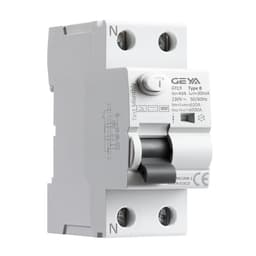
GEYA GEYA GYL9 40 A

Best overall

GEYA GEYA GYL9 40 A
9.6/10about £59.99
DIHOOL DIHOOL 4-pole 63 A

Best value

DIHOOL DIHOOL 4-pole 63 A
8.6/10about £69.88
On this page

What “best” means in this set

“Best” here is a shopping rule for these seven listings, not a laboratory ranking. You check the stated standard, the pole count, and whether a review line exists. Rated current is what the device can carry, so 63 A is not a more sensitive trip than 40 A. Every unit here is marked 30 mA. GEYA is the only listing that states IEC/EN 61008.1. At £59.99 it is 2-pole and 40 A, scored 4.8 from seven reviews, so it is the top pick for a two-pole 40 A job. Type B against Type A is covered in type B versus type A RCD.

GEYA when you need 2-pole 40 A

GEYA (B0G51N327V) is the listing for a single-phase circuit that needs two poles at 40 A and 30 mA. On 19 October 2026 it cost £59.99, scored 4.8 from seven reviews. It states IEC/EN 61008.1, and that line is not, by itself, a Type B waveform certificate. You still want BS EN 62423 on a matching datasheet. GEYA does not say “smooth DC”. Leave it for four poles, for 63 A, or where the manual rejects 30 mA. If the wallbox may already contain the DC protection, use the type B RCD for an EV charger.
GEYA GEYA GYL9 40 A

Testsieger

GEYA GEYA GYL9 40 A
9.6/10about £59.99

DIHOOL when the board is 4-pole

DIHOOL (B0C3CHR3QQ) is the four-pole listing with reviews, at £69.88 and 4.3 from 77 reviews. It is the best value marker only because it alone has 50 or more reviews. For a single-phase 40 A job, GEYA matches the poles and DIHOOL does not. The listing states neither IEC/EN 61008.1 nor “smooth DC”. A UK review complains about the busbar. A review of a German purchase, not a UK install, reports a trip at 338 mA. That report is not a UK laboratory result. Leave DIHOOL when you need a named standard, a two-pole circuit, or when those two reviews are enough doubt.

The £40 titles

Five listings sat between £39.94 and £44.64 on 19 October 2026, with no reviews and no stated standard, so none is a top pick. Hosrivae at £39.94 does not claim smooth DC. EcoLivzen at £43.36 and Vootnifig at £44.48 do. ZMdooreasy at £44.64 does not, so the extra pence buys no standard. Opatiny at £43.02 is the exception: 4-pole, 40 A and 30 mA, and it does claim smooth DC, with no reviews and no IEC/EN 61008.1 line. None of the five is certified to BS EN 62423. This set has no 2-pole 63 A unit with a stated standard. That line sits only on the 40 A GEYA.

Trade prices are a different shelf

Hager’s CDB540E, a 1P+N 40 A 30 mA Type B, is listed at £347.59 and is four modules wide. The CDB640E, a 3P+N 40 A 30 mA Type B, is listed at £998.08. On 21 October 2026 a trade seller had a Hager 40 A 2-pole 30 mA Type B at £221.84, and a Verso Type B RCCB at £250 excluding VAT. A £59.99 GEYA is not the same part in a cheaper box. The £998 unit is the three-phase 40 A device, easy to mix up with a two-pole job. When you need a datasheet and UKCA paperwork, you are on the trade shelf.

Common questions

Which listing states a standard?
Only GEYA states IEC/EN 61008.1. That line does not certify the Type B waveform. DIHOOL and the five cheaper listings do not state it. A title that only says “type B” is not a datasheet.
Is the dearest listing the one to buy?
DIHOOL is the dearest listing here, at £69.88, because it is the four-pole unit with 77 reviews. For two poles and 40 A, GEYA at £59.99 matches and DIHOOL does not. Hager’s four-module 40 A part costs hundreds of pounds and is a different product.
Can I use a 63 A 2-pole unit on a 40 A circuit?
A 63 A mark is carrying current, not a tighter trip. Sensitivity stays 30 mA on the GEYA and on the 63 A titles. The MCB or fuse still provides overload protection, because these are RCCBs rather than RCBOs.
Why do Hager’s own pages show hundreds of pounds?
Hager lists the four-module CDB540E at £347.59 and the four-pole CDB640E at £998.08. A trade site showed a Hager 40 A two-pole unit at £221.84 on 21 October 2026. Those are catalogue prices for named parts, not a discount on the amazon titles.
Do listings with no reviews count as a top pick?
Hosrivae, Opatiny, EcoLivzen, Vootnifig and ZMdooreasy had no reviews on 19 October 2026, so they are not the top pick. That place is GEYA, and only when the poles match. No review does not prove a fault.
Who should skip DIHOOL despite the review count?
Leave it on a two-pole board, when you need IEC/EN 61008.1 in the listing, or when the UK busbar note and a German report of a trip at 338 mA outweigh 77 reviews. That 338 mA figure is not a UK lab test. EcoLivzen, Vootnifig and Opatiny say “smooth DC”. GEYA and DIHOOL do not.

Related pages

Sources

Public sources are listed below. amazon.co.uk prices in this comparison were captured on 19 October 2026. UK trade prices were checked on 21 October 2026.

  1. IET: Which RCD Type? (September 2019) (retrieved 19 October 2026)
  2. IET: RCDs for EVSE (May 2024) (retrieved 19 October 2026)
  3. IET: RCD testing, BS 7671:2018+A2:2022 (July 2022) (retrieved 19 October 2026)
  4. HSE: electrically powered equipment (retrieved 19 October 2026)
  5. BEAMA: RCD selection for EV charging installations (retrieved 19 October 2026)
  6. Doepke UK: Type B RCCBs (retrieved 19 October 2026)
  7. Heat Pump Association: RCD guidance (March 2025) (retrieved 19 October 2026)
  8. GOV.UK: building work, replacements and repairs (retrieved 19 October 2026)