Independent comparisons. We may earn from shop links. More info

How to test a type B RCD

Updated: October 2026

You are at the consumer unit because a wallbox, a solar inverter, or another electronic load sits on a Type B RCD, and you want to know how to test a type B RCD without treating a click as a certificate. The check you can do yourself is the button marked T. It shows that the mechanism opened. It does not show that the device still detects smooth direct current. If the button does nothing, or the device will not stay on, stop and call a qualified electrician. Leave the cover on, and do not bypass the device. Which unit to fit is in the [Type B RCD comparison](/hub/electrical-equipment/type-b-rcd).

You are at the consumer unit because a wallbox, a solar inverter, or another electronic load sits on a Type B RCD, and you want to know how to test a type B RCD without treating a click as a certificate.

Our top picks

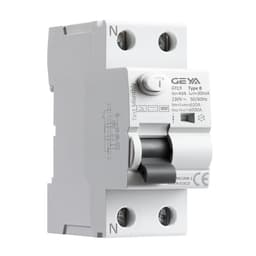
GEYA GEYA GYL9 40 A

Best overall

GEYA GEYA GYL9 40 A
9.6/10about £59.99
DIHOOL DIHOOL 4-pole 63 A

Best value

DIHOOL DIHOOL 4-pole 63 A
8.6/10about £69.88
On this page

What the test button is for

The button marked T checks the mechanism. The IET keeps this mechanical check separate from the instrument test on a certificate. The current it creates is not an earth fault, so an upstream RCD is not expected to open when you press T here. Note the circuits this RCD feeds, press T, and expect the handle to drop. Reset, then restore the loads one at a time. It does not show the device is Type B, because other types have a T button too. That difference is on the type B versus type A RCD page. If the cover has to come off to reach T, stop and call an electrician.

If it does not trip, or it will not stay on

Nothing moving is a failed test. The Health and Safety Executive says you should not keep using a faulty RCD or bypass it. Call an electrician instead of pressing the button again. You may reset once after a trip in use if you unplug the appliance you had just started and the RCD then stays on. If it opens again at once, leave it off. Reviews of DIHOOL devices have described a failed test button and a measured trip at 338 mA. Treat that as a reason to replace the unit, not as a test to copy.
GEYA GEYA GYL9 40 A

Testsieger

GEYA GEYA GYL9 40 A
9.6/10about £59.99

What an electrician records under BS 7671

Under BS 7671:2018 Amendment 2, the compliance test is an alternating-current test at the rated residual current, with a maximum trip time of 300 ms. The IET says that test applies to Type AC, Type A, Type F, and Type B. It is independent of the button. A tester may have a Type B setting, but that setting is not the certificate test. Amendment 2 still records the alternating-current result. When the electrician quotes a figure, it should be a pass or fail against 300 ms. Choosing a replacement is covered in the type B RCD buying guide, and fitting it still needs a competent person.

Smooth DC is a different test

The button does not prove that a Type B RCD still responds to smooth direct current. Doepke puts the smooth-DC trip band at 15–60 mA on a 30 mA device. BS 7671 does not require that check for a certificate. A socket tester is not that test. You may say the contacts opened when you pressed T. You may not say the device still detects smooth direct current. If that extra check is wanted, the electrician's instrument does it.

How often, and what a trip of the lights means

Where a button is fitted, IET guidance for clients on an electric-vehicle installation is a button check about every six months. Six months is a habit for the button, not a certificate interval. The press still does not prove smooth-DC detection. Lights going out as you press T mean the test worked. Lights going out in normal use mean a fault. Unplug the last appliance, reset once, and stop if it trips again. Do not bypass the device.

Common questions

Can I press the test button myself?
Yes, if you can reach T without opening the consumer unit and you know which circuits will go off. Press it, confirm those circuits lose power, reset, and restore the loads one at a time. That checks the mechanism only. It is not an Electrical Installation Certificate.
What if nothing happens when I press it?
Stop. A button that does not open the contacts has failed the only check you should do. Do not keep pressing it, do not bypass the RCD, and do not measure it yourself. Call a qualified electrician and leave the device off if it will not stay on. Repeated trips after one reset are the same stop, even if T worked the first time.
Does a successful button test mean the device is Type B?
No. The button only shows that the mechanism can open. Other RCDs have a test button too, so a click does not prove the type or smooth-DC detection. Read the label. If the label is missing, an electrician should identify the device before you rely on it.
How often should I test a type B RCD?
Where a button is fitted, the IET tells clients on electric-vehicle installations to press it about every six months. Six months does not replace the alternating-current test under BS 7671 Amendment 2.
Is the BS 7671 test for a Type B device a direct-current test?
No. Amendment 2 asks for an alternating-current test at the rated residual current, with a maximum of 300 ms, including on a Type B device. The smooth-DC band of 15–60 mA on a 30 mA device is a separate check, and BS 7671 does not require it for the certificate.
What trip time should I expect to be quoted?
Expect a pass or fail against a maximum of 300 ms on the alternating-current test at the rated residual current. Pressing T will not give you a time. The smooth-DC check is a current band, 15–60 mA on a 30 mA device, not a trip time for the certificate. If the result is outside 300 ms, an electrician repairs or replaces the device.

Related pages

Sources

Public sources are listed below. amazon.co.uk prices in this comparison were captured on 19 October 2026. UK trade prices were checked on 21 October 2026.

  1. IET: Which RCD Type? (September 2019) (retrieved 19 October 2026)
  2. IET: RCDs for EVSE (May 2024) (retrieved 19 October 2026)
  3. IET: RCD testing, BS 7671:2018+A2:2022 (July 2022) (retrieved 19 October 2026)
  4. HSE: electrically powered equipment (retrieved 19 October 2026)
  5. BEAMA: RCD selection for EV charging installations (retrieved 19 October 2026)
  6. Doepke UK: Type B RCCBs (retrieved 19 October 2026)
  7. Heat Pump Association: RCD guidance (March 2025) (retrieved 19 October 2026)
  8. GOV.UK: building work, replacements and repairs (retrieved 19 October 2026)