






An evening in a flat
You need lights, phones, and broadband through a cut, and you cannot run petrol outdoors. The Jump 600X is about £239.99, with 600 W pure sine claimed and 268.8 Wh.
The best backup generators, compared.
Top pick: FOSSiBOT F2400 2,048 Wh – Highest star line in this set: about £649.00, 4.6 from 346 reviews, score 92, with 2,400 W and 2,048 Wh claimed. The voltage lines on the listing do not agree. Best value: VTOMAN Jump 600X 268.8 Wh – Lowest price among rows with at least 500 W continuous AC claimed and an independent UK review count above 100: about £239.99, 4.4 from 473 reviews, score 88. Updated 22.10.2026.


You use one for phones, a router, lights, and sometimes a fridge in a power cut, or for quiet camping. Separate a useful unit from a toy by continuous watts, watt-hours, waveform, and a real UK 13 A socket. How to size watts and watt-hours is in the [backup generator buying guide](/hub/electrical-equipment/backup-generator/sub/backup-generator-buying-guide). On these amazon.co.uk listings, a backup generator is almost always a portable power station: a battery and an inverter, not a petrol engine. It runs while you can fuel it, and says never to run it indoors because of carbon monoxide. None of the twelve rows here is a petrol genset. If that is the machine you need, compare an [inverter generator](/hub/electrical-equipment/inverter-generator).
You use one for phones, a router, lights, and sometimes a fridge in a power cut, or for quiet camping. Separate a useful unit from a toy by continuous watts, watt-hours, waveform, and a real UK 13 A socket.

42 products checked · 64 hrs invested · +21,800 readers
Swipe for more
1-2 of 12


Personal buying guide
Question 1 of 2
What do you need it to run?
The FOSSiBOT F2400 lists 2,400 W and 2,048 Wh of LiFePO4 in the title, with a claimed 4,800 W surge and three AC outlets, at £649.00. The amazon.co.uk line is 4.6 from 346 reviews, the highest stars in this set, though the saved sample mixes UK titles with other countries. UK titles call it well made, while a Spanish note says anything other than light bulbs emptied the battery in seven hours and a German note complains about after-sales help. The title says 240 V, the attribute says 230 V, and a bullet says 110 V. A panel is sold separately, and the word UPS appears with no switchover time printed. It is the highest single-pack claim here, and you should read the plate for voltage before you rely on it.
Pros
Cons
Best for: You want the largest single-pack watt and watt-hour claim in this set and you will confirm the outlet voltage on the hardware.
Less suitable: You need a panel in the box, a UK-only review file, or a listing whose voltage lines agree.
Specifications
Common questions
Which mains voltage does the listing use?
The title says 240 V. The attribute says 230. The outlets bullet says 110 V / 50–60 Hz.
Is a solar panel included?
No. The listing says solar panels are sold separately.
Does UPS mean a stated switchover time?
The title uses the word UPS. No millisecond figure is printed.
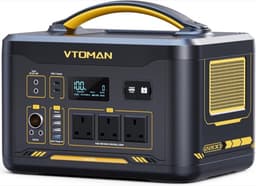
The VTOMAN Jump 600X lists 600 W of claimed pure sine, a 1,200 W surge, and 268.8 Wh of LiFePO4, with two AC outlets and a 230 V attribute, at £239.99. The amazon.co.uk line is 4.4 from 473 reviews, and the first 50 texts are United Kingdom. Reviewers describe camper hair dryers, phones kept charged, a small camping kettle, and LED lights in a power cut. The same notes say heavier appliances shut it down, and that USB-C was hit and miss in one camping review. Some texts assume an expansion battery or a panel this listing does not include. AC input is printed as 170 W and also as up to 270 W. It is the step up when an 80–150 W box is too small and a 2 kWh station is more than the job.
Pros
Cons
Best for: You want a mid station around £240 with a stated pure sine claim for lights, chargers, and small camper loads under 600 W.
Less suitable: You need a household kettle, a heater, or a panel and an expansion battery in the carton.
Specifications
Common questions
Is a solar panel included?
No. The box list is the station, an AC adapter, a car cable, a USB-C cable and a quick guide.
What waveform does the listing claim?
Pure sine wave, 600 W continuous, with a 1,200 W surge.
Do the 473 reviews all describe this 600X?
The score line says 4.4 from 473. The sample also mentions a Jump 600, a Jump 1500, extra batteries and panels.
The VTOMAN FlashSpeed 1500 bundle is a 1,500 W station with a claimed 3,000 W surge, an extra battery, and a 200 W panel, at £899.99, shipping as three packages. Capacity is printed as 1,548 Wh, as 2,956 Wh with the extra battery, and also as 3,096 Wh. The amazon.co.uk line is 4.4 from 31 reviews, with 19 UK texts in the file. Those notes praise months of use and solar charging on cloudy UK days, including places where a petrol generator was refused. They also describe a faulty extra battery, charging that stopped past about 90% after about two weeks, and a delivery that looked returned. Waveform is not stated, and an official report on a FlashSpeed 1000 is a different model.
Pros
Cons
Best for: You want the extra battery and a 200 W panel in one VTOMAN bundle and you can live with 31 reviews and conflicting capacity lines.
Less suitable: You want a stated pure sine claim, one agreed watt-hour figure, or a lower price without the bundle.
Specifications
Common questions
What arrives in the bundle?
The listing says the station, an extra battery and a 200 W Pro panel, sent as three packages.
Which watt-hour figure should you read?
The capacity bullet says 1,548 Wh, or 2,956 Wh with the extra battery. Another field says 3,096 Wh, and the highlight says 1,408 Wh extra.
Does the listing say pure sine?
Those words are not in the bullets. It does claim 1,500 W rated and 3,000 W peak.
This VTOMAN Jump 2200 ASIN is the station without a solar panel: 2,200 W of claimed pure sine, a 4,400 W surge, 1,408 Wh of LiFePO4, and three 230 V outlets, at £499.99 and about 20 kg. The 4.3 from 140 line is the same UK review text as the panel kit, so a panel-in-the-box comment is not evidence for this carton. Those texts describe camper kettles, fridges, and a cool box kept for several days once the owner added a panel. The fan is called very noisy under load, and extra-battery switchover fails in some notes. Fault lines include front ports dead within three weeks while the display showed about 73%. A separate 200 W panel is quoted at about six to nine hours, so this pack is a high-output battery, not a fuel refill.
Pros
Cons
Best for: You want the 2,200 W station for camper or backup loads and you will buy a panel separately if you need solar.
Less suitable: You want the 110 W panel in the same carton, or a review file that is only about this station-only pack.
Specifications
Common questions
Is the 110 W panel in this box?
No. This pack list has no solar panel. The panel is on ASIN B0D4Q45KD3.
Can the capacity grow?
The listing says 1,408 Wh, expandable to 2,956 Wh with a Jump 1500 extra battery sold separately.
Are the 140 reviews only for the station-only pack?
The same 4.3 from 140 line and the same review text are on the panel-kit ASIN.
This £569.99 ASIN is the same 2,200 W and 1,408 Wh Jump 2200 claim plus a 110 W panel in the box. The 4.3 from 140 reviews is shared with the station-only ASIN, and several texts describe an extra battery or a larger panel than this kit. Reviewers run camper loads and keep a cool box going for several days with a panel connected. They also criticise a noisy fan, solar charging slower than the advert, and the 20 kg weight. One replacement story says the seller lost the solar panel. The outlet attribute says two, against three AC outlets in the bullet, and the extra battery is still sold separately.
Pros
Cons
Best for: You want this Jump 2200 and the 110 W panel in one carton for camper solar, and you accept the shared review file.
Less suitable: You do not need a panel, or you need the extra battery included rather than sold separately.
Specifications
Common questions
What is in the box that the £499.99 pack lacks?
This package list adds one 110 W solar panel.
Is the extra battery included?
No. Expansion to 2,956 Wh needs a Jump 1500 extra battery, sold separately.
Does the listing claim pure sine?
Yes. It says a pure sine wave 2,200 W load, with a 4,400 W surge.
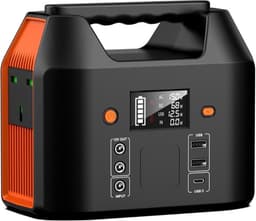
The MARBERO M82 is an 80 W continuous, 120 W peak station with 88.8 Wh and one 220 V outlet, at £93.99. The listing shows 4.0 from 7,329 reviews, and the same rating line and UK review text sit on the M82 Plus and the M168 Plus. In that shared sample, reviewers praise the 1.04 kg body, charge several phones with power left, and one person ran an 84 W guitar amp for just over eight hours. The same texts say a laptop lasted about an hour, a self-inflating bed would not inflate, and a 30 W practice amp would not run. A unit that stopped holding charge after about six months is in the fault notes. The solar panel is not in the box, so this is a small AC box for loads that stay under 80 W.
Pros
Cons
Best for: You want a light box for phones and a load under 80 W, and you will not treat 7,329 as reviews of this model alone.
Less suitable: You need a stated 230 V, 50 Hz pure sine outlet, or a panel in the carton.
Specifications
Common questions
Is the 4.0 score from 7,329 reviews of this M82?
The saved listing prints 4.0 from 7,329, and the same review text is on the M82 Plus and the M168 Plus.
Does it include a solar panel?
No. The listing says it can take a 15–24 V panel, and the panel is not in the box.
What AC voltage does the attribute give?
220 V AC, 50 Hz, 80 W running and 120 W maximum.
The MARBERO M168 Plus lists 100 W continuous and 150 W peak from 97.68 Wh, at £103.54, and both the AC bullet and the attribute say 220 V / 60 Hz. UK mains are 230 V at 50 Hz, so that pair is a problem on the page itself. The 4.0 from 7,329 line is the same shared text as the other two MARBERO ASINs, not a separate census of this model. Those reviews include phone charging and one 84 W amp run of just over eight hours, plus slow charging and a unit that stopped charging after about six months. The listing says it does not support loads over 100 W. At 1.32 kg it is still a carry box, and you should leave it if you need the page to state 50 Hz.
Pros
Cons
Best for: You want about 100 W in a small MARBERO body and you have checked that 220 V / 60 Hz is acceptable on your loads.
Less suitable: You need a listing that states 230 V and 50 Hz, or an independent review file for this model.
Specifications
Common questions
Will it run a kettle or a fridge?
The low-power bullet says it does not support appliances rated over 100 W, and names portable fridges and motor loads as incompatible.
Why does the frequency say 60 Hz?
Both the attribute and the AC-outlet bullet say 220 V / 60 Hz.
Is this a separate 7,329-review sample?
No. The same 4.0 from 7,329 line and the same UK review text are on the other two MARBERO ASINs.
The MARBERO M82 Plus repeats an 80 W continuous and 120 W peak claim with one 220 V outlet, at £104.99, while the bullets print both 98 Wh and 111 Wh. The warranty bullet says 12 months and the warranty field says two years. The 4.0 from 7,329 figure is the shared MARBERO line, not a separate UK census of the Plus. Shared notes praise the 1.04 kg body and phone charging, then report a laptop lasting about an hour and a 30 W amp that would not run. A charge failure after about six months is in the fault list, and the panel is not included. You pay more than the M82 without one agreed watt-hour figure on the page.
Pros
Cons
Best for: You specifically want the M82 Plus body for phones and a sub-80 W load, after you pick one of the two watt-hour figures as unknown.
Less suitable: You want one agreed capacity, a stated 50 Hz UK socket, or a lower price than the M82 for the same 80 W class.
Specifications
Common questions
Which capacity figure is on the listing?
One bullet says 98 Wh. The ports bullet says 111 Wh. Both cite 26,400 mAh.
How long is the warranty?
The bullet says 12 months. The product-warranty field says 2 year manufacturer.
Are the 7,329 reviews only for the M82 Plus?
The same rating line and the same review text are on the M82 and the M168 Plus files.
The VCLPOWER listing is a USB and bulb pack at £69.99, with 75 Wh of LiFePO4 and a 10 W panel in the title. The wattage attribute instead says 75 kilowatt hours, and the bullets do not describe an AC socket. The amazon.co.uk line is 3.9 from 200 reviews. UK titles call it a workable phone charger outdoors, then complain that solar charging missed expectations, that the panel lacked kickstands, and that a USB port was not connected. One review says the panel would not charge the pack, and one unit is described as stopping within weeks of a 1 June delivery. The package bullet counts one panel and the included-components field counts two, so treat 75 Wh in the title as the capacity claim.
Pros
Cons
Best for: You want USB and a couple of bulbs for camping, and you will ignore the kilowatt-hour attribute.
Less suitable: You need a 230 V socket, or you are buying it mainly for the 10 W panel to refill the pack.
Specifications
Common questions
Can it run a mains appliance?
The bullets describe USB ports and bulb ports. They do not describe an AC socket.
Is the capacity 75 kWh?
The title says 75 Wh and the bullet says 20,000 mAh. The output-wattage attribute says 75 kilowatt hours.
Is the solar panel in the box?
The package bullet includes one 10 W panel. The included-components field says two solar panels.
The SinKeu R150 is a 99 Wh station with one 230 V / 50 Hz outlet rated 150 W maximum, at £109.99. The amazon.co.uk line is 3.8 from 1,334 reviews, and the first 50 texts in the file are United Kingdom. Reviewers use it for phones, a router, camping fans, and a 3-pin socket on a shed, and one two-year note says it still works. The same file says AC runtime was about an hour and a half, that the fan was noisy, and that the socket would not run the loads people expected. Fault notes include charging that stopped in under a year, a burning plastic smell on first use, and a unit dead on a first camping night. The panel is not included, so read that defect trail before you rely on it in a cut.
Pros
Cons
Best for: You want a small station whose listing actually prints 230 V and 50 Hz for phones, a router, or a light fan.
Less suitable: You need pure sine stated on the page, a panel in the box, or a pack with a clean fault record.
Specifications
Common questions
Is the solar panel included?
No. The title says the solar panel is not included. The box list is the station, an AC charger, a car cable and a manual.
What is the AC limit?
One 230 V / 50 Hz socket, 150 W maximum.
Does the listing name the battery chemistry?
No. Chemistry is not in the bullets or the attribute block.
The Oumefar listing is a hand crank rated about 20 W at a claimed 2,000 rpm, so you only get power while you turn it. On amazon.co.uk it is £42.79 with a 3.4 line from five reviews, and the saved file holds one Spanish review rather than five UK texts. That note calls it a workable emergency charger and asks for a better support so cranking is less awkward. No stored watt-hours and no AC socket are stated, and the attribute block still prints 4 stroke beside a hand-crank description. Weight is 758 g in one bullet and 820 g in the attribute. It is a last-resort USB crank, and it stops the moment you stop turning.
Pros
Cons
Best for: You need a hand-turned USB trickle when every battery is already flat and you can keep cranking.
Less suitable: You want stored power for an evening, a 230 V socket, or a UK review sample.
Specifications
Common questions
Does this store power for later?
The listing gives about 20 W while it is generating. It does not state a battery capacity in watt-hours.
Is there a UK mains socket?
No AC socket is described. The special-features line names a USB port.
How many UK reviews are in the saved listing?
The listing score is 3.4 from 5 reviews. The file contains one review, from Spain.
The VTOMAN Jump 100 is an 89.6 Wh LiFePO4 box at £49.99, with a title claim of 100 W AC and 65 W USB-C PD and a 230 V attribute. Across 130 amazon.co.uk reviews the line is 2.9, the weakest star average in this set. UK reviewers describe an air bed and phones through an 11-hour cut, and several praise the 65 W port. The same sample says a full charge added about 10% to one phone, that small AC loads lasted about five minutes, and that one reviewer calls the AC output modified sine. The listing itself does not state the waveform, and fault notes include a unit that would not take a charge after one use. At 1.2 kg it is easy to carry, and it is a weak bet for a laptop or a television.
Pros
Cons
Best for: You want the cheapest LiFePO4 box here with an AC title for phones and a short air-bed inflate, and you have read the 2.9 line.
Less suitable: You need a stated pure sine output for a laptop, a TV, or speakers.
Specifications
Common questions
Does the listing say pure sine?
No. Waveform is not in the bullets. A UK review calls the AC output modified sine.
Is a solar panel included?
The included-components field names the Jump 100 only.
What chemistry does the title name?
LiFePO4, with LIFEBMS protection listed in the bullets.
Twelve backup generators on amazon.co.uk were scored from saved listings dated 20 October 2026. There was no lab test. The published score is the amazon.co.uk star average times 20, so 4.6 is 92 and 2.9 is 58. Review volume is not inside the score. Shared rating lines, thin samples, and voltage clashes stay in the assessment. The scores were not reduced again, and price is not inside the score.
Amazon star line
70%The published score is the amazon.co.uk star average times 20. A 4.6 line is 92 and a 2.9 line is 58. Review volume is not inside that number, so a line of 7,329 and a line of 31 can share a star band.
Watts, watt-hours and waveform
20%Continuous watts, watt-hours, waveform, chemistry, sockets, and what is in the box are read from the listing and shown in the table. Those facts do not add points on top of the star line.
Limits kept in the assessment
10%Shared rating lines, thin or non-UK samples, and voltage clashes are written beside the product. Scores were not reduced again for those limits. Price is not inside the score.
Start with continuous watts, then watt-hours, then whether the listing says pure sine and a UK-suitable socket. Price comes after those three. The notes below follow that order for these twelve amazon.co.uk listings, saved on 20 October 2026. None of the scores is a lab test.
On these amazon.co.uk listings, a backup generator is almost always a portable power station: a battery and an inverter, not a petrol engine. You use one for phones, a router, lights, and sometimes a fridge in a power cut, or for quiet camping. A petrol generator is a different machine. It runs while you can fuel it, and National Grid says never to run it indoors because of carbon monoxide. None of the twelve rows here is a petrol genset.

On these twelve listings the machine is a battery and an inverter, or a hand crank. A petrol set runs while you can fuel it and must stay outdoors. A 4 stroke line on a battery attribute is noise.
Watts are what the inverter can supply at once. Watt-hours are how long that load can run. An 80–150 W station cannot run a kettle. A 2,400 W station still stops when the watt-hours are gone. The VCLPOWER attribute says 75 kilowatt hours; the title says 75 Wh.
Three MARBERO ASINs share one 4.0 from 7,329 line. The two Jump 2200 ASINs share one 4.3 from 140 line. A panel in the title photo is not proof it is in the box. The station-only Jump 2200 has no panel; the £569.99 kit does.
Continuous watts decide whether the appliance can start. Watt-hours decide how long it can stay on. In this set the hand crank is about 20 W with no stored watt-hours. VCLPOWER does not describe an AC socket. The small AC boxes are about 80–150 W and under about 120 Wh. The Jump 600X is 600 W and 268.8 Wh. The Jump 2200 is 2,200 W and 1,408 Wh. The FOSSiBOT F2400 title says 2,400 W and 2,048 Wh. The FlashSpeed bundle is 1,500 W, with an extra battery taking a claimed capacity toward 2,956 Wh.
Prefer a listing that says pure sine and 230 V, 50 Hz. The Jump 600X and both Jump 2200 rows claim pure sine, and they print a 230 V attribute. The FOSSiBOT title says 240 V, the attribute says 230 V, and a bullet says 110 V. The FlashSpeed bundle states 230 V and does not state a waveform. The Jump 100 does not state sine, and a UK reviewer called the AC output modified sine. The M168 Plus attribute block says 220 V and 60 Hz.
Three typical situations, each with a recommendation from this comparison.
You need lights, phones, and broadband through a cut, and you cannot run petrol outdoors. The Jump 600X is about £239.99, with 600 W pure sine claimed and 268.8 Wh.
You want quiet USB and a small AC socket whose listing prints 230 V and 50 Hz. The SinKeu R150 is about £109.99, 150 W and 99 Wh. A panel is not in the box.
You are weighing a large battery against a fuel generator for a longer cut. The FOSSiBOT F2400 is about £649.00, with 2,400 W and 2,048 Wh claimed. Confirm the outlet voltage on the hardware.
In this set of twelve amazon.co.uk listings, the top pick is the FOSSiBOT F2400. It is about £649.00, with 4.6 from 346 reviews, and the title claims 2,400 W and 2,048 Wh of LiFePO4. The score is 4.6 times 20, which is 92, the highest star line here. The title, the attribute, and a bullet do not agree on voltage, and that limit stays in the assessment. The best value is the VTOMAN Jump 600X at about £239.99, with 4.4 from 473 reviews, 600 W pure sine claimed and 268.8 Wh. Among listings with a stated continuous AC output of at least 500 W and an independent UK review count above 100, it is the lowest price. The score is 88. None of these scores is a lab test.
FOSSiBOT F2400 2,048 Wh
Highest star line in this set: about £649.00, 4.6 from 346 reviews, score 92, with 2,400 W and 2,048 Wh claimed. The voltage lines on the listing do not agree.

VTOMAN Jump 600X 268.8 Wh
Lowest price among rows with at least 500 W continuous AC claimed and an independent UK review count above 100: about £239.99, 4.4 from 473 reviews, score 88.
Editorial

Peter F. is the editor for DIY & tools at productscompared.co.uk. Comparisons in this category are checked against amazon.co.uk listings, review evidence and public UK sources.
Guides on what to look for, how to use a product, and common mistakes.
Public UK sources from the research digest. Shelf prices and star lines are the amazon.co.uk figures in the display file, saved on 20 October 2026.
Expert source (DIY & tools): Charlie White (Charlie DIYte) (external profile) – public expert commentary used as a research source, not as a contributor to our pages.
This page contains affiliate links to amazon.co.uk. If you buy through them, we may earn a commission at no extra cost to you. Prices, stars and review counts are from the UK listings saved on 20 October 2026. We did not lab-test these backup generators.