


A low sheet on a curved van roof
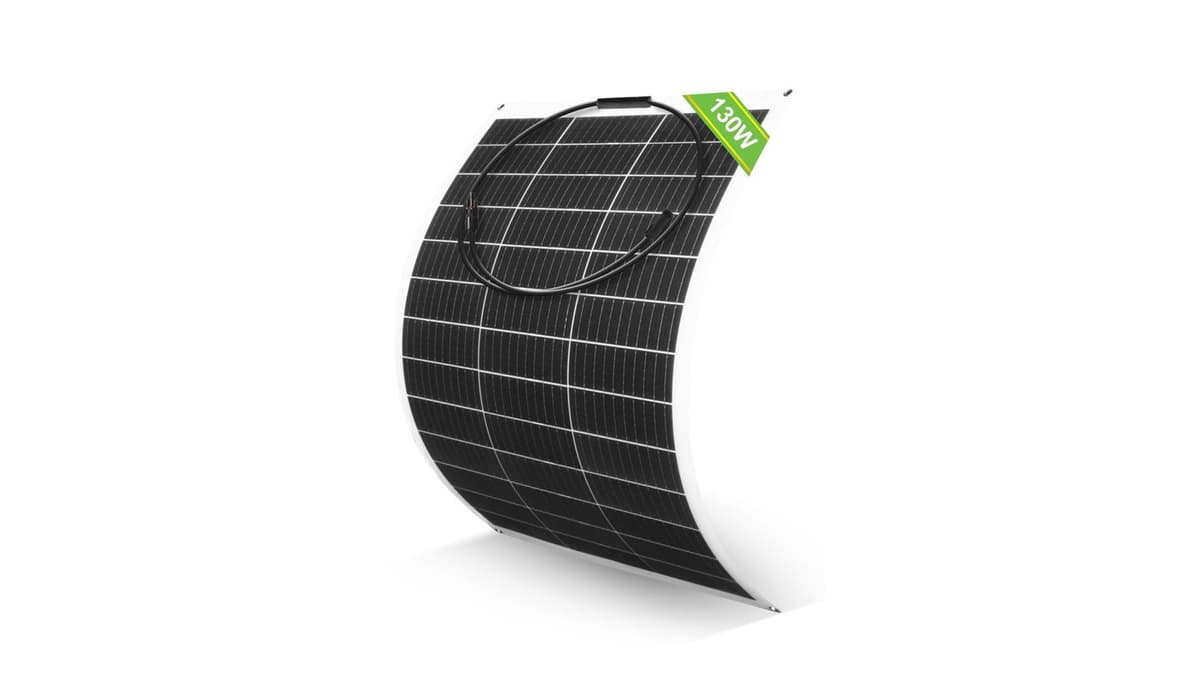
You want one gentle curve on a campervan or caravan and you will add an MPPT. The ECO-WORTHY 130 W sheet is about £74.99, with MC4 leads and no controller in the box.
The best flexible solar panels, compared.
Top pick: ECO-WORTHY 130W flexible solar panel – Highest score on a single 130 W sheet: about £74.99, 4.7 from 114 reviews, score 94, with the shared review pool awarded once. Best value: ECO-WORTHY 260W flexible solar panel (2 x 130W) – Two 130 W sheets at about £124.99, below two single orders, with the same score of 94 because the reviews are shared. Updated 22.10.2026.


A flexible solar panel here is a thin monocrystalline sheet for one gentle curve on a campervan, boat or caravan. You buy it on amazon.co.uk to charge a leisure battery or a power station. Quality is the true pack size, a named front sheet, a stated bend limit, leads and a warranty you can read. Glass in a frame, or a folding blanket, does not. A 50 W strip can hold a parked battery. A single roof panel here is about 100–180 W. A fridge and a laptop push toward a two-pack. Watts, film and bend are in the [flexible solar panel buying guide](/hub/electrical-equipment/flexible-solar-panel/sub/flexible-solar-panel-buying-guide). Hire an electrician if 230 V meets a consumer unit or shore power. Glass in a frame belongs with a rigid module. A kit stays here when the panel is the core object. Start with the job, then the watts the carton actually contains. Those bands are UK van-guide ranges, not a measured audit of your roof.
A flexible solar panel here is a thin monocrystalline sheet for one gentle curve on a campervan, boat or caravan. You buy it on amazon.co.uk to charge a leisure battery or a power station.

33 products checked · 64 hrs invested · +24,100 readers
Swipe for more
1-2 of 9


Personal buying guide
Question 1 of 2
How many sheets do you want?
The ECO-WORTHY 130 W sheet is listed at £74.99, about 96 x 69 cm and 3.98 kg, with MC4 leads and no controller in the box. On amazon.co.uk it is 4.7 from 114 reviews, and the 47 UK bodies in the review notes are the same text as the 260 W pair, so this is one sample rather than two. Buyers report about 83 W to 115 W in good sun into an EcoFlow, Anker or similar station, and one May day on a flat van roof produced about 500 Wh. The sheet bends without feeling flimsy, and people fix it with Velcro, adhesive or silicone. MC4 leads are short, the side-exit cables spring back, and one delivery arrived with the polarity housings swapped. A bonded pair delaminated after about 13 months, with support declined outside 12 months, so you should not read the star line as a multi-year roof life. It is the top pick here for a single polymer sheet around 130 W when you will add your own controller or power station.
Pros
Cons
Best for: You want one sheet around 130 W for a van or caravan and you will pair it with a power station or a separate MPPT.
Less suitable: You need a controller in the same carton, or you are treating the 4.7 as a separate sample from the 260 W pair.
Specifications
Common questions
Does this listing include a charge controller?
No. Included components list the 130 W panel. The listing asks the controller question and does not answer it.
Are the 114 reviews unique to this listing?
The review notes say these 47 review bodies are the same text as the 260 W pair, and both listings show 4.7 from 114.
How long are the leads?
The bullet says a pair of 2.9 ft MC4 cables. Reviews say the leads are short and that some buyers added an extender.
ECO-WORTHY lists this row at £124.99 with 260 W in the title and the power field, while the highlight says two 130 W sheets. The star line is the same 4.7 from 114, and the review notes say the review bodies match the single 130 W listing, so you are not looking at a second independent sample. At this price the pair is cheaper per sheet than buying the £74.99 panel twice, which is the value case if you already want two. Buyers on those shared reviews still report about 83 W to 115 W on one sheet in good sun, short leads, and a seller diagram with the series and parallel labels reversed. The pair is listed at 6.06 kg, the thickness bullet says 2 mm against 0.3 cm on the dimensions line, and there is still no controller. One buyer says a panel behaved as 24 V rather than 12 V, so you should check the station input before you wire them in series. Buy it when two 130 W polymer sheets are the job, and leave it if the title made you think one 260 W panel was in the box.
Pros
Cons
Best for: You have already decided on two ECO-WORTHY 130 W sheets and want them in one order.
Less suitable: You wanted one 260 W panel, or you need the charge controller in the box.
Specifications
Common questions
Is this one 260 W panel?
The title and the power field say 260 W. Included components, model ECOM-130 and the highlight say two 130 W panels.
Does the pair include a controller?
No. Included components name the panel only, with two packs.
Do these reviews differ from the 130 W listing?
No. The review notes say the 47 review bodies and the 4.7 from 114 stars match the single 130 W sheet.
Renogy’s 100 W semi-flexible panel is £89.99 and 4.4 from 92 reviews, with all 33 review bodies in the file marked United Kingdom. Buyers pair it with a Bluetti AC200MAX, an Anker SOLIX C200, an EcoFlow River 2 or a Victron MPPT, and reported peaks include about 83 W, 80–90 W and 92 W, plus about 70–80 W in a UK summer and about 40 W on a clear winter day. The sheet is 3.72 kg, which is heavy beside the 2 mm rows in this table, and the dimensions line says 2.1 cm while the bullet says 2.4 mm. The connector field says USB, while the bullets describe solar connector cables and an IP67 junction box, so you should read both before you order an adaptor. Leads are short, brass rivets in the holes had to come out for a tape fit, and one set of four showed about 21 V and 0 A. The bullet allows a bend within 240 degrees, which is a storage line rather than a tight crease on a roof. It suits you if you want the Renogy name and will check the plug, and it is a poor match on a pop-top that cannot take the weight.
Pros
Cons
Best for: You want a known-brand 100 W sheet and you will confirm the connector from the bullet, not from the USB field.
Less suitable: A pop-top that cannot carry about 3.7 kg, or a job that needs ETFE named on the listing.
Specifications
Common questions
Does the Renogy listing include a charge controller?
No. Included components are one 100 W panel. The listing asks the controller question and does not answer it.
Is the connector USB?
The connector field says USB. The bullets describe 2.3 ft solar connector cables and an IP67 junction box. Both lines are on the listing.
How does the listing say to fix it?
There are pre-drilled holes, and the bullet says modules must be mounted with silicone structural adhesive.
The XINPUGUANG kit is £139.90 and is the row that puts two 100 W sheets and a 20 A controller in one box, with MC4 leads and alligator clips. The title says 200 W, the maximum-power field says 100 W, and the efficiency line says 22% while a bullet says 23%. It is 4.3 from 76 reviews. UK buyers call the kit easy to fit on a boat, with nothing else to buy, and one Victron reading in the file reached about 5 A per panel. Full sun did not pass 140 W for the set in one review, and another buyer measured about 18.2 V with only 0.12–0.25 A. French reports describe sheets around 2.3 mm, missing connectors, a box with no regulator, and a controller display that died after about two months while the battery still charged. Frosted PET is named, and there is no stated bend radius. Choose it when you want the regulator in the carton and you will check the contents on the day it arrives.
Pros
Cons
Best for: You want two 100 W sheets and a 20 A controller together for a boat or a van.
Less suitable: You need a measured 200 W from the pair in full sun, or an MPPT with monitoring.
Specifications
Common questions
Is the controller in the box?
Yes. Included components list a 12 V / 24 V 20 A controller with two 100 W panels and the leads.
Why do the title and the power field disagree?
The title and the highlight say 200 W from two 100 W panels. The maximum-power field says 100 W, and the part number is XPG-PERC-100W.
How many UK review bodies are noted?
Five UK bodies sit inside 24 review bodies in total. The star line says 4.3 from 76.
Topsolar’s single 180 W sheet is £119.99, with ETFE and a TPT backing named on the listing, MC4 connectors, six mounting holes and a 40 cm minimum arc. It is 4.2 from 37 reviews, and all 13 bodies in the file are from the United Kingdom. One bright day produced about 7 A, while other buyers saw peaks of about 100–120 W, or 130 W and 6 A, against 180 W and 8.38 A on the page. The highlight says 2 mm and IP67, and the only warranty figure is a one-year manufacturer line. Milky patches under the film, and a glue patch about 12 cm by 10 cm, show up after the protective film comes off. One of four panels failed after the summer, and a seller replaced a faulty unit for another buyer. There is no controller in the box. Open this row when you need ETFE and TPT written on the page, and leave it if you expect the nameplate on a flat British roof.
Pros
Cons
Best for: You want ETFE and TPT named on the amazon.co.uk page, with a 40 cm bend limit in the bullet.
Less suitable: You need close to 180 W on a flat roof, or a controller in the same carton.
Specifications
Common questions
Does this 180 W panel include a controller?
No. The bullet says it needs a controller to protect the battery, and included components are the panel only.
What is the front sheet?
The materials line says ETFE and TPT. The highlight says IP67 and 2 mm. IP67 here is a listing highlight, not a years-in-water claim.
What bend radius does the listing state?
The bullet says a minimum arc radius of 40 cm (15.75 in).
This XINPUGUANG 50 W strip is £47.40, listed at 115 x 24 x 0.3 cm, with textured PET, MC4 plugs and a bullet that allows a bend up to 90 degrees. It is 4.0 from 52 reviews. UK buyers have used one to keep a parked-car battery topped up through a cheap regulator, strapped a sheet along a yacht boom, and added another beside an existing caravan panel. A UK marine buyer found it lighter and less protected than the deck panels it was meant to replace, and expected to return the spare. French readings sit around 35–40 W when the angle is not perfect. Italian reports include a boat T-top that worked for about two months and then stopped, and a panel that read 0.8 V after a month instead of about 19 V. There is no controller, no hole count and no walk-on line. It fits a narrow keeper job, and it does not stand in for a protected deck panel.
Pros
Cons
Best for: You need a narrow 50 W keeper for a parked battery or a yacht boom, and you will add your own regulator.
Less suitable: A marine deck that needs a protected panel, or a compressor fridge as the main load.
Specifications
Common questions
Does the 50 W panel come with a controller?
No. The included-components field says no, and the connector field says MC4.
How wide is it?
The dimensions line is 115 x 24 x 0.3 cm, so the sheet is a narrow strip.
What bend does the listing state?
The bullet says the panel can bend up to 90 degrees. There is no walk-on sentence.
Topsolar’s £199.99 row prints 360 W on the title, and the included-components line is two 180 W panels. It is 3.9 from 89 reviews. A fence install with a Victron 100/20 reached 285 W without tilting, and four panels on a VW T6 roof peaked around 620 W in that reviewer’s conditions, about 155 W each. Other buyers saw 219 W and 12 A from two panels in full sun, or about 180 W from a series pair, against 360 W and 21 A on the listing. The front sheet is not named ETFE, two buyers say it is not the ETFE type in other photos, and the weight lines disagree at 3.5 kg and about 2 kg. Three of four panels were dead after about two years in one review, another set stopped after about two years, and screwed panels blew off a motorhome when the fixing failed. Skip the row if you thought 360 W meant one sheet.
Pros
Cons
Best for: You want two Topsolar 180 W sheets and you will read 360 W as the pair, not as one panel.
Less suitable: You need ETFE written on the listing, or you expected a single 360 W sheet.
Specifications
Common questions
Is this one 360 W panel?
The title and the power field say 360 W. Included components say two 180 W panels, and the pack count is 2.
Does the pair include a controller?
No. The bullet says a controller is needed to protect the battery. Included components are the two panels.
Does this listing name ETFE?
No. The single 180 W listing names ETFE and TPT. This pair listing does not, and one reviewer says the sheet is not ETFE.
The XINPUGUANG 105 W sheet is the lowest price in this set at £47.09, with transparent PET, a black backsheet, MC4 plugs and a 2.5 mm highlight. The star line is 3.7 from only eight reviews, and the file holds six bodies. A boat owner with four says they often reach full output, a caravan fitter bonded one in place of a heavy framed panel, and a van install in the file works with a Victron controller. No failed unit is described in those six bodies, and the UK texts say the sheet has not been up long enough to judge weathering. The bullet allows a bend up to 260 degrees, while a French reviewer calls it semi-rigid plastic and warns that a hard crease on one axis could snap it. Leads leave the front face rather than the back, and there is no controller. The dimensions line puts 0.3 cm in the width slot against the 2.5 mm highlight. Treat it as a low-price PET sheet with a thin sample, not as a proven long-term roof.
Pros
Cons
Best for: You want a cheap single PET sheet around 105 W and you accept a sample of eight reviews.
Less suitable: You need a large UK review history, or a charge controller in the box.
Specifications
Common questions
Does this 105 W panel include a charge controller?
No. Included components list one 105 W panel. The listing asks whether a controller is included and does not answer it.
How thick is the sheet?
The highlight says 2.5 mm. The bullet says 0.098 inch. The dimensions line puts 0.3 cm in the width slot and 114 cm in the height slot.
What bend does the listing allow?
The bullet says the panel can be bent up to 260 degrees. A reviewer calls the sheet semi-rigid and warns against a sharp crease.
KOLLNIUN’s 120 W kit is £81.99 and is one of only two rows here that include a controller, in this case a 30 A PWM, plus cable ties and a solar extension. The amazon.co.uk line is 2.0 from a single review, and in that UK text the buyer says it charges well and that the panel was chipped in the first week. The technical table does not name cell type, efficiency, current, open-circuit voltage or the panel’s own size, and the connector is a solar Y plug in the bullet rather than a named MC4. The sheet is described as 2 mm, with six metal-reinforced holes, six cable ties and an IP67 junction box. A 480 Wh daily line is the listing’s four hours of full sun at 120 W, not a measured day on a British roof. Van guides treat PWM as a compromise once you are past a trickle charge, because it pulls panel voltage down toward the battery. With one review and an edge chip in week one, buy it only if that PWM and the price are enough and you can send a damaged sheet back.
Pros
Cons
Best for: You specifically want a 30 A PWM in the same carton and you will inspect the sheet as soon as it arrives.
Less suitable: You want a reviewed MC4 panel, or you are sizing a sheet for a van fridge.
Specifications
Common questions
Is a charge controller in this kit?
Yes. The title, the included-components line and the bullets list a 30 A PWM controller for 12 V or 24 V.
Which connector does the listing name?
The listing does not say MC4. The bullets say a pair of solar Y plugs and a 16.4 ft 2.5 mm2 extension.
How many reviews are on the listing?
The star line is 2.0 from 1 review. That review says it charges well and was chipped in the first week.
Nine flexible solar panels on amazon.co.uk were scored on 19 October 2026 from the listing and the review notes, not from a lab test and not as an MCS or IEC 61215 result. No listing in the set prints an IEC 61215 number. The start is the review sample and the star line. A sample under about 10 reviews, or review bodies shared with another listing, is counted once and marked down. Listing completeness, the price against what the carton contains, and repeated faults then move the score. A brand name, a best-seller badge, or a standard the listing does not cite does not add points. The weights below are the relative place of those checks.
Review sample and stars
40%The amazon.co.uk star line and review count are the largest share. A 4.7 from 114 holds more than a single review. Shared bodies are counted once, so the pair does not get a second sample.
Listing completeness
25%Points cover a named film or polymer, MC4 or a stated plug, a bend or fixing note, and an honest pack count. A title that doubles the watts, or a connector field that contradicts the bullet, is a gap.
Price against the carton
20%The GBP price is judged against one usable sheet, or against a kit that includes a controller. Two sheets for less than two single orders can hold a score. A low price with eight reviews does not.
Sentiment deductions
15%Points come off for a thin sample, early failure, missing parts, delamination, or a measured output far under the title. PWM in the box is kit completeness, not a reason to outrank an MC4 sheet you will pair with your own MPPT.
Start with the job and the watts in the carton, then the front sheet, the bend limit and whether a controller is included. Price comes after those. The notes below follow that order for these nine amazon.co.uk listings, checked on 19 October 2026. None of the scores is a lab test.
A flexible solar panel on this page is a thin monocrystalline sheet for one gentle curve on a campervan, boat or caravan. It is not film you roll into a tube, and none of the nine listings is described as CIGS. You use it to charge a leisure battery or a power station. Glass in a frame belongs with a rigid module. A folding blanket is a different product. A kit stays here when the panel is the core object.
The ECO-WORTHY pair title says 260 W and the box is two 130 W sheets. The Topsolar pair title says 360 W and the box is two 180 W sheets. The XINPUGUANG kit title says 200 W while the power field says 100 W. Compare the included-components line, not the headline wattage.
Nameplate watts are lab figures. Reviewers on these listings commonly see less: about 90–115 W from a 130 W ECO-WORTHY sheet, about 100–130 W from a Topsolar 180 W sheet, and about 70–92 W from a Renogy 100 W sheet. Those notes are not a lab result.
Follow that model’s fixing drawing. A poor bond can lift. Do not blame the panel first if a budget PWM is the limit, and do not buy a framed glass module or a folding blanket when you wanted one curved sheet.
A 50 W strip can hold a parked battery. A single roof panel here is about 100–180 W. A fridge and a laptop push toward a two-pack. Those bands are UK van-guide ranges, not a measured audit. The ECO-WORTHY 130 W sheet is one panel at about £74.99. The pair at about £124.99 is two of those sheets under a 260 W title. Topsolar’s 180 W sheet is one panel. The £199.99 row is two 180 W sheets under a 360 W title.
Topsolar’s 180 W listing is the only single sheet here that names ETFE and TPT, with a 40 cm minimum arc and a one-year warranty line. XINPUGUANG’s 105 W and 50 W listings state PET. ECO-WORTHY states polymer. Renogy does not name the film, and the connector field says USB while the bullets describe solar leads. PV Logic’s about 3 cm of curve per metre is a specialist rule of thumb, not a figure on these Amazon pages. A bare panel still needs a controller.
Three typical situations, each with a recommendation from this comparison.
You want one gentle curve on a campervan or caravan and you will add an MPPT. The ECO-WORTHY 130 W sheet is about £74.99, with MC4 leads and no controller in the box.
You need a narrow strip for a boom or a gap, and you must read that model’s walking note. The XINPUGUANG 50 W sheet is about £47.40 and 24 cm wide. The listing has no walk-on sentence.
You need a lead into an EcoFlow, Bluetti or Anker, with the open-circuit voltage inside the station’s limit. Renogy’s 100 W sheet is about £89.99. The connector field says USB while the bullets describe solar leads.
In this set of nine amazon.co.uk listings, the top pick is the ECO-WORTHY 130 W sheet. It is about £74.99, with 4.7 from 114 reviews, a polymer face and MC4 leads, and the score is 94. The best value is the ECO-WORTHY pair at about £124.99, two 130 W sheets under a 260 W title. The score stays at 94 because that star line is the same shared sample, and the price per sheet is lower. Every other listing has no badge. Renogy’s 100 W sheet scores 88 after a USB field that disagrees with the solar-lead bullet. These scores are not a lab test, and none of these listings prints an IEC 61215 number.
ECO-WORTHY 130W flexible solar panel
Highest score on a single 130 W sheet: about £74.99, 4.7 from 114 reviews, score 94, with the shared review pool awarded once.
ECO-WORTHY 260W flexible solar panel (2 x 130W)
Two 130 W sheets at about £124.99, below two single orders, with the same score of 94 because the reviews are shared.
Editorial

Peter F. is the editor for DIY & tools at productscompared.co.uk. Comparisons in this category are checked against amazon.co.uk listings, review evidence and public UK sources.
Guides on what to look for, how to use a product, and common mistakes.
Public UK sources from the research digest, last checked on 19 October 2026. Shelf prices and star lines are the amazon.co.uk figures checked on that date.
Expert source (DIY & tools): Charlie White (Charlie DIYte) (external profile) – public expert commentary used as a research source, not as a contributor to our pages.
This page contains affiliate links to amazon.co.uk. If you buy through them, we may earn a commission at no extra cost to you. Prices, stars and review counts are from the UK listings checked on 19 October 2026. We did not lab-test these flexible solar panels.