Independent comparisons. We may earn from shop links. Our editors compare products independently. Some links go to shops, and we may earn a commission. More info
Top pick: Renogy ShadowFlux 120W Best value: DOKIO 100W suitcase – Best value when you want the regulator in the carton: about £79.99, a stated 10 A controller, and 4.5 from 1,000 reviews. Score 93. One clear-sun reading was about 60 W. Updated October 2026.
A solar panel is a photovoltaic module for a leisure battery, a shed, a boat, or a portable power station, not a fitted house array. Nameplate watts are measured at 1,000 W/m² and 25 °C cell temperature, and British sun often lands below that sticker. You tell a suitable panel by form, stated watts, the highest voltage printed, the connector, and whether a charge controller is in the box.
A framed module stays on a bracket. A folding suitcase suits a pitch or a power station. A flexible sheet suits a curve. A bifacial panel needs light on the back. A 12 V title names the intended battery, and the printed voltage is often higher. MC4 is the usual framed plug.
Connecting a panel straight to a battery is the common mistake. The [solar panel buying guide](/hub/electrical-equipment/solar-panel/sub/solar-panel-buying-guide) orders form, watts, voltage, connector, and controller. House wiring needs planning, G98 or G99, and an MCS or equivalent installation. England's roof limits do not apply in Scotland, Wales, or Northern Ireland. UK mains are 230 V with a BS 1363 plug.
A solar panel is a photovoltaic module for a leisure battery, a shed, a boat, or a portable power station, not a fitted house array.
A solar panel is a photovoltaic module for a leisure battery, a shed, a boat, or a portable power station, not a fitted house array. Nameplate watts are measured at 1,000 W/m² and 25 °C cell temperature, and British sun often lands below that sticker. You tell a suitable panel by form, stated watts, the highest voltage printed, the connector, and whether a charge controller is in the box.
A framed module stays on a bracket. A folding suitcase suits a pitch or a power station. A flexible sheet suits a curve. A bifacial panel needs light on the back. A 12 V title names the intended battery, and the printed voltage is often higher. MC4 is the usual framed plug.
Connecting a panel straight to a battery is the common mistake. The [solar panel buying guide](/hub/electrical-equipment/solar-panel/sub/solar-panel-buying-guide) orders form, watts, voltage, connector, and controller. House wiring needs planning, G98 or G99, and an MCS or equivalent installation. England's roof limits do not apply in Scotland, Wales, or Northern Ireland. UK mains are 230 V with a BS 1363 plug.
A solar panel is a photovoltaic module for a leisure battery, a shed, a boat, or a portable power station, not a fitted house array. Nameplate watts are measured at 1,000 W/m² and 25 °C cell temperature, and British sun often lands below that sticker. You tell a suitable panel by form, stated watts, the highest voltage printed, the connector, and whether a charge controller is in the box. A framed module stays on a bracket. A folding suitcase suits a pitch or a power station. A flexible sheet suits a curve. A bifacial panel needs light on the back.
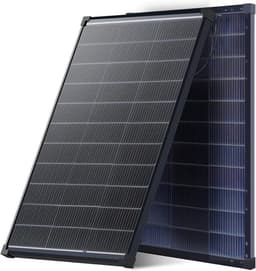
The Renogy 120 W ShadowFlux is listed at £108.99 with a 5.0 star line from only five reviews, and only two of those bodies are marked United Kingdom. One of those UK reviews charged an Anker Solix C1000 through a window while part of the panel was shaded. The other return was because the panel was too big and heavy for that buyer, at 8.72 kg and 105.2 × 57.8 × 3 cm, rather than because of a stated electrical fault. The output field prints 33.69 V DC even though the title says 12 V, so you have to check that figure against the controller or power station before you connect it. No charge controller is listed in the box, and the warranty field is empty. Five ratings cannot carry a top-pick claim, however clean the stars look.
Pros
One UK review: charged an Anker Solix C1000 through a window while partly shaded
MC4 connectors on a 120 W rigid frame
105.2 × 57.8 × 3 cm if that footprint fits the space
Cons
5.0 from only five reviews, with two UK bodies read
Output field prints 33.69 V despite the 12 V title
No controller in the box, and the warranty field is empty
One return because the panel was too big and heavy
Best for: A partly shaded spot when the controller or power station manual accepts 33.69 V and you can live with five reviews.
Less suitable: A simple 12 V regulator you have not checked, or a buy decided on a 5.0 star line alone.
The AeternaSol 100 W bifacial panel is listed at £69.99, the lowest shelf price in this set, with 4.9 from only 16 reviews. UK reviewers call it compact for a shed leisure battery, and one saw about 35 W under thick northern cloud. Bifacial behaviour showed up in an early-autumn test, though a reviewer said the rear gain is hard to judge without an identical single-face panel beside it, and it disappears if the back is covered. The highlight claims IP68, MC4, and 25.6% N-type cells, and the panel weighs 4.99 kg. Mounting holes are there, while a roof kit and a charge controller are not described as included. One delivery arrived with a damaged outer carton and an undamaged panel. Sixteen reviews is too small a sample to treat 4.9 as a settled ranking.
Pros
Lowest price in the set at £69.99
4.9 from 16 reviews, with shed-battery use described
About 4.99 kg, with mounting holes noted by a reviewer
Bifacial behaviour noted in an early-autumn UK test
Cons
Only 16 reviews, so the star line is thin
Rear gain depends on the mount and vanishes if the back is covered
No charge controller or roof kit described in the box
Warranty field is empty
Best for: A small shed battery when you already have a controller and can leave the back of the panel open to light.
Less suitable: Anyone ranking on stars alone, or a roof where the panel back will sit flat against a surface.
The Renogy RSP200D-UK is a 200 W rigid panel listed at £129.99, and across 163 amazon.co.uk reviews the line is 4.6, the deepest sample among the framed 200 W modules here. UK owners report roughly 160–212 W in sun or bright cloud, including about 175 W out of the box, about 212 W on a good day, and just over 160 W into a Jackery 1000 v2 on a cloudy rainy day. A Sprinter roof and a motorhome leisure battery are both described, including a winter comment that the battery stayed topped up. The listing prints MC4, 6.85 A, and 20 V maximum, with a five-year material and workmanship warranty, and the box is the panel only. One reviewer found the underside mastic only partly sealed and worried about later delamination, which is a single report in the 50 UK reviews read. Brackets and legs are not included, so a free-standing setup needs props you supply. It is the top pick in this set for a fixed 200 W glass panel, and the wrong carton if you wanted a controller or a panel that folds.
Pros
4.6 from 163 amazon.co.uk reviews
UK reports of about 160–212 W in sun or bright cloud
MC4, 6.85 A, and 20 V maximum printed on the listing
Five-year material and workmanship warranty
Used on a motorhome leisure battery and a Sprinter roof
Cons
No charge controller, brackets, or legs in the box
One UK review: underside mastic only partly sealed
Output still depends on the weather, including about 160 W in rain
Best for: A shed, campervan, or boat where a 10.6 kg rigid 200 W panel can stay put and you will add your own controller.
Less suitable: A fold-flat kit, a curved roof, or any setup that needs the regulator in the same box.
The Renogy 200 W ShadowFlux is listed at £194.99, the highest price in this set, with 4.6 from 20 reviews. The output field prints 36.5 V DC and MC4 connectors, with no charge controller, so a small nominal 12 V regulator can be the wrong match even though the title talks about motorhomes and boats. UK reviews split on cloud: one owner saw about 46 W on a heavily cloudy rainy day and about 214 W in ideal summer sun, while two others found dull-day output too low for the controller to register. Partial shade and weaker morning sun are where the anti-shading claim is praised, and one owner ran it in parallel with existing 400 W panels. The panel weighs 10.8 kg at 126.2 × 76.4 × 3 cm, the same footprint as the cheaper Renogy 200 W rigid panel. Twenty reviews is a thin sample, and the price only makes sense if shade is the problem you are actually solving.
Pros
UK report of about 214 W in ideal summer sun
Partial shade and weaker morning sun praised by owners
4.6 from 20 reviews
Same 126.2 × 76.4 × 3 cm footprint as the standard Renogy 200 W
Cons
£194.99, the highest price in the set
36.5 V output, with no controller in the box
Dull-day output too low to register for two UK reviewers
Only 20 reviews
Best for: A roof with real partial shade, when the controller manual accepts 36.5 V and the cheaper unshaded Renogy 200 W is the wrong tool.
Less suitable: An unshaded roof, a simple 12 V controller you have not checked, or a first panel chosen on price.
The DOKIO FSP100M is a 100 W suitcase listed at £79.99, and the star line is 4.5 from 1,000 amazon.co.uk reviews, the largest sample in this set. The bullets include a 10 A controller, an XT60 lead of about 9.8 ft, alligator clips, DC adapters, and USB outlets on the controller, which is the only listing here that states a battery charge controller in the box. UK reviews describe multi-year weekend use at rallies and on a caravan battery off hook-up, and one owner saw the controller draw 70 W plus. The same sample includes a lead called a bit short, legs that annoy some owners, safety instructions described as poorly translated, and one return because the kit did not suit a Jackery 1000 v2, while another owner used a Jackery successfully. One user saw about 60 W in clear sun, so the 100 W title is not a daily figure. It weighs 7.94 kg with fold-out legs. It is the best value here when you want the regulator in the carton, and the wrong kit when you need a roof module near 200 W.
Pros
10 A charge controller stated in the box, the only one in this set
4.5 from 1,000 amazon.co.uk reviews
UK reviews of multi-year caravan and rally use on a 12 V battery
XT60 lead, alligator clips, DC adapters, and USB on the controller
Listed at £79.99 on the saved page
Cons
Lead length is a repeated complaint
One return as incompatible with a Jackery 1000 v2
Safety instructions described as poorly translated
One clear-sun reading of about 60 W, and legs annoy some owners
Best for: A caravan or camping battery when you do not already own a controller and you can live with a 100 W suitcase.
Less suitable: A power station whose input is known to reject this kit, or a job that needs about 200 W of glass on a roof.
The MHPOWOS 110 W panel folds like a briefcase and is listed at £79.99, with 4.5 from 98 amazon.co.uk reviews. The connector is XT60, the maximum voltage is 20 V, and the box does not include a charge controller, so you still need a power-station input or a separate regulator. UK reviewers describe a convenient fold and a sturdy build for charging a power station, and one said a 600 W station took a couple of hours on a first outing. That review had only been used once, and the UK bodies that were read are short, so they do not show how the hinges last. The listing also disagrees with itself on weight: the item field says 3.54 kg and the bullets say 4.5 kg. An IP67 claim is printed, without a fixed-roof bracket.
Pros
Foldable 110 W panel listed at £79.99
4.5 from 98 amazon.co.uk reviews
XT60 connector, with a 7-in-1 lead in the bullets
One UK review: a 600 W power station charged in a couple of hours
Cons
No charge controller in the box
Weight prints as 3.54 kg and as 4.5 kg
UK reviews read are short, and one owner had used it only once
Best for: A portable top-up for a power station that already accepts XT60, once you have weighed the packed panel yourself.
Less suitable: A fixed shed roof, or a leisure battery that still needs a regulator you do not own.
The ECO-WORTHY listing is priced at £189.99 for a bifacial pair, and the title says both 400 W and 2×195 W while the included-component line says a 195 W panel and the item count is 2. Across 52 reviews the line is 4.4. UK owners report a series pair into an EcoFlow, with one London test around 73% of the rated watts in mixed sun, about 320 W in hot sun, and about 78 W on an overcast day when an older panel produced nothing. Pre-drilled holes and a 20.4 kg combined weight are noted, and there is no charge controller in the box. One buyer would skip bifacial next time because the power was lower than they expected, and another said the seller cancelled a dispatch. The watt fields do not add up to a clean 400 W, so count the panels and read the label on the glass before you plan a roof.
Pros
Two rigid bifacial panels, with MC4 connectors
UK reports of about 320 W in hot sun and useful watts on an overcast day
Pre-drilled holes praised, at 20.4 kg for the pair
4.4 from 52 reviews
Cons
Title watts, 2×195 W, and the 195 W component line do not match
No charge controller in the box
One UK buyer would skip bifacial next time
One review: dispatch cancelled, then a higher relist price
Best for: A caravan or motorhome roof that can take two framed panels, once you have confirmed the carton and you already own a controller.
Less suitable: A single-panel budget, or a plan that treats the title’s 400 W as a measured daily yield.
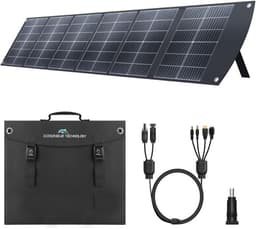
The Ecosonique UC-200 is a 200 W six-fold suitcase listed at £149.99, with 4.3 from 62 reviews. UK owners often report 150 W or more into an EcoFlow Delta 2, including about 170 W on a heatwave day and a peak around 188 W, while the same file also records about 96–118 W into a Jackery Explorer 1000 v2 in strong sun and about 92 W on a hot July day that the seller called inside tolerance. It weighs about 5 kg, the folded size in the bullet is roughly 45.8 × 41.5 × 7.5 cm, and the box includes a 3 m MC4 cable plus a short lead to XT60, Anderson, and DC barrels. The output field is 24 V at 10.8 A, and the bullets describe a protection chip for the USB side rather than a leisure-battery charge controller. The title says USB-C PD 65 W and a bullet says PD 45 W. One carry handle broke, and the kickstands are called average in wind, including a panel that blew over.
Pros
About 5 kg, with kickstands and a carry bag named in the box
UK reports often at 150 W or more into an EcoFlow Delta 2
MC4 cable plus a short lead to XT60, Anderson, and DC barrels
USB-C and USB-A on the panel, and a 24-month warranty in the bullets
Cons
Sustained UK readings often below 200 W, including about 92–118 W on some stations
24 V output, and the USB chip is not a leisure-battery controller
USB-C printed as PD 65 W and as PD 45 W
One broken carry handle, and stands that can blow over
Best for: A pitch where you want a foldable panel around 200 W for a power station whose input accepts 24 V.
Less suitable: A leisure battery that needs a proper charge controller, or a windy site where the kickstands are the only support.
The ECOBOSS 200 W rigid panel is listed at £88.99 with MC4 connectors, 20.84 V maximum, 9.6 A, and an IP68 claim, and the star line on the UK page is 4.2 from 77 reviews. None of the review bodies saved with this ASIN is headed United Kingdom. The bodies read are headed United States, and the same text, star count, and best-seller line also appear on the two-panel ECOBOSS ASIN. That sample cannot be treated as independent UK opinion, or as proof the panel has been used on a British shed. The manufacturer field is two years, the weight is 10.8 kg, and the dimension string 77 × 3 × 134 cm looks as if width and thickness are swapped. Bullets claim pre-drilled points and 3.2 mm glass, with no controller in the box. At this price it is a cheap stated 200 W, and you are buying it without a UK review narrative in the saved file.
Pros
200 W rigid panel listed at £88.99
MC4, 20.84 V maximum, and 9.6 A printed
Two-year manufacturer field
IP68 and pre-drilled points claimed in the listing
Cons
No United Kingdom review headings in the saved file
The same star count and review text as the two-panel ECOBOSS ASIN
No charge controller in the box
Dimension line looks swapped
Best for: A low shelf price on a stated 200 W frame when you accept that the saved reviews are not UK bodies and you already have a controller.
Less suitable: A decision that needs British owner comments, or a listing you want to treat as a separate sample from the ECOBOSS pair.
The ECOBOSS two-panel listing is priced at £159.99 and the title says 400 W as 2×200 W, while the maximum-power field prints 200 W and the weight field repeats the single panel’s 10.8 kg. The star line is the same 4.2 from 77 reviews as the single ECOBOSS ASIN, and the saved review bodies are the same United States text, with no United Kingdom heading. You cannot treat that as a second sample of British owners, or as proof that two panels arrived. Dimensions, 20.84 V, 9.6 A, MC4, and the two-year manufacturer field match the single listing, and no charge controller is included. The title also claims IP68 and up to 25.6% efficiency, which remain seller claims. Buy this ASIN only after you have confirmed the carton is actually two panels, and only if you already accept that the saved review file does not describe them in the UK.
Pros
Title offers two 200 W frames for £159.99
MC4, 20.84 V maximum, and 9.6 A printed
Two-year manufacturer field
IP68 claimed on the title
Cons
Maximum-power field prints 200 W against a 2×200 W title
Weight field copies the single panel’s 10.8 kg, so pack weight is unclear
Same 77-review widget as the single ECOBOSS listing, with no UK headings
No charge controller in the box
Best for: A pair of rigid frames only after you have checked that two panels are in the carton and your controller accepts 20.84 V.
Less suitable: Anyone treating the shared 4.2 from 77 as a separate UK test of a 400 W array.
The Topsolar 180 W flexible sheet is listed at £119.99, weighs about 3 kg, and is about 2 mm thick, with 4.2 from 37 reviews. UK owners have moved it for a van leisure battery, and one bonded it to a GRP coachbuilt roof so it followed the curve, inside a claimed 40 cm minimum bend radius. On a bright day reviewers report about 7 A against a stated 8.38 A, about 100–120 W against the 180 W title, and about 130 W with 6 A in full sun. More than one UK review mentions a glue patch or milky film on the cell surface, including marks that showed after the film came off, and one faulty unit was replaced by a seller whose name was not the brand on the title. MC4 connectors and an IP67 highlight are printed, the warranty field is one year, and the bullets say a charge controller is required and is not in the box. It is the curved-roof option in this set, and a weak default if you wanted glass that approaches its sticker watts.
Pros
About 3 kg and about 2 mm thick, so it can follow a gentle curve
One UK install bonded to a GRP coachbuilt roof
MC4 connectors, with a stated 40 cm minimum bend radius
About 7 A reported on a bright day
Cons
UK sun readings of about 100–130 W against a 180 W title
Glue patches and milky film in more than one UK review
No charge controller, and a one-year warranty field
One faulty unit replaced by a seller who was not the brand on the title
Best for: A gently curved GRP roof when you will stay inside the 40 cm bend radius, add a controller, and accept output below 180 W.
Less suitable: A flat roof that can take a framed panel, or a sheet you plan to fold into a bag every night.
The AeternaSol 200 W rigid panel is listed at £99.99 as an N-type module with a 12 V output field, and the star line is 4.0 from 33 reviews. UK reviewers have used it on a garage roof into a Jackery 1000 v2 and on an allotment, and one measured about 200 W at 12 V in clear sun with a multimeter. The same reviews put an overcast day at about 20–70 W and treat 200 W as an ideal-conditions figure. Mounting holes are pre-drilled, though screws, brackets, and a charge controller are not in the box, and one stables install questioned the frame on a raised mount. The dimension line prints 67 × 3 × 134 cm, which looks as if thickness and width are swapped, and the efficiency field prints the letter A rather than a percentage. The manufacturer field is one year, while the bullets claim longer seller support that the spec fields do not match.
Pros
200 W rigid glass panel listed at £99.99
One UK multimeter reading of about 200 W in clear sun
Pre-drilled holes used for an annex fit
MC4 connectors stated in the bullets
Cons
No controller, screws, or brackets in the box
Frame rigidity questioned on one raised mount
Dimension line looks swapped, and the efficiency field prints A
4.0 from 33 reviews, a thinner sample than the Renogy 200 W
Best for: A shed or garage roof when you already own a controller or a power station and you will buy the brackets.
Less suitable: A raised free-standing mount, or a first panel when you need the regulator and the fixings in the same carton.
No. Reviewers note pre-drilled holes, and that screws and brackets are extra.
What is the panel made of?
The material field lists aluminium, monocrystalline silicon, and tempered glass.
Does it include a charge controller?
No. A reviewer said a control system is a separate cost.
How we compared
Twelve amazon.co.uk solar-panel listings were read from the saved shelf pages. This is not a laboratory test. Nameplate watts, IP codes, and efficiency bullets are listing claims. The score on each card is the display score. The weights below follow the buying order: form, usable watts, voltage and connector, a controller in the box, and the strength of the review file.
1
Form and mounting
25%
A framed module stays on a bracket, a folding suitcase is for a pitch or a power station, and a flexible sheet is for a curve or a roof that should not carry glass. A bifacial panel needs light on the back. The form has to match the job before the sticker watts matter.
2
Usable watts
20%
Nameplate watts are measured at 1,000 W/m² and 25 °C cell temperature. A 100 W listing is a battery topper and a 200 W listing suits a van roof or a shed. Review readings in British sun often sit below the title, and a title that disagrees with its own power field is not treated as a settled array.
3
Voltage and connector
20%
A 12 V title names the battery the seller has in mind. The highest voltage printed, from 20 V to 36.5 V in this set, has to fit the controller or the power station. MC4 is the framed plug. XT60, USB, or a bundle of adapters does not raise that input limit.
4
Controller in the box
15%
Only one listing states a charge controller in the carton. The others need a controller you already own, or a power station. A direct connection to a battery lowers this part. A USB protection chip on a folder is not a leisure-battery controller.
5
Review evidence
20%
The amazon.co.uk star line is read with its count. A deep file outweighs a 5.0 from a handful of ratings. Saved review bodies headed United States are not counted as British owners. A single UK note, such as a seal or a short lead, stays in the cons.
Independent review
Last updated: October 2026
7 sources checked
Solar panel buying guide
Start with the form, then the watts you can actually use, then the voltage and the connector, and only then the price. A controller in the box is rare on this shelf. None of the scores is a laboratory test.
What is a solar panel?
A solar panel here is a photovoltaic module for a leisure battery, a shed, a boat, or a power station. Nameplate watts are a standard test condition, 1,000 W/m² and 25 °C cell temperature, not a promise of a British afternoon. Reviews on the listings in this set often sit below the sticker. BS EN IEC 61215-1:2021 is a design-qualification standard for open-air modules, not a yield figure. An IP67 or IP68 line on a bullet is a claim. Cover a lit panel. These modules are direct current.
Best for
Caravan owners topping up a leisure battery, watching roof weight and shade
Shed buyers mounting a framed module with a separate controller
Not ideal for
Anyone connecting a panel straight to a battery
A buyer treating England's roof limits as the rule in Scotland, Wales, or Northern Ireland
Mistakes to avoid
1
Reading only the 12 V title
Those words name the battery the seller has in mind. Printed figures in this set run from 20 V to 36.5 V. A small nominal 12 V regulator can be the wrong match for a module at 33.69 V or 36.5 V. Check the controller or power-station limit before you connect it.
2
Expecting sticker watts under cloud
Nameplate watts are measured at 1,000 W/m² and 25 °C cell temperature. Reviews often sit below that in British sun. A clear day can land near the sticker, and a dull day can land far under it. The sticker is the test condition, not a forecast.
3
Connecting the panel straight to a battery
Only one listing in this set states a charge controller in the box. The other modules need a controller you own, or a power station. An adapter does not replace that regulator. House wiring, and any inverter into it, is for a competent person.
What to weigh up
Form and usable watts
High
Match the shape to the place before you compare prices. A framed module stays on a bracket and suits a shed, a van roof, or a boat where the glass can stay put. A folding suitcase is for a pitch or a power station, and it is the shape you pack away. A flexible sheet is for a curve, or a roof that should not carry glass. A bifacial panel only earns its keep if light can reach the back. Cover that back and the rear gain goes.
Stated watts are the next cut.
Voltage, connector, and evidence
High
The printed voltage has to match the controller or the power station, not the words 12 V on the title. Those words name the battery the seller has in mind. Printed figures in this set run from 20 V to 36.5 V. A module at 33.69 V or 36.5 V can sit outside a small nominal 12 V regulator. MC4 is the plug on a framed panel. A folder may offer XT60, USB, or a bundle of adapters, and an adapter does not raise the power station's solar-input limit.
Which option suits you?
Three typical situations, each with a recommendation from this comparison.
🚐
A caravan leisure battery
You want a weekend top-up and you do not already own a regulator. The DOKIO 100 W suitcase is about £79.99, with a stated 10 A controller and 4.5 from 1,000 reviews. UK notes include multi-year rally use, a lead some owners call short, and one clear-sun reading around 60 W.
You already have a power station that accepts XT60, and you want a panel that folds. The MHPOWOS 110 W suitcase is about £79.99, with 4.5 from 98 reviews and no controller in the box. The listing prints both 3.54 kg and 4.5 kg, so weigh it if the locker is tight.
You can leave a framed panel in place and you will add your own controller. The Renogy 200 W rigid panel is about £129.99, with 4.6 from 163 reviews, MC4 leads, and 20 V maximum. Brackets are not in the box. It is the top pick for that fixed glass job.
The top pick is the Renogy 200 W rigid panel, about £129.99, with 4.6 from 163 amazon.co.uk reviews. UK owners report roughly 160 to 212 W in sun or bright cloud. The listing prints MC4, 6.85 A, 20 V maximum, and a five-year material and workmanship warranty. The carton is the panel only, so you add a controller and brackets. The score is 87 out of 100. That is not a laboratory test.
Which solar panel is best value?
The best value is the DOKIO 100 W suitcase at about £79.99, with 4.5 from 1,000 reviews. The bullets include a 10 A controller, an XT60 lead, alligator clips, DC adapters, and USB outlets on the controller. It is the only listing here that states a battery charge controller in the box. One clear-sun reading was about 60 W, so the 100 W title is not a daily figure. The score is 93 out of 100. A power station can still reject the kit.
What should you check before you buy a solar panel?
Separate listings by form, stated watts, the highest voltage printed, the connector, and whether a controller is included. A 12 V title names the battery the seller has in mind. Printed figures in this set run from 20 V to 36.5 V. MC4 is the usual framed plug. A folder may use XT60, USB, or adapters, and an adapter does not override a power-station input. Connecting the panel straight to a battery is the mistake. Nameplate watts are a test condition, not a British afternoon.
Will the sticker watts appear on a British afternoon?
No. Nameplate watts are measured at 1,000 W/m² and 25 °C cell temperature. Reviews in this set often sit below that in British sun, including about 60 to 70 W on a 100 W suitcase in clear sun and about 100 to 120 W on a 180 W flexible sheet. A clear day can also land near the sticker, including a multimeter reading around 200 W on one rigid panel. Treat the sticker as the test condition. Cloud, angle, and heat still move the result.
Do these solar panels include a charge controller?
Most of these modules do not include one. You need a controller you already own, or a power station whose solar input accepts the printed voltage. Only the DOKIO 100 W suitcase states a 10 A controller in the box. An adapter lead does not raise that input limit. Cold open-circuit voltage can sit above the running figure, so check the controller manual before you connect a high-voltage module. The solar charge controller comparison covers the regulator on its own. Straight onto a battery is the mistake.
Does buying a solar panel qualify you for the Smart Export Guarantee?
No. Smart Export Guarantee payments need a half-hourly export meter and an MCS or equivalent installer certificate. A self-bought module does not qualify by itself, and this page does not treat any listing here as MCS certified. MCS MIS 3002 covers photovoltaic systems normally in parallel with the network. It points at EREC G98 up to and including 16 A per phase, and G99 above that. A 12 V leisure battery that never touches the mains is outside that scope.
Do England's roof rules apply across the UK?
In England, house-roof solar can be permitted development under the GPDO 2015, Schedule 2, Part 14, Class A, within 0.2 metres of the slope, not above the ridge, and clear of listed buildings, scheduled monuments, and a conservation-area wall facing a highway. Scotland, Wales, and Northern Ireland are separate, and a campsite folder is not that class. Approved Document P is England's guide for dwellings. A new circuit, or an inverter into house wiring, is for a competent person.
How much does a solar panel cost on amazon.co.uk?
The twelve amazon.co.uk captures sit in three bands: about £70 to £80 at the entry, about £90 to £130 in the middle, and about £150 to £195 at the upper end of this shelf. Those are module prices, not a fitted roof and not a payback. VAT Notice 708/6 zero-rates installing solar panels in residential accommodation until 31 March 2027, then 5 percent. That rate is the installer's supply, not the price of a module on amazon.co.uk. Live shelf prices move.
Our verdict
In this set of 12 amazon.co.uk listings, the top pick is the Renogy 200 W rigid panel at about £129.99, with 4.6 from 163 reviews and a score of 87. UK reports sit around 160 to 212 W in sun or bright cloud, on MC4 leads, with a five-year material and workmanship warranty, and the carton is the panel only. The best value is the DOKIO 100 W suitcase at about £79.99, with 4.5 from 1,000 reviews and a score of 93, because it is the only listing that states a 10 A controller in the box. Neither score is a laboratory test. Nameplate watts are a standard test condition, and a module that joins the mains is work for a competent person.
Best value when you want the regulator in the carton: about £79.99, a stated 10 A controller, and 4.5 from 1,000 reviews. Score 93. One clear-sun reading was about 60 W.
Solar panelsLeisure electricsamazon.co.uk listings
Peter F. is the editor for DIY & tools at productscompared.co.uk. Comparisons in this category are checked against amazon.co.uk listings, review evidence and public UK sources.
Updated: October 2026
7 sources checked
Guides to solar panels
Guides on what to look for, how to use a product, and common mistakes.
This page contains affiliate links to amazon.co.uk. If you buy through them, we may earn a commission at no extra cost to you. Prices, stars, and review counts are from the UK listings in the saved captures. We did not laboratory-test these solar panels.