Independent comparisons. We may earn from shop links. Our editors compare products independently. Some links go to shops, and we may earn a commission. More info
Top pick: Victron SmartSolar MPPT 100/15 – Highest score: documented 15 A and 100 V, 4.7 from 538 reviews, and few defect reports in the UK sample. Best value: Topcloud 10A PWM – A shelf-honest 10 A PWM at about £8.96 that names lead-acid and LiFePO4 and still scores 72 after the failure notes. Updated October 2026.
A solar charge controller regulates panel current into a battery so the battery is not overcharged, and many models switch a small load off before the battery is flattened. On amazon.co.uk, people fitting a shed, allotment, campervan or boat should compare system voltage, battery chemistry, stated charge current and maximum panel voltage, rather than the word MPPT in a title.
A PWM controller pulls the panel toward battery voltage. It suits one modest panel already near the battery, often a 12 V panel on a 12 V lead-acid battery. An MPPT controller steps a higher panel voltage down to battery voltage, up to a rated current. Cold open-circuit voltage rises as the panel cools and must stay inside the limit for that unit.
Charge current and any USB or load output are separate ratings. The [MPPT or PWM guide](/hub/electrical-equipment/solar-charge-controller/sub/solar-charge-controller-mppt-or-pwm) is where you choose a method. Connect the battery first, then the panel, then a load. Keep a lithium battery off a unit that says lead-acid only.
A solar charge controller regulates panel current into a battery so the battery is not overcharged, and many models switch a small load off before the battery is flattened.
A solar charge controller regulates panel current into a battery so the battery is not overcharged, and many models switch a small load off before the battery is flattened. On amazon.co.uk, people fitting a shed, allotment, campervan or boat should compare system voltage, battery chemistry, stated charge current and maximum panel voltage, rather than the word MPPT in a title.
A PWM controller pulls the panel toward battery voltage. It suits one modest panel already near the battery, often a 12 V panel on a 12 V lead-acid battery. An MPPT controller steps a higher panel voltage down to battery voltage, up to a rated current. Cold open-circuit voltage rises as the panel cools and must stay inside the limit for that unit.
Charge current and any USB or load output are separate ratings. The [MPPT or PWM guide](/hub/electrical-equipment/solar-charge-controller/sub/solar-charge-controller-mppt-or-pwm) is where you choose a method. Connect the battery first, then the panel, then a load. Keep a lithium battery off a unit that says lead-acid only.
A solar charge controller regulates panel current into a battery so the battery is not overcharged, and many models switch a small load off before the battery is flattened. On amazon.co.uk, people fitting a shed, allotment, campervan or boat should compare system voltage, battery chemistry, stated charge current and maximum panel voltage, rather than the word MPPT in a title. A PWM controller pulls the panel toward battery voltage. It suits one modest panel already near the battery, often a 12 V panel on a 12 V lead-acid battery.
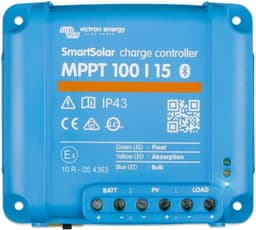
Across 538 amazon.co.uk ratings, the Victron SmartSolar MPPT 100/15 sits at 4.7 and is number 1 on the MPPT best-seller line in this capture. At £61.60 it is a 12/24 V unit rated 15 A, with 100 V in the model name, and the bullets describe Bluetooth plus a 30-day history in VictronConnect. Reviewers in the 36 UK texts often mention the app, a compact case, and the unit tracking panel watts through the day, including after they swapped out another controller. The attribute field says LCD, while the feature bullets centre on the app, so the page does not give you one consistent display story. Chemistry presets are not listed in the captured bullets, even though the app text says you can set battery presets. It is often called pricey next to the sub-£10 PWM units, and a minority say it misbehaved until the wiring was put right. Few defect reports appear in that UK sample, and one comment that it ran hot is not a repeated failure.
Pros
15 A MPPT with 100 V in the model name, at £61.60
Bluetooth and VictronConnect, including a 30-day history in the bullets
4.7 from 538 ratings, with the app praised in the UK sample
Load output described as disconnecting if battery voltage drops too low
Cons
Called pricey beside the sub-£10 PWM listings
Chemistry presets are not in the captured bullets
Attribute field says LCD while the bullets centre on the app
A minority of reviews needed the wiring corrected before it behaved
Best for: You have a 12 V or 24 V battery and a panel string whose cold open-circuit voltage stays inside 100 V, and you want the app history.
Less suitable: You only have one small 12 V panel on lead-acid and you want the cheapest PWM, or your string open-circuit voltage is above 100 V.
The Victron BlueSolar PWM-LCD&USB 10 A is £23.99, with 4.5 from 96 ratings, and the title puts an LCD and two 5 V USB outputs on a 12/24 V PWM unit. In the nine UK review bodies, people call it well made, easy to fit, and enough for a single panel where an MPPT was not justified, including one 100 W panel. The bullets describe three-stage charging and a programmable load output with low-voltage disconnect, though a named chemistry list is not in the capture. One review says a USB slot failed and the unit stuck in an error loop. Another reports a loose internal cable, flicker, and support that did not replace it. Reviewers also call it expensive for a PWM controller next to the sub-£10 plastic units. The capture does not print a battery-first sentence or a maximum PV voltage.
Pros
10 A PWM at £23.99 with 4.5 from 96 ratings
LCD and two 5 V USB outputs in the title
Programmable load output with low-voltage disconnect
UK reviews describe a simple single-panel fit, including a 100 W panel
Cons
Called expensive for a PWM unit
One USB slot failed into an error loop
Loose internal cable, flicker, and no replacement from support in one review
No chemistry list and no maximum PV voltage in this capture
Best for: You have one panel already near battery voltage, you want a Victron PWM with a load output, and you can live without a printed chemistry list.
Less suitable: You need the cheapest PWM, a named LiFePO4 preset on the listing, or USB ports you will rely on every day.
The Topcloud 10 A PWM is £8.96, with 4.4 from 237 ratings, and it is number 1 on the PWM best-seller line in this capture. The bullets rate both charge and discharge at 10 A on 12/24 V automatic, and they tell you to select lead-acid (open, AGM, gel), ternary lithium, or LiFePO4 on the LCD before use. It is not for nickel hydride. Forty-nine UK texts describe a simple unit on fences, motorbike batteries, and an allotment, including one that was still working after a year inside a wooden box. The connect order is battery, then panel, then load. One unit failed after some months with the display gone, and another worked for a day and then went dead, with no panel light and no power. The colour attribute in the file says 30A on this 10 A unit, and the weight attribute says 30 g, so those two technical lines do not describe the product cleanly. You get a documented 10 A PWM at the bottom of the price band, with a chemistry menu the £8.48 Depvko listing does not offer, and with failures you should still expect in a cheap plastic case.
Pros
£8.96 with 4.4 from 237 ratings
10 A charge and 10 A discharge stated together
Lead-acid, ternary lithium, and LiFePO4 modes on the LCD
A UK review describes a year on an allotment inside a wooden box
Cons
One unit failed after months, and another died after a day
Colour attribute says 30A and weight says 30 g on a 10 A unit
Not for nickel hydride
No IP rating, so the allotment example was inside a box
Best for: You want the cheapest PWM in this set that names both lead-acid and LiFePO4, for a small 12 V or 24 V panel you will set up yourself.
Less suitable: You need more than about 10 A of charge current, or you want attribute fields that agree with the title.
The AeternaSol 100 A listing is £39.99 with 4.4 from 12 ratings, and the bullets say it auto-detects 12/24/36/48 V while the attribute voltage field says 12 Volts. The captured weight is 140 g, the same order of magnitude as the £8.48 30 A PWM units, not a heavy high-current charger. Seven UK reviews say it worked on a 12 V bank, including a large battery and a big panel, and they call it easy. One reviewer notes a slight buzz, and another marks down the lack of an on/off switch. A bullet also says the unit combines MPPT and PWM charging, so the method is not a single claim. Weatherproof is asked on the listing and not answered. The highlight says a maximum 100 V input. Twelve ratings and a 140 g line are the limit on treating 100 A as a measured current.
Pros
£39.99 with 4.4 from 12 ratings on a 12 V bank in the UK texts
Bullets name sealed, gel, flooded, and LiFePO4
Highlight states a 100 V input ceiling
Bullets say connect the battery first, with enough voltage to be recognised
Cons
100 A title against a captured weight of 140 g
Attribute voltage says 12 Volts while the bullets claim up to 48 V
One bullet mixes MPPT and PWM in the same unit
Only 12 reviews, with a buzz noted and no on/off switch
Best for: You already checked a 12 V job against the highlight’s 100 V line and you will not take the 100 A title as measured current.
Less suitable: You need a documented 100 A controller, a 24 V system you can prove from one consistent field, or a weatherproof rating.
The AeternaSol 10 A listing at £18.99 is titled as a 12 V MPPT regulator, and the bullets say it is not for 24 V or 36 V batteries or for panels that already have a controller. Across 33 ratings the line is 4.3. In the 22 UK texts, reviewers report charging a 12.8 V LiFePO4 and a small 12 V battery, and one person charged a phone from the USB ports after the SAE connectors were matched. The same bullets disagree on USB power: the highlight says 36 W Type-C and 18 W USB, while another line says 22 W PD USB-C and 18 W QC. One unit smoked and failed within seconds of being plugged into a portable panel. Another review says the case ran too hot to touch, and a charge LED failed on one unit. There is no numeric open-circuit voltage limit in the capture.
Pros
12 V, 10 A title at £18.99, on the MPPT shelf
Bullets name gel, AGM, sealed, flooded, and LiFePO4
SAE leads, with battery-then-panel order printed
Reviewers report phone charging from the USB ports
Cons
One unit smoked within seconds on a portable panel
USB watt figures in the bullets do not match each other
No numeric panel-voltage limit in the capture
4.3 from only 33 reviews, and one case was too hot to touch
Best for: You have a single 12 V panel without its own controller, a 12 V battery including LiFePO4, and you will stop if the case smokes.
Less suitable: You need 24 V, a stated open-circuit voltage limit, or a panel that already has a controller built in.
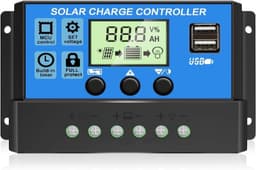
The Depvko 30 A PWM is the cheapest row in this set at £8.48, with 4.2 from 2,439 ratings, and the title matches the PWM best-seller shelf. The bullets say 12/24 V automatic and lead-acid only, including open, sealed, and colloid, and they tell you not to charge lithium or nickel-metal hydride. Thirty UK reviews mention buying several for caravans and sheds, a clear display, and steady charging at this price. The highlight says 6 mm wire is not included, and it names camper or shed use. The rear gets hot when the USB ports are used, and one reviewer says it overheated after a couple of days to the point they thought it would melt. Another unit stopped after about two weeks, and a return was criticised. The feature text says to connect the battery first, then the panel, and to mount the unit on a ventilated surface. A first-install note also says the battery should be fully charged so the voltage is recognised.
Pros
£8.48, the lowest price in this set, with 4.2 from 2,439 ratings
PWM title matches the PWM best-seller shelf
Lead-acid limit is explicit, including open, sealed, and colloid
UK reviews describe shed and caravan use with a clear display
Cons
Not for lithium or nickel-metal hydride
Rear gets hot on USB, and one unit overheated toward melting
One unit stopped after about two weeks
6 mm wire is not included
Best for: You have a lead-acid battery in a shed or caravan, a modest panel, and you will mount the unit where it can shed heat.
Less suitable: You have a lithium leisure battery, or you will run phones from the USB ports for long periods.
The Topcloud 30 A PWM at £9.96 is on the PWM best-seller shelf, and the bullets rate it at 30 A charge with 10 A discharge on 12/24 V automatic. Across 835 ratings the score is 4.2. The 49 UK texts describe a compact unit that does a simple job once a video fills in for the instructions, with some long-term comments that it works. You have to pick the battery mode on the LCD: lead-acid (open, AGM, gel), ternary lithium, or LiFePO4, and the listing says it is not for nickel hydride. Terminals are called too small for thicker cable, and the build is called plasticky. In the defect notes, one unit blew up after the reviewer suspected too much panel power, one burned and melted in a shed, one display was dead on arrival, and USB ports failed after little use. The connect order in the bullets is battery, then panel, then load.
Pros
£9.96 PWM with 4.2 from 835 ratings
12/24 V automatic, with lead-acid and LiFePO4 modes you select
Battery, then panel, then load printed in the bullets
Dual USB in the title
Cons
30 A charge stated beside only 10 A discharge
One unit melted in a shed and another blew up
Terminals called too small for thicker cable
Instructions called poor, and a display was dead on arrival
Best for: You want a cheap 12/24 V PWM for a modest panel, you will set the battery mode, and you will stop if the case gets hot.
Less suitable: You need a 30 A load output, thick cable in the terminals, or a unit without a melt report in the UK sample.
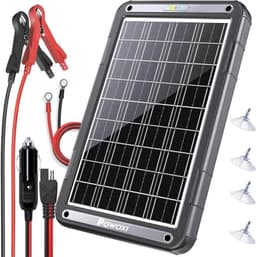
The POWOXI listing at £54.99 is a 15 W, 12 V panel kit with a controller built in, and the attribute line is 1.02 A, not a 15 A regulator. Across 438 ratings the score is 4.2, and the 11 UK review bodies describe trickle charging a car, a windscreen fit, or a boat battery when the sun is decent. The bullets claim IP65, tempered glass, and three LEDs: blue for sun, red for charging, green for full. A UK review says the control circuit corroded and failed after about three months on a campervan roof, and that the circuit under the LEDs was not sealed. Another boat user never saw the green full-charge LED on a new battery. The included component is listed as the solar panel, and the best-seller line in the capture is polycrystalline solar panels. You are buying a maintainer of about one amp, and the roof-corrosion report is the limit if you planned to leave the electronics on a van roof.
Pros
15 W panel and controller in one kit at £54.99
4.2 from 438 ratings for a trickle-charge job
Bullets name gel, AGM, SLA, VRLA, and lithium-ion
Three LED indicators described on the listing
Cons
1.02 A and 15 W, not a 15 A standalone controller
A UK review reports corrosion and failure after about three months on a campervan roof
Green full-charge LED did not come on for one boat user
Reviewers needed decent sun before they saw a benefit
Best for: You want a plug-in 15 W maintainer for a 12 V battery that sits idle, and you will not treat the kit as a roof-mounted regulator.
Less suitable: You need a standalone controller for a roof array, or you plan to leave the control circuit on a campervan roof.
The Rolokit 30 A PWM is £9.99 and scores 4.1 from 525 ratings, with the title on the PWM shelf for 12/24 V automatic. The bullets limit it to lead-acid batteries, open, AGM, and gel, and they say it is not suitable for lithium. Dual USB is stated as 5 V / 3 A, and the connect order is battery, then solar panel, then load. Only eight UK review bodies are in the file. Those texts say a panel and battery connected and charged, and they also call the instructions rubbish and the timer awkward. One USB port smoked after a few minutes and the reviewer pulled the unit out. One unit did not work at all, and another died in under two months. The 525-star line is much larger than the eight texts you can actually read here.
Pros
£9.99 PWM with 4.1 from 525 ratings
Lead-acid limit stated clearly: open, AGM, and gel
Battery, then panel, then load printed in the bullets
Dual USB stated as 5 V / 3 A
Cons
Not for lithium, stated on the listing
A USB port smoked after a few minutes in one review
One unit did not work, and another died in under two months
Only eight UK review bodies behind a 525-rating line
Best for: You have a 12 V or 24 V lead-acid battery, you will ignore the USB ports, and you want a cheap PWM that says lead-acid only.
Less suitable: You have a LiFePO4 leisure battery, or you plan to charge a phone from the USB port.
The Y&H 60 A listing at £69.99 prints 12/24/36/48 V auto, a 150 V open-circuit ceiling, and a watt table of 780, 1,560, 2,340, and 3,120 W by system voltage, plus IP30 and a range of −20 °C to +55 °C. The star line is 4.1 from only seven ratings, and three UK review bodies are in the file. One reviewer said it worked, and another said the first day looked more productive than a cheap 20 A Bluetooth unit. The third says the unit was faulty and was returned for a refund. Load control is stated at 30 A discharge, which is half the 60 A charge figure in the title. Gel, sealed, flooded, and lithium, including LiFePO4 and Li(NiCoMn)O2, are named with presets. Seven reviews is a thin sample for a 60 A claim, and the capture does not say to connect the battery first.
Pros
Bullets print 150 V Voc and a watt table by system voltage
12/24/36/48 V auto, with gel, flooded, and lithium presets named
Load control stated at 30 A discharge
IP30 and a −20 °C to +55 °C range printed in the bullets
Cons
4.1 from only seven reviews
One of three UK reviews says the unit was faulty and returned
60 A charge against a stated 30 A discharge
No battery-first sentence in this capture
Best for: You need a listing that prints a 150 V ceiling and a watt table, and you will treat seven reviews as too few to settle reliability.
Less suitable: You want a large UK review count before you spend £69.99 on a 60 A title.
The Depvko listing at £19.54 puts 100 A and MPPT in the title, scores 4.0 from 266 ratings, and the best-seller line in the capture is PWM controllers. A UK review says the MPPT name is misleading and that it is not a proper MPPT. Another suspects it is not dedicated MPPT, notes poor solder, and reports overheating terminals after a short run. The captured weight is 290 g, and some campervan users say it works and shows amps, and some call it good for the price compared with cheaper units that had been useless. One unit would not switch on and left a holiday without power. The bullets say connect the battery first, then the panels, and that the battery needs enough voltage to be recognised. There is no open-circuit voltage limit in the bullets, a reviewer’s input figure of about 22 V on a 12 V system is that person’s meter rather than a specification, and the 6 mm wire is not included.
Pros
£19.54 with 4.0 from 266 ratings
Some campervan reviews say it shows amps and charges
Bullets say battery first, then panels
Highlight names lead-acid and lithium
Cons
Title says MPPT while the best-seller line is PWM controllers
A UK review says it is not a proper MPPT
Overheating terminals, poor solder noted, and a unit that would not switch on
100 A title on a captured weight of 290 g, with no Voc limit in the bullets
Best for: You already know you are buying a cheap 12/24 V controller and you will not rely on the MPPT word in the title.
Less suitable: You need a documented MPPT with a printed voltage ceiling, or a 100 A current you can point to on a datasheet in this file.
The elejoy 60 A listing is the most expensive row at £139.99 and the weakest star line, 2.0 from three ratings, with model EMD60A and a captured weight of 4.09 kg. Two UK review bodies are in the file, and one calls it large, heavy, and powerful next to a Victron 100/50, and mentions the fan, while also calling the instructions poor. The other says it was nothing like the advert and looked cheap for the price. The bullets say 12/24/48 V, while the highlight also says 36 V and an adjustable 10–60 V output, and the file does not reconcile those lines. No chemistry list is captured, and the question about which batteries it works with is unanswered. A 99 per cent tracking line is a claim on the listing, not a measurement in this set. Outdoor use is asked and not answered. Three reviews cannot settle a £139.99 purchase.
Pros
Captured weight 4.09 kg, with a fan claimed in the bullets
External LCD described in the bullets
One UK review calls it powerful beside a Victron 100/50
Cons
2.0 from three reviews, the weakest line in this set
£139.99, the highest price here
36 V and 10–60 V lines are not reconciled with 12/24/48 V
No chemistry list, and outdoor use is unanswered
Best for: You are comparing a heavy fan-cooled case with a Victron 100/50 you already know, and you will read the two UK texts before you pay £139.99.
Less suitable: You want a settled star line, a printed chemistry, or a voltage story that agrees with itself.
Bullets say 12/24/48 V. Highlight also says 36 V and adjustable 10–60 V output. The file does not reconcile those lines.
Which battery types does the listing name?
A chemistry list is not in this capture. Listing question 'What batteries does it work with?' is unanswered.
Does the listing tell you to connect the battery first?
Not stated in this capture
How we compared
Twelve amazon.co.uk listings were scored from the shelf on 19 October 2026. This is not a lab test. Stars are the amazon.co.uk line. Review notes are the UK review texts captured for those listings. The score is five parts, clamped at 0. The four positive parts below sum to 100. Heat, smoke, a title the shelf contradicts, and a faulty return are deductions, not a fifth weight.
1
Star line
40%
The amazon.co.uk star rating, scaled as (stars minus 1) divided by 4, then multiplied by 40. A 5.0 would be 40. A 2.0 is 10. Stars are not a safety test.
2
Review count
20%
A log scale from about 3 reviews to about 2,500, capped at 20. A thin file cannot outrank a large one on stars alone.
3
Listing agreement
25%
Up to 25 points when the charge method matches the best-seller shelf, the voltage fields agree, the chemistry is named, and the weight is plausible for the amp claim.
4
Price against the job
15%
Up to 15 points for shelf price against a job the listing actually documents. A cheap panel kit is not scored as a cheap 15 A regulator.
Independent review
Last updated: October 2026
8 sources checked
Solar charge controller buying guide
Start with battery voltage and chemistry, then cold open-circuit voltage, then charge current. Method, load output and the title come after those three. The notes below follow that order for these 12 amazon.co.uk listings, captured on 19 October 2026. None of the scores is a lab test.
What is a solar charge controller?
A solar charge controller regulates panel current into a battery so the battery is not overcharged, and many models switch a small load off before the battery is flattened. UK shoppers on amazon.co.uk are mostly fitting a shed, allotment, campervan or boat. Compare charge current, maximum panel voltage and battery chemistry, not the word MPPT in a title. This page compares 12 listings captured on 19 October 2026. Shelf prices will move. None of the scores is a lab test.
Best for
A shed or allotment owner running lights or a pump from a 12 V or 24 V battery, off the consumer unit
A campervan or boat owner choosing between a trickle panel and a standalone regulator
Someone who will match chemistry, cold open-circuit voltage and charge current before the price
Not ideal for
A householder connecting export or a home battery without an installer, isolation, and G98 or G99
Anyone treating a 100 A title, or a 15 W kit, as a measured high-current regulator
A lithium battery on a listing that says lead-acid only
Mistakes to avoid
1
Trusting a 100 A title
In this capture, 100 A titles sit on weights of 140 g and 290 g, close to the cheap 30 A PWM units. One title says MPPT while the best-seller line is PWM controllers, and a UK review says it is not MPPT. Read the weight and the shelf before you treat the amp figure as measured current.
2
Confusing 15 W with 15 A
A 15 W, 12 V panel kit in this set has an attribute of 1.02 A. That is about one amp, not a 15 A regulator. A rough check is amps times battery voltage: about 10 A near 120 W on 12 V, before losses. That is arithmetic, not a datasheet.
3
Ignoring chemistry, cold voltage or a hot USB port
Two PWM listings say lead-acid only. Cold open-circuit voltage rises below 25 °C and has to stay inside the limit for that unit. Review texts here include USB ports that smoked or failed, and one 30 A PWM still quotes 10 A of discharge. After smoke or melted terminals, stop and call a competent person.
What to weigh up
Voltage, chemistry and current
High
Match 12 V or 24 V, and set flooded, AGM, gel or LiFePO4 from the battery maker's sheet. In this set the Depvko 30 A and the Rolokit 30 A say lead-acid only. The AeternaSol 10 A says 12 V only and names LiFePO4. The Topcloud 10 A tells you to select lead-acid, ternary lithium or LiFePO4.
Cold open-circuit voltage has to stay inside the printed limit.
Method, load output and the title
High
PWM suits one panel already near battery voltage. MPPT is the point when panels are in series or panel voltage sits well above the battery. Claims of 99 per cent tracking and 30 per cent more are listing text, not measurements here.
Load output and USB are separate from charge current. The Topcloud 30 A quotes 30 A charge and 10 A discharge. Review texts describe USB ports that smoked or failed. Several listings print battery, then panel, then load.
Which option suits you?
Three typical situations, each with a recommendation from this comparison.
🏠
A lead-acid battery in a shed
You want lights or a small pump on a 12 V or 24 V lead-acid battery, and you will keep the controller off the consumer unit. The Depvko 30 A PWM is about £8.48, with 4.2 from 2,439 reviews, and the listing says lead-acid only. Mount it where it can shed heat.
You have a 12 V or 24 V battery and a panel string whose cold open-circuit voltage stays inside 100 V, and you want app history. The Victron SmartSolar MPPT 100/15 is about £61.60, with 4.7 from 538 reviews. Chemistry presets are not in the captured bullets.
You want the cheap PWM in this set that names both lead-acid and LiFePO4. The Topcloud 10 A is about £8.96, with 4.4 from 237 reviews, and it states 10 A for charge and discharge. Some units in the review texts died in use.
Which solar charge controller is the top pick in this set?
The top pick is the Victron SmartSolar MPPT 100/15, about £61.60, with 4.7 from 538 amazon.co.uk reviews and a score of 86. The model name states 100 V and 15 A, the title matches the MPPT shelf, and the bullets describe Bluetooth plus a load output. Chemistry presets are not in the captured bullets. Few defect reports appear in the UK sample. The score is not a lab test. Skip it if cold open-circuit voltage is above 100 V.
Which solar charge controller is best value?
The best value is the Topcloud 10 A PWM at about £8.96, with 4.4 from 237 reviews and a score of 72. Charge and discharge are both stated at 10 A on 12/24 V, and the bullets name lead-acid, ternary lithium and LiFePO4. Among PWM listings under £15 with at least 200 reviews, it names both chemistries and still scores above 70 after failure notes. The cheaper Depvko 30 A scores higher, but it is lead-acid only and a UK review describes overheating.
When is PWM enough, and when does MPPT earn its place?
PWM pulls the panel toward battery voltage and suits one modest panel already close to the battery. MPPT converts a higher panel voltage down to battery voltage, up to a rated current, when panels are in series or sit well above the battery. A small-MPPT installation note asks for nominal panel voltage at least about 5 V above the battery, and for cold open-circuit voltage to stay inside the model limit. A claim of 30 per cent more is listing text, not a measurement here.
What order should you connect a solar charge controller?
Several listings say connect the battery first, then the solar panel, then any load. The battery needs enough voltage for the controller to recognise the system. Isolate the panel and the battery before you remove a controller, because both can stay live. A USB port is not the charge rating. Review texts here include ports that smoked, and one 30 A PWM still quotes only 10 A of discharge. If you cannot prove the DC side is dead, stop and call a competent person.
Can you charge a lithium battery on any controller?
No. Match the chemistry the listing names. The Depvko 30 A and the Rolokit 30 A say lead-acid only. The Topcloud 10 A tells you to select lead-acid, ternary lithium or LiFePO4 on the screen. The AeternaSol 10 A says 12 V only, names LiFePO4, and says it is not for 24 V or 36 V. Set the mode from the battery maker's sheet. A lithium bank inside a dwelling is a job for a competent person.
Does a 100 A title mean a measured 100 A?
Not from these captures. One 100 A title sits on a captured weight of 140 g, and another on 290 g, close to the cheap 30 A PWM units. One title says MPPT while the best-seller line is PWM controllers, and a UK review says it is not a proper MPPT. A 15 W panel kit is about 1.02 A, not a 15 A regulator. Treat the amp figure as listing text until voltage, weight and shelf agree. Stars are not a safety test.
When do you need an installer rather than a controller?
A shed, allotment, campervan or boat controller stays off the consumer unit. Householders adding export or a home battery need an installer, isolation, and G98 or G99. EREC G98 is connect-and-notify for export up to 3.68 kW. G99 is approval before connection above that. Electrical Safety First puts DNO registration on the building owner and advises against plug-in battery systems on a grid-tied home. Call a competent person after smoke or melted terminals, and when you cannot prove the DC side is dead.
What should a campervan owner compare first?
Campervan and boat owners choose between a trickle panel and a standalone regulator. They care about corrosion, cable size and a lithium preset. A 15 W kit in this set is about one amp at 12 V, and a UK review reports corrosion after about three months on a campervan roof. The battery is a separate choice in the leisure battery comparison. Do not leave an unsealed circuit on a van roof if a review already describes corrosion.
Our verdict
In this set of 12 amazon.co.uk listings, the top pick is the Victron SmartSolar MPPT 100/15 at about £61.60, with 4.7 from 538 reviews and a score of 86. It states 15 A and 100 V, with Bluetooth and a load output, and few defect reports in the UK sample. The best value is the Topcloud 10 A PWM at about £8.96, with 4.4 from 237 reviews and a score of 72. It names lead-acid and LiFePO4, and it states 10 A for both charge and discharge. The cheaper Depvko 30 A scores 73 and stays off that badge because the listing is lead-acid only and a UK review describes overheating. Neither score is a lab test.
Best overall
Victron SmartSolar MPPT 100/15
Highest score: documented 15 A and 100 V, 4.7 from 538 reviews, and few defect reports in the UK sample.
Solar charge controllersOff-grid batteriesamazon.co.uk listings
Peter F. is the editor for DIY & tools at productscompared.co.uk. Comparisons in this category are checked against amazon.co.uk listings, review evidence and public UK sources.
Updated: October 2026
8 sources checked
Guides to solar charge controllers
Guides on what to look for, how to use a product, and common mistakes.
This page contains affiliate links to amazon.co.uk. If you buy through them, we may earn a commission at no extra cost to you. Prices, stars and review counts are from the UK listings captured on 19 October 2026. We did not lab-test these solar charge controllers.