Solar charge controller buying guide
You are about to buy a regulator for a 12 V leisure battery in a shed, and the amazon.co.uk shelf in this set runs from £8.48 to £139.99. A solar charge controller buying guide only helps if you settle the battery and the panel before you sort by price. The twelve listings captured on 19 October 2026 mix PWM units, units titled MPPT, and one 15 W panel kit. This page is the question order: voltage, chemistry, cold open-circuit voltage, then charge current. Prices and review counts sit on the [solar charge controller comparison](/hub/electrical-equipment/solar-charge-controller). Nothing here is a lab test. A qualifying Amazon purchase can earn us a commission at no extra cost to you.
You are about to buy a regulator for a 12 V leisure battery in a shed, and the amazon.co.uk shelf in this set runs from £8.48 to £139.99.
You are about to buy a regulator for a 12 V leisure battery in a shed, and the amazon.co.uk shelf in this set runs from £8.48 to £139.99. A solar charge controller buying guide only helps if you settle the battery and the panel before you sort by price. The twelve listings captured on 19 October 2026 mix PWM units, units titled MPPT, and one 15 W panel kit. This page is the question order: voltage, chemistry, cold open-circuit voltage, then charge current. Prices and review counts sit on the solar charge controller comparison. Nothing here is a lab test. A qualifying Amazon purchase can earn us a commission at no extra cost to you.
Our top picks
| Badge | Product | System voltage | Battery types | Max PV voltage | Note | Price | Offer |
|---|---|---|---|---|---|---|---|
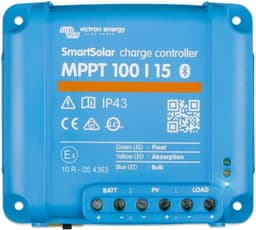
| Best overall |  Victron Energy Victron SmartSolar MPPT 100/15 | 12/24 V | Presets not listed | 100 V | 8.6 | about £61.60 | View offer |
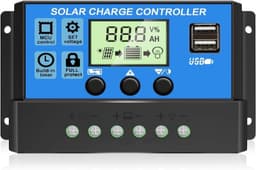
| Best value |  Topcloud Topcloud 10A PWM | 12/24 V auto | Lead-acid, LiFePO4 | Not stated | 7.2 | about £8.96 | View offer |
 Depvko Depvko 30A PWM | 12/24 V auto | Lead-acid only | Not stated | 7.3 | about £8.48 | View offer |

On this page
Match the battery voltage and the chemistry
Keep cold open-circuit voltage inside the controller
Size the charge current, then look at the load output separately
Read the title against the shelf
Common questions
Do I need 12 V, 24 V, or a controller that does both?
Will this charge a LiFePO4 battery or only lead-acid?
What does 100/15 mean?
Is a 100 A controller at under £40 a larger controller?
What should I check on the panel label before two panels go in series?
Related pages
Sources
Public UK and manufacturer sources are listed below. Shelf prices and star lines are the amazon.co.uk figures captured on 19 October 2026.
- Victron Energy, BlueSolar MPPT installation (75/10 to 100/20) (retrieved 19 October 2026)
- Victron Energy UK, solar charge controllers (retrieved 19 October 2026)
- MCS MIS 3002 (2026), solar PV systems (retrieved 19 October 2026)
- Electrical Safety First, solar panels (retrieved 19 October 2026)
- Electrical Safety First, plug-in solar consumer guide (retrieved 19 October 2026)
- GOV.UK, fire and solar PV recommendations (retrieved 19 October 2026)
- IEA PVPS, Recommended Practices for Charge Controllers (retrieved 19 October 2026)
- Consumer Rights Act 2015, section 22 (retrieved 19 October 2026)