Solar charge controller for a campervan
The listing in the basket says 15 A when the parcel is a 15 W panel. A solar charge controller for a campervan is either a small maintainer for a battery that sits idle, or a regulator sized in amps for a roof array on a leisure battery. Those are different products. A plastic box bolted to the roof is a third mistake, including when the bullet says waterproof. This page stays with campervans and small boats, using the amazon.co.uk rows on the [solar charge controller comparison](/hub/electrical-equipment/solar-charge-controller), captured on 19 October 2026. Nothing here was installed on a van. A qualifying Amazon purchase can earn us a commission at no extra cost to you.
The listing in the basket says 15 A when the parcel is a 15 W panel.
The listing in the basket says 15 A when the parcel is a 15 W panel. A solar charge controller for a campervan is either a small maintainer for a battery that sits idle, or a regulator sized in amps for a roof array on a leisure battery. Those are different products. A plastic box bolted to the roof is a third mistake, including when the bullet says waterproof. This page stays with campervans and small boats, using the amazon.co.uk rows on the solar charge controller comparison, captured on 19 October 2026. Nothing here was installed on a van. A qualifying Amazon purchase can earn us a commission at no extra cost to you.
Our top picks
| Badge | Product | Charge method | Charge current | Battery types | Note | Price | Offer |
|---|---|---|---|---|---|---|---|
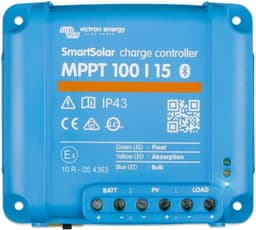
| Best overall |  Victron Energy Victron SmartSolar MPPT 100/15 | MPPT | 15 A | Presets not listed | 8.6 | about £61.60 | View offer |
| Best value |  Topcloud Topcloud 10A PWM | PWM | 10 A | Lead-acid, LiFePO4 | 7.2 | about £8.96 | View offer |
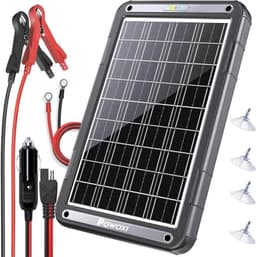
 POWOXI POWOXI 15W 12V solar maintainer | Panel kit | 1.02 A | Gel, AGM, SLA, Li-ion | 4.9 | about £54.99 | View offer |

On this page
Trickle charging an engine battery
A leisure battery needs a controller sized in amps
Lithium in a van is a setting, not a sticker
Keep the controller inside, and keep the house mains out
Common questions
Do I want a trickle panel or a separate controller?
Can I leave a controller on the roof?
Will it charge a lithium leisure battery?
Is PWM acceptable for a single van panel?
Can the same controller do the engine battery and the leisure battery?
Related pages
Sources
Public UK and manufacturer sources are listed below. Shelf prices and star lines are the amazon.co.uk figures captured on 19 October 2026.
- Victron Energy, BlueSolar MPPT installation (75/10 to 100/20) (retrieved 19 October 2026)
- Victron Energy UK, solar charge controllers (retrieved 19 October 2026)
- MCS MIS 3002 (2026), solar PV systems (retrieved 19 October 2026)
- Electrical Safety First, solar panels (retrieved 19 October 2026)
- Electrical Safety First, plug-in solar consumer guide (retrieved 19 October 2026)
- GOV.UK, fire and solar PV recommendations (retrieved 19 October 2026)
- IEA PVPS, Recommended Practices for Charge Controllers (retrieved 19 October 2026)
- Consumer Rights Act 2015, section 22 (retrieved 19 October 2026)