How to connect a solar charge controller
The controller, the panel, and the battery are on the bench. How to connect a solar charge controller comes down to one order that six listings in this amazon.co.uk set actually print: battery first, then the panel, then the load. UK reviews in the same files include a USB port that smoked, a case that melted in a shed, and displays that never came up. This page is that sequence and the point where you stop. Ranks and prices stay on the [solar charge controller comparison](/hub/electrical-equipment/solar-charge-controller). This is not a substitute for BS 7671 where the wiring is part of a fixed installation. A qualifying Amazon purchase can earn us a commission at no extra cost to you.
The controller, the panel, and the battery are on the bench.
The controller, the panel, and the battery are on the bench. How to connect a solar charge controller comes down to one order that six listings in this amazon.co.uk set actually print: battery first, then the panel, then the load. UK reviews in the same files include a USB port that smoked, a case that melted in a shed, and displays that never came up. This page is that sequence and the point where you stop. Ranks and prices stay on the solar charge controller comparison. This is not a substitute for BS 7671 where the wiring is part of a fixed installation. A qualifying Amazon purchase can earn us a commission at no extra cost to you.
Our top picks
| Badge | Product | Battery first | Battery types | System voltage | Note | Price | Offer |
|---|---|---|---|---|---|---|---|
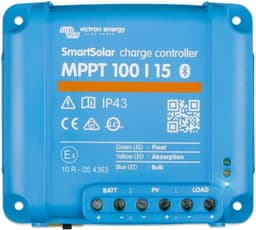
| Best overall |  Victron Energy Victron SmartSolar MPPT 100/15 | Not stated in this capture | Presets not listed | 12/24 V | 8.6 | about £61.60 | View offer |
| Best value |  Topcloud Topcloud 10A PWM | Battery, then panel, then load | Lead-acid, LiFePO4 | 12/24 V auto | 7.2 | about £8.96 | View offer |
 AeternaSol AeternaSol 10A 12V MPPT | Battery first, then the panel | Lead-acid, LiFePO4 | 12 V only | 5.5 | about £18.99 | View offer |


On this page
Connect the battery before the panel
Set the battery type before you trust the numbers
Use the load terminals only for a small DC load
Stop if it is hot, blank, or smoking
Common questions
Do I connect the battery or the panel first?
Can I run an inverter from the load terminals?
The display is blank. Did I wire it wrong?
The case is too hot to touch. Do I leave it?
When do I stop and call someone?
Related pages
Sources
Public UK and manufacturer sources are listed below. Shelf prices and star lines are the amazon.co.uk figures captured on 19 October 2026.
- Victron Energy, BlueSolar MPPT installation (75/10 to 100/20) (retrieved 19 October 2026)
- Victron Energy UK, solar charge controllers (retrieved 19 October 2026)
- MCS MIS 3002 (2026), solar PV systems (retrieved 19 October 2026)
- Electrical Safety First, solar panels (retrieved 19 October 2026)
- Electrical Safety First, plug-in solar consumer guide (retrieved 19 October 2026)
- GOV.UK, fire and solar PV recommendations (retrieved 19 October 2026)
- IEA PVPS, Recommended Practices for Charge Controllers (retrieved 19 October 2026)
- Consumer Rights Act 2015, section 22 (retrieved 19 October 2026)