Independent comparisons. We may earn from shop links. More info

MPPT or PWM solar charge controller

Updated: October 2026

You already know the battery is 12 V and you know the panel wattage, and the amazon.co.uk titles still shout MPPT at every price from £8.48 to £139.99. An MPPT or PWM solar charge controller choice is a voltage question first. PWM is enough when one panel already sits near battery voltage. MPPT is the method when the panel voltage is higher and the controller is actually built to convert it down. A word in the title is not the method. This page uses the listings on the [solar charge controller comparison](/hub/electrical-equipment/solar-charge-controller), captured on 19 October 2026. Nothing here is a measured percentage gain. A qualifying Amazon purchase can earn us a commission at no extra cost to you.

You already know the battery is 12 V and you know the panel wattage, and the amazon.co.uk titles still shout MPPT at every price from £8.48 to £139.99.

Our top picks

On this page

What each method does

A PWM controller pulls the panel toward battery voltage and pulses the current so the battery sees a controlled charge. That is the description in the IEA PVPS recommended practices for charge controllers in stand-alone systems. If your panel is already a 12 V module on a 12 V battery, the voltages are close. You do not gain a large conversion step, because there is not a large voltage difference to convert. An MPPT controller finds a higher-power point on the panel and converts that higher voltage down to battery voltage, up to a rated current. Victron's BlueSolar MPPT manual asks for the nominal panel voltage to sit at least about 5 V above the battery, and for cold open-circuit voltage to stay inside the model limit. The AeternaSol 10 A bullets claim up to 30 per cent more than PWM. Treat that as listing text.

One matched panel

Take a single 100 W panel whose working voltage already matches a 12 V lead-acid battery. The current is in the region of 8 A in full sun. A 10 A PWM controller has room for that panel. A 60 A title does not create extra watts the panel never made. The Victron BlueSolar PWM 10 A at £23.99 is the branded example. A UK review used it on a 100 W panel where an MPPT was not justified. The Depvko 30 A at £8.48 is the cheap example of the same class. The bullets say 12/24 V automatic and lead-acid only. A UK review describes overheating. It is a bad buy if the battery is LiFePO4, because the method does not override the chemistry line. That profile check lives on the solar charge controller buying guide.

Higher panel voltage

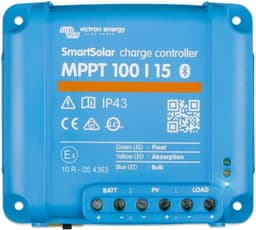
Series wiring adds open-circuit voltage. Two panels that were comfortable in parallel can exceed a controller's ceiling on a cold morning, because Voc rises below 25 °C. That is when an MPPT unit earns the extra pounds, and only if it publishes a ceiling you can check. The Victron SmartSolar MPPT 100/15 at £61.60 is the row where the name is the limit: 100 V and 15 A, 4.7 from 538 ratings. If your string is above 100 V, this 100/15 is the wrong MPPT. PWM will drag a high-Voc panel down toward 12 V or 24 V and leave most of the voltage unused. The Y&H 60 A listing prints 150 V and a watt table, and it has only seven reviews, with a faulty return in the UK sample. A printed number with a thin review count is a document, not a recommendation.

When the title and the shelf disagree

Depvko B0CBRW54VY is £19.54. The title says 100 A and MPPT. The best-seller line in the capture is PWM controllers. A UK review says the MPPT name is misleading and that it is not a proper MPPT. The captured weight is 290 g. The Consumer Rights Act 2015 requires goods to be as described. The best solar charge controller page names the SmartSolar when you can use 100 V and 15 A. Choose PWM when one panel's voltage already matches the battery and the array is small. Choose MPPT when the panels are in series, and only buy a unit whose ceiling you can read. Then wire it battery first, which is the how to connect a solar charge controller page.

Common questions

When is PWM enough?
PWM is enough when one panel already works near battery voltage, typically a single 12 V module on a 12 V lead-acid battery in a shed. In this set that is the BlueSolar 10 A at £23.99 or, for lead-acid only, the Depvko 30 A at £8.48. PWM is a poor match for panels wired in series.
When does MPPT earn the extra cost?
When the panel voltage is meaningfully higher than the battery, which is the usual result of series wiring, and when the controller prints a voltage ceiling you can check. The SmartSolar 100/15 at £61.60 is that case inside this basket, up to 100 V and 15 A. It does not cover a string whose cold Voc is over 100 V.
Is every unit with MPPT in the title actually MPPT?
No. The Depvko listing at £19.54 says MPPT and is filed under PWM controllers in this capture. A UK review says it is not a proper MPPT. The SmartSolar is on the MPPT shelf and the model name states 100 V and 15 A, which is a different kind of evidence.
Will MPPT help a single 12 V panel on a 12 V battery?
Only a little, because the voltages are already close. Victron asks for nominal panel voltage at least about 5 V above the battery before that MPPT family is in its element. A UK review of the BlueSolar PWM used a 100 W panel on the basis that MPPT was not justified.
Should I believe a 30 per cent more efficient line?
Treat it as the seller's claim. The AeternaSol 10 A listing uses a figure in that region, and this category has not measured it. Choose from the voltage difference and from a ceiling you can read, not from a percentage in a bullet.

Related pages

Sources

Public UK and manufacturer sources are listed below. Shelf prices and star lines are the amazon.co.uk figures captured on 19 October 2026.

  1. Victron Energy, BlueSolar MPPT installation (75/10 to 100/20) (retrieved 19 October 2026)
  2. Victron Energy UK, solar charge controllers (retrieved 19 October 2026)
  3. MCS MIS 3002 (2026), solar PV systems (retrieved 19 October 2026)
  4. Electrical Safety First, solar panels (retrieved 19 October 2026)
  5. Electrical Safety First, plug-in solar consumer guide (retrieved 19 October 2026)
  6. GOV.UK, fire and solar PV recommendations (retrieved 19 October 2026)
  7. IEA PVPS, Recommended Practices for Charge Controllers (retrieved 19 October 2026)
  8. Consumer Rights Act 2015, section 22 (retrieved 19 October 2026)