


One 230 V device on Schuko
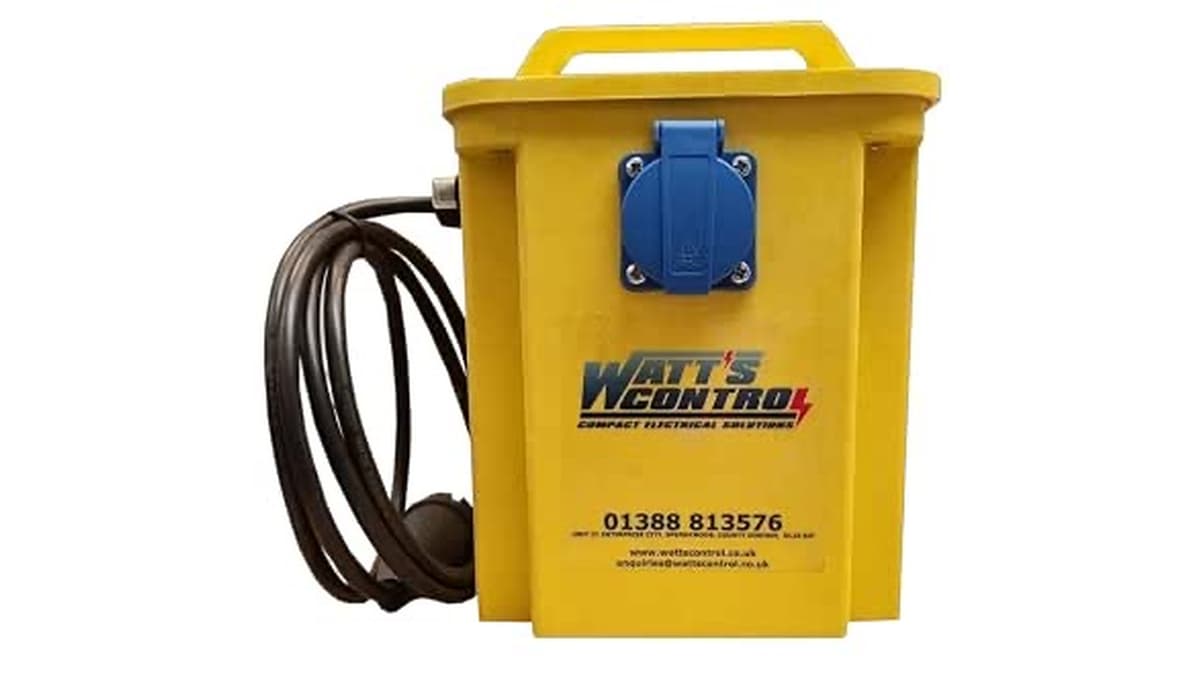
You already use 16 A Schuko connectors and you want a portable 230 V to 230 V box at 1.5 kVA continuous. The Watts Control unit is about £149.99. The intermittent duty is unstated, and it is not a BS 1363 plug.
The best isolation transformers, compared.
Top pick: Watts Control 1.5 kVA cased isolator – Only cased 230 V listing in this set: about £149.99, GRP case, 1.5 kVA continuous, 10 A trip, score 68 after Schuko connectors, no duty cycle and no reviews. Best value: SACVXOKD BK150VA 150 VA chassis – Lower price that still states 150 VA and 0.68 A: about £41.99, score 44 after no enclosure, no plug, no standard and a 220 V plate. Updated 22.10.2026.


An isolation transformer here is a mains unit with separate windings, usually 230 V to 230 V, so the output is galvanically separated from the supply. In the UK it is for one appliance or a repair bench, not a substitute for a 110 V site transformer. Judge a listing by the BS EN IEC 61558 part, a continuous rating that matches the load, and a connector that fits the socket you have. A floating secondary is still 230 V between its lines. Those checks are set out in the [isolation transformer buying guide](/hub/electrical-equipment/isolation-transformer/sub/isolation-transformer-buying-guide). The consumer object is a portable cased unit, usually 230 V to 230 V, with a lead, a socket and a trip. It is not a 110 V site transformer, and it is not a [mains isolation switch](/hub/electrical-equipment/mains-isolation-switch), which opens the supply rather than separating the windings. Chassis parts of 20 VA or 150 VA have no plug and no declared enclosure.
An isolation transformer here is a mains unit with separate windings, usually 230 V to 230 V, so the output is galvanically separated from the supply.

11 products checked · 51 hrs invested · +17,200 readers
Swipe for more
1-2 of 3


Personal buying guide
Question 1 of 2
What are you fitting?
The Watts Control WCPT3000/230/SCHUKO is the only cased unit in this amazon.co.uk set, listed at £149.99 with a GRP enclosure and a stated 230 V input and 230 V output. The rating line on the page is 1.5 kVA continuous and 3 kVA intermittent, plus a 10 A thermal-magnetic trip you reset by hand. At 230 V that 10 A trip is 2,300 VA, which sits between those two figures, and the listing never states the intermittent duty, so the 3 kVA in the title is not an all-day load. The connectors are a 16 A Schuko plug and two 16 A Schuko sockets, which do not fit a BS 1363 socket. The page claims BS EN 61558 and does not name a part, and amazon.co.uk shows no customer-review line. It is the top pick in this set only because it is the sole listing that states a case, a trip and sockets, and only if you already accept Schuko connectors.
Pros
Cons
Best for: A reader who already uses 16 A Schuko connectors and wants a portable 230 V to 230 V box at 1.5 kVA continuous, accepting that the intermittent duty is unstated.
Less suitable: A UK 13 A socket, a load that needs the 3 kVA figure all day, medical IT, or a 110 V building-site supply.
Specifications
Common questions
What voltages does this isolation transformer list?
The listing states a single-phase supply, 230 V input and 230 V output, for electrical isolation of a standard European 230 V mains supply.
What load does the listing allow?
The listing states 1.5 kVA continuous and 3 kVA intermittent, plus a 10 A thermal-magnetic trip that can be reset by hand. It does not state the intermittent duty cycle.
Does the plug fit a UK 13 A socket?
The listing states a 16 A Schuko input plug and two 16 A Schuko output sockets. It does not state a BS 1363 plug or socket.
The SACVXOKD BK150VA is a chassis transformer listed at £41.99 as 150 VA, 220 V to 220 V, a 1:1 ratio and 0.68 A. The title names copper, and the page does not state a plug, a socket, an enclosure or a standard. The listing asks whether it has a thermal cut-off, and the page does not answer that. Amazon.co.uk shows no customer-review line, so there is no UK account of heat or a failed winding. At 0.68 A the part is a small instrument or control load, not a kettle or a mains drill. It is the best value here only as the lower price that still states a current you can compare with a load, if a competent person is building it into an enclosure, and the 220 V plate is not a 230 V claim.
Pros
Cons
Best for: A competent person fitting a stated 0.68 A, 220 V chassis part into their own enclosure for a load that stays inside 150 VA.
Less suitable: Anyone who wants a finished appliance, a UK 13 A plug, or a kettle, drill or other load above a fraction of an amp.
Specifications
Common questions
What power does this isolation transformer list?
The title states 150 VA, 220 V to 220 V, a 1:1 ratio, and 0.68 A. The current-rating field also states 0.68 amps.
Does the listing include a UK plug or a thermal cut-off?
No plug, socket, enclosure or standard is stated. The listing asks whether it has a thermal cut-off and does not answer that.
Is there a customer rating?
The amazon.co.uk listing has no customer-review line and no review text.
The FUNTLY listing, with DB-20VA in the title, is a 20 VA chassis transformer at £22.00, stated as 220 V to 220 V and 1:1, surface mount and corded electric. Product dimensions are printed as 1 x 1 x 1 cm, with no weight, and that size is the listing line rather than a figure we measured. No plug, trip, enclosure rating or standard is stated, and the model-number field reads 1. Amazon.co.uk shows no customer-review line. Twenty volt-amperes will not supply a mains appliance, and a 1 cm cube is not a credible description of a 220 V winding you would wire into a bench. It is the cheapest row in the set, and it is a poor match for a finished isolation job because the power, the size line and the missing standard sit together.
Pros
Cons
Best for: Only a comparison of a 20 VA 220 V chassis listing, where you will not treat the part as a portable appliance.
Less suitable: Any plug-in tool, a repair-bench supply, or a buyer who needs a stated BS EN 61558 part and a believable size.
Specifications
Common questions
What power rating does the listing give?
The title states 20 VA, model DB-20VA, 220 V to 220 V, and a 1:1 ratio. No current in amps is stated.
How is it mounted?
Technical details state plug profile Surface Mount and power source Corded Electric. No enclosure rating is stated.
What size does the listing give?
Product dimensions are stated as 1 x 1 x 1 cm. No weight is stated, and there is no customer-review line.
Three isolation transformers on amazon.co.uk were scored from the listing text, not from a winding test and not from star ratings. None of the three has a customer-review line, so the score does not start from stars. The published figure is the display score. A cased 230 V unit with a stated trip, sockets and a BS EN 61558 claim sits highest, then is marked down for Schuko connectors, no duty cycle, no part number and no reviews. A lower price that still states VA and current is the best-value row, marked down for an open chassis, a 220 V plate and no standard. A 20 VA listing with a 1 cm size line sits lowest. A brand story does not add points. The weights below follow the buying order in the digest.
Standard part
20%A 230 V secondary needs an isolating transformer for general use, BS EN IEC 61558-2-4. BS EN 61558 with no part number is incomplete. No standard on the listing is marked down. Medical IT, EV separation and a construction site are not covered by that incomplete line.
Continuous VA and trip
25%Continuous VA comes first, then any intermittent VA, then the trip current. The 3 kVA title is not treated as an all-day load when the listing states 1.5 kVA continuous and gives no duty cycle.
Printed voltage
15%UK public supply in HSE guidance is 230 V. A 220 V to 220 V plate is left as 220 V. None of these listings is scored as a 110 V output.
Plug and socket
20%A UK 13 A socket wants BS 1363 and a BS 1362 fuse. A 16 A Schuko plug is the wrong pattern and the wrong current. A chassis listing with no plug is a component, not a finished appliance.
Case and enclosure
20%A closed case and a stated trip count for a portable box. An open chassis part with no enclosure and no IP rating does not score as a finished appliance.
Start with the standard part, then continuous VA and the trip, then the voltage printed on the plate, then the plug. A closed case comes after those. The notes below follow that order for these three amazon.co.uk listings. None of the scores is a winding test, and none of the listings has a customer-review line.
An isolation transformer in this set is a mains unit with separate primary and secondary windings, so the output is galvanically separated from the supply. The consumer object is a portable cased unit, usually 230 V to 230 V, with a lead, a socket and a trip. It is for one appliance or a repair bench. It is not a 110 V site transformer, and it is not a [mains isolation switch](/hub/electrical-equipment/mains-isolation-switch), which opens the supply rather than separating the windings.
HSE tells construction work to use cordless tools or 110 V centre-tapped to earth, so voltage to earth does not exceed 55 V. These three listings are 230 V or 220 V to the same voltage. They are not a site transformer.
The cased listing states 1.5 kVA continuous and 3 kVA intermittent, and it does not state a duty cycle. At 230 V the 10 A trip is 2,300 VA. A sustained load belongs under 1.5 kVA. A 3 kW kettle is about 13 A, above both.
A 16 A Schuko plug does not belong in a shuttered BS 1363 socket. The 20 VA and 150 VA chassis parts have no plug and no enclosure. Twenty volt-amperes will not supply a mains tool.
A general isolating transformer with a secondary above 50 V AC sits in BS EN IEC 61558-2-4. Part 2-6 is SELV. Part 2-15 is fixed medical IT. Part 2-23 is the centre-tapped site transformer. The Watts Control page claims BS EN 61558 and prints no part number. The two chassis listings state no standard. That incomplete claim is not cover for a medical room, an EV supply or a building site. Continuous VA comes before the intermittent figure.
UK public supply in HSE guidance is 230 V. Watts Control states 230 V to 230 V. SACVXOKD and FUNTLY state 220 V to 220 V. Do not relabel a 220 V plate as 230 V, and do not expect 110 V from any of these three. None describes a centre-tapped secondary. Regulation 35 of the Electrical Equipment (Safety) Regulations 2016 requires a BS 1363 plug, or a non-UK plug with a conversion plug and a BS 1362 fuse, for domestic use on a BS 1363 socket.
Three typical situations, each with a recommendation from this comparison.
You already use 16 A Schuko connectors and you want a portable 230 V to 230 V box at 1.5 kVA continuous. The Watts Control unit is about £149.99. The intermittent duty is unstated, and it is not a BS 1363 plug.
A competent person is fitting a stated 0.68 A, 220 V chassis part into their own enclosure, and the load stays inside 150 VA. The SACVXOKD BK150VA is about £41.99. It has no plug and no standard.
You are looking at the £22 listing and you need to see that 20 VA is not a portable appliance. The FUNTLY DB-20VA states 220 V to 220 V and dimensions of 1 x 1 x 1 cm. It is not a repair-bench supply.
In this set of three amazon.co.uk listings, the top pick is the Watts Control cased unit at about £149.99. The display score is 68 because it is the only row that states a GRP case, 230 V to 230 V, 1.5 kVA continuous, a 10 A trip and a BS EN 61558 claim. It is marked down for no reviews, Schuko connectors, no duty cycle and no part number. The best value is the SACVXOKD BK150VA at about £41.99. The display score is 44 because that lower price still states 150 VA and 0.68 A. It is marked down for no reviews, no enclosure, no plug, no standard and a 220 V plate. The FUNTLY at about £22 has no award. Its score is 26. None of these scores is a lab test, and none of the three has a customer-review line.
Watts Control 1.5 kVA cased isolator
Only cased 230 V listing in this set: about £149.99, GRP case, 1.5 kVA continuous, 10 A trip, score 68 after Schuko connectors, no duty cycle and no reviews.

SACVXOKD BK150VA 150 VA chassis
Lower price that still states 150 VA and 0.68 A: about £41.99, score 44 after no enclosure, no plug, no standard and a 220 V plate.
Editorial

Peter F. is the editor for DIY & tools at productscompared.co.uk. Comparisons in this category are checked against amazon.co.uk listings, review evidence and public UK sources.
Guides on what to look for, how to use a product, and common mistakes.
Public UK sources from the research digest. Shelf prices are the amazon.co.uk figures in the display file. We did not treat trade-catalogue prices as amazon.co.uk prices.
Expert source (DIY & tools): Charlie White (Charlie DIYte) (external profile) – public expert commentary used as a research source, not as a contributor to our pages.
This page contains affiliate links to amazon.co.uk. If you buy through them, we may earn a commission at no extra cost to you. Prices are the saved UK listing figures. None of these three has a customer-review line. We did not lab-test these isolation transformers.