Independent comparisons. We may earn from shop links. Our editors compare products independently. Some links go to shops, and we may earn a commission. More info
Top pick: DC HOUSE Group 24 100 Ah – Highest score in this set: about £179.99, 4.8 from 68 reviews, 100 Ah, a 100 A BMS and Bluetooth. Score 96. No millimetres, and the cut-off is printed in Fahrenheit. Best value: DC HOUSE 100 Ah – 100 Ah at about £159.99, £20 below the Group 24, with 4.6 from 338 reviews, a Celsius cut-off and millimetres. Score 92. No charger in the box. Updated 22.10.2026.
A leisure battery is a 12 V deep-cycle battery for hours of steady load in a caravan, motorhome, boat, or a small job such as a radio. You will also see tiny packs, and sometimes a charger or a pair of clamps that is not a battery. You tell a suitable one by the job, the ampere-hours at a named rate, the tray, and a charger setting that matches the chemistry.
Those checks are set out in the [leisure battery buying guide](/hub/electrical-equipment/leisure-battery/sub/leisure-battery-buying-guide).
A C100 figure looks larger than C20 for the same battery. Flooded and AGM lead-acid are usually planned to about half the printed rating. Lithium iron phosphate is lighter, and you can use more of the rating, but it needs a lithium charge profile and no charge below 0 °C unless that model heats itself. Do not charge gel above 14.2 V, or AGM above 14.4 V, unless the maker says otherwise. A desulphate mode can permanently damage lithium. Measure the locker first. For lead-acid, a heavier case usually means more lead.
A leisure battery is a 12 V deep-cycle battery for hours of steady load in a caravan, motorhome, boat, or a small job such as a radio.
A leisure battery is a 12 V deep-cycle battery for hours of steady load in a caravan, motorhome, boat, or a small job such as a radio. You will also see tiny packs, and sometimes a charger or a pair of clamps that is not a battery. You tell a suitable one by the job, the ampere-hours at a named rate, the tray, and a charger setting that matches the chemistry.
Those checks are set out in the [leisure battery buying guide](/hub/electrical-equipment/leisure-battery/sub/leisure-battery-buying-guide).
A C100 figure looks larger than C20 for the same battery. Flooded and AGM lead-acid are usually planned to about half the printed rating. Lithium iron phosphate is lighter, and you can use more of the rating, but it needs a lithium charge profile and no charge below 0 °C unless that model heats itself. Do not charge gel above 14.2 V, or AGM above 14.4 V, unless the maker says otherwise. A desulphate mode can permanently damage lithium. Measure the locker first. For lead-acid, a heavier case usually means more lead.
A leisure battery is a 12 V deep-cycle battery for hours of steady load in a caravan, motorhome, boat, or a small job such as a radio. You will also see tiny packs, and sometimes a charger or a pair of clamps that is not a battery. You tell a suitable one by the job, the ampere-hours at a named rate, the tray, and a charger setting that matches the chemistry. Those checks are set out in the leisure battery buying guide. A C100 figure looks larger than C20 for the same battery.
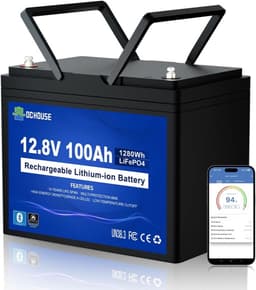
The DC HOUSE Group 24 is a 12 V 100 Ah LiFePO4 battery at £179.99 and 10.8 kg, with a 100 A BMS and Bluetooth quoted at 5–10 m. It carries the highest score in this set, on a 4.8 line from 68 amazon.co.uk reviews, and the captured texts are short, mostly from the United Kingdom, and mostly positive. Reviewers call it light against the lead-acid or AGM battery it replaced, and one electric dinghy still showed about 65 percent after two hours, against about an hour on the old battery. The listing cuts charge below 32 °F and discharge below -7.6 °F, recovers after the temperature rises to 0 °F, and names no heater. Millimetres are missing, so Group 24 is a case name rather than a measured fit, and the specification table says lithium metal while the title says LiFePO4. No charger is included, one unit would not charge until the seller sent a replacement, and several reviews are a single line, so a long-term fault rate is not visible. It is the Group 24-shaped 100 Ah pack when that outline matches your tray and you accept Fahrenheit on the cut-off.
Pros
4.8 from 68 reviews, the highest score in this comparison
100 Ah, 100 A BMS, Bluetooth, 10.8 kg, and a 3-year warranty
BCI Group 24 named, with a limit of four batteries in series or parallel
The seller sent a replacement when one unit would not charge
Cons
£179.99, which is £20 above the other DC HOUSE 100 Ah, and no millimetres
Cut-off printed in Fahrenheit, and no heater is named
The table says lithium metal while the title says LiFePO4
Short reviews hide a long-term fault rate, and a charger is extra
Best for: You need a Group 24 case and a 100 Ah lithium battery with Bluetooth, and you will buy a dedicated lithium charger.
Less suitable: You want millimetre dimensions, a Celsius cut-off, or the larger 338-review sample on the cheaper DC HOUSE 100 Ah.
What low-temperature cut-off does this Group 24 listing print?
Charge cuts off below 32 °F and discharge cuts off below -7.6 °F. The listing says operation recovers after the temperature rises to 0 °F. No heater is named.
How many batteries can be linked?
The listing says no more than four in series or parallel, and it says to use a dedicated lithium charger.
Why does the specification table say lithium metal?
The table label is Lithium Metal. The title and bullets say LiFePO4. Both wordings are in the listing and they conflict.
The DC HOUSE ECO-LFP1210003 is a 12.8 V 100 Ah LiFePO4 battery at £159.99, with a 100 A BMS, Bluetooth 5.1, and a listed weight of 10.8 kg. Across 338 amazon.co.uk reviews the line is 4.6, the largest count in this set, and owners describe a lighter swap for a camper lead-acid battery, a readable app, and multi-day use with solar, lights, and a fridge. The case is 260 × 168 × 234 mm, which the listing says is about 8.13 mm taller than a BCI Group 24 outline, so the locker still needs a tape measure. This listing stops charging below -7 °C and discharge below -20 °C, and it does not mention a heater. No charger is included: one reviewer quoted about 16 hours from a low state of charge on a 5 A charger, another install was missing terminal screws, and one unit failed after a controlled discharge. A shunt user also saw state of charge fall about 40 percent over a couple of months in storage. The claim of up to 15,000 cycles has no depth of discharge. It is the 100 Ah row to compare first when you want a Celsius cut-off and a large review sample at £159.99.
Pros
100 Ah, 100 A BMS, Bluetooth 5.1, 10.8 kg, at £159.99
4.6 from 338 reviews, the largest count in this set
Charge cut-off printed below -7 °C, with dimensions in millimetres
Reviewers report a lighter camper or boat fit than the lead-acid it replaced
Cons
No charger, and one motorhome install was missing terminal screws
One failure after a discharge, plus about 40 percent loss in storage on a shunt
One small continuous load appeared well below 100 Ah
The 15,000-cycle claim has no depth of discharge, and the case is slightly taller than Group 24
Best for: A caravan, motorhome, or boat bank around 100 Ah, with a lithium charger and a locker that takes 260 × 168 × 234 mm.
Less suitable: Charging below -7 °C without another heat source, or a job that needs a charger in the box.
The PUPVWMHB 12V300AH-BT is listed at £279.00 as a 12.8 V lithium battery whose title says 300 Ah, 3,840 Wh, and a 200 A BMS. Across 244 amazon.co.uk reviews the line is 4.6, and buyers who already owned a Fogstar Drift liked the price when they did not need a heater. One motorhome test quoted about 15 hours from flat on a 20 A charger, and one UK buyer said the app reported about 306 Ah. The case is 34.5 × 19 × 24.5 cm and 26.8 kg, with M8 terminals, and reviewers said handles and terminal bolts made it larger than the printed figure. The specification table says 3,840 Ah, which conflicts with the title, while 3,840 Wh matches 300 Ah at 12.8 V, so the table's ampere-hour line is not the capacity. The title names a low-temperature cut-off without a degree, reviews describe this model as non-heated, and the specification table has no warranty line. On one pack the app voltage disagreed with the posts and then drained other batteries in a bank. It is the large-case row when the locker and the payload can take 26.8 kg, and you do not read 3,840 Ah as real.
Pros
Title says 300 Ah and 3,840 Wh, with a 200 A BMS and Bluetooth, at £279
4.6 from 244 reviews
Case 34.5 × 19 × 24.5 cm, 26.8 kg, M8 terminals
One UK app reading of about 306 Ah, and a 15-hour note on a 20 A charger
Cons
The specification table says 3,840 Ah, which conflicts with the 300 Ah title
No heater and no degree on the cut-off, and no warranty line in the table
The app can switch charge and discharge off, which one reviewer treated as a risk
Handles and terminal bolts make the case larger than the printed size
Best for: A large 12 V bank in a motorhome or boat when you have measured for 26.8 kg and you do not need an internal heater.
Less suitable: A standard caravan tray, charging below freezing, or anyone treating 3,840 Ah as the capacity.
The title says 12 V 300 Ah and a maximum of 3,840 Wh. The specification table says 3,840 amp hours. Those lines conflict. The watt-hour figure matches 300 Ah at 12.8 V, not 3,840 Ah.
Does this battery include a heater?
The title names a low-temperature cut-off and does not give a temperature or a heater. Reviews describe it as the non-heated version.
Can it be used in a caravan?
The bullets name motorhomes, caravans, and marine use. The case is 34.5 x 19 x 24.5 cm and 26.8 kg, so the locker still has to be measured.
The ECO-WORTHY ECO-LFPYZ1208 is a 12 V 8 Ah LiFePO4 battery at £35.99, measuring 152 × 96 × 65 mm and about 1.05 kg, with a 5 A BMS. Across 99 amazon.co.uk reviews the line is 4.6, and the captured texts are almost all from the United Kingdom. Owners run a 25 W transceiver for a day, a boat pump, shed lights on a 25 W panel, or a small fence energiser. The box is the battery and two F2 cables, not a charger, and the listing prints neither a charge voltage nor a cold-charge cut-off. One barely used unit stopped accepting a charge inside a year, and a buyer of five said only two still worked after a few months. A bench test reported that the BMS did not shut down on over-voltage or at 15 A, and the case got hot. One UPS owner also found the discharge current too low for a load an older lead-acid pack had run. It suits a light 12 V job that stays inside 5 A, and those early failures are too specific to ignore.
Pros
8 Ah LiFePO4 at £35.99, 152 × 96 × 65 mm, about 1.05 kg
4.6 from 99 reviews, with the captured texts mostly from the United Kingdom
Two F2 charging cables in the box and a 3-year warranty on the listing
Used in reviews for radio, a boat pump, and a small solar panel
Cons
5 A BMS; a bench test saw a hot case at 15 A and on over-voltage
Early failures, including two of five still working after a few months
No charger, no printed charge voltage, and no cold-charge threshold
The cycle claim has no depth of discharge
Best for: A fish-finder, amateur radio, or other light 12 V load that stays under 5 A, with a separate LiFePO4 charger.
Less suitable: A caravan bank, a motor mover, or a PC UPS that previously ran on a larger lead-acid battery.
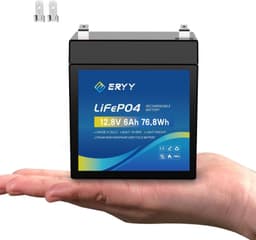
The ERYY YD1206 is a 12.8 V 6 Ah LiFePO4 pack at £28.49, with an 8 A BMS and F2 terminals, and the listing says it powers devices rather than starting an engine. Across 59 amazon.co.uk reviews the line is 4.6, and people use it for a radio, a fish-finder, a kayak, or a small solar panel through an MPPT controller. At 739 g it is easy to carry, and one bench test said the BMS shut down at the stated limits. The charge line is printed as 14.2 V ± 0.2 V at 1.5–3 A, only from 0 °C to 45 °C, and the box has an F2 cap and an F2-to-F1 adapter, not a charger. One unit died after four days at zero volts and would not charge, which the reviewer blamed on the BMS. The specification table's 28 × 35 × 42 mm also conflicts with that 739 g weight, so the dimensions are not a size you can trust. It is a small-load pack when you already own a LiFePO4 charger, and it is the wrong battery for a caravan habitation circuit.
Pros
12.8 V 6 Ah LiFePO4 at £28.49 and about 739 g
8 A BMS, with one bench test shutting down at the stated limits
Charge figures printed: 14.2 V ± 0.2 V, 1.5–3 A, 0 °C to 45 °C
F2-to-F1 adapter in the box, and 4.6 from 59 reviews
Cons
No charger in the box, and a lead-acid setting is the wrong charger
One unit failed after four days and sat at zero volts
Printed size of 28 × 35 × 42 mm conflicts with the 739 g weight
6 Ah and an 8 A BMS are not a caravan bank or a motor mover
Best for: You want a light pack for a radio, fish-finder, or small solar load, and you already have a LiFePO4 charger.
Less suitable: A caravan habitation circuit, a motor mover, or starting an engine.
No. The listing specifies a LiFePO4 charger at 1.5–3 A and 14.2 V ± 0.2 V, and it says to avoid a lead-acid charger. The box is the battery, an F2 cap, and an F2-to-F1 adapter.
Can it start a vehicle?
The listing says it is for powering devices only, not for starting vehicles.
Can it be used for camping?
The bullets name camping lights, a fish-finder, a radio, and small solar storage. At 6 Ah it is a small-load pack, not a caravan habitation battery.
The Varta LFS75 is listed at £94.13 as a 12 V 75 Ah leisure battery, model 812071000B912, with a 17 kg item weight on amazon.co.uk and a 2-year warranty. The listing has no customer-review line and no review text, so there is no star rating to quote. The title and a Deep Cycle Batteries rank point at a habitation battery, while the only bullet describes a Varta Professional starter for marine starting and says no maintenance is required. Those two descriptions conflict, and the page asks about camping without answering it. The specification table lists 12 V, six cells, and lead-acid, and it does not repeat 75 Ah. A trade data sheet for the same LFS75 model shows a wet dual-purpose battery, 600 A EN, and a filled weight of 23.25 kg, so Amazon's 17 kg is not that filled figure. Dimensions, terminals, and a charge voltage are absent. It is the only lead-acid row in this set when you can match LFS75 to the data sheet before it goes in the locker.
Pros
Title is a 12 V 75 Ah leisure battery, model LFS75, at £94.13
Lead-acid, six cells, 2-year warranty, country of origin Germany
The only lead-acid battery kept in this comparison
Listed in Deep Cycle Batteries on amazon.co.uk
Cons
No customer-review line and no review text on the listing
The only bullet describes a marine starter and conflicts with the title
Amazon weight is 17 kg; the data sheet's filled weight is 23.25 kg
No dimensions, terminals, or charge voltage on the listing
Best for: You have matched LFS75 to a dual-purpose data sheet and you want the lead-acid option in this set.
Less suitable: You need UK reviews, a printed leisure charge profile, or a lithium weight saving.
Is there a star rating for the Varta LFS75 listing?
No. The amazon.co.uk listing has no customer-review line and no review text.
Does the listing say the battery is maintenance-free?
The only bullet says no maintenance is required, inside a sentence about Varta Professional starter batteries for marine starting. That sentence conflicts with the leisure-battery title. Camping use is asked on the page and not answered.
What capacity does the specification table give?
The title says 12 V 75 Ah. The specification table lists 12 V, six cells, and lead-acid, and does not repeat the ampere-hour figure.
How we compared
Six amazon.co.uk leisure-battery listings were scored from the shelf on 21 October 2026. This is not a lab test. A printed ampere-hour figure, BMS current, cycle claim or temperature cut-off is a listing claim. None of these six prints an NCC class. A cycle line with no depth of discharge is not treated as proven life. A missing star line is left unrated.
1
Job and stated capacity
30%
The battery has to match the job: habitation, a trolling motor, or a light load such as a radio. Ampere-hours are read at a named rate. A C100 figure is not treated as larger than C20 for the same battery. A 6 Ah or 8 Ah pack is not scored as a caravan bank.
2
Tray, weight and terminals
20%
A case you can measure, a stated weight, and a terminal type. Conflicting dimensions, a Group 24 name with no millimetres, or a listing weight that disagrees with the filled data-sheet weight, lower this part.
3
Charger match and cold charge
25%
Whether a charger is in the box, whether the charge voltage is printed, and whether a cold-charge cut-off is stated in a unit you can use. A cut-off stops charging. It is not a heater. No listing in this set includes a charger.
4
Review evidence
15%
The amazon.co.uk star line and review count, plus review notes that describe the job. A listing with no customer-review line scores as unrated. A small count does not outweigh a conflict on the specification table.
5
Price against the job
10%
Shelf price against the job the listing actually supports. The lowest price does not win when the pack is a few ampere-hours, or when the capacity lines conflict.
Independent review
Last updated: 22.10.2026
8 sources checked
Leisure battery buying guide
Start with the job, then usable ampere-hours, then the tray and the charger. Price comes after those. The notes below follow that order for a 12 V leisure battery used in a UK caravan, motorhome, boat or small load. None of the scores is a lab test.
What is a leisure battery?
A leisure battery is a 12 V deep-cycle battery for hours of steady load in a caravan, motorhome, boat, or a small job such as a radio. It is not the engine starter. A charger, a pair of clamps, or a set of leads from the same search is not a battery either. You choose one by the job, the ampere-hours at a named rate, whether the case fits the locker, and a charge setting that matches the chemistry.
The job comes first.
Best for
A caravan or motorhome owner replacing a habitation battery
A boat owner who needs a domestic or trolling battery, not the engine starter
A radio, fish-finder or other light 12 V load, with a charger you already own
Not ideal for
Anyone using a starter battery as a leisure battery
A 6 Ah or 8 Ah pack used as a caravan habitation battery
A desulphate charger on lithium, or charging lithium below 0 °C when the model has no heater
Mistakes to avoid
1
Comparing C100 with C20
A C100 ampere-hour figure looks larger than C20 for the same battery. Read the rate before you compare two listings. Then apply depth of discharge. About 50 percent is the usual planning habit for flooded and AGM lead-acid, not a law.
2
A desulphate mode on lithium
A desulphate or recondition mode can permanently damage a lithium battery. Gel charge voltage should not exceed 14.2 V, and AGM 14.4 V, unless the maker says otherwise. None of these listings includes a charger, so the charger you already own has to match.
3
Reading a cycle claim with no depth of discharge
A line such as 15,000 cycles, with no depth of discharge, is not comparable with 200 cycles at 50 percent. Do not charge lithium iron phosphate below 0 °C unless that model heats itself. A BMS cut-off is not a heater.
What to weigh up
Job and usable ampere-hours
High
Weekend hook-up, off-grid use, a motor mover, a trolling motor and a handheld radio are different jobs. In this set the ERYY is 6 Ah and the ECO-WORTHY is 8 Ah. Both are light-load packs. The Varta title says 75 Ah. Both DC HOUSE listings say 100 Ah. The PUPVWMHB title says 300 Ah and 3,840 Wh, while its specification table says 3,840 Ah. Use the title and the watt-hour line, not that table figure.
Divide a day's watt-hours by 12, then apply depth of discharge.
Tray, charger and cold charge
High
Measure the locker before you compare prices. The ECO-WORTHY is 152 x 96 x 65 mm and about 1.05 kg. The DC HOUSE 100 Ah is 260 x 168 x 234 mm and 10.8 kg, slightly taller than a Group 24 outline. The Group 24 listing names the case and prints no millimetres. The PUPVWMHB is 34.5 x 19 x 24.5 cm and 26.8 kg, and reviewers said handles and bolts make it larger. The Varta listing weight is 17 kg. A data sheet for LFS75 gives a filled weight of 23.25 kg.
None of the six includes a charger.
Which option suits you?
Three typical situations, each with a recommendation from this comparison.
🚐
Replacing a caravan habitation battery
You are swapping a habitation battery and you can measure the locker. The DC HOUSE 100 Ah is about £159.99, 12.8 V and 100 Ah, at 10.8 kg, with charge cut off below -7 °C. The case is 260 x 168 x 234 mm. No charger is in the box.
You need a domestic or trolling battery, and you will not use it to start the engine. The DC HOUSE Group 24 is about £179.99, with 4.8 from 68 reviews, a 100 A BMS and Bluetooth. The listing names a Group 24 case and prints the charge cut-off in Fahrenheit.
You want a light pack and you already have a lithium charger. The ERYY YD1206 is about £28.49, 12.8 V and 6 Ah, with an 8 A BMS. The listing says it is not for starting a vehicle. The printed size conflicts with the 739 g weight.
Which leisure battery is the top pick in this set?
The top pick in this set is the DC HOUSE Group 24 100 Ah, about £179.99, with 4.8 from 68 amazon.co.uk reviews and a score of 96. The listing states a 100 A BMS, Bluetooth at 5 to 10 m, and a weight of 10.8 kg. Charge cuts off below 32 °F, and no heater or millimetre size is printed. The specification table says lithium metal while the title says LiFePO4. The score is not a lab test.
Which leisure battery is best value?
The best value is the DC HOUSE 100 Ah at about £159.99, which is £20 less than the Group 24 in this set. It has 4.6 from 338 reviews, the largest count here, a 100 A BMS, Bluetooth 5.1, and a listed weight of 10.8 kg. Charging stops below -7 °C. The case is 260 x 168 x 234 mm. No charger is included, and the cycle claim has no depth of discharge. The score is 92, and it is not a lab test.
What is a leisure battery?
A leisure battery is a 12 V deep-cycle battery for hours of steady load in a caravan, motorhome, boat, or a small job such as a radio. It is not the engine starter. A charger or a set of clamps from the same search is not a battery. Judge one by the charger match, the ampere-hours at a named rate, the tray, and a cycle claim that states depth of discharge. Flooded and AGM lead-acid are planned to about half the rating. Lithium iron phosphate needs a lithium charge profile.
Should you choose lead-acid or lithium iron phosphate?
Flooded lead-acid suits mostly hook-up use and needs ventilation, and Yuasa does not recommend it for a motor mover. AGM is sealed, with a charge ceiling around 14.4 V. Gel is sealed, with a ceiling around 14.2 V, and it is not automatically better than wet lead-acid. Lithium iron phosphate is about 12.8 V and lighter, and you can use more of the rating, but you need a lithium profile and you do not charge it below 0 °C unless that model heats itself.
How do you work out what size leisure battery you need?
Divide a day's watt-hours by 12. That is the Caravan and Motorhome Club's rule of thumb. Then apply depth of discharge. About 50 percent is the usual planning habit for flooded and AGM lead-acid, not a law. Check whether the figure is C20 or C100, because a C100 number looks larger. A 6 Ah or 8 Ah pack can run a radio or a fish-finder. It is the wrong object for a caravan habitation circuit. An NCC class only helps when that battery is on the verified list.
Can you charge a leisure battery below freezing?
Do not charge a lithium iron phosphate leisure battery below 0 °C unless that model heats itself. The Camping and Caravanning Club states that limit. A BMS cut-off stops charging. It is not a heater. In this set, the DC HOUSE 100 Ah listing stops charge below -7 °C. The Group 24 listing prints the cut-off as below 32 °F and names no heater. The 300 Ah title names a low-temperature cut-off and gives no degrees. Victron Smart Lithium blocks charge below 5 °C, so the cut-off is brand-specific.
Does a leisure battery include a charger?
No battery in this set includes a charger. Use a lithium profile for lithium iron phosphate, and do not use a desulphate or recondition mode on it, because that mode can cause permanent damage. Gel charge voltage should not exceed 14.2 V, and AGM 14.4 V, unless the maker says otherwise. Leave a lead-acid battery charged. A flat one can freeze and often will not recover. Mains, solar and alternator charging are a separate job from choosing the case.
How is a leisure battery different from a solar battery?
A leisure battery here is the 12 V battery for habitation loads or a small job such as a radio. Storage sold for panels is compared on the solar battery page. A panel still needs a charge profile that matches the chemistry. A charge controller does not replace a lithium setting, and a desulphate mode can damage lithium. Measure the locker before you treat a solar listing as a caravan battery.
Our verdict
In this set of 6 amazon.co.uk listings, the top pick is the DC HOUSE Group 24 100 Ah at about £179.99, with 4.8 from 68 reviews and a score of 96. It states a 100 A BMS, Bluetooth and 10.8 kg. The best value is the DC HOUSE 100 Ah at about £159.99, with 4.6 from 338 reviews and a score of 92, because that 100 Ah class costs £20 less and the listing prints millimetres and a cut-off below -7 °C. Neither score is a lab test. A 6 Ah pack is not a caravan bank, and 230 V wiring is work for a competent person.
Best overall
DC HOUSE Group 24 100 Ah
Highest score in this set: about £179.99, 4.8 from 68 reviews, 100 Ah, a 100 A BMS and Bluetooth. Score 96. No millimetres, and the cut-off is printed in Fahrenheit.
Leisure batteriesLiFePO4 and lead-acidamazon.co.uk listings
Peter F. is the editor for DIY & tools at productscompared.co.uk. Comparisons in this category are checked against amazon.co.uk listings, review evidence and public UK sources.
Updated: 22.10.2026
8 sources checked
Guides to leisure batteries
Guides on what to look for, how to use a product, and common mistakes.
This page contains affiliate links to amazon.co.uk. If you buy through them, we may earn a commission at no extra cost to you. Prices, stars and review counts are from the UK listings checked on 21 October 2026. We did not lab-test these leisure batteries.