Independent comparisons. We may earn from shop links. More info

Lithium or lead-acid leisure battery

Updated: October 2026

You are stood between a heavy lead-acid battery that the van already knows how to charge and a lighter LiFePO4 pack that uses more of the ampere-hours on the label. A lithium or lead acid leisure battery is not a single upgrade. Choose lead-acid if you mostly hook up and the charger you have is already that chemistry. Choose LiFePO4 if you need the weight and the deeper use, and only if you can charge above freezing or that model heats itself first. The six rows are the [Leisure battery comparison](/hub/electrical-equipment/leisure-battery). Listings were compared on 21 October 2026. We did not run a cycle test. A qualifying purchase can earn a commission at no extra cost to you.

You are stood between a heavy lead-acid battery that the van already knows how to charge and a lighter LiFePO4 pack that uses more of the ampere-hours on the label.

Our top picks

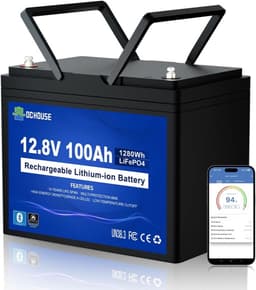
DC HOUSE DC HOUSE Group 24 100 Ah

Best overall

DC HOUSE DC HOUSE Group 24 100 Ah
9.6/10about £179.99
DC HOUSE DC HOUSE 100 Ah

Best value

DC HOUSE DC HOUSE 100 Ah
9.2/10about £159.99
Varta Varta LFS75 75 Ah

Rank 3

Varta Varta LFS75 75 Ah
0.0/10about £94.13
On this page

Usable ampere-hours, not the sticker

A 100 Ah label is the rating, not the energy you should plan to take out every night. The usual planning habit for flooded and AGM leisure batteries is about half of that rating, so a 100 Ah lead-acid battery is often treated as about 50 Ah you can use. Other copy puts a 100 Ah lithium close to the full rating. Those habits disagree, and none of them is a British standard. If an evening adds up to about 40 Ah, a lead-acid battery planned at half wants a rating near 80 Ah or more. A desulphate or equalise mode can permanently damage lithium. The watt-hour worksheet sits on what size leisure battery for a caravan.

When lead-acid is the calmer buy

Lead-acid is the calmer buy when you mostly sit on a hook-up, you already own a charger for that chemistry, and you are not chasing every kilogram. Yuasa does not recommend a basic flooded battery for a motor mover, and a flooded battery in an occupied space needs a breather. AGM is sealed and is usually the lead-acid chemistry a mover manual asks for. Gel stays on this side of the choice, with a lower voltage ceiling of about 14.2 V, against about 14.4 V for AGM, unless the maker says otherwise. If the charger has no gel setting, gel is the awkward lead-acid option. The only lead-acid listing here is the Varta LFS75 at £94.13. The title says 75 Ah. Trade data describe a wet dual-purpose battery and 600 A EN. Amazon shows 17 kg. A filled data sheet shows 23.25 kg. There is no charge profile, so you do not invent a voltage.
DC HOUSE DC HOUSE Group 24 100 Ah

Testsieger

DC HOUSE DC HOUSE Group 24 100 Ah
9.6/10about £179.99

When lithium is worth the change

Lithium is worth the change when locker weight matters and you regularly use the battery away from a hook-up. The Camping and Caravanning Club describes LiFePO4 as about half the weight of lead-acid. The two 100 Ah DC HOUSE cases are listed at 10.8 kg, against a Varta line of 17 kg on Amazon and 23.25 kg filled on the data sheet. The 300 Ah case is 26.8 kg. The 6 Ah pack is about 739 g and the 8 Ah pack about 1.05 kg. Do not charge a lithium leisure battery below 0 °C unless that model heats the cells first. A cut-off is not a heater. The ERYY listing prints 0 °C to 45 °C. One DC HOUSE listing stops charge below -7 °C. The Group 24 listing prints the cut-off below 32 °F. The PUPVWMHB listing prints no threshold. You do need a charger with no desulphate cycle.

What that means for the batteries in this comparison

Five of the six listings are lithium. One is lead-acid. If you already have a lead-acid charger and you mostly hook up, the Varta is the only row in that chemistry, with the conflicts above. If you want LiFePO4 at about 100 Ah, the two DC HOUSE listings are separated by cut-off wording, Bluetooth, and whether millimetres are printed, not by one of them being more lithium than the other. If you want a large bank, the PUPVWMHB title says 300 Ah and the table conflicts. This page stops you treating a 100 Ah sticker as a shared promise across chemistries.

Common questions

Is lithium always better?
No. Lithium is the stronger side when you need lower weight and deeper use, and when you can charge it above freezing or the pack heats itself. Lead-acid is the calmer buy when you mostly use a hook-up and you already have that charger. A 6 Ah lithium pack is not a better caravan battery than a 75 Ah lead-acid battery.
Will it charge on a winter pitch?
Not if the battery is below 0 °C and the model does not heat itself before charging. In this set the printed lines are 0 °C to 45 °C on the ERYY pack, below -7 °C on one DC HOUSE listing, and below 32 °F on the Group 24 listing. A cut-off refuses the charge. It does not warm the cells.
Do I have to buy a new charger?
You need a charger whose profile matches the chemistry, with desulphate and equalise switched off for lithium. If the charger in the van has a repair mode you cannot disable, lithium is a charger change as well as a battery change. None of the six listings includes a charger.
Where does gel sit?
Gel sits on the lead-acid side, with AGM and flooded batteries, not with LiFePO4. Its charge ceiling is about 14.2 V, a little lower than the 14.4 V figure often used for AGM, unless that maker prints another limit. Gel does not cancel the habit of planning only about half the rating.
Is lithium safe in a caravan locker?
A LiFePO4 pack does not ask for a flooded-battery breather in the same way. Safety still depends on the battery management system, the charger, and the charge temperature. Do not run a desulphate cycle, and do not charge below 0 °C unless that model heats first. A hot or swollen case is a reason to stop.

Related pages

Sources

Public UK sources are listed below. Shelf prices and star lines are the amazon.co.uk figures checked on 21 October 2026.

  1. Camping and Caravanning Club: leisure batteries (retrieved 21 October 2026)
  2. Camping and Caravanning Club: charging a leisure battery (retrieved 21 October 2026)
  3. The AA: caravan leisure batteries (retrieved 21 October 2026)
  4. Yuasa UK: how to choose a leisure battery (retrieved 21 October 2026)
  5. NCC verified battery list (retrieved 21 October 2026)
  6. GOV.UK: batteries (retrieved 21 October 2026)
  7. GOV.UK: recycling batteries and electrical waste (retrieved 21 October 2026)
  8. Caravan and Motorhome Club: batteries (retrieved 21 October 2026)