Independent comparisons. We may earn from shop links. More info

Leisure battery buying guide

Updated: October 2026

You are standing at a caravan locker with the old battery out, and the amazon.co.uk results have put a 6 Ah pack in the same list as a 100 Ah bank. A leisure battery buying guide is the order of decisions, not a winner. You name the job, then the usable ampere-hours, then whether the case enters the hole, then the chemistry and the charger that is already fitted. Prices and which listing suits whom stay on the [Leisure battery comparison](/hub/electrical-equipment/leisure-battery). Listings were captured on 21 October 2026. We did not lab-test a battery. A qualifying purchase can earn a commission at no extra cost to you.

You are standing at a caravan locker with the old battery out, and the amazon.co.uk results have put a 6 Ah pack in the same list as a 100 Ah bank. A leisure battery buying guide is the order of decisions, not a winner.

Our top picks

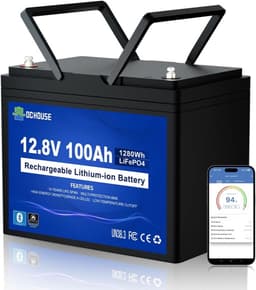
DC HOUSE DC HOUSE Group 24 100 Ah

Best overall

DC HOUSE DC HOUSE Group 24 100 Ah
9.6/10about £179.99
DC HOUSE DC HOUSE 100 Ah

Best value

DC HOUSE DC HOUSE 100 Ah
9.2/10about £159.99
Varta Varta LFS75 75 Ah

Rank 3

Varta Varta LFS75 75 Ah
0.0/10about £94.13
On this page

Start with the job, not the title

The first split is what the battery has to run, and for how long, away from a hook-up. A weekend on a site with a mains lead is a different battery from three nights off-grid with a fridge, and both are different from a motor mover that pulls a high current for a few minutes. A handheld radio, a fish-finder, or a shed light is a fourth job. In this set the ERYY pack is 6 Ah at £28.49 and the ECO-WORTHY pack is 8 Ah at £35.99. Both are the wrong object once the load is a habitation circuit. The Varta LFS75 title says 75 Ah at £94.13. If you buy the £28 pack because the star line looks similar, you have bought a radio battery for a van. How to turn lights, a pump, and a television into a number is on what size leisure battery for a caravan.

Five checks before you pay

Work down the listing in this order, and stop when a line you need is missing. First, capacity and the rate it was measured at. A figure taken over 100 hours looks larger than the same lead-acid battery measured over 20 hours, and none of these six listings prints that rate. Second, the tray, in millimetres, before you trust a Group 24 name. Third, the chemistry: flooded, AGM, gel, or LiFePO4. Fourth, the charger you will use. None of the six boxes includes a charger. Fifth, the cold-charge line. A battery management system that stops charging in a freeze is not a heater. The voltages are on how to charge a leisure battery.
DC HOUSE DC HOUSE Group 24 100 Ah

Testsieger

DC HOUSE DC HOUSE Group 24 100 Ah
9.6/10about £179.99

What an NCC class is for

The National Caravan Council verified list is a starting point for caravan and motorhome batteries, not a medal you can hang on a star rating. Class A is at least 90 Ah and 350 cycles at 50 percent depth of discharge. Class B is at least 90 Ah and 200 cycles at that same depth. Class C is at least 60 Ah and 70 cycles. A class says nothing about your locker or your charger. None of the six amazon.co.uk listings in this comparison prints an NCC class, so a 4.6 line is not Class A under another name. Up to 15,000 cycles with no depth of discharge is not comparable with 200 cycles at 50 percent. Lithium quality varies, so you buy from a seller you can question.

Weight, posts, and the locker

For a flooded or AGM battery, heavier usually means more lead, which is why a suspiciously light case with a high ampere-hour claim deserves a second look at the label. Lithium is the exception. The Camping and Caravanning Club describes it as about half the weight of lead-acid. The 100 Ah DC HOUSE batteries are listed at 10.8 kg, while the Varta listing shows 17 kg and a filled data sheet for the same LFS75 model shows 23.25 kg. You do not treat Amazon’s 17 kg as the filled weight. The PUPVWMHB case is 34.5 × 19 × 24.5 cm and 26.8 kg, and reviewers said handles made it larger than the printed figure. The DC HOUSE Group 24 prints no millimetres. A flooded battery in an occupied space also needs a breather, which Yuasa states.

Common questions

What should I decide first: ampere-hours, chemistry, or the locker?
Decide the job first, then measure the locker, then read the ampere-hours at a named rate. Chemistry comes after you know whether a lead-acid charger is already fitted in the van. A 6 Ah lithium pack can be the right product for a radio and the wrong one for a caravan. If the case does not go in, the chemistry debate can wait.
Do I need AGM if I have a motor mover?
Yuasa does not recommend a basic flooded battery for a motor mover. AGM is the usual lead-acid answer, and the mover’s own manual may ask for about 80 Ah or 100 Ah. Lithium can work when the continuous current covers the mover, which the 5 A and 8 A packs in this set do not. A class sticker or a star line does not replace that manual.
Why is a £28 battery in the same search as a £160 one?
Amazon files a 6 Ah LiFePO4 pack and a 100 Ah habitation battery under the same leisure wording. The £28.49 ERYY listing is for small 12 V loads. The £159.99 DC HOUSE listing is 100 Ah with a 100 A battery management system. They are not substitutes.
Does Group 24 mean it will fit my locker?
No. Group 24 is a case family, not a measurement of your locker. The DC HOUSE Group 24 listing prints no millimetres. The other DC HOUSE 100 Ah case is 260 × 168 × 234 mm and is described as slightly taller than a Group 24 outline. Measure the hole, including the posts and the lid.
What if the listing has no NCC logo?
You are then buying on the maker’s cycle claim, the review sample, and the measurements you can check, not on a verified class. None of these six listings prints Class A, B, or C. A claim of many thousands of cycles still needs a depth of discharge. Do not treat a missing logo as a hidden Class A.

Related pages

Sources

Public UK sources are listed below. Shelf prices and star lines are the amazon.co.uk figures checked on 21 October 2026.

  1. Camping and Caravanning Club: leisure batteries (retrieved 21 October 2026)
  2. Camping and Caravanning Club: charging a leisure battery (retrieved 21 October 2026)
  3. The AA: caravan leisure batteries (retrieved 21 October 2026)
  4. Yuasa UK: how to choose a leisure battery (retrieved 21 October 2026)
  5. NCC verified battery list (retrieved 21 October 2026)
  6. GOV.UK: batteries (retrieved 21 October 2026)
  7. GOV.UK: recycling batteries and electrical waste (retrieved 21 October 2026)
  8. Caravan and Motorhome Club: batteries (retrieved 21 October 2026)