


A 12 V shed bank
The bank is already 12 V and a 600 W PV cap is enough. The Y&H 1 kW is about £159.99, with a 40 A MPPT. The watt fields also print 600 W and 2000 W, and one UK review says it shuts off after two minutes.
The best hybrid inverters, compared.
Top pick: Y&H 4.2 kW 24 V hybrid – 4200 W and 4800 W peak agree, with 5.0 from 3 reviews and two UK notes that describe outhouse use. Score 100, shared with the Anern 3 kW row. The start voltage is above 90 V, and the BMS brand is not named. Best value: Y&H 3.2 kW 24 V hybrid – About £255.99, 4.4 from 8 reviews, a named PYLON and PACE BMS, and a two-year warranty. Score 88. The 3200 W and 3000 W lines still disagree, and the Wi-Fi dongle is not in the box. Updated 22.10.2026.


A hybrid inverter is an all-in-one for a UK shed, outhouse or house battery. It inverts battery DC to about 230 V AC, charges the battery from solar through a built-in MPPT, and can charge from the mains or a generator. Battery voltage comes first: 12 V, 24 V or 48 V, and the unit has to match the bank. A usable listing states continuous watts apart from surge, plus maximum array watts, maximum open-circuit voltage, start voltage and charge current. Cold UK weather raises open-circuit voltage. Battery-less running, a second AC output and a named BMS are modes, not assumptions. Wi-Fi is often a separate dongle. An off-grid all-in-one is not permission to parallel the public network. EREC G98 covers up to 16 A per phase, about 3.68 kW, and EREC G99 covers more. Words such as on grid in a title are not that permission. How voltage, watts and the MPPT window fit is in the [hybrid inverter buying guide](/hub/electrical-equipment/hybrid-inverter/sub/hybrid-inverter-buying-guide).
A hybrid inverter is an all-in-one for a UK shed, outhouse or house battery. It inverts battery DC to about 230 V AC, charges the battery from solar through a built-in MPPT, and can charge from the mains or a generator.

30 products checked · 64 hrs invested · +22,100 readers
Swipe for more
1-2 of 8


Personal buying guide
Question 1 of 2
What is the battery voltage?
The Y&H SUN-4.2KW-HV is listed at about £369.99 as a 24 V unit at 4200 W continuous and 4800 W peak, with a 120 A MPPT and a max PV array of 6200 W. Two UK reviews, in April and August 2026, are positive, one after six months and one after a week in an outhouse feeding a house, and neither names a defect, though the count is still only three reviews at 5.0. The continuous and peak figures agree with each other, which lets you plan a running load separately from a short surge. The PV window is 60–450 V DC with a start above 90 V, so a short shed string can sit below that floor even when the watt cap looks generous. Dual output is stated: the main output stops between 20.0 V and 23.0 V as set, and the second output stays on. The title says Wi-Fi and BMS, but the BMS brand is not named, and there is no G98 or G99 reference. It weighs 14.5 kg, with a two-year manufacturer warranty. It is the top pick in this set for a 24 V string that can clear 90 V, not because a 5.0 from three reviews is a large sample.
Pros
Cons
Best for: A 24 V bank and a string that can start above 90 V, when you want a second output that the listing says stays on as the main output drops.
Less suitable: A short string that cannot clear 90 V, a 48 V bank, or a grid-parallel install that needs a type-test reference.
Specifications
Common questions
What battery voltage is listed?
24 V DC, with a cold start at 23 V. Lithium brands are not named on this page.
What happens when the battery voltage falls?
The listing says the main output stops below a setting from 20.0 V to 23.0 V, and the second output keeps working.
What do the UK reviews say?
Two UK reviews, in April and August 2026, are positive: one after six months, one after a week in an outhouse feeding a house. Neither names a defect. The listing count is 3.
The Anern 24 V unit at about £235.90 is titled 3 kW, while the bullets print 3200 W, the capacity line prints 3000 VA, and the peak is 4800 W. One UK review on 23 July 2026 says it does what it says and calls it a brilliant unit, but the listing count is only two reviews at 5.0. The MPPT is 80 A, with a max PV array of 3000 W, a first connection above 35 V, then 30 V, and a max open-circuit voltage of 400 V. It names 24 V sealed, AGM, gel, flooded, and lithium batteries, with a 23 V cold start. The attribute table prints 80 Ah beside the 80 A controller, and no battery is listed in the box. A named BMS, battery-free start, and dual output are not stated. The title says off-grid, there is no G98 or G99 reference, and the warranty line only says replace broken parts.
Pros
Cons
Best for: A 24 V outhouse bank with a short string that can clear about 35 V, when you do not need a named BMS.
Less suitable: A PYLON or PACE battery that needs a communication line, or a buyer who wants more than two reviews behind a 5.0 star line.
Specifications
Common questions
Can it be used with lead-acid batteries?
The bullets say yes: 24 V sealed, AGM, gel and flooded lead-acid, and lithium, with a 23 V cold start.
Does it have an LCD?
Yes. The listing says an LCD and three LED indicators.
What do the reviews say?
One UK review on 23 July 2026 says it does what it says and calls it a brilliant unit. It names no defect. The listing count is 2.
The Y&H RS-3200W-24V-M80A is a 24 V all-in-one at about £255.99 with an 80 A MPPT, a stated battery-less start, and BMS communication limited to PYLON and PACE. Eight amazon.co.uk reviews give 4.4, the fullest star line on this shelf that still sits above 4. Two UK reviews say they bought the Wi-Fi dongle separately and describe the Sun House app as poor, so monitoring is an extra purchase. The bullets print 3200 W and 3200 VA while an attribute prints 3000 W, and the surge is 6000 W. The PV window is 55–450 V DC, with a start above 60 V, a max open-circuit voltage of 450 V, and a max array of 3000 W. The two-year manufacturer warranty is longer than the one-year lines on the cheaper Anern pages. A second AC output is not stated, and no G98 or G99 reference is printed. It is the best value here when the battery is PYLON or PACE, not a bargain if the watt clash or the missing dongle is a problem for you.
Pros
Cons
Best for: A 24 V bank on a PYLON or PACE battery, if you will buy the Wi-Fi dongle separately when you want the app.
Less suitable: A different lithium BMS, a 12 V bank, or a reader who assumed the monitoring dongle was in the box.
Specifications
Common questions
Does the listing say it works with lithium?
Yes. It names 24 V sealed, AGM, gel and flooded lead-acid, and lithium. BMS communication is printed as PYLON and PACE only.
Does it include a battery charger from the mains?
The title says an 80 A MPPT solar charger plus an AC charger. Charge modes include only solar, solar first, and mains and solar.
Is the Wi-Fi dongle in the box?
The contents line does not list one. Two UK reviews say they bought it separately, and they describe the Sun House app as poor.
The DATOUBOSS DT-4862L is the most reviewed unit in this set, at about £449.99 with 3.8 from 17 amazon.co.uk reviews, and the title rates it 6200 W on 48 V with a claimed battery-free start. One UK review is positive about output and noise, another says the AC terminals have no polarity marks, and a third reports high AC voltage on the solar terminals and smoke from arcing. That smoke report is a reason to stop and call an electrician, not a detail to average away because the review count is the largest here. The output-voltage attribute prints 48 V DC, and the bullets do not print 230 V AC, so the mains voltage is not settled on the page. Max PV is printed as both 6500 W and 8500 W, the window is 60–500 V DC with a recommended band of 360–430 V, and the peak is 9300 W. Warranty is not stated, dual output is not stated, and no G98 or G99 reference appears.
Pros
Cons
Best for: A 48 V reader who will treat the 17-review sample, including the smoke report, as the evidence and will not guess a 230 V output from a 48 V DC line.
Less suitable: Anyone who needs a coherent AC voltage on the page, a second output, or a listing without a smoke and arcing report.
Specifications
Common questions
What protection does the listing name?
Short circuit, over-voltage, under-voltage, overload, over-current and overheating, plus lightning and surge protection, and a temperature-controlled fan.
Does the page say it runs off-grid?
The title says off-grid. It also says the inverter can run with or without a battery. No G98 or G99 reference is printed.
What do UK reviews report?
One UK review is positive about output and noise. One says the AC terminals have no polarity marks. One reports high AC voltage on the solar terminals and smoke from arcing.
The Anern AN-FGI-S6500 is listed at about £175.99 as a 48 V unit rated 6500 W, with a 120 A MPPT, dual AC outputs, and a highlight that says it can start without a battery. The attribute table also prints 6500 KW, and the peak line is the same 6500 W as the continuous figure, so a separate surge is not shown. A bullet prints the MPPT as 1×27 A as well as 120 A, which is a clash you should leave unresolved. The PV window is 60–450 V DC, with a max no-load of 500 V and a max array of 9000 W. Four reviews give 3.8. One UK review says Great. A Belgium review describes a buzz about every ten seconds and a return that was not arranged, and that text is not a UK rating. The warranty is a one-year replacement for defective parts, and no G98 or G99 reference is printed.
Pros
Cons
Best for: A 48 V bench where you will read the watt and MPPT clashes before you treat the title as a 6.5 kW unit.
Less suitable: A buyer who needs one coherent watt line, a named BMS, or a type-test reference before any mains parallel connection.
Specifications
Common questions
Which batteries does the listing name?
Lithium and lead-acid. The attribute table also prints 200 Ah, and no battery is listed in the box.
Does the page say it has a display?
Yes. It says an LCD, plus RGB lighting that changes with standby, battery, mains and PV modes.
What is in the captured reviews?
One UK review says Great. A Belgium review describes a buzz about every ten seconds and a return that was not arranged. That second text is not a UK rating.
The Y&H SUN-6.2KW-HV-UK is a 48 V unit at about £399.99, listed at 6200 W continuous and 6500 W peak, with a 120 A MPPT and a max PV array of 6500 W. Dual output is stated: the main output stops between 40.0 V and 46.0 V as set, and the second output stays on. The PV window is 60–450 V DC, the start is above 90 V, and the cold start is 46 V. Three reviews give 3.8: one says the unit was well packed but did not meet their requirements, without saying why, and another says it would not let the battery discharge below 70%. A bullet says four charge modes and then lists three: solar first, solar and utility, and only solar. The bullets say on/off-grid working and use with no grid, and they do not show a G98 or G99 reference. The photograph matches the 4.2 kW unit, so the picture is a poor way to tell the two apart, and the warranty is two years.
Pros
Cons
Best for: A 48 V bank with a string that starts above 90 V, if you can accept a review that the battery would not discharge below 70%.
Less suitable: A short low-voltage string, a buyer who needs the bank to run down toward empty, or a parallel mains connection.
Specifications
Common questions
Can the listing be read as off-grid?
The bullets say on/off-grid working and describe use with no grid. They do not show a G98 or G99 reference.
Which loads are named?
Refrigerators, lamps, televisions, fans and air conditioning. That is the listing's list, not a measured test.
What do the UK reviews say?
One says it was well packed but did not meet their requirements, with no detail. Another says it would not let the battery discharge below 70%. The listing count is 3.
The Y&H NMS-1000-12 is listed at about £159.99 as a 12 V all-in-one with a 40 A MPPT and a printed PV cap of 600 W. Across four amazon.co.uk reviews the line is 3.1, and one UK review on 9 October 2026 says the unit keeps switching off after two minutes without an error code. The bullets print 1000 W while the attribute table also prints 600 W and 2000 W, so you cannot treat one of those figures as the running load. The PV window is 20–150 V DC, with a start above 30 V and a max open-circuit voltage of 150 V. Battery-free start and a second AC output are not stated. The listing says to expect 50–70 dB and not to site the unit by a bedroom, and the warranty is one year. A second captured review text is not about this inverter, so the star line is thinner than four reviews suggests.
Pros
Cons
Best for: A small 12 V shed load where the bank is already 12 V and a 600 W PV cap is enough.
Less suitable: A 24 V or 48 V bank, a coherent multi-kilowatt rating, or a unit you need to place next to a bedroom.
Specifications
Common questions
Does the listing say it works with lithium?
Yes. The bullets name 12 V sealed, AGM, gel and flooded lead-acid, and lithium.
What PV input is printed?
The title and the technical bullet say 600 W, 20–150 V DC, start above 30 V, and a 40 A MPPT. The attribute table also prints output power of 600 W and wattage of 2000 W.
What do the captured reviews say?
One UK review on 9 October 2026 says it keeps going off after 2 minutes and names no error code. A second captured text is not about this inverter.
The Anern AN-FGI-S12000 is the largest title on this shelf, at about £579.99, with 12000 W continuous, 15000 W peak, dual PV inputs, and dual AC outputs on a 48 V bank, and the attribute wattage prints 12000 KW. The MPPT is shown as 160 A, as 2×22.5 A, and in a highlight as double 160 A, so the charge current is not one number. The only review, from the UK on 29 April 2026, leaves the line at 3.0 and says the inverter was great, but the pictured USB Wi-Fi module was misleading, a compatible module could not be found, and the manual and support were poor. The cable note goes up to 000 AWG, about 85 mm², on the battery, which is a conductor an electrician should size, not a casual shed lead. Max PV is 15000 W, the window is 60–450 V DC, and the max no-load voltage is 500 V. AC out 1 is listed at 70 A max and AC out 2 at 40 A max, and a highlight says battery-free. There is no G98 or G99 reference, and the warranty is a one-year replacement for defective parts.
Pros
Cons
Best for: A 48 V install where you already have an electrician for the cable and you do not need a second review or a Wi-Fi module you can identify.
Less suitable: A shed on a short string, a buyer who needs the pictured Wi-Fi dongle to exist, or any parallel connection to the mains.
Specifications
Common questions
Does the listing say it can be used off-grid?
The title says on/off grid tie and the bullets call it an off-grid solar inverter. No G98 or G99 reference is printed.
Does it have an LCD?
Yes. The listing says an LCD and RGB lighting that changes with the working mode.
What does the only review say about Wi-Fi?
The UK review on 29 April 2026 says the inverter was great but the pictured USB Wi-Fi module was misleading, a compatible module could not be found, and the manual and support were poor.
Eight amazon.co.uk hybrid-inverter listings stayed in this set after pure DC-to-AC vehicle inverters were removed. Scores use the published star line, whether the battery voltage, watts and PV window agree, and what the UK review notes say. This is not a lab test. A printed watt figure or a CE mark is a listing claim. None of these pages prints an EREC G98 or G99 type-test reference, and a high star line cannot supply one.
Battery voltage
25%The bank is 12 V, 24 V or 48 V. A listing scored here has to name that voltage. A different voltage cannot count as a fit, whatever the watt title says.
Continuous output and surge
20%Continuous watts and the surge figure are read as two numbers. A peak printed as the same figure as continuous output, or watt fields that disagree, lowers this part.
PV window
25%Maximum array watts, maximum open-circuit voltage, start voltage and MPPT current. A start voltage the string cannot clear, or two PV caps on one page, lowers this part.
Modes
15%Battery-less start, a second AC output and a named BMS count only when the listing states them. The word BMS in a title, with no brand, is not a named system.
Review notes and price
15%UK review notes that describe the job, including a shutdown, a discharge limit or smoke. Shelf price is weighed against that evidence. The lowest price does not win when the watt fields clash.
Match the battery voltage first, then continuous watts against surge, then the PV window. Modes and the review notes come after that. The notes below follow the eight amazon.co.uk listings in this set. None of the scores is a lab test, and none of the pages prints a G98 or G99 reference.
A hybrid inverter on amazon.co.uk, in this category, is an all-in-one. It inverts battery DC to about 230 V AC, charges the battery from solar through a built-in MPPT controller, and can charge from the mains or a generator. People fit one in a shed, an outhouse or as a house battery. The bank is 12 V, 24 V or 48 V. The inverter has to match that voltage. A vehicle power inverter that only turns DC into AC, with no MPPT, is not this product. Titles use three architectures.
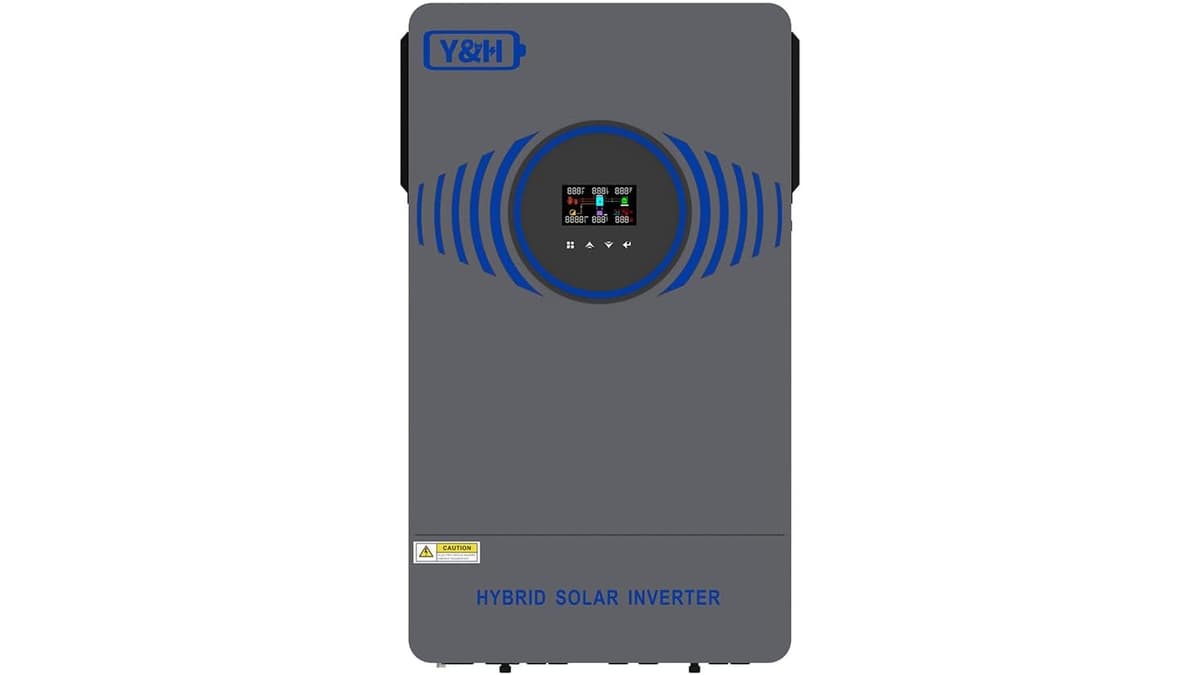
The kept listings are 12 V, 24 V or 48 V. The inverter has to match the bank. A 24 V unit on a 48 V bank is the wrong product, not a setting you can guess.
Continuous watts and surge are different numbers, except where a page prints them as the same figure. On grid in a title is not an EREC G98 or G99 type test. A CE mark is not that reference either.
Monitoring is often a separate dongle. On the 3.2 kW listing the contents line does not include one, and UK reviews say they bought it separately. A picture of a USB module is not proof you can buy a match.
Voltage is the first cut. This set is one 12 V listing, three 24 V listings and four 48 V listings. A 12 V page will not run a 48 V bank. After voltage, read continuous output and the surge as two lines. The Y&H 4.2 kW prints 4200 W and 4800 W peak, and those fields agree. The Anern 6.5 kW prints peak equal to the 6500 W continuous figure, and the attribute line also prints 6500 KW. The Y&H 1 kW bullets print 1000 W while other fields print 600 W and 2000 W.
You need maximum array watts, maximum open-circuit voltage, start voltage and MPPT current. Cold UK weather raises open-circuit voltage. The Y&H 4.2 kW and 6.2 kW want a start above 90 V. The Y&H 1 kW wants a start above 30 V. The Anern 3 kW describes a first connection above 35 V, then 30 V, with a 400 V Voc cap. Battery-less start is stated on the Y&H 3.2 kW and the DATOUBOSS, and it appears in the highlights of the Anern 6.5 kW and 12 kW.
Three typical situations, each with a recommendation from this comparison.
The bank is already 12 V and a 600 W PV cap is enough. The Y&H 1 kW is about £159.99, with a 40 A MPPT. The watt fields also print 600 W and 2000 W, and one UK review says it shuts off after two minutes.
You want 4200 W continuous, 4800 W peak and a second output. The Y&H 4.2 kW is about £369.99. The start voltage is above 90 V. Two UK reviews describe outhouse use. The star line is 5.0 from 3 reviews.
You are comparing 48 V units and you will still use a competent person if the system meets the mains. The Y&H 6.2 kW is about £399.99, at 6200 W with dual output and a start above 90 V. One review says discharge stopped at 70%. No G98 reference is printed.
In this set of 8 amazon.co.uk listings, the top pick is the Y&H 4.2 kW 24 V hybrid at about £369.99, with 5.0 from 3 reviews and a score of 100. Continuous output is 4200 W and peak is 4800 W, and those watt fields agree. The best value is the Y&H 3.2 kW 24 V hybrid at about £255.99, with 4.4 from 8 reviews and a score of 88, because the listing names a PYLON and PACE BMS and a two-year warranty. The Anern 3 kW row shares the score of 100, from 5.0 and only 2 reviews. The award follows the coherent watt fields on the Y&H 4.2 kW, not a lab test. None of these listings prints an EREC G98 or G99 reference.
Y&H 4.2 kW 24 V hybrid
4200 W and 4800 W peak agree, with 5.0 from 3 reviews and two UK notes that describe outhouse use. Score 100, shared with the Anern 3 kW row. The start voltage is above 90 V, and the BMS brand is not named.
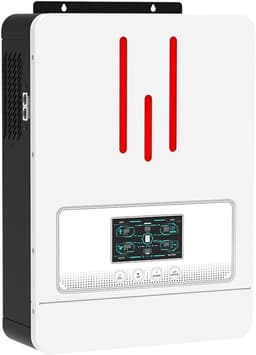
Y&H 3.2 kW 24 V hybrid
About £255.99, 4.4 from 8 reviews, a named PYLON and PACE BMS, and a two-year warranty. Score 88. The 3200 W and 3000 W lines still disagree, and the Wi-Fi dongle is not in the box.
Editorial

Peter F. is the editor for DIY & tools at productscompared.co.uk. Comparisons in this category are checked against amazon.co.uk listings, review evidence and public UK sources.
Guides on what to look for, how to use a product, and common mistakes.
Public UK sources are listed below. Shelf prices and star lines are the amazon.co.uk figures recorded for these listings.
Expert source (DIY & tools): Charlie White (Charlie DIYte) (external profile) – public expert commentary used as a research source, not as a contributor to our pages.
This page contains affiliate links to amazon.co.uk. If you buy through them, we may earn a commission at no extra cost to you. Prices, stars and review counts are the amazon.co.uk figures recorded for these listings. We did not lab-test these hybrid inverters.