Independent comparisons. We may earn from shop links. Our editors compare products independently. Some links go to shops, and we may earn a commission. More info
Top pick: Fit4Less 1500W 24 V Best value: MINGHAOXIN 2000W pure sine – Best-value 2000 W listing at about £132.99, with two UK sockets, a wireless remote and 4.6 from 63 reviews. Score 81. Budget for a thicker DC cable. The warranty is 60 days, and frequency is not printed. Updated October 2026.
A sine wave inverter turns 12 V or 24 V battery power into alternating current near UK mains, nominally 230 V at 50 Hz. You use one to run mains appliances in a van, caravan or boat, or during a short power cut.
You tell a suitable sine wave inverter apart by waveform, continuous watts, battery voltage and the DC connection. Pure sine is the default for motors, microwaves, audio and sensitive chargers. A modified wave is stepped and suits only simple heat. The word sine in a title is not the specification. Size from continuous watts, not the peak, and leave headroom above the appliance. At 12 V and about 90 percent efficiency, a rule of thumb is about 93 A per 1,000 W. At 24 V that current halves. A 10 A accessory socket supplies only about 100 W of AC after losses, so heavier loads need cables fused at the battery and a BS 1363 socket. Those checks are in the [sine wave inverter buying guide](/hub/electrical-equipment/sine-wave-inverter/sub/sine-wave-inverter-buying-guide).
A sine wave inverter turns 12 V or 24 V battery power into alternating current near UK mains, nominally 230 V at 50 Hz. You use one to run mains appliances in a van, caravan or boat, or during a short power cut.
A sine wave inverter turns 12 V or 24 V battery power into alternating current near UK mains, nominally 230 V at 50 Hz. You use one to run mains appliances in a van, caravan or boat, or during a short power cut.
You tell a suitable sine wave inverter apart by waveform, continuous watts, battery voltage and the DC connection. Pure sine is the default for motors, microwaves, audio and sensitive chargers. A modified wave is stepped and suits only simple heat. The word sine in a title is not the specification. Size from continuous watts, not the peak, and leave headroom above the appliance. At 12 V and about 90 percent efficiency, a rule of thumb is about 93 A per 1,000 W. At 24 V that current halves. A 10 A accessory socket supplies only about 100 W of AC after losses, so heavier loads need cables fused at the battery and a BS 1363 socket. Those checks are in the [sine wave inverter buying guide](/hub/electrical-equipment/sine-wave-inverter/sub/sine-wave-inverter-buying-guide).
A sine wave inverter turns 12 V or 24 V battery power into alternating current near UK mains, nominally 230 V at 50 Hz. You use one to run mains appliances in a van, caravan or boat, or during a short power cut. You tell a suitable sine wave inverter apart by waveform, continuous watts, battery voltage and the DC connection. Pure sine is the default for motors, microwaves, audio and sensitive chargers. A modified wave is stepped and suits only simple heat. The word sine in a title is not the specification. Size from continuous watts, not the peak, and leave headroom above the appliance.
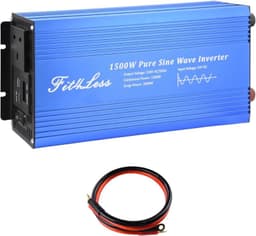
The Fit4Less unit is the only 24 V inverter in this set, listed at £89.99 with one BS socket, an LCD, USB at 5 V 2.1 A and USB-C at 18 W. The title says 1500 W continuous and 3000 W peak into 230 V at 50 Hz. The wattage field also says 1000 W, and that clash is unresolved. The star line is 5.0 from one rating, and the listing has no review text, so the average cannot carry a buying decision. Battery cables are listed in the box, the warranty line is 1 year, and the weight is 3.18 kg. A single 12 V leisure battery is the wrong input. It only makes sense if you already run a 24 V bank and you treat the continuous watts as unproven until the fields agree. It is the wrong buy on the strength of one star.
Pros
Only 24 V input in this set, 230 V at 50 Hz on the table
One BS socket, LCD, USB and 18 W USB-C
Battery connection cables listed in the box
1-year warranty line at £89.99
Cons
5.0 from one rating and no review text
Title says 1500 W; wattage field also says 1000 W
Will not run from a single 12 V battery
Remote and shore-power transfer are not stated
Best for: You already have a 24 V battery bank and you want one BS socket, accepting that 1500 W is not confirmed by reviews.
Less suitable: You have a 12 V leisure battery, or you are choosing from the star line.
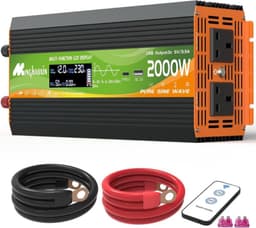
The MINGHAOXIN 218-2000W is a 12 V pure sine inverter listed at £132.99 for 2000 W continuous and 4000 W peak, with two UK sockets, an LCD and a wireless remote. Across 63 amazon.co.uk reviews the line is 4.6. The listing claims efficiency up to 95%, plus USB and 30 W USB-C, and a 60-day warranty against manufacturer defects. One review says the supplied cable set is for 100 A, about 1200 W at 12 V, so a thicker cable is needed for the 2000 W label. The specification table does not print a frequency, and output is given as 240 V. At 37 × 16.5 × 10 cm and 3.5 kg it is lighter than the Renogy 2000 W case. It is the best-value 2000 W listing here if you budget for new DC leads. It is a poor match if you need a frequency on the page or a warranty longer than 60 days.
Pros
2000 W pure sine at £132.99, below the other 2000 W prices here
Two UK sockets, LCD and a wireless remote
4.6 from 63 reviews
USB and 30 W USB-C on the listing
Cons
60-day warranty only
Frequency is not printed
One review says the supplied cable is about 100 A, short of 2000 W at 12 V
No shore-power transfer claim
Best for: You want two UK sockets and a 2000 W pure sine label under £140, and you will replace the DC cable before a full load.
Less suitable: You need a stated 50 Hz figure, a warranty beyond 60 days, or leads that already match 2000 W.
The Giandel HS-4000QBT is listed at £403.99 as a 12 V pure sine inverter with 4000 W continuous, 7900 W peak for 2 seconds, three AC outlets and a Bluetooth app. The star line is 4.6 from 42 amazon.co.uk reviews. Most of those texts name a 1500 W Giandel with a wired remote, and one text matches the Bluetooth app, so 4.6 is not a test of this model. No review on the listing measures a 4000 W load on this ASIN. The case is 37.1 × 20.5 × 17 cm and 6.9 kg, which is a small box for the label. Frequency, efficiency, connection and box contents are not stated. The warranty line is 24 months, and two USB ports are listed without a current. It suits you only if you already accept a 4000 W claim with almost no reviews of this model and you will supply your own DC cables. It is the wrong buy if the star line is why you would pay £403.99.
Pros
4000 W continuous label, the highest in this set
Three AC outlets and a Bluetooth app
24-month warranty on the listing
Peak bullet states 7900 W for 2 seconds
Cons
Most of the 42 reviews describe a 1500 W Giandel, not this model
No review on the listing of a 4000 W load
Cables, frequency and box contents are not stated
£403.99 for a case listed at 6.9 kg
Best for: You are comparing a 4000 W pure sine label with an app and you will ignore the 1500 W reviews and supply your own cables.
Less suitable: You are using the 4.6 star line as evidence, or you need a stated cable and frequency.
The FLAMEZUM 1500W is a 12 V pure sine inverter listed at £149.99 for 1500 W continuous and 3000 W peak, with a wired LCD remote on a 5 m lead and two AC sockets. Across 67 amazon.co.uk reviews the line is 4.5, but many texts name other FLAMEZUM wattages, including 2500 W, 3000 W and 4000 W. One return says output topped out around 1520 W, an 1800 W air fryer would not run, and the battery cables went red hot in 1–2 minutes. The table says 230 V and a bullet says 240 V, and no frequency is printed. BS 1363 is not named on the sockets. The box includes the inverter, the remote, two battery cables and a ground wire, with a 12-month warranty and a no-load claim of 0.6 A. At 24 × 20 × 10.5 cm and 3.63 kg it is compact for the label. It suits a 1500 W case with a remote only if you ignore other wattages' reviews. It is a weak match if the leads in the box are your plan for a long high load.
Pros
1500 W continuous pure sine with a 5 m wired LCD remote
Two AC sockets, USB-A and 36 W USB-C
Ground wire and two battery cables in the box
12-month warranty at £149.99
Cons
Many reviews name other FLAMEZUM wattages
One return: cables red hot in 1–2 minutes and an 1800 W air fryer would not run
No frequency printed; 230 V and 240 V both appear
BS 1363 is not named on the sockets
Best for: You want a compact 1500 W pure sine case with a wired remote, and you will not treat other wattages' reviews as this ASIN.
Less suitable: You need a printed frequency, named BS 1363 sockets, or leads that stay cool at high load.
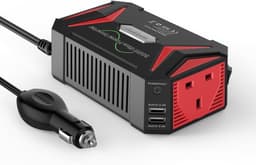
The BESTEK MRZ3013HU-BK-UK is a 12 V pure sine inverter with a cigarette-lighter plug, listed at £49.99 as 300 W continuous and 700 W peak. Across 946 amazon.co.uk reviews the line is 4.4, the largest sample in this set. Two USB ports are rated up to 2.4 A each, and the unit weighs 680 g. Reviews say a 10 A lighter socket cannot supply the 300 W label and may blow the vehicle fuse. The specification table prints 60 Hz, which conflicts with UK 50 Hz mains, and the socket type is not named. The box line is a fuse and a manual. It suits a laptop or a small charger if you stay near the current the socket can actually give. It is a poor match if you expect the full 300 W from the lighter plug or a confirmed 50 Hz output.
Pros
Pure sine with a lighter plug at £49.99
4.4 from 946 reviews, the largest sample here
Two USB ports, up to 2.4 A each
Light case at 680 g with an LED
Cons
Reviews say a 10 A lighter socket cannot supply 300 W
Specification table says 60 Hz, not 50 Hz
UK socket type is not named
No remote and no shore-power transfer line
Best for: You want a pure sine plug for a laptop or charger in a car, and you will stay well under the lighter socket's real limit.
Less suitable: You need the full 300 W, a stated 50 Hz output, or a hard-wired battery connection.
The Renogy R-INVT-PUH1-101235-UK is a 12 V pure sine inverter listed at £113.99 for 1000 W continuous and 2000 W peak, with a remote in the box. Across 163 amazon.co.uk reviews the line is 4.4. The table states 230 V at 50 Hz and an efficiency claim above 90%, and the bullets claim a 50 ms grid-priority transfer. The title says 240 V, and the warranty is 2 years in the bullets and 1 year in the table. At 34.2 × 17.3 × 7.6 cm and 2.6 kg it is a hard-wired case, not a lighter-plug brick. It is the strongest match here when 1000 W continuous is enough and you want the remote and the transfer claim on one listing. It is a weaker match if you need a 2000 W continuous load or one warranty figure you can quote.
Pros
Pure sine, 1000 W continuous, 50 Hz on the table
Remote, cable and manual listed in the box
4.4 from 163 reviews at £113.99
50 ms grid-priority claim printed on the listing
Cons
Title says 240 V while the table says 230 V
Warranty printed as both 2 years and 1 year
No USB figure on the listing
Battery cables only, so a lighter socket will not run it
Best for: You want a 12 V pure sine inverter around 1000 W, with a remote and a printed 50 ms transfer claim, and your loads stay inside 1000 W continuous.
Less suitable: You need 2000 W continuous, a single warranty sentence, or a cigarette-lighter plug.
The MINGHAOXIN 202-1000W is a 12 V pure sine inverter listed at £79.99 for 1000 W continuous and 2000 W peak, with 240 V at 50 Hz on the table. Across eight amazon.co.uk reviews the line is 4.4, and only four review texts are on the listing. Owners called the cables short, and one added a fuse holder and an isolator. Another said leaving it on overnight drains the battery, against an idle claim under 0.3 A. The title says UK sockets and three USB ports, a bullet says one AC outlet and dual USB, and a catalogue field says five outlets. The display is LCD in the table and LED in a bullet. There is no remote, and the warranty is 60 days. It suits a small hard-wired 1000 W job only if you can live with a thin sample and counts that do not match. It is a weak match if you need a remote or a socket count you can trust.
Pros
Pure sine, 1000 W continuous, 50 Hz on the table
£79.99 with cable, fuse and manual in the box
Idle claim under 0.3 A and efficiency up to 95%
Compact case at 30 × 13 × 6 cm and 1.2 kg
Cons
Only eight reviews, four of them with text
Socket and USB counts conflict across title, bullet and catalogue
60-day warranty and no remote
Owners called the cables short, and one reported an overnight battery drain
Best for: You want a compact 1000 W pure sine inverter on battery cables and you will check the socket count on the live page.
Less suitable: You need a large review sample, a remote, or a warranty longer than 60 days.
No. The box contents are a cable, a fuse and an instruction manual.
How many sockets does it have?
The title says UK sockets and 3 USB. A bullet says an AC outlet and dual USB at 5 V 3.4 A. The catalogue field says 5 outlets. Those counts do not match.
What did the few reviews say about the cables?
Four texts are on the listing. Owners called the cables short and one added a fuse holder and an isolator. One said leaving it on overnight drains the battery.
The Renogy R-INVT-PUH1-201235-UK is a 12 V pure sine inverter listed at £199.99 for 2000 W continuous and 4000 W peak, with 230 V at 50 Hz on the table. Across 216 amazon.co.uk reviews the line is 4.3. A remote is listed in the box, and the bullets claim a 50 ms grid-priority transfer and efficiency above 90%. Reviewers call the supplied leads about 100 A and 4 AWG, short, and in several reports copper-coated aluminium, and they say those leads overheat. One reviewer received no remote lead and two cable sets instead. The warranty is 2 years in the bullets and 1 year in the table. At 44.2 × 22 × 9.2 cm and 4.8 kg it is a van-sized case. It suits a 2000 W label only after you fit cable for the current. It is a weak match if you plan to use the leads in the box at full load.
Pros
Pure sine, 2000 W continuous, 50 Hz stated
Remote in the box and a 50 ms transfer claim
4.3 from 216 reviews
Efficiency claim above 90%
Cons
Reviewers say the supplied leads overheat
Leads described as about 100 A, short, and sometimes copper-coated aluminium
One report of a missing remote lead
Warranty printed as both 2 years and 1 year
Best for: You want Renogy's 2000 W UK listing with a remote and a transfer claim, and you will fit a heavier DC cable than the one in the box.
Less suitable: You expect the supplied leads to carry 2000 W, or you need one warranty figure.
The Giandel PS-2000KAR is a 12 V pure sine inverter listed at £249.99 for 2000 W continuous and 4000 W peak, with two AC outlets, an LED display and a wired remote the bullet describes as 15 ft. Across 103 amazon.co.uk reviews the line is 4.3. One camper ran a 650 W oven and an 850 W kettle together. Others report cut-out on a 1650 W hot plate, a 1700 W pressure washer on an 80 Ah battery, and shutdown after 10 minutes at 750 W. The warranty line is 24 months, and an item highlight claims UKCA. Frequency is not printed, and output is given as 240 V. Efficiency is claimed up to 91%. At 40.5 × 24 × 9.5 cm and 4.8 kg it is a full-size case, with one USB port at 2.4 A. It suits a buyer who wants 24 months on a 2000 W pure-sine listing and will test the cut-out on their own loads. It is a poor match if you need 2000 W held for a long cook, or a frequency figure on the page.
Pros
2000 W pure sine with a 24-month warranty
Wired remote, LED display and two AC outlets
UKCA claimed on the item highlight
4.3 from 103 reviews, including a combined oven-and-kettle report
Cons
Cut-out reports below the 2000 W label, including a 1650 W hot plate
Frequency is not printed
£249.99, the dearest 2000 W unit in this set
No shore-power transfer claim
Best for: You want a 2000 W pure sine inverter with a 24-month warranty and a wired remote, and you will prove the load on your own battery.
Less suitable: You need a printed frequency, a lower price, or a long run at the full 2000 W label.
One camper ran a 650 W oven and an 850 W kettle together. Others report cut-out on a 1650 W hot plate, a 1700 W pressure washer on an 80 Ah battery, and shutdown after 10 minutes at 750 W.
Is there a remote?
Yes. The bullet says a 15 ft cable remote. Box contents are a remote controller and battery cables.
The Renogy R-INVT-PUH1-301235-UK is a 12 V pure sine inverter listed at £259.99 for 3000 W continuous and 6000 W peak, with 230 V at 50 Hz, a remote and a 50 ms grid-priority claim. Across 217 amazon.co.uk reviews the line is 4.2, the lowest Renogy average in this set. Reviewers call the supplied leads about 25 mm² and too light for roughly 170–250 A, and several fitted about 70 mm². One report says the leads reached about 80 °C on a 1500 W load. Another says earth and neutral cannot be bonded, so a downstream RCD will not trip. That is one report, not a lab test. The catalogue size of 4.82 × 2.2 × 0.09 m is not a credible case, and the listed weight is 6.4 kg. The warranty again splits between 2 years and 1 year. It suits a 3000 W label only with cable and a fuse you choose. It is the wrong unit if you need a proven RCD trip or a dimension you can plan a cupboard around.
Pros
3000 W continuous pure sine at 50 Hz
Remote in the box and a 50 ms transfer claim
4.2 from 217 reviews
Efficiency claim above 90%
Cons
Supplied leads called too light; one report of about 80 °C at 1500 W
One report that a downstream RCD will not trip
Catalogue dimensions are not a credible case size
Warranty printed as both 2 years and 1 year
Best for: You are specifying a 3000 W 12 V pure sine inverter and you will supply your own heavy DC cable and fuse.
Less suitable: You plan to use the leads in the box, or you need a measured RCD trip and a trustworthy case size.
Reviewers call them about 25 mm² and too light for roughly 170–250 A. Several fitted about 70 mm². One report says the leads reached about 80 °C on a 1500 W load.
Does a downstream RCD work as supplied?
One review says earth and neutral cannot be bonded, so a downstream RCD will not trip. That is one report, not a lab test.
What are the case dimensions?
The catalogue prints 4.82 x 2.2 x 0.09 metres. That length is not credible. The listed weight is 6.4 kg. Reviewers only say it is large and heavy.
The JIGUUN 300W listing is £39.99, the lowest pure-sine price in this set, with one UK socket, 240 V at 50 Hz and USB-C PD at 30 W. The table says 300 W continuous, 600 W peak and 12 V DC. The title also says 300W/600W and 12V/24V. One reviewer says 300 W on 12 V and 600 W on 24 V, and the table does not state that split. Across 103 amazon.co.uk reviews the line is 4.1, and a reviewer says other JIGUUN capacities are mixed into the same reviews. The box lists battery cables, an English manual and a spare fuse, plus a lighter-socket warning, so this is not only a plug-in brick. The case is 15 × 12 × 7 cm and 1.14 kg, with a 1-year warranty line and a UL claim. It suits a small pure-sine load on battery cables if you plan from 300 W at 12 V. It is a poor match if you need the title's 600 W or reviews that are only this model.
Pros
Lowest pure-sine price here at £39.99
One UK socket, 50 Hz, and USB-C PD 30 W
Battery cables, spare fuse and an English manual in the box
1-year warranty line and a stated efficiency of at least 92%
Cons
Title also says 600 W and 24 V; the table says 300 W and 12 V
Review pool mixes other JIGUUN capacities
4.1 from 103 reviews, below the lighter-plug BESTEK sample
No remote in the box
Best for: You want a small pure sine inverter with a UK socket and battery cables, and you will treat 300 W at 12 V as the planning figure.
Less suitable: You need a confirmed 600 W or 24 V rating, or a star line that is only this model.
The table says 300 W continuous, 600 W peak and 12 V DC. The title says 300W/600W and 12V/24V. One reviewer says 300 W on 12 V and 600 W on 24 V. The table does not state that split.
Does it plug into a cigarette lighter?
The box lists battery cables and a spare fuse. A bullet also tells you to check the lighter-socket limit. It is not only a lighter-plug inverter.
Can the star rating be read as this model only?
A reviewer says other JIGUUN capacities are mixed into the same reviews. Texts about 800–1000 W cut-off or a microwave are not evidence for this 300 W ASIN.
The VeftBltrem YJ-XZ-JJDW-0HCIPA0000001 is the modified-sine listing in this set, at £29.99, with one UK socket, an LCD and four USB ports. A bullet says 900 W continuous and 2000 W peak at 12 V, into 220–240 V at 50 Hz. The title and the wattage field say 2000 W and do not say modified. There is no review line and no review text, so there is no owner evidence to weigh. The warranty field says no, the connection is not stated, and the case is 205 × 60 × 105 mm at 770 g, with an efficiency claim above 95%. It is the cheap end of this set, not a pure-sine default. It only belongs in the basket if every load is simple heat and you plan from the 900 W bullet. It is the wrong unit for a charger you care about, a motor, or any job that uses the title watts.
Pros
Lowest price in the set at £29.99
One UK socket, LCD and four USB ports
50 Hz and 220–240 V printed on the output line
Small case at 770 g
Cons
Modified sine, not pure sine
Bullet says 900 W continuous; title says 2000 W
No reviews and a warranty field that says no
Connection and box contents are not stated
Best for: You only run simple resistive heat and you will plan from the 900 W bullet, not the 2000 W title.
Less suitable: You want pure sine, a review sample, a warranty, or the watts printed in the title.
No. The specification line and a bullet say modified sine wave. The title leads with 2000 W and does not say modified.
What continuous power should you use?
The bullet says 900 W rated continuous and 2000 W peak. The title and the wattage field say 2000 W. Use the bullet figure for continuous power.
Are there reviews or a stated warranty?
There is no review line and no review text. The warranty field says no. Box contents are not listed.
How we compared
Twelve amazon.co.uk sine wave inverter listings were scored from the shelf on 19 October 2026. This is not a lab test. Continuous watts, waveform, frequency and warranty lines are taken from each listing, including conflicts between the title and the table. A star line with no review text, or reviews that name a different model, does not prove that ASIN. Public UK sources cover waveform, headroom, plugs and caravan wiring.
1
Waveform
25%
Pure sine is the default for motors, microwaves, audio and sensitive chargers. A modified sine wave only suits simple resistive heat. A title that says sine is not treated as the specification.
2
Continuous power
25%
The continuous figure is used, not the peak in the title. Headroom of roughly 50 to 100 percent above the appliance watts is a planning habit from a UK 12 V guide, not a lab result. Conflicting wattage fields lower this part.
3
Voltage and connection
20%
12 V or 24 V has to match the battery. A 10 A lighter socket is only on the order of 100 W of AC after losses. Supplied leads that reviewers say overheat lower this part.
4
UK socket and listing conflicts
15%
A BS 1363 socket, a stated 50 Hz output, and a warranty that does not contradict itself. A 50 ms transfer claim is not scored as a UPS. A missing frequency or a 60 Hz table lowers this part.
5
Review evidence
15%
The amazon.co.uk star line and review count, read against texts that name a different wattage. A missing review line is no owner evidence. A single star does not outweigh a specification clash.
Independent review
Last updated: October 2026
8 sources checked
Sine wave inverter buying guide
Start with the waveform, then continuous watts, then battery voltage and the DC connection. Price comes after those. The notes below follow that order for a sine wave inverter used from a 12 V or 24 V battery in the UK. None of the scores is a lab test.
What is a sine wave inverter?
A sine wave inverter turns direct current from a 12 V or 24 V battery into alternating current near UK mains, nominally 230 V at 50 Hz. You buy one to run mains appliances in a van, caravan, boat or shed, or to cover a short power cut. A small pure-sine unit with a lighter plug is the usual car type, for a laptop or a charger. A hard-wired pure-sine unit is the usual van type. A modified sine wave is a stepped wave. Keep that type only when every load is simple resistive heat.
Best for
A driver who needs a laptop or a small charger inside the real limit of a lighter socket
A campervan owner who will hard-wire for a kettle or microwave and fuse the cable at the battery
A shed, boat or short-backup user who needs pure sine and will not energise house wiring
Not ideal for
Anyone treating the peak watts in the title as continuous power
A lighter socket asked to deliver a 300 W label
Vital medical kit that would have to run on the inverter alone
Mistakes to avoid
1
Buying the peak watts
Size from continuous watts, then add headroom. A UK 12 V guide suggests roughly 50 to 100 percent above the appliance watts. An 800 W microwave can draw about 1,100 to 1,300 W at the input. The peak in the title is not the figure to plan from.
2
Expecting 300 W from a lighter socket
A 10 A accessory socket is only on the order of 100 W of AC after losses. Reviews of lighter-plug units say the socket cannot supply a 300 W label and may blow the vehicle fuse. Kettle-class loads need cables to the battery.
3
Using the leads in the box at 2,000 W
At 12 V and about 90 percent efficiency, a rule of thumb is about 185 A at 2,000 W. Reviewers of large 12 V units say the supplied leads overheat. Fit a heavier cable and a fuse at the positive post. Do not leave a large inverter idling all night.
What to weigh up
Waveform and continuous watts
High
Eleven listings in this set state pure sine. The VeftBltrem specification says modified sine, with 900 W continuous in a bullet and 2,000 W in the title. Use the bullet. The JIGUUN table says 300 W and 12 V, while the title also says 600 W and 24 V. The Fit4Less title says 1,500 W and the wattage field also says 1,000 W. Renogy prints 1,000 W, 2,000 W and 3,000 W continuous, each with double the peak. MINGHAOXIN prints 1,000 W and 2,000 W. FLAMEZUM prints 1,500 W.
Voltage, cables and the UK socket
High
Fit4Less is the only 24 V input. Every other listing is 12 V on the table, and at 12 V the current is about 93 A per 1,000 W at roughly 90 percent efficiency. BESTEK is the lighter-plug unit. JIGUUN includes battery cables and a lighter-socket warning. The Renogy 2,000 W and 3,000 W reviews say the supplied leads overheat. One MINGHAOXIN 2,000 W review puts the supplied set at about 100 A. The Renogy 3,000 W catalogue size is not a credible case.
Which option suits you?
Three typical situations, each with a recommendation from this comparison.
🚗
A laptop or charger from a car socket
You want pure sine for a laptop or a small charger, and you will stay well under what a 10 A lighter socket can give. The BESTEK is about £49.99, labelled 300 W continuous and 700 W peak, with 4.4 from 946 reviews. Reviews say the socket cannot supply the full 300 W, and the table prints 60 Hz.
You will hard-wire for a higher load and replace the DC cable before a full 2000 W run. The MINGHAOXIN 2000 W is about £132.99, with two UK sockets, a wireless remote and 4.6 from 63 reviews. The warranty is 60 days, and the frequency is not printed.
You want about 1000 W continuous, a remote and a printed 50 ms transfer claim, and you will not treat that claim as a computer-room UPS. The Renogy 1000 W is about £113.99, with 4.4 from 163 reviews. The title says 240 V and the table says 230 V. The warranty is printed as both 2 years and 1 year.
A sine wave inverter turns 12 V or 24 V battery power into alternating current near UK mains, nominally 230 V at 50 Hz, for a van, caravan, boat or a short power cut. Pure sine is the smooth wave for motors, microwaves, audio and sensitive chargers. Modified sine is a stepped wave and the wrong default. Judge one by continuous watts, battery voltage, and whether the DC side is a lighter plug or fused battery cables.
When is a modified sine wave acceptable?
Modified sine is a stepped wave. It can run simple resistive heat. It is the wrong default for motors, microwaves, audio and sensitive chargers. In this set, one listing states modified sine in the specification and 900 W continuous in a bullet, while the title says 2,000 W and does not say modified. Read the specification line before you trust the title. If the load is a charger or a motor, choose pure sine.
Which sine wave inverter is the top pick?
The top pick is the Renogy 1000 W pure sine inverter, about £113.99, with 4.4 from 163 amazon.co.uk reviews and a score of 85. The table states 12 V in, 1000 W continuous, 2000 W peak and 230 V at 50 Hz, plus a remote and a 50 ms grid-priority claim. The title says 240 V, and the warranty is 2 years in the bullets and 1 year in the table. It fits when loads stay inside 1000 W continuous. The score is not a lab test.
Which sine wave inverter is best value?
The best value is the MINGHAOXIN 2000 W at about £132.99, below the other 2000 W prices here. It has two UK sockets, an LCD, a wireless remote and 4.6 from 63 reviews. The score is 81. One review says the supplied cable is about 100 A, short of 2000 W at 12 V, so budget for a thicker lead. The warranty is 60 days, and the table does not print a frequency. It is not a lab test.
Will a cigarette-lighter socket run 300 W?
A 10 A accessory socket is only on the order of 100 W of AC after losses. The BESTEK listing is a lighter-plug pure sine unit labelled 300 W continuous. Reviews say a 10 A lighter socket cannot supply that and may blow the vehicle fuse. The specification table also prints 60 Hz, which conflicts with UK 50 Hz mains. Use a lighter plug only for a small load well under the socket's real limit.
How much battery current does a 12 V inverter draw?
At 12 V and about 90 percent efficiency, a rule of thumb is about 93 A per 1,000 W, about 185 A at 2,000 W and about 280 A at 3,000 W. The battery management system must deliver that current. At 24 V the current halves. Fit the fuse at the positive battery post. Reviewers of the Renogy 2,000 W and 3,000 W listings say the supplied leads overheat. Plan the cable for the current, not for the leads in the box.
Is a 50 ms transfer claim a UPS?
Renogy's 1,000 W, 2,000 W and 3,000 W listings claim a 50 ms grid-priority transfer. That printed claim is not a computer-room UPS, and it will not keep every computer running. Do not backfeed a house or a hook-up socket. Some Renogy reviewers say there is no neutral-earth bond, so a downstream RCD may not see a fault. That is a review report, not a lab test. AC distribution is an electrician's job.
When should an electrician take over?
Call an electrician when the inverter feeds a van consumer unit, when shore power and the inverter can both be live, or when an RCD trip is unproven. Fixed caravan wiring follows BS 7671 Section 721: a 30 mA RCD on all live conductors, and no PME bond onto the vehicle metalwork. The battery is a separate choice, set out in the leisure battery comparison. Do not rely on an inverter alone for vital medical kit.
Our verdict
The top pick is the Renogy 1000 W pure sine inverter. It is the strongest match when 1000 W continuous is enough and you want a remote and a printed 50 ms transfer claim on one listing. It is a weaker match if you need 2000 W continuous or one warranty figure. The best value is the MINGHAOXIN 2000 W if you budget for new DC leads. It is a poor match if you need a printed frequency or a warranty longer than 60 days. None of these scores is a lab test.
Best-value 2000 W listing at about £132.99, with two UK sockets, a wireless remote and 4.6 from 63 reviews. Score 81. Budget for a thicker DC cable. The warranty is 60 days, and frequency is not printed.
Sine wave inverters12 V and 24 V DCamazon.co.uk listings
Peter F. is the editor for DIY & tools at productscompared.co.uk. Comparisons in this category are checked against amazon.co.uk listings, review evidence and public UK sources.
Updated: October 2026
8 sources checked
Guides to sine wave inverters
Guides on what to look for, how to use a product, and common mistakes.
This page contains affiliate links to amazon.co.uk. If you buy through them, we may earn a commission at no extra cost to you. Prices, stars and review counts are from the UK listings checked on 19 October 2026. We did not lab-test these sine wave inverters.