Independent comparisons. We may earn from shop links. More info

How to install a sine wave inverter

Updated: October 2026

You have a hard-wired 12 V inverter on the bench, and the leads in the box may already be the weak part. How to install a sine wave inverter, for a single appliance on the inverter’s own socket, is a short DC order: a cool dry place, a fuse at the battery, negative before positive, then a small load while you watch for heat. It is not a lab test, and it is not a licence to wire a consumer unit. A purchase from the table can earn a commission at no extra cost to you. The units those steps refer to are on the [sine wave inverter comparison](/hub/electrical-equipment/sine-wave-inverter).

You have a hard-wired 12 V inverter on the bench, and the leads in the box may already be the weak part.

Our top picks

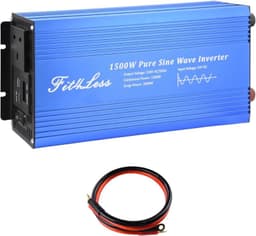
Fit4Less Fit4Less 1500W 24 V

Best overall

Fit4Less Fit4Less 1500W 24 V
6.4/10about £89.99
Renogy Renogy 1000W pure sine

Rank 3

Renogy Renogy 1000W pure sine
8.5/10about £113.99
On this page

Place it where it can cool

Fit4Less is the exception before you start. It is the only 24 V input in the set. Do not connect it to one 12 V battery. The cable advice below is the 12 V case. Waveform and continuous watts, if you have not chosen the box yet, are on the sine wave inverter buying guide. Ring’s UK instructions put the case indoors, cool and dry, with about 10 cm of clearance, not in a battery compartment and not near fuel. Mount it so the DC run stays short. If the cables are not in the box and not in the manual, stop before you improvise. Do not sit the inverter in the same sealed locker as the battery.

Fuse, then negative, then positive

Ring’s order is the one to copy unless your own manual contradicts it. Switch the inverter off. Fit an inline fuse in the positive lead, close to the battery positive post, so a short along the cable is protected. Connect black, negative, first. Connect red, positive, second. Reverse polarity is not a reset. Ring states that reverse polarity is not covered by the warranty. Expect a spark as the capacitors charge. That is a reason for the fuse and for doing this with the appliance unplugged, not a reason to skip the fuse. The fuse rating comes from the manual and from the cable you actually fitted, not from the peak watts on the carton. A fuse at the inverter end leaves the run back to the battery unprotected.
Fit4Less Fit4Less 1500W 24 V

Testsieger

Fit4Less Fit4Less 1500W 24 V
6.4/10about £89.99

Size the cable for continuous watts

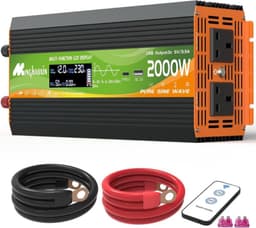
This page does not add a homemade cross-section chart. Follow the manual’s cable and fuse, and treat a hot supplied lead as a stop. On the Renogy 2000 W, owners call the supplied leads about 100 A and 4 AWG, short, and in several reports copper-coated aluminium, and they say the leads overheat. On the Renogy 3000 W, owners call the leads about 25 mm² and too light for roughly 170–250 A. One report says the leads reached about 80 °C on a 1500 W load. One MINGHAOXIN 2000 W review says the supplied set is for 100 A, about 1,200 W at 12 V. If your manual specifies a cross-section and a fuse, those figures win over a review.

First switch-on, and where you stop

Plug in one small load you already know, such as a lamp, with the battery clamps tight and the fuse in place. Switch on. If the case, the plug or the lead is hot within a minute or two, switch off. Red insulation, a smell, or a lead you cannot hold is the end of the test, not a cue to try the kettle. Leave the larger appliance for a second test only after the small one stays cool. Do not plug the inverter into a house socket to feed a ring main. BS 1363 plugs are not a way to push inverter power back into household wiring. A 2026 allowance for certain plug-in solar products, up to 800 W AC, is not permission to backfeed one of these battery inverters. Midsummer Energy’s wiring note makes the same split: their inverter socket is for one appliance; a distribution circuit needs an earth, an RCD, and preferably an electrician. One Renogy review says there is no neutral-earth bond, so a downstream RCD may not trip. That is one report. This page does not give a bonding recipe. Caravan hook-up, PME and that RCD limit are on sine wave inverter for a caravan.

Common questions

Where does the fuse go?
In the positive lead, close to the battery positive post, so a short in the cable is protected. A fuse only at the inverter leaves the run back to the battery bare. Use the manual’s fuse rating for the cable you fitted, not the peak watts on the title.
Which cable do I connect first?
With the inverter switched off, connect black, negative, first, then red, positive. That is the Ring order. Reverse polarity can damage the inverter, and Ring says that damage is outside the warranty. Expect a spark as the input capacitors charge.
What current should the cable be sized for at 2,000 W on 12 V?
About 185 A, using roughly 93 A per 1,000 W at about 90% efficiency. At 3,000 W the same rule is about 280 A. At 24 V the current halves. Follow the manual’s cable rather than a chart this page does not print, and stop if the supplied lead gets hot.
Can I plug the inverter into a house socket to run the ring main?
No. A BS 1363 plug is not a feed into household wiring. The plug-in solar allowance for certain products up to 800 W AC does not cover these battery inverters. One appliance in the inverter’s own socket is the DIY limit described by Midsummer Energy. A distribution circuit is an electrician’s job.
When do I stop and call an electrician?
When the AC side feeds a consumer unit, when shore power and the inverter could be live together, when an RCD trip is unproven, or when the lithium route is outside the manual. Do not invent a neutral-earth bond from a single review. Ring’s own safety text already points at a qualified electrician.

Related pages

Sources

Public UK sources are listed below. Shelf prices and star lines are the amazon.co.uk figures checked on 19 October 2026.

  1. Electrical Equipment (Safety) Regulations 2016 (retrieved 19 October 2026)
  2. GOV.UK: electrical equipment safety regulations 2016 (retrieved 19 October 2026)
  3. GOV.UK: UKCA and CE marking in Great Britain (retrieved 19 October 2026)
  4. Plugs and Sockets etc. (Safety) Regulations 1994 (retrieved 19 October 2026)
  5. IET: electrical installations in caravans and motor caravans (retrieved 19 October 2026)
  6. 12 Volt Planet: inverter guide (retrieved 19 October 2026)
  7. Camping and Caravanning Club: inverters (retrieved 19 October 2026)
  8. Ring Automotive: pure sine inverter instructions (retrieved 19 October 2026)