Independent comparisons. We may earn from shop links. More info

Pure sine wave vs modified sine wave

Updated: October 2026

You are comparing a £29.99 inverter whose title says 2000 W with a pure sine unit that costs more and admits a lower continuous figure. Pure sine wave vs modified sine wave is one decision: the shape of the 230 V output, and whether your loads will accept a stepped version of it. It is not a cable chart and not a ranking of every wattage. This page uses UK trade guides and the 12 amazon.co.uk listings in this comparison, captured on 19 October 2026. It is not a lab waveform test. A purchase from the table can earn a commission at no extra cost to you. The rows are on the [sine wave inverter comparison](/hub/electrical-equipment/sine-wave-inverter).

You are comparing a £29.99 inverter whose title says 2000 W with a pure sine unit that costs more and admits a lower continuous figure.

Our top picks

On this page

Two shapes, one mains frequency

Eleven of those listings print pure sine on the specification line. One prints modified sine. Buy pure sine unless every load is simple resistive heat, and read the specification line, because a 2000 W title can still be modified sine at 900 W continuous. Watts and the plug, once the shape is chosen, are on the sine wave inverter buying guide. UK mains are a smooth alternating wave at 50 Hz, nominally 230 V. A pure sine inverter is trying to copy that shape. A modified sine inverter builds a stepped approximation: the voltage sits high, then at zero, then high the other way. A smooth wave at the wrong frequency is still the wrong mains.

What copes with a stepped wave

Resistive heat is the case the UK guides still allow on modified sine. A kettle element or a simple heater turns extra distortion into heat in the element, which is what the element was for. TLC says modified sine suits kettles, heaters and many adaptors. That is the narrow yes. It is not a yes for the rest of the van. TLC says motors and microwaves run faster, quieter and cooler on pure sine, and it lists some chargers as unreliable on modified sine. Do not merge those sources into “modified is fine for electronics.” If the compressor is the load you care about, pure sine is the side to buy.

The 2000 W title that is modified sine

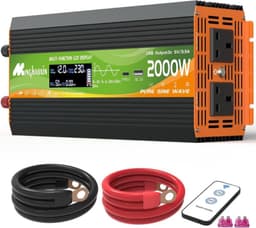
VeftBltrem, ASIN B0GZW314N1, is the modified listing kept in this set so the trap is visible. The specification line and a bullet say modified sine wave. Continuous power in the bullet is 900 W, with 2000 W peak, 12 V in, and 220–240 V at 50 Hz out. The title leads with 2000 W and does not say modified. The wattage field also says 2000 W. The price is £29.99. There is no review line and no review text. The warranty field says no. Connection and box contents are not stated. Plan from 900 W if you still want it, and only for simple resistive heat. Do not plan a microwave, a fridge, or a charger you cannot replace from a 2000 W title that the specification contradicts. The other eleven ASINs are pure sine on the specification line.

Pure sine is not unlimited watts

A pure sine label does not make the continuous watts true, and it does not turn a lighter socket into a kettle supply. BESTEK is pure sine at 300 W on a lighter plug, and reviews say a 10 A socket cannot supply that. Renogy’s pure sine units state 50 Hz and still ship with leads reviewers say overheat at 2000 W and 3000 W. Shape was not the failure in those reports. Current was. A smooth wave into a 10 A lighter plug is still about 100 W of useful AC.

Common questions

What is the actual difference in the waveform?
Pure sine aims at the smooth 50 Hz shape of UK mains. Modified sine uses a stepped approximation that is cheaper and electrically harsher. Guides from TLC, Shield Batteries and 12 Volt Planet describe the steps as the reason some equipment buzzes, runs hot, or will not run properly. Frequency still has to be checked separately.
Will a laptop charger run on modified sine?
It might. 12 Volt Planet still allows modified sine for a laptop, a charger or a television when price is the reason. The Camping and Caravanning Club does not extend that tolerance to CPAP or to switch-mode chargers it treats as sensitive. If the charger is awkward to replace, buy pure sine. A charger that happens to run is not a test of the next one.
Will a microwave, fridge or audio system cope?
UK guides expect microwaves and AC motors to run better on pure sine, with less heat and noise. TLC also flags audio buzz, some ballasts, variable-speed tools and some chargers on modified sine. They do not claim every fridge will be destroyed. For a motor or a microwave you rely on, pure sine is the side to buy, and you still need the continuous watts.
Is modified sine ever the right buy?
Yes, narrowly. Simple resistive heat, such as a kettle element or a heater, is the case TLC still puts on modified sine, and the Club allows a cheap modified unit beside a pure sine unit for other loads. It is the wrong default if any load is a motor, a microwave, audio, or kit you cannot afford to stop.
How do I spot modified sine if the title says 2000 W?
Read the specification line, not the title. VeftBltrem’s title says 2000 W and does not say modified. The bullet says modified sine and 900 W continuous, with 2000 W as peak. No reviews and a warranty field that says no are further reasons not to treat the title as the rating.
Does pure sine mean any appliance will run?
No. Pure sine removes the stepped-wave problem. It does not remove continuous watts, battery current, frequency or the socket limit. A pure sine 300 W lighter plug still cannot deliver 300 W from a 10 A socket, and a pure sine 2000 W unit can still have leads that overheat.

Related pages

Sources

Public UK sources are listed below. Shelf prices and star lines are the amazon.co.uk figures checked on 19 October 2026.

  1. Electrical Equipment (Safety) Regulations 2016 (retrieved 19 October 2026)
  2. GOV.UK: electrical equipment safety regulations 2016 (retrieved 19 October 2026)
  3. GOV.UK: UKCA and CE marking in Great Britain (retrieved 19 October 2026)
  4. Plugs and Sockets etc. (Safety) Regulations 1994 (retrieved 19 October 2026)
  5. IET: electrical installations in caravans and motor caravans (retrieved 19 October 2026)
  6. 12 Volt Planet: inverter guide (retrieved 19 October 2026)
  7. Camping and Caravanning Club: inverters (retrieved 19 October 2026)
  8. Ring Automotive: pure sine inverter instructions (retrieved 19 October 2026)