Independent comparisons. We may earn from shop links. More info

Sine wave inverter for a caravan

Updated: October 2026

You want 230 V in a caravan or motorhome from a leisure battery, and the tempting mistake is to push that power back into the hook-up inlet. A sine wave inverter for a caravan is a leisure-battery tool for loads the battery can actually supply. It is not a second mains supply in parallel with the site bollard. It is not a lab test and not a wiring diagram. A purchase from the table can earn a commission at no extra cost to you. Models and prices are on the [sine wave inverter comparison](/hub/electrical-equipment/sine-wave-inverter). Fuse position and polarity stay on [how to install a sine wave inverter](/hub/electrical-equipment/sine-wave-inverter/sub/sine-wave-inverter-how-to-install).

You want 230 V in a caravan or motorhome from a leisure battery, and the tempting mistake is to push that power back into the hook-up inlet.

Our top picks

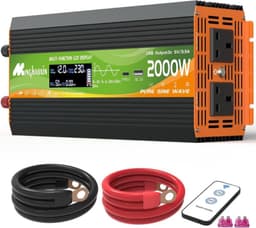
MINGHAOXIN MINGHAOXIN 2000W pure sine

Best overall

MINGHAOXIN MINGHAOXIN 2000W pure sine
8.1/10about £132.99
Renogy Renogy 1000W pure sine

Rank 3

Renogy Renogy 1000W pure sine
8.5/10about £113.99
On this page

Laptop and CPAP versus kettle and microwave

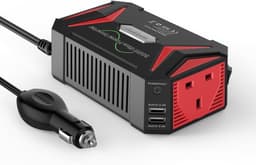
Split the loads before you split the budget. A laptop or a charger can live on a small pure sine inverter if you stay inside the socket. A 10 A lighter socket is on the order of 100 W of AC after losses. BESTEK is the pure sine lighter-plug listing, at £49.99 and 300 W on the label, and reviews say that socket cannot supply 300 W. A kettle does not belong on that plug. A microwave is the other end. That is a hard-wired inverter in the 1500–2000 W class, with cable for the battery current, not a dash socket. VeftBltrem, the modified-sine unit at £29.99, is the wrong default for a charger or a CPAP. Its bullet is 900 W continuous, whatever the 2000 W title says. The decision order for waveform and watts is on the sine wave inverter buying guide.

The leisure battery has to deliver the amps

Watts on the inverter become amps at the battery posts. A leisure battery’s amp-hour label is not the current it can deliver continuously. A 100 Ah battery is not a 100 A supply for an hour at the inverter’s full label, and it is not a reason to hang a 2000 W inverter on the starter battery. The starter battery’s job is to start the engine. Lithium banks add a BMS limit that can sit below the inverter’s draw. If that limit is outside the manual, the job has left DIY. Reviews on the Renogy 2000 W and 3000 W units say the supplied leads overheat. Fit4Less is 24 V only. A normal single 12 V leisure battery is the wrong input. The wattage field on that listing also says 1000 W, and there is one rating with no review text.

Hook-up is a separate supply

The Club’s line is plain: do not connect the inverter to the caravan sockets by plugging into the hook-up lead, and do not connect inverter output to the mains. A pure sine unit can still be overloaded, and a badly arranged feed can end up trying to charge the battery that is powering it. The hook-up inlet is for the site supply. It is not a convenient socket for your inverter. The moment you want the van’s own sockets to work from the battery, you are redesigning the AC side. If you want shore power and the inverter to change over, you still need a changeover that cannot backfeed the inlet.

When the van wiring is an electrician’s job

If your inverter will feed the van consumer unit, the RCD, the bonding and the inlet are an electrician’s design, not a bullet on an amazon.co.uk listing. This page does not turn Section 721 into a connection diagram. Do not put a PME earth bond onto the vehicle metalwork, and do not leave shore power and the inverter able to be live together. One Renogy review says earth and neutral cannot be bonded, so a downstream RCD will not trip. That is one report, not a recipe.

Common questions

Can I run a caravan kettle from a cigarette lighter?
No. A 10 A lighter socket is on the order of 100 W of AC after losses. BESTEK’s 300 W lighter-plug label is already more than reviews say that socket will supply. A kettle needs a hard-wired inverter and a leisure battery that can deliver the current, often around 185 A at 2,000 W on the 12 V planning rule.
What battery current does a microwave need?
Size from the input, not the cooking watts on the door. An 800 W oven can need about 1,100–1,300 W at the input, and one 700 W oven drew about 1,150 W in the 12 Volt Planet note. At 12 V and about 90% efficiency, 1,000 W of AC is about 93 A from the battery. The battery’s amp-hour figure is not that current.
Can I plug the inverter into the hook-up inlet?
No. The Camping and Caravanning Club says not to feed the caravan sockets from the inverter via the hook-up cable, and not to connect inverter output to the mains. The inlet is for the site supply. Joining the two can overload the inverter or try to charge the battery that is running it.
Will Renogy’s 50 ms transfer keep a computer running on site?
Not as a promise. The 1000 W, 2000 W and 3000 W Renogy listings claim 50 ms grid priority. That is not a computer-room UPS, and it does not mean every PC will ride through. It also does not allow shore power and the inverter to be paralleled on the hook-up inlet.
Is an inverter enough for a CPAP?
The Club recommends pure sine for CPAP and still says not to rely on an inverter alone if the kit is vital. Prefer hook-up or a generator for that use. None of these listings is medical advice, and this page does not give a runtime.
Do I need an electrician if the inverter feeds the van consumer unit?
Yes. Section 721, as the IET note describes it, includes a 30 mA RCD breaking all live conductors, bonding, and a BS EN 60309 inlet. That design, plus any shore-power changeover, is not a DIY reading of an inverter manual.

Related pages

Sources

Public UK sources are listed below. Shelf prices and star lines are the amazon.co.uk figures checked on 19 October 2026.

  1. Electrical Equipment (Safety) Regulations 2016 (retrieved 19 October 2026)
  2. GOV.UK: electrical equipment safety regulations 2016 (retrieved 19 October 2026)
  3. GOV.UK: UKCA and CE marking in Great Britain (retrieved 19 October 2026)
  4. Plugs and Sockets etc. (Safety) Regulations 1994 (retrieved 19 October 2026)
  5. IET: electrical installations in caravans and motor caravans (retrieved 19 October 2026)
  6. 12 Volt Planet: inverter guide (retrieved 19 October 2026)
  7. Camping and Caravanning Club: inverters (retrieved 19 October 2026)
  8. Ring Automotive: pure sine inverter instructions (retrieved 19 October 2026)