




Keep a stored battery topped up
You only need to hold a car, van, caravan or small-boat battery. The ECO-WORTHY 25 W kit is about £38.99, with a PWM controller, an SAE cable and brackets. It is a maintainer. It will not carry a motorhome roof load.
The best solar panel kits, compared.
Top pick: ECO-WORTHY 240W solar panel kit – Highest score in this set, 85, from 4.6 from 79 reviews and a full Z-bracket kit at about £164.49. The listing still clashes on 100 W versus 120 W panels, and one delivery contained only the panels. Best value: KOLLNIUN 240W solar panel kit – Cheapest two-panel kit whose wattage lines agree: 2 x 120 W, a 30 A controller and Z brackets at about £129.99. The 390 W kit costs more and its title disagrees with a 340 W spec field. Updated October 2026.


A solar panel kit is a set of photovoltaic modules sold with a charge controller and cables, often with brackets, to charge a 12 V battery. In the UK you buy one to top up a caravan, van, boat or shed battery, rather than to build a home array. A small panel maintains a stored battery. A mid-size panel suits light camping. A larger pair suits a van. A daily figure that assumes four hours at nameplate power is a listing claim, not a UK winter yield. PWM suits a small lead-acid maintainer. A larger array or lithium is where MPPT is the usual recommendation. 12 V is a system label. Panel voltage is higher, so series wiring must stay inside the controller input limit. Brackets, a roof gland and a battery fuse are often extra. A folding kit clips on. Fixed wiring in a dwelling falls under Part P and BS 7671 in England and Wales. Clips on a van battery do not. Watt band, controller and mounting are set out in the [solar panel kit buying guide](/hub/electrical-equipment/solar-panel-kit/sub/solar-panel-kit-buying-guide).
A solar panel kit is a set of photovoltaic modules sold with a charge controller and cables, often with brackets, to charge a 12 V battery.

26 products checked · 62 hrs invested · +21,800 readers
Swipe for more
1-2 of 7


Personal buying guide
Question 1 of 2
What do you need the kit to do?
The ECO-WORTHY 240 W kit is the fixed array UK reviewers bolted to van roofs and left holding a leisure battery, including on duller days. Named fits include a Renault Trafic, a VW T4, a Sprinter, and a log cabin, and one buyer charged a 100 Ah battery in just over a day. The box lists a 30 A controller with two USB ports at 5 V 2 A, Z brackets, MC4 leads, a 16 ft pair, and Y connectors, at £164.49. Amazon shows 4.6 from 79 reviews, the highest star line in this set, and on these scores it is the top pick. You still supply nuts for the self-tapping screws, roof sealant, and a cable gland, and you need a basic grasp of 12 V wiring. The listing disagrees with itself: the title says 240 W, a package line says 2 x 100 W, and a highlight says 2 x 120 W. One delivery contained only the two panels, and one review says the panels overheated and then stopped.
Pros
Cons
Best for: A campervan or cabin 12 V battery if you can finish the roof glands and you live with the wattage clash.
Less suitable: A buyer who wants one wattage figure on the listing, or a fold-flat panel for weekends.
Specifications
Common questions
Does this kit include a charge controller and brackets?
Yes. The package list includes a 30 A controller with two USB ports, 16 ft solar cables, a tray cable, Y connectors and Z mounting.
Do the wattage lines on the listing match?
The title says 240 W. The package bullet says two 100 W panels. The highlight says two 120 W panels.
Can the panels be wired for 24 V?
The listing says the kit can be connected in series for 24 V or in parallel for 12 V.
The ECO-WORTHY bifacial kit is two rigid panels and a 30 A PWM controller for a motorhome, boat, or similar 12 V bank. One UK reviewer saw more than 200 W into a battery, another saw useful voltage on a cloudy day, and the notes include 12 V loads such as a water heater and TVs. The title says 390 W from 2 x 195 W panels, a spec field says 340 W, the weight is 23.5 kg, and the price is £209.99, with Y-branch leads, a 16 ft pair, USB at 5 V 2 A, and corner brackets. Amazon shows 4.5 from 105 reviews. More than one reviewer blamed the PWM controller for lost panel watts and fitted an MPPT unit instead. Brackets were not pre-drilled, screws were missing, or the feet did not suit a roof rack, and a Ford Transit Custom took only one panel. The kit ships as two parcels, and more than one review describes a panel that arrived broken and was replaced.
Pros
Cons
Best for: A larger motorhome or boat roof if you can mount both panels and you may replace the PWM controller.
Less suitable: A short van roof, such as a Transit Custom that fitted only one panel, or a single-parcel order.
Specifications
Common questions
Does this kit include a controller and brackets?
Yes. The package is two panels, a 30 A controller with two USB ports, 16 ft cables, Y connectors and corner brackets.
Does it arrive in one box?
The listing says the panels are in one package and the controller, cables and brackets are in the other.
What power does the listing state?
The title and package say 390 W from two 195 W panels. A specification field says maximum power 340 W.
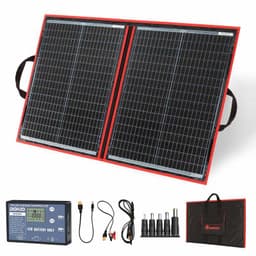
The DOKIO kit folds into a fabric case and clips onto a 12 V leisure battery in direct sun. UK reviewers topped up caravan and camper batteries, and they ran phones and power banks from the two USB outputs on the 10 A controller. The panel is listed at 100 W, 18 V DC, 6.1 A, and 2.7 kg, with a 9.8 ft SAE-to-XT60 lead, an alligator lead, and five DC adapters, at £79.99. Amazon shows 4.4 from 1,325 reviews, the largest sample here. Several UK reviews measured about 50 W, including 52 W at midday, rather than the 100 W title. There is no fold-out tilt stand, so the panel lies flat or has to lean, and cloud cuts output sharply. One plug worked only when it was held, one unit failed on a later trip, and the jack plugs did not suit a Jackery Explorer 1000.
Pros
Cons
Best for: A caravan or camper battery you can clip on in full sun, plus light USB charging.
Less suitable: Anyone counting on 100 W, a tilt stand, or a direct Jackery Explorer 1000 lead.
Specifications
Common questions
Does this kit include a charge controller?
Yes. The bullets include a 100 W panel, a 10 A controller and the listed cables and adapters.
Does it fold?
Yes. The title and bullets describe a foldable panel with a fabric pocket and carry handle.
Is a tilt stand included?
UK reviews say there is no fold-out stand, so the panel is laid flat or leant against something.
The ECO-WORTHY 25 W kit keeps a small 12 V battery topped up. UK reviews cite a Ford Transit with a parasitic drain, a caravan leisure battery behind a window at a poor angle, a fishing-boat battery, and a truck fitted in about five minutes. At £38.99 the box has the 25 W panel, a PWM controller the listing calls waterproof, an SAE cable, corner guards, and mounting brackets. The listing names LiFePO4, AGM, SLA, lithium-ion, gel, and MF, and one buyer had two battery-end types. Amazon shows 4.4 from 16 reviews, with only nine written notes, so the complaint list is thin. One box had no instructions, and a longer run needed an extra lead. A 25 W panel will not carry a motorhome roof load.
Pros
Cons
Best for: A car, van, caravan, or small-boat battery you only need to keep topped up.
Less suitable: A motorhome roof load, or a daily watt-hour target this 25 W panel cannot meet.
Specifications
Common questions
Does this kit include a charge controller?
Yes. The listing includes a 25 W panel, a PWM charge controller described as waterproof, and an SAE cable.
Are mounting brackets included?
Yes. The title and the item highlight include mounting brackets and corner guards.
Which 12 V batteries does the listing name?
The bullets name LiFePO4, AGM, SLA, lithium-ion, gel and MF batteries.
The Hoysicy 100 W kit is one rigid panel and a 20 A PWM controller for a 12 V battery. The listing gives 36 cells, 18 V output, 21.6 V maximum, 5.56 A, a 51 x 2.5 x 101 cm panel at 6.5 kg, and 16.4 ft extension cables, at £79.99. Amazon shows 4.3 from 67 reviews. None of the 12 written reviews is marked United Kingdom, so the comments below are United States notes on the same listing. Those notes describe an easy fit on a cab-over camper and an RV, a sailboat battery kept charged, and pre-drilled holes. They also say the glass was thinly packed, alligator clips were missing or swapped for post terminals, and one controller did not stop overcharging. Components were reported rusted within weeks. Brackets are not listed, and the listing does not answer whether 24 V is supported.
Pros
Cons
Best for: A 12 V camper or boat battery only if you accept that the written notes are from the United States.
Less suitable: A UK buyer who wants UK reviews, listed brackets, or a clear 24 V answer.
Specifications
Common questions
Does this kit include a charge controller?
Yes. The included-components line is one 100 W panel, a 20 A controller and solar cables.
Does the listing confirm 24 V batteries?
A question on the page asks about 24 V systems. The visible bullets describe 12 V charging and do not confirm 24 V.
Are alligator clips guaranteed in the box?
The included-components line says solar cables. Reviews on the listing disagree about whether alligator clips arrived.
The KOLLNIUN kit puts two rigid 120 W panels and a 30 A PWM controller on a fixed 12 V array. One UK review measured about 200 W on the ground on a bright winter day and called the panels solid, with the Z brackets. At £129.99 it is £34.50 below the other 240 W kit in this set, which is why it is the best value here, with branch connectors and a 16.4 ft pair stated as 2.5 mm². Amazon shows 4.2 from 13 reviews, and only four of them are written notes. Those notes include a regulator screen that did not work and leads judged at about 2 mm² on the panels and about 1 mm² to the battery. In one review, one of two panels arrived dead, with an unsoldered tab in the junction box, and a delivery to Ireland arrived damaged and was returned. The same manual reading put the controller input near 23 V, so that reviewer paralleled the panels instead of wiring them in series on a 12 V battery.
Pros
Cons
Best for: A starter 12 V array if you parallel the panels and you can return a dead module.
Less suitable: Anyone who wants a deep review sample, or series wiring of both panels on a 12 V battery.
Specifications
Common questions
Does this kit include a charge controller?
Yes. The listing is two 120 W panels, a 30 A PWM controller, a branch connector, solar cable and Z brackets.
Can the two panels be wired in series?
The bullets say the kit suits 12 V or 24 V batteries. A UK review says the controller 12 V input limit is about 23 V and the panels were paralleled.
Are brackets included?
Yes. The included-components line lists Z brackets.
The Hoysicy 30 W kit trickle-charges a 12 V battery through a 10 A controller the bullets call PWM. UK notes say setup was easy, a boat battery stayed charged, and a flat battery came back on a very sunny day, with more than one cable option. The panel is listed at 1.11 A and 2.54 kg, with two 6.5 ft leads, alligator clips, and O-ring terminals, at £39.99. Amazon shows 4.1 from 204 reviews. Mounting feet are not in the package list, a UK reviewer found no USB-C, and the bullets do not name lithium. A UK review says one unit was defective and caught fire on installation. The maximum-voltage field reads 1000 V, which is not a usable open-circuit figure.
Pros
Cons
Best for: A shed, gate, or small boat battery if you can check the controller before you leave it connected.
Less suitable: A LiFePO4 bank, a USB-C load, or anyone who wants mounting feet in the box.
Specifications
Common questions
Does this kit include a charge controller?
Yes. The package line is a 30 W panel, a 10 A controller, and two 6.5 ft cables with alligator clips and O-ring terminals.
Are mounting feet in the box?
The package list does not include feet or brackets. It does mention pre-drilled holes and corner protectors.
Does the listing promise USB-C?
The connector-type field says USB. A UK review says there is no USB-C.
Seven amazon.co.uk solar panel kit listings were scored from the shelf and the written reviews as of 19 October 2026. This is not a lab test. A manufacturer daily-energy line is not treated as measured output. Deductions cover a thin review sample, conflicting wattage lines, a dead or broken panel, a series limit, and a review that reports a unit catching fire.
Stars
30%amazon.co.uk stars in fixed bands: 4.1 scores 18, 4.2 scores 21, 4.3 scores 24, 4.4 scores 26, 4.5 scores 28 and 4.6 scores 30.
Review count
15%Under 20 reviews scores 4, 50 to 99 scores 10, 100 to 299 scores 13, and 300 or more scores 15.
Kit contents
25%Panel and controller, brackets, leads, named battery types, controller headroom, and a folding case or bifacial panels. A 30 A PWM unit on a 12 V array near 390 W scores no headroom.
Review sentiment
20%Repeated practical use in the review notes, minus ordinary complaints. Serious defects are separate deductions, not a second cut in this block.
Price per rated watt
10%Shelf price divided by the titled watts. At or under £0.55 per watt scores 10, then the bands step down to 3 once the price is above £1.50 per watt.
Use this guide to match a kit to a 12 V job before you read the table. Wattage, controller chemistry and mounting are the checks that stay useful when the brand changes. A maintainer, a camping panel and a van array are different purchases. The scores on this page come from amazon.co.uk listings and reviews dated 19 October 2026, not from a lab.
A solar panel kit is a retail set of one or more photovoltaic modules sold with a charge controller and cables, and often with brackets, to charge a 12 V battery. Most UK buyers use one to top up a caravan, van, boat or shed battery. A certified home array is a different purchase. None of the kits in this comparison includes a battery or a mains inverter. The first check is the job and the energy you need in a day. A 25–30 W kit maintains a stored battery. About 100 W suits light camping.

A module on its own is not a kit for a 12 V battery. The controller is what limits charge voltage. Every kit in this set includes a PWM controller, and you still have to confirm it lists your battery chemistry.
A daily kilowatt-hour figure that assumes four hours at nameplate power is a listing claim. It is not a measured UK average and it is not a winter yield. Size the kit for the job, then expect cloud and a flat angle to cut the result.
12 V on the title is a system label. Panel voltage is higher. One reviewer read an input limit of about 23 V on a 12 V setting and paralleled the panels. Connect the battery before the panel, and do not lengthen a thin lead with more thin cable.
Start with the battery job, not the largest wattage in the title. A 25–30 W kit maintains a stored battery in a car, van, caravan or small boat. About 100 W suits light camping and a day of USB charging. About 240–390 W is the range UK reviewers fit when a leisure battery has to support a campervan. A per-day kilowatt-hour line assumes four hours at the nameplate power. Treat it as a listing claim. It is not a UK winter yield, and it is not a measured average.
PWM is acceptable on a small lead-acid maintainer. For a larger array, shade or a lithium battery, MPPT is the usual UK recommendation, once the array is more than a trickle charger. Confirm the listing names your chemistry. A 12 V or 12/24 V title is a system label. Panel voltage is higher, and series wiring can exceed a 12 V input limit. One reviewer paralleled two panels after reading a limit of about 23 V.
Three typical situations, each with a recommendation from this comparison.
You only need to hold a car, van, caravan or small-boat battery. The ECO-WORTHY 25 W kit is about £38.99, with a PWM controller, an SAE cable and brackets. It is a maintainer. It will not carry a motorhome roof load.
You have roof space and you can finish glands and sealant. The ECO-WORTHY 240 W kit is about £164.49, with a 30 A controller and Z brackets. It is the top pick on these scores. The listing still disagrees on panel wattage.
You want a fixed pair and you will stop if the job becomes a new mains circuit. The KOLLNIUN kit is about £129.99, with two 120 W panels, a 30 A PWM controller and Z brackets. Parallel the panels if the 12 V input limit is about 23 V. The review sample is 13.
In this set of seven amazon.co.uk kits, the top pick is the ECO-WORTHY 240 W kit at about £164.49, with 4.6 from 79 reviews and a score of 85. It is a fixed array with a 30 A controller, Z brackets and MC4 leads, and the wattage lines on the listing still disagree. The best value is the KOLLNIUN 240 W kit at about £129.99: two 120 W panels whose wattage lines agree, with Z brackets and a 30 A PWM controller. The 25 W and 30 W kits are battery maintainers, not a cheaper version of that array. Scores use listing data and reviews, not a lab test, and none of these kits is MCS certified.
ECO-WORTHY 240W solar panel kit
Highest score in this set, 85, from 4.6 from 79 reviews and a full Z-bracket kit at about £164.49. The listing still clashes on 100 W versus 120 W panels, and one delivery contained only the panels.

KOLLNIUN 240W solar panel kit
Cheapest two-panel kit whose wattage lines agree: 2 x 120 W, a 30 A controller and Z brackets at about £129.99. The 390 W kit costs more and its title disagrees with a 340 W spec field.
Editorial

Peter F. is the editor for DIY & tools at productscompared.co.uk. Comparisons in this category are checked against amazon.co.uk listings, review evidence and public UK sources.
Guides on what to look for, how to use a product, and common mistakes.
Public UK sources and the amazon.co.uk listings used for this comparison. Prices and star ratings are the listing lines from 19 October 2026.
Expert source (DIY & tools): Charlie White (Charlie DIYte) (external profile) – public expert commentary used as a research source, not as a contributor to our pages.
This page contains affiliate links to amazon.co.uk. If you buy through them, we may earn a commission at no extra cost to you. Scores use listing data and published reviews, not a lab test.