Independent comparisons. We may earn from shop links. More info

Best solar panel kit for a 12 V battery

Updated: October 2026

A caravan left on a drive through a British winter, a folding panel in the boot, and a rigid pair on a van roof are three jobs. Search pages still fold them into one best solar panel kit. In this set the cheapest amazon.co.uk listing is a £38.99 maintainer and the dearest is a £209.99 pair stated as 390 W. The [Solar panel kit comparison](/hub/electrical-equipment/solar-panel-kit) holds the seven-kit table. This page says who each shortlisted kit is for, and who should leave it. If you still need a watt band before a model, use the [solar panel kit buying guide](/hub/electrical-equipment/solar-panel-kit/sub/solar-panel-kit-buying-guide).

A caravan left on a drive through a British winter, a folding panel in the boot, and a rigid pair on a van roof are three jobs. Search pages still fold them into one best solar panel kit.

Our top picks

On this page

Best for keeping a stored battery charged

When the battery only has to stay off the floor while a van or caravan sits unused, 25–30 W matches the job. An alarm and a little self-discharge on a lead-acid leisure battery do not need a roof of glass. The storage pick is the ECO-WORTHY 25 W (B0G2R7BXBM), at £38.99 with 4.4 from 16 ratings. You get a small rigid panel, a PWM controller, and brackets. Sixteen ratings is a thin sample, and buyers say the instructions are thin, so you set the battery profile yourself before the kit sits for a month. The Hoysicy 30 W (B097J9RXX3) was £39.99 with 4.1 from 204 ratings. For a stored lead-acid battery that will sit unattended, take the 25 W ECO-WORTHY if you can live with fewer reviews.

Best folding kit in this set

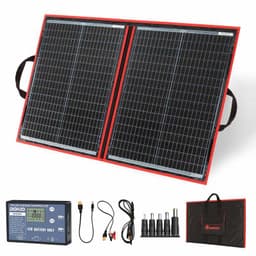
The only folding kit here is the DOKIO 100 W (B07YKQGRTM), at £79.99 with 4.4 from 1,325 ratings, a 10 A PWM controller, and a fabric case. That review count is why it is the portable pick. It is a poor permanent mount on a van roof. There is no tilt stand, so a chair, a cool box, or the side of the van is how you aim the glass. If the panel will live in one place, a rigid pair with brackets is the clearer roof buy. Connection order, the fuse at the battery, and the profile you set are in how to connect a solar panel kit.

Best fixed kit for a van roof in this set

The fixed kit UK reviewers in this set describe fitting is the ECO-WORTHY pair listed as 240 W (B0DGL5BC9Q). It was £164.49, with 4.6 from 79 ratings, and brackets are included. The title says 240 W, and the listing disagrees on whether each panel is 100 W or 120 W. Treat the module size as unresolved until both panels are in front of you. The step up in stated watts is the ECO-WORTHY kit listed as 390 W (B09XV2G1DJ), at £209.99 with 4.5 from 105 ratings and a stated weight of 23.5 kg. The title says two 195 W bifacial panels, and a spec field says 340 W. Keep or replace it using PWM or MPPT. Take the 390 W kit only when the roof can carry 23.5 kg and you have already decided what to do about PWM.

What to skip

The Hoysicy 100 W rigid kit (B0HCY1VBHL) was £79.99 with 4.3 from 67 ratings on the UK page. The written reviews on that listing are from the United States, so they do not describe a wet British roof or a short December day on a caravan. Skip the Hoysicy 100 W when you are buying from this set for a UK van or a UK pitch. The KOLLNIUN 240 W (B0DJY3NK6L) was £129.99 with 4.2 from 13 ratings, brackets included, so the price undercuts the ECO-WORTHY 240 W on paper. Thirteen ratings is a tiny sample for a kit you might bolt to a roof, and buyers in it report a screen fault and a dead panel. The ECO-WORTHY 240 W has the fuller UK fitting record, and you still live with its wattage conflict.

Common questions

What is the best kit if I only need to stop a battery going flat?
For a lead-acid battery in storage, the ECO-WORTHY 25 W at £38.99 is the pick: a small panel, a PWM controller, and brackets. Sixteen ratings and thin instructions are the limit. The Hoysicy 30 W has 204 ratings at £39.99 and lists AGM, flooded, and gel, and it also carries a UK fire report plus a review that says the controller does not suit lithium.
What if I want something I can pack in the boot?
The DOKIO 100 W is the folding kit, at £79.99 with a fabric case and a 10 A controller. The 1,325 ratings make it the portable pick. UK comments that describe about half the stated watts, and the missing tilt stand, mean a flat panel on a grey pitch will lag the label.
Is the dearest kit the best because it says 390 W?
Stated watts are the wrong test on their own. The £209.99 ECO-WORTHY listing says 390 W and two 195 W bifacial panels, while a spec field says 340 W. Reviewers attack the PWM controller, and a title wattage is a poor stand-in for a dull British day.
Which kit has the weakest UK review evidence?
The KOLLNIUN 240 W is the weak sample among the van-style pairs: 13 ratings, a reported screen fault, and a reported dead panel. The Hoysicy 100 W has 67 ratings, and the written reviews are American, so they do not answer a UK roof.
Which kits are a poor match for lithium?
The Hoysicy 30 W bullets name AGM, flooded, and gel, and a review says that controller does not suit lithium. A lithium leisure battery, or a larger array on a van, is where you look hard at replacing that controller, and the replacement still has to list your chemistry.

Related pages

Sources

Public UK sources and the amazon.co.uk listings used for this comparison. Prices and star ratings are the listing lines from 19 October 2026.

  1. GOV.UK: Register energy devices in homes or small businesses (retrieved 19 October 2026)
  2. legislation.gov.uk: GPDO 2015 Schedule 2 Part 14 (retrieved 19 October 2026)
  3. GOV.UK: VAT Notice 708/6, energy-saving materials (retrieved 19 October 2026)
  4. GOV.UK: VAT on energy-saving products (retrieved 19 October 2026)
  5. National Grid: G98 microgeneration (retrieved 19 October 2026)
  6. Electrical Safety First: solar panels (retrieved 19 October 2026)
  7. MCS: why certification matters (retrieved 19 October 2026)
  8. Azeco: PWM versus MPPT charge controllers (retrieved 19 October 2026)