Solar panel kit for a campervan
You are packing a short campervan for a long weekend in the Peak District. The leisure battery is already under the seat, and the pitch has no electric hook-up. A solar panel kit for a campervan earns its place only if the panels sit on that roof, or fold out beside the van, and the cable reaches the battery without a leak. The watt figure on the title does not decide it. The [Solar panel kit comparison](/hub/electrical-equipment/solar-panel-kit) lines the kits up. This page stays on the vehicle: a panel you pack away at the pitch, or a fixed pair that charges while you are out walking.
You are packing a short campervan for a long weekend in the Peak District. The leisure battery is already under the seat, and the pitch has no electric hook-up.
You are packing a short campervan for a long weekend in the Peak District. The leisure battery is already under the seat, and the pitch has no electric hook-up. A solar panel kit for a campervan earns its place only if the panels sit on that roof, or fold out beside the van, and the cable reaches the battery without a leak. The watt figure on the title does not decide it. The Solar panel kit comparison lines the kits up. This page stays on the vehicle: a panel you pack away at the pitch, or a fixed pair that charges while you are out walking.
Our top picks
| Badge | Product | Rated power | Foldable | Brackets | Note | Price | Offer |
|---|---|---|---|---|---|---|---|
| Best overall |  ECO-WORTHY ECO-WORTHY 240W solar panel kit | 240 W stated; lines also say 2 x 100 W and 2 x 120 W | No | Z brackets | 8.5 | about £164.49 | View offer |
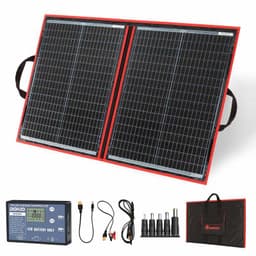
 DOKIO DOKIO 100W foldable solar panel kit | 100 W | Yes | No tilt stand in UK reviews | 7.5 | about £79.99 | View offer | |
| Best value |  KOLLNIUN KOLLNIUN 240W solar panel kit | 240 W (2 x 120 W) | No | Z brackets | 6.0 | about £129.99 | View offer |


On this page
A folding kit at the pitch, or panels on the roof
What UK reviewers actually bolted on
Weight, brackets, and the cable hole
Winter light and a compressor fridge
Common questions
Will a folding 100 W kit run a camper for a week?
Do I need to drill the campervan roof?
Are the brackets enough, or do I still buy sealant and a gland?
Can both panels of the 390 W kit fit a short van?
Will solar alone run a compressor fridge in a British winter?
Do I need a leisure battery as well?
Related pages
Sources
Public UK sources and the amazon.co.uk listings used for this comparison. Prices and star ratings are the listing lines from 19 October 2026.
- GOV.UK: Register energy devices in homes or small businesses (retrieved 19 October 2026)
- legislation.gov.uk: GPDO 2015 Schedule 2 Part 14 (retrieved 19 October 2026)
- GOV.UK: VAT Notice 708/6, energy-saving materials (retrieved 19 October 2026)
- GOV.UK: VAT on energy-saving products (retrieved 19 October 2026)
- National Grid: G98 microgeneration (retrieved 19 October 2026)
- Electrical Safety First: solar panels (retrieved 19 October 2026)
- MCS: why certification matters (retrieved 19 October 2026)
- Azeco: PWM versus MPPT charge controllers (retrieved 19 October 2026)