How to choose a 12 V solar panel kit
You have a leisure battery going flat in a caravan on the drive, a van between trips, or a shed lamp that fades after a grey week. On amazon.co.uk the boxes look alike: a panel, a small controller, and a price from about £39 to £210. A 12 V solar panel kit in that range charges a 12 V battery. Finish this page knowing whether you are maintaining a stored battery, covering a light weekend, or trying to live from the roof. The [Solar panel kit comparison](/hub/electrical-equipment/solar-panel-kit) lists the seven kits once that class is clear. Watts, the controller, and the parts still missing from the box should narrow the list before you compare models.
You have a leisure battery going flat in a caravan on the drive, a van between trips, or a shed lamp that fades after a grey week.
You have a leisure battery going flat in a caravan on the drive, a van between trips, or a shed lamp that fades after a grey week. On amazon.co.uk the boxes look alike: a panel, a small controller, and a price from about £39 to £210. A 12 V solar panel kit in that range charges a 12 V battery. Finish this page knowing whether you are maintaining a stored battery, covering a light weekend, or trying to live from the roof. The Solar panel kit comparison lists the seven kits once that class is clear. Watts, the controller, and the parts still missing from the box should narrow the list before you compare models.
Our top picks
| Badge | Product | Rated power | Controller | Brackets | Note | Price | Offer |
|---|---|---|---|---|---|---|---|
| Best overall |  ECO-WORTHY ECO-WORTHY 240W solar panel kit | 240 W stated; lines also say 2 x 100 W and 2 x 120 W | 30 A, USB 5 V 2 A | Z brackets | 8.5 | about £164.49 | View offer |
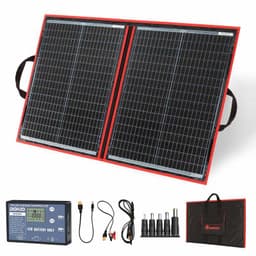
 DOKIO DOKIO 100W foldable solar panel kit | 100 W | 10 A, USB outputs | No tilt stand in UK reviews | 7.5 | about £79.99 | View offer | |
 ECO-WORTHY ECO-WORTHY 25W 12V solar panel kit | 25 W | PWM, waterproof as listed | Yes | 6.8 | about £38.99 | View offer |


On this page
What a 12 V kit is for
Match watts to the job
Controller, brackets, and the parts still to buy
How to read a listing that disagrees with itself
Common questions
Does a solar panel kit include the charge controller?
Is 25 W or 30 W enough to keep a stored leisure battery alive?
Is 100 W enough for a weekend, or do I need two panels?
Why do the daily kilowatt-hour claims assume four hours?
Should the controller be PWM or MPPT on an unshaded shed?
What is not in the box?
Do I need planning permission or an MCS certificate for a van kit?
Related pages
Sources
Public UK sources and the amazon.co.uk listings used for this comparison. Prices and star ratings are the listing lines from 19 October 2026.
- GOV.UK: Register energy devices in homes or small businesses (retrieved 19 October 2026)
- legislation.gov.uk: GPDO 2015 Schedule 2 Part 14 (retrieved 19 October 2026)
- GOV.UK: VAT Notice 708/6, energy-saving materials (retrieved 19 October 2026)
- GOV.UK: VAT on energy-saving products (retrieved 19 October 2026)
- National Grid: G98 microgeneration (retrieved 19 October 2026)
- Electrical Safety First: solar panels (retrieved 19 October 2026)
- MCS: why certification matters (retrieved 19 October 2026)
- Azeco: PWM versus MPPT charge controllers (retrieved 19 October 2026)