Independent comparisons. We may earn from shop links. Our editors compare products independently. Some links go to shops, and we may earn a commission. More info
Top pick: K&S KSB 21i S Best value: K&S KSB 21i – Lowest price among the 230 V listings around 2,000 W running, at about £271.00, score 74, from 3.7 and 10 reviews. BS 1363 is not named, it ships without oil, and the saved texts are from Germany and France. Updated 22.10.2026.
An inverter generator is a petrol engine and an electronic inverter in one portable box. The inverter lets the AC output feed phone chargers and laptops without the engine holding one fixed speed. In the UK you buy one for a pitch with no hook-up, a garden job, or a short power cut, and you run it outdoors only.
For a British appliance, start with 230 V at 50 Hz and a socket you can use. A BS 1363 13 A socket takes a UK plug. An EU 16 A, VDE or TT-30R outlet does not. Plan on running watts, not the peak in the title. A 13 A circuit is about 2,990 W at 230 V.
Voltage, the socket and running watts are set out in the [inverter generator buying guide](/hub/electrical-equipment/inverter-generator/sub/inverter-generator-buying-guide).
Run it outdoors only, with the exhaust clear of doors, windows, tents and awnings. A carbon monoxide shut-off does not make indoor use safe. Many of these engines are shipped dry, and a low-oil shut-off will not fill the crankcase.
An inverter generator is a petrol engine and an electronic inverter in one portable box. The inverter lets the AC output feed phone chargers and laptops without the engine holding one fixed speed.
An inverter generator is a petrol engine and an electronic inverter in one portable box. The inverter lets the AC output feed phone chargers and laptops without the engine holding one fixed speed. In the UK you buy one for a pitch with no hook-up, a garden job, or a short power cut, and you run it outdoors only.
For a British appliance, start with 230 V at 50 Hz and a socket you can use. A BS 1363 13 A socket takes a UK plug. An EU 16 A, VDE or TT-30R outlet does not. Plan on running watts, not the peak in the title. A 13 A circuit is about 2,990 W at 230 V.
Voltage, the socket and running watts are set out in the [inverter generator buying guide](/hub/electrical-equipment/inverter-generator/sub/inverter-generator-buying-guide).
Run it outdoors only, with the exhaust clear of doors, windows, tents and awnings. A carbon monoxide shut-off does not make indoor use safe. Many of these engines are shipped dry, and a low-oil shut-off will not fill the crankcase.
An inverter generator is a petrol engine and an electronic inverter in one portable box. The inverter lets the AC output feed phone chargers and laptops without the engine holding one fixed speed. In the UK you buy one for a pitch with no hook-up, a garden job, or a short power cut, and you run it outdoors only. For a British appliance, start with 230 V at 50 Hz and a socket you can use. A BS 1363 13 A socket takes a UK plug. An EU 16 A, VDE or TT-30R outlet does not. Plan on running watts, not the peak in the title. A 13 A circuit is about 2,990 W at 230 V.
The K&S KSB 21i S lists 230 V at 50 Hz, 2,000 W in both the running and starting fields, a 4 litre tank and a weight of 21 kg, at £347.03. The amazon.co.uk line is 5.0 from 4 reviews, which is why the score is 100, the highest number in this set. The two saved texts are from Italy and Germany, so that line is a very small sample from outside the United Kingdom. Economy mode and pure sine are claimed, BS 1363 is not named, and the outlet-count field says 1. A noise field prints 70/95 with no distance, so it cannot be ranked against a figure taken at 7 metres. The displacement field says 1.8 litres beside a 21 kg set, which reads as a listing error. It costs about £76 more than the KSB 21i for the same running watts and the same weight, with no separate surge printed. The score reflects four five-star ratings, not a confirmed UK plug.
Pros
5.0 from 4 reviews, score 100
230 V, 50 Hz, 4 litre tank and economy mode listed
Pure sine claimed
21 kg
Cons
Only four reviews, saved from Italy and Germany
BS 1363 is not named
Starting watts equal the 2,000 W running figure
1.8 litre displacement field, and 70/95 with no distance
Best for: You want the 2,000 W K&S row that states a 4 litre tank, and you can live with an unnamed socket.
Less suitable: You are choosing from the star score alone, or you need a named UK 13 A socket and a separate surge figure.
The K&S KSB 12i S is the light case in this set, at 13 kg, with a 2.5 litre tank and a claimed runtime of 2 hours that does not state the load, priced at £280.00. The running field says 1.2 kW and another wattage field says 1 kW, with starting watts listed at 1,500 W, so a kettle around 3 kW is outside this continuous figure. The star line is 4.8 from 6 reviews, which is why the score is 96, and the saved texts are not from the United Kingdom. The page states 230 V and 50 Hz and mentions USB in the title, yet it does not name a BS 1363 socket. Technical fields print 357 cubic centimetres and 1.2 kiloamps beside a 1.2 kW title, which you should not plan a job around. Pure sine is claimed, a 12 V vehicle socket is listed in the box, and a parallel cable is described as possibly included. Low-oil shut-off is not stated. You can lift it more easily than the 21 kg K&S rows, and the running watts still will not cover a microwave at the indicative 1,500 W.
Pros
13 kg, the lightest listing in this set
230 V and 50 Hz stated, with pure sine claimed
2.5 litre tank and USB named in the title
4.8 from 6 reviews
Cons
Running field 1.2 kW, with a separate field that says 1 kW
BS 1363 is not named
357 cc and 1.2 kA fields sit beside a 1.2 kW title
Six reviews, and the saved texts are not from the United Kingdom
Best for: You want a liftable 230 V case for lights, chargers and a small fridge's running load, and you will ignore the odd displacement field.
Less suitable: You need a kettle, a microwave near 1,500 W, or a socket the listing names as BS 1363.
The PowerSmart 2500W lists two 120 V 15 A three-prong outlets, a 12 V DC socket, USB and parallel ports, at £800.87, with 1,900 W running and 2,500 W starting. The frequency field says 50 Hz while the outlets are described as 120 V, and BS 1363 is not listed. It is one of only two rows here that name a carbon monoxide auto shut-off. The noise bullet prints 52 dBA from 23 feet at 25% load and 59 dBA from 23 feet at full load, with a THD claim under 3%. That is the only distance in this set, and it is still not a 7 metre test you can rank against listings that print no decibels. The star line is 4.7 from 17 reviews, and the saved texts are marked United States. Weight is 19.1 kg in one field and 39.7 lb in the bullet, which do not match, and economy mode and low-oil shut-off are listed. The tank is given as 1.05 imperial gallons, with 5.5 hours at 50% load in the bullet and 5 hours in a field, and a CO sensor does not make a garage safe or give you a UK kettle.
Pros
Carbon monoxide auto shut-off, economy mode and low-oil shut-off listed
The only noise figure in the set that includes a distance
Parallel ports and a THD claim under 3%
4.7 from 17 reviews
Cons
120 V outlets, with a 50 Hz field that conflicts
£800.87 for 1,900 W running
19.1 kg in one field versus 39.7 lb in the bullet
Reviews marked United States
Best for: You want a 120 V inverter that lists a CO shut-off and a noise figure with a distance, and your appliances are 120 V.
Less suitable: You need 230 V UK mains, or you want to rank 52 dBA against sets that print no distance.
The voltage field says 120 V and the bullet describes 120 V three-prong outlets. The frequency field says 50 Hz. Those two lines conflict. BS 1363 is not listed.
Does it list a carbon monoxide shut-off?
Yes. The bullet names Carbon Monoxide Auto Shutdown, plus low-oil shutdown and overload protection. That sensor does not make indoor use safe.
What noise figure is printed?
52 dBA from 23 feet at 25% load, and 59 dBA from 23 feet at full load. That distance is in the bullet, not a 7 metre test.
The Mutaomay 4400W is an open-frame petrol inverter listed at 120 V and 60 Hz, with two 120 V outlets, a TT-30R RV socket and a 12 V DC outlet, at £677.71. It does not list 230 V or a BS 1363 socket, so it will not run a UK kettle directly. The title says 3,400 W running and a 4,400 W peak, the running field says 3,200 W, and the starting field says 4,000 W. The star line is 4.5 from 75 reviews, and the saved texts are marked United States. Some of those reviews report about 7 to 12 hours, against a bullet of up to 14 hours at 25% load on a 7.5 litre tank. Economy mode and low-oil shut-off are listed, and a carbon monoxide shut-off is not. The engine is 208 cc, the weight is 25.4 kg, and an EPA claim on the bullet is not a UK approval number inspected for this comparison. The Camping and Caravanning Club has said open-frame sets may be refused, and this frame is open as well as 120 V.
Pros
4.5 from 75 reviews, the largest count in this set
Economy mode, low-oil shut-off and a 7.5 litre tank
Up to 14 hours at 25% load claimed
120 V outlets and a TT-30R socket if that is the load you own
Cons
120 V and 60 Hz, with no BS 1363 socket
Open frame
Four watt figures on one listing: 4,400 W, 4,000 W, 3,400 W and 3,200 W
Reviews marked United States, and no CO shut-off listed
Best for: You already own 120 V, 60 Hz kit or a TT-30R lead and you want the open-frame listing with the busiest star count.
Less suitable: You need 230 V UK appliances, a closed suitcase, or a pitch that may refuse an open frame.
The WEN 56432iX is the dearest listing here at £977.84, with 120 V receptacles, a TT-30R outlet, 12 V DC and two USB ports, and a frequency field of 60 Hz. The bullet says 4,500 surge watts and 3,600 rated watts, while the output-wattage field says 4,500 W, so the continuous figure to plan on is the 3,600 W rated line if you follow the bullet. A WEN Watchdog CO shutdown sensor is named, and a fuel shut-off is listed to empty the carburettor. The engine is 181 cc, the weight is 27.2 kg, and the tank is 1.27 gallons with a 5-hour runtime that does not state the load. The star line is 4.4 from 35 reviews, and the saved texts are marked United States. A three-year warranty is in the bullet, and quiet is in the title with no decibel figure. BS 1363 is not listed, so this is not a direct supply for a UK fridge during a power cut. The CO sensor is an extra on a 120 V set, and it is not permission to run the engine in a garage.
Pros
CO watchdog and a fuel shut-off that empties the carburettor
3,600 W rated in the bullet and 4,500 W surge
Three-year warranty stated in the bullet
4.4 from 35 reviews
Cons
120 V and 60 Hz, with no BS 1363 socket
£977.84, the highest price in this set
Output field says 4,500 W against a 3,600 W rated bullet
No decibel figure, and the saved reviews are marked United States
Best for: You want a 120 V, 60 Hz inverter with a listed CO sensor and a carburettor fuel shut-off.
Less suitable: You are buying for UK 230 V appliances, or you expected this price to include a British socket.
The bullet lists 120 V receptacles and a TT-30R outlet. The frequency field says 60 Hz. A BS 1363 socket is not listed.
What is the running figure?
The bullet says 4500 surge watts and 3600 rated watts. The output-wattage field says 4500 W. Plan on the 3600 W rated line.
Does it list a CO sensor?
Yes. The bullet names a WEN Watchdog CO shutdown sensor and a fuel shut-off that empties the carburettor. The sensor is not permission to run the engine indoors.
The Ark Mat PG-2 is the only listing here whose bullet claims 2×16 A UK sockets, at £349.95, with 230 V and 50 Hz, a 149 cc recoil engine, a 6 litre tank and a weight of 27.3 kg. The bullet says 3.2 kW rated and 3.5 kW maximum, while the running-wattage field says 3,500 W, so the lower bullet is the safer planning figure. The star line is 4.0 from 3 reviews: one UK owner used it in a motorhome, charged an EcoFlow and ran a vacuum, and says it started on the first pull, while another UK review calls it a bit noisy and smoky. That is the whole saved UK sample in this set. Oil alert is listed, pure sine is claimed, and there is no decibel figure. A 13 A circuit is about 2,990 W at 230 V, so a 3.2 kW rated bullet can sit above one 13 A outlet even when the socket shape is British. It is the top pick because it is the only row that both claims UK sockets and has UK review text, not because the sample is large or the watt lines agree.
Pros
Bullet claims 2×16 A UK sockets, the only such claim in this set
Only saved UK review texts in this set
6 litre tank, oil alert and a 149 cc engine
3.2 kW rated bullet, above the 2 kW K&S rows
Cons
3.2 kW bullet versus a 3,500 W running field
4.0 from 3 reviews, and one calls it noisy and smoky
27.3 kg, with no wheel kit mentioned
No decibel figure; one 13 A circuit is about 2,990 W
Best for: You want the listing that claims UK sockets, and you will plan on the 3.2 kW bullet rather than the 3,500 W field.
Less suitable: You need a light set for one person to carry, a large UK review sample, or a printed noise figure with a distance.
The K&S KSB 21i is listed at £271.00 as a 230 V, 50 Hz petrol inverter with 2,000 W running, 2,500 W starting and a weight of 21 kg. The claimed runtime is 6 hours, and the page does not state the load. Across 10 amazon.co.uk ratings the line is 3.7, the largest count among the 230 V rows here, though the saved texts are from Germany and France. The listing says the set is shipped without oil or petrol, so you fill the crankcase before the first pull. Economy mode is claimed at up to 50% less fuel, which is the listing's figure rather than a test on this page. The title says two 16 A sockets while the outlet-count field says 1, and BS 1363 is not named. A wattage field also prints 1.8 kW beside the 2,000 W running line, and the waveform note says double conversion without saying pure sine. It is the best value here as the lowest price around 2,000 W running, which still leaves the plug unconfirmed.
Pros
£271.00, the lowest price among the 230 V listings
2,000 W running and 2,500 W starting on the main fields
Economy mode and low-oil shut-off are listed
21 kg, lighter than the Ark Mat PG-2
Cons
BS 1363 is not named, and the outlet count conflicts with the title
Shipped without engine oil or petrol
3.7 from 10, with saved texts from Germany and France
1.8 kW field beside 2,000 W running; pure sine is not named
Best for: You want the lowest price in this set around 2,000 W running, and you will check the socket before you rely on a UK 13 A plug.
Less suitable: You need a named BS 1363 socket, a UK review sample, or a confirmed pure sine claim.
The Stanley SIG 1900S lists 230 V at 50 Hz, 1,900 W running and 3,800 W starting, a 4 litre tank and 6 hours at 50% load, at £785.49. That starting figure is the widest gap between surge and running watts in the 230 V group. The bullet says two 230 V VDE sockets, which is not BS 1363, and the outlet-count field says 1. The star line is 3.6 from 4 reviews, with saved texts from Germany plus one short Polish line, and one mention of case damage on delivery. Weight is 23.5 kg, with a 2-year manufacturer guarantee and a low-oil warning stated. The title says silent and quiet without a decibel figure, and the waveform line says inverter technology without naming pure sine. You pay more than twice the KSB 21i's £271.00 for a lower running wattage and a continental socket style. The 3,800 W starting claim may help a motor that only surges, and it does not raise the 1,900 W ceiling for a kettle.
Pros
230 V and 50 Hz, with 3,800 W starting against 1,900 W running
6 hours at 50% load stated on a 4 litre tank
2-year manufacturer guarantee
Low-oil warning listed
Cons
VDE sockets, not BS 1363, and the outlet count conflicts
£785.49 for 1,900 W running
3.6 from 4, with saved texts that are not from the United Kingdom
One saved review mentions case damage, and there is no decibel figure
Best for: You already use VDE plugs and want a stated 50% runtime with a high starting figure.
Less suitable: You want a UK 13 A socket, or a lower price for about 2,000 W running.
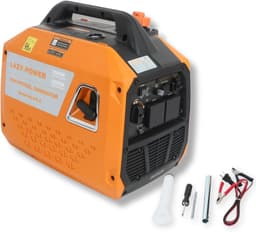
The Ark Mat PG-1 lists 230 V at 50 Hz, a 98 cc recoil engine, a 5.6 litre tank and a weight of 23 kg, at £299.95, with a 12-month warranty. Both the running and starting fields say 2,200 W, so the page does not give a surge above that continuous figure. The bullet names 2×16 A EU sockets plus USB, USB-C and DC, which is not a BS 1363 13 A socket. No customer-review line was saved, so the score stays 0 and there is no owner report of noise, oil fill or a first start. Oil alert is listed, and the carton includes an oil funnel, a screwdriver, a DC wire and a spark plug wrench. The page does not say the crankcase arrives full. Pure sine is claimed, and the noise line says low noise without a decibel figure or a distance. You are buying the printed specification: the tank is larger than the unstated tank on the KSB 21i, and the sockets are explicitly European.
Pros
230 V, 50 Hz, with 2,200 W on both power fields
5.6 litre tank and oil alert listed
Pure sine claimed
Oil funnel and spark plug wrench in the box
Cons
EU 16 A sockets, not BS 1363
No saved reviews, so the score is 0
Running and starting watts are the same figure
No decibel figure or distance
Best for: You already use EU 16 A plugs and want a 2,200 W listing with a 5.6 litre tank.
Less suitable: You need a UK 13 A socket, or any owner feedback, before you pay £299.95.
The bullet says 2×16 A EU sockets, plus USB and a DC output. It does not say BS 1363.
What output does the listing give?
230 V, 50 Hz, and 2200 W in both the running and starting fields. No separate surge is printed.
Is there a star rating on the saved listing?
No customer-review line was saved for this ASIN. The score stays 0. Stars were not added.
How we compared
Nine amazon.co.uk inverter-generator listings were scored from saved pages dated 19 October 2026. This is not a lab test. The published score is the amazon.co.uk star average times 20, so 4.0 is 80 and 5.0 is 100. A missing review line stays 0. Review volume is not inside the score. Price is not inside the score, so a 120 V listing can outscore a 230 V listing. Thin samples, unnamed sockets, watt conflicts and a missing noise distance stay in the assessment. Scores were not reduced again for those points. The top pick and the best value do not follow the raw highest number.
1
Amazon star line
70%
The published score is the amazon.co.uk star average times 20. A 4.0 line is 80 and a 5.0 line is 100. A missing review line stays 0. Review volume is not inside that number, so four reviews and 75 reviews can sit far apart while the stars alone set the score.
2
Voltage, socket and running watts
20%
Voltage, frequency, socket type and running watts are read from the listing and shown in the table. They do not add points on top of the star line. A 120 V row can still outscore a 230 V row.
3
Why the picks differ from the score
10%
The top pick is the listing that claims UK sockets and has saved UK review text. Best value is the lowest price among 230 V listings around 2,000 W running. Those choices are not extra points on the star score. Price is not inside the score.
Independent review
Last updated: 22.10.2026
8 sources checked
Inverter generator buying guide
Start with 230 V at 50 Hz, then the socket, then running watts. Price, weight and a quiet claim come after those three. The notes below follow that order for petrol inverter generators. None of the scores is a lab test.
What is an inverter generator?
An inverter generator is a petrol engine and an electronic inverter in one portable box. The inverter is there so the AC output can run chargers and laptops without the engine holding a fixed speed. In the UK the usual jobs are a pitch without a hook-up, a garden tool, or a short power cut. You run it outdoors only. A battery pure sine wave inverter has no engine and does not belong in this comparison. A fixed-speed site generator is a different category.
Best for
A camper or caravanner without a hook-up, who needs a closed set the site will allow
A household keeping a fridge, a router and lamps through a short cut, with leads outdoors
An owner of 120 V kit who is choosing a 120 V listing on purpose
Not ideal for
Anyone who will run the engine in a garage, tent, awning or caravan
A buyer treating a 120 V star line, or a VDE or EU socket, as a UK 13 A generator
A job that needs the set wired into the consumer unit
Mistakes to avoid
1
Buying the peak wattage
The number in the title is often a starting or surge figure. Plan a kettle or a heater on the running watts. A 3 kW kettle does not fit a running rating around 1.8 to 2.0 kW. Which? quotes a fridge near 100 W and a microwave near 1,500 W. Those are not tests of these sets.
2
Treating the wrong socket as British
BS 1363 is the UK 13 A plug. An EU 16 A socket, a VDE socket, or a TT-30R outlet is not that plug. A 120 V or 60 Hz listing is for American loads. A high star line on those pages is not UK owner opinion when the saved texts are marked United States.
3
Starting dry, or ranking a bare quiet claim
These engines are often shipped without oil. Low-oil shut-off will not fill the crankcase. Compare noise only when the distance and the load are both printed. A carbon monoxide sensor does not make a garage, tent or awning safe.
What to weigh up
Voltage, socket and running watts
High
UK mains appliances want 230 V at 50 Hz. A 120 V or 60 Hz listing is a different job. Next, name the socket. BS 1363 takes a UK 13 A plug. EU 16 A, VDE and TT-30R do not. A 13 A circuit is about 2,990 W at 230 V, so a higher rated bullet can still be too much for one British outlet.
Then use running watts, not the peak in the title. Starting watts cover a fridge motor for a moment. Kettles and heaters sit on the continuous figure.
Place, oil, noise and price
High
Stand the set outdoors, exhaust away from doors, windows, tents and awnings. Refuel only when it is cool. Do not wire it into the house. A CO shut-off does not change that. Fill the oil before the first pull. Read a runtime only when it states the load, such as 25% or 50%.
Ignore a quiet adjective that has no distance.
Which option suits you?
Three typical situations, each with a recommendation from this comparison.
🏕️
A liftable set for a pitch
You need a closed 230 V case you can carry, and the site may refuse an open frame. The K&S KSB 12i S is about £280.00 and 13 kg, with 1.2 kW running listed. It does not name a BS 1363 socket, and the six saved reviews are not from the United Kingdom.
You want leads outdoors to a fridge, a router and lamps, and a listing that claims UK sockets. The Ark Mat PG-2 is about £349.95. Plan on the 3.2 kW bullet, not the 3,500 W field. It weighs 27.3 kg, and the star line is 4.0 from 3.
Choose a 120 V listing on purpose. The PowerSmart 2500W is about £800.87, with 120 V outlets, a listed CO shut-off and 1,900 W running. The frequency field says 50 Hz, which conflicts, and the saved reviews are marked United States.
Which inverter generator is the top pick in this set?
The top pick in this set is the Ark Mat PG-2, about £349.95, with 4.0 from 3 amazon.co.uk reviews and a score of 80. It is the only listing whose bullet claims 2×16 A UK sockets, and the only row with saved UK review text. The bullet says 3.2 kW rated and the running field says 3,500 W, so plan on the lower figure. It weighs 27.3 kg. The score is the star line times 20, not a lab test, and three reviews are a small sample.
Which inverter generator is best value?
The best value is the K&S KSB 21i at about £271.00, with a score of 74 from 3.7 and 10 reviews. It is the lowest price among the 230 V listings that print about 2,000 W running, with 2,500 W starting and a weight of 21 kg. The page does not name a BS 1363 socket, the set is shipped without oil, and the saved review texts are from Germany and France. That choice is the price against the running-watt class, not a confirmed British plug.
Is an inverter generator the same as a battery power station?
An inverter generator is a petrol engine and an electronic inverter in one portable box, so the AC output can run chargers and laptops without a fixed engine speed. In the UK you buy one for a pitch, a garden job or a short power cut, and you run it outdoors. A battery power station has no exhaust and is a different product. If you need a battery unit rather than petrol, see the backup generator comparison.
Can you run an inverter generator indoors or in a garage?
No. Never run a petrol generator indoors, in a garage, tent, awning or caravan. The NHS says carbon monoxide has no smell. Symptoms include headache, dizziness, nausea and confusion. Use NHS 111, or 999 if someone is seriously affected. HSENI says not to place the set beside open windows, to refuel only when it is cool, and not to wire it into the house. A carbon monoxide shut-off on a listing does not make indoor use safe.
Will a 120 V inverter generator run UK appliances?
A UK appliance wants 230 V at 50 Hz and a socket you can use, normally BS 1363. A 120 V or 60 Hz listing is for American loads. Three rows in this set are 120 V, and the saved review texts are marked United States. Those counts are not UK owner opinion. A high star line does not make a 120 V set run a 230 V kettle. The score here is the star average times 20, and review volume is not inside that number.
Do these inverter generators come with oil?
These engines are often shipped without oil or petrol. Fill the crankcase before the first pull. A low-oil shut-off, where the listing includes one, stops the engine when the oil is low. It does not put oil in the box. If the engine has already been run dry, or the carburettor is gummed after storage, that is a job for a small-engine shop. Steps for oil, fuel and storage are in the how to use an inverter generator guide.
Can you wire an inverter generator into the house?
Do not wire the set into the house. HSENI says not to connect a portable generator into the home. The Electricity Safety, Quality and Continuity Regulations 2002, regulation 21, say a switched alternative must not run in parallel with the network. Leads from the generator to the appliances you need avoid that. A consumer unit or a changeover switch is an electrician's job. For a short cut, keep the generator outdoors.
How should you compare inverter generator noise?
Compare noise only when the listing states both the distance and the load. A title that says quiet, or a decibel number with no distance, is not the same measurement. One listing in this set prints a figure from 23 feet. That is not a 7 metre test, and it cannot be ranked against rows that print no decibels. Councils in England can treat noise as a statutory nuisance. This page did not measure any of these generators.
Our verdict
In this set of 9 amazon.co.uk listings, the top pick is the Ark Mat PG-2 at about £349.95, with 4.0 from 3 reviews and a score of 80. It is the only bullet that claims UK 16 A sockets, and the only row with saved UK review text. The best value is the K&S KSB 21i at about £271.00, score 74, the lowest price among the 230 V listings that print about 2,000 W running. Neither the top pick nor the best value follows the highest star score. The K&S KSB 21i S scores 100 from 5.0 and four reviews saved from Italy and Germany, and it does not name BS 1363. A 120 V listing can outscore a 230 V listing because the score is the star line times 20. This is not a lab test, and it is not a claim that the PG-2 is the best inverter generator on the UK market.
Lowest price among the 230 V listings around 2,000 W running, at about £271.00, score 74, from 3.7 and 10 reviews. BS 1363 is not named, it ships without oil, and the saved texts are from Germany and France.
Peter F. is the editor for DIY & tools at productscompared.co.uk. Comparisons in this category are checked against amazon.co.uk listings, review evidence and public UK sources.
Updated: 22.10.2026
8 sources checked
Guides to inverter generators
Guides on what to look for, how to use a product, and common mistakes.
This page contains affiliate links to amazon.co.uk. If you buy through them, we may earn a commission at no extra cost to you. Prices, stars and review counts are from the UK listings checked on 19 October 2026. We did not lab-test these inverter generators.