Independent comparisons. We may earn from shop links. Our editors compare products independently. Some links go to shops, and we may earn a commission. More info
Top pick: Novopal 3000W pure sine, 12V, LCD – Highest score in this set: 12 V pure sine at about £323.99, 4.5 from 384 reviews, with an LCD and a remote. Not a lab result, and many reviews describe other Novopal models. Best value: EDECOA 3000W modified wave – Score 84 at about £208.99, the lowest price among listings that still score 84 with more than 100 reviews. The saving is modified sine, and reviews often stop near 2000 W. Updated 22.10.2026.
A power inverter turns a 12 V or 24 V battery into about 230–240 V AC for a motorhome, van, boat or shed. A 6000 W peak does not run a kettle, and a 3000 W load at 12 V is roughly 250–300 A, so the battery, cable and fuse decide the job.
Match voltage, waveform and cable in the [3000 W power inverter buying guide](/hub/electrical-equipment/3000w-power-inverter/sub/3000w-power-inverter-buying-guide). Do not feed a house socket unless a qualified person has designed a changeover that cannot run in parallel with the mains.
Judge it by continuous watts, not the peak. A listing that is 400 W continuous and 3000 W peak is a different product and was left out of this set, as was a 4000 W continuous unit. 6000 W peak does not run a kettle. UK mains are 230 V, and a BS 1363 socket is about 3000 W at 230 V.
A power inverter turns a 12 V or 24 V battery into about 230–240 V AC for a motorhome, van, boat or shed.
A power inverter turns a 12 V or 24 V battery into about 230–240 V AC for a motorhome, van, boat or shed. A 6000 W peak does not run a kettle, and a 3000 W load at 12 V is roughly 250–300 A, so the battery, cable and fuse decide the job.
Match voltage, waveform and cable in the [3000 W power inverter buying guide](/hub/electrical-equipment/3000w-power-inverter/sub/3000w-power-inverter-buying-guide). Do not feed a house socket unless a qualified person has designed a changeover that cannot run in parallel with the mains.
Judge it by continuous watts, not the peak. A listing that is 400 W continuous and 3000 W peak is a different product and was left out of this set, as was a 4000 W continuous unit. 6000 W peak does not run a kettle. UK mains are 230 V, and a BS 1363 socket is about 3000 W at 230 V.
A power inverter turns a 12 V or 24 V battery into about 230–240 V AC for a motorhome, van, boat or shed. A 6000 W peak does not run a kettle, and a 3000 W load at 12 V is roughly 250–300 A, so the battery, cable and fuse decide the job. Match voltage, waveform and cable in the 3000 W power inverter buying guide. Do not feed a house socket unless a qualified person has designed a changeover that cannot run in parallel with the mains. Judge it by continuous watts, not the peak.
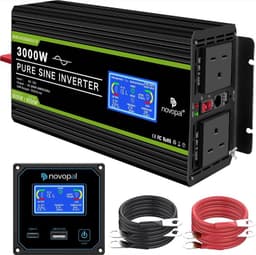
At £323.99 this 6.72 kg Novopal DLCD3000 is the highest-scoring 12 V pure sine unit in the set, with 4.5 stars from 384 amazon.co.uk reviews. The LCD covers battery, input voltage, AC voltage, load and faults, the remote is stated at 16.4 ft, and microwave, air fryer and coffee machine use is reported, with fans stated to start above 45°C. A large share of those reviews describe a 1500 W or 24 V Novopal, so the 4.5 is not a clean sample of this exact model. Kettle use is described as flattening the battery quickly. One first unit arrived with the LCD loose inside the case, and later reports include a continuous beep with no output after 26 months, plus a battery-input short after about two years. Support answered within hours in one repair story and was slow and email-only after the 26-month failure. It is the 12 V pure sine listing to shortlist when you want the screen and will fit your own cables, at a higher price than the Renogy.
Pros
4.5 from 384 reviews, the highest star line in this set
LCD for voltage, load and faults, plus a wired remote
12 V pure sine with two AC sockets and 2.4 A USB
Microwave, air fryer and coffee machine reported running
Cons
Many reviews are of a 1500 W or 24 V Novopal, not this model
£323.99 is the highest price among the kept listings
LCD arrived loose in one unit, with failures reported around two years
Kettle loads described as flattening the battery quickly
Best for: You have a 12 V bank, want a readable display and a remote, and you will supply heavy DC cable yourself.
Less suitable: A 24 V system, or a buyer who needs every one of the 384 reviews to be about this 3000 W model.
This is the only 24 V pure sine inverter in the set, listed at 3000 W continuous and 6000 W peak, at £292.99 with 4.2 stars from 452 amazon.co.uk reviews. Camper owners describe it as quieter than earlier inverters, with a compressor fridge run for years, an air conditioner around 1200 W for hours, and a microwave and air fryer also reported working. The wired remote, stated at 16.4 ft, is used in trucks and caravans, but standby is not free: one review puts the drain at about 2 A, and the supplied cables are called inadequate around 2000 W. A reviewer says the output has a floating earth, so an RCD adapter did not work, and the fuses sit inside the case. Defect reports include two units that failed a short-circuit test, one with fire, where the internal fuses did not blow. A further unit was dead after about 18 months, and one arrived smelling of fried electronics and was replaced. You buy it when the bank is already 24 V, because a converter in front of a 12 V inverter is not the same machine.
Pros
24 V pure sine, so full output draws about half the current of a 12 V 3000 W unit
4.2 from 452 reviews, the largest sample here
Remote and two cable sets in the box
Compressor fridge, a 1200 W air conditioner, microwave and air fryer reported in use
Cons
Wrong machine for a 12 V bank
Floating earth reported, and an RCD adapter did not work
Supplied cables called too light around 2000 W
Short-circuit test failures, including one fire report, and a unit dead by about 18 months
Best for: You already run a 24 V camper, truck or boat bank and want pure sine at this wattage.
Less suitable: A 12 V motorhome, or an output you expect a plug-in RCD to protect without a proper installation.
Across 217 amazon.co.uk reviews rated 4.2, this 6.4 kg Renogy is a 12 V pure sine inverter listed at 3000 W continuous and 6000 W peak, and owners report an induction hob around 2000 W, a microwave, an air fryer and power tools inside that rating. The listing states a mains-priority transfer in 50 ms, reviewers use that path on shore power, and the fans stay quiet until the load rises, with the remote in the box. Idle consumption is the complaint that keeps returning: one reviewer lost about 20 percent of a 200 Ah battery overnight with nothing plugged in. Supplied battery cables are called too light, and one report describes them overheating on a 1500 W load. The low-battery alarm is described as piercing and not silenceable, with short-wave radio interference mentioned while FM and TV were said to be unaffected. Failures show up in the reviews too, including a unit that switched AC on and off from new and died within about a week, and another that failed after about seven months. Refunds are reported, though after-sales on an Amazon purchase is described as weaker than buying from the brand, so you still fit your own heavy copper.
Pros
12 V pure sine, 3000 W continuous, with UK sockets and a remote in the box
Mains-priority transfer stated at 50 ms
Reviewers run hobs around 2000 W, microwaves, air fryers and tools
4.2 from 217 reviews
Cons
One report of about 20 percent of a 200 Ah battery gone overnight at no load
Supplied cables called too light, and overheating reported on a 1500 W load
Low-battery alarm described as piercing and not silenceable
Units reported dead within a week or after about seven months
Best for: You already have a 12 V bank and want pure sine plus a short switch over to shore power.
Less suitable: A 24 V battery, or an inverter you leave on all night to feed a fridge from a modest leisure battery.
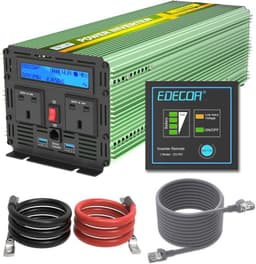
At £208.99 this EDECOA, model CT9M21G30L, is the lowest price that still sits on the same score band as several dearer pure sine listings, with 4.2 stars from 107 amazon.co.uk reviews. It is modified wave, 12 V, two UK sockets, an LCD and a remote on a 4.26 kg case, and the 6000 W peak is stated as under 10 ms. Reviewers run battery chargers and a microwave, use a jump pack for allotment tools, and like that the remote lets the box stay out of sight, within a stated working range of 11 to 14.5 V. The same reviews say it shuts down around 2000 W on two 130 Ah batteries after a few minutes, and one owner called the 3000 W rating optimistic beside a 2000 W inverter they already owned. A 2400 W heater ran for five days and then faulted. Other reports cover overheating with only LED lights on, a remote lead dead after about three weeks, a unit that beeped with no output in a power cut, and a first unit called unsafe that Amazon replaced after the supplier refused. The saving against a pure sine Renogy is worth taking only when the loads are simple and you do not need the title watts to hold.
Pros
£208.99 with 4.2 from 107 reviews
Two UK sockets, LCD and a remote on a 4.26 kg case
Chargers, a microwave and allotment tools reported
Peak stated as under 10 ms, so the surge claim is at least time-limited on the page
Cons
Modified wave, not pure sine
Shutdowns around 2000 W reported on two 130 Ah batteries
2400 W heater faulted after five days in one report
Remote lead, overheating and dead-during-a-power-cut reports, plus one unit called unsafe
Best for: You want the lowest price among the score-84 listings and your loads are chargers, lights and occasional heat, not a sustained 3000 W.
Less suitable: A microwave or motor you need to trust, a pure sine requirement, or any job that assumes the 3000 W figure will hold for minutes.
The JARXIOKE listing is £246.49 for a 12 V pure sine inverter with two UK sockets, USB-C, USB-A and a 4.5 m LCD remote, and it sits at 4.2 from 94 amazon.co.uk reviews. Owners report an air fryer and a microwave used separately, and a motorhome or yacht fit after a faulty first unit was replaced. The wattage field says 4000 W while the bullets say 3000 W continuous and 6000 W peak, and some reviewers say they received a 2000 W or 2500 W version. The wattage display is reported about 10 to 20 percent high against appliance plates. Cable text conflicts as well: bullets mention 40 mm² and also 2×20 mm², while the box line is 60 cm leads marked 2×20 mm², which is light for a 12 V draw at this title wattage. Standby use worries people on a solar battery, and one larger chop saw would not start. It is the cheaper pure sine option only if you check the label on the case when it arrives.
Pros
12 V pure sine bullets, two UK sockets, USB-C and USB-A
4.5 m LCD remote in the box
4.2 from 94 reviews, with air fryer and microwave reported separately
£246.49, below the Renogy and both Novopal prices
Cons
Wattage field says 4000 W against 3000 W in the bullets
Some reviewers say they received a 2000 W or 2500 W unit
Included leads stated as 2×20 mm², with a conflicting 40 mm² bullet
Display watts reported 10–20 percent high, and one chop saw would not start
Best for: You want pure sine on 12 V below the £260 Renogy price and you will read the label and the cable size before you rely on it.
Less suitable: Anyone who needs the listing, the wattage field and the reviews to describe one and the same 3000 W machine.
The EDECOA 3000W Pro is a 4 kg modified sine inverter at £225, with 4.1 stars from 103 amazon.co.uk reviews. The listing states 3000 W continuous, 6000 W peak, a 4 m LCD remote, fans above 45°C with a stop at 75°C, and a no-load current under 0.8 A. Boat owners describe a TV, phone charging and a kettle at anchor, and some reviews cover a low-wattage camping kettle or a toaster. The same reviews say it struggles above about 2000 W even with two batteries, and separate reports say it would not run a 1500 W compressor or a 2 kW kettle. USB figures disagree, with 4.2 A in the title and 2.1 A in a bullet, and one delivery had no digital display against the listing. Failures include a rocker switch stuck on, a dead screen while the inverter still ran, a burning smell, and units that stopped within about six weeks or a little over two months. It is a resistive-load tool if you accept that the reviews do not support the full 3000 W line, and one reviewer wanted pure sine instead.
Pros
4 m LCD remote and a stated no-load current under 0.8 A
4.1 from 103 reviews
Low-wattage kettle, toaster, TV and phone charging reported
Fans and a 75°C stop are stated on the listing
Cons
Modified sine, and a reviewer wanted pure sine
Struggles above about 2000 W in reviews, including a 2 kW kettle and a 1500 W compressor
USB current disagrees between the title and a bullet
Early failures from about six weeks to a little over two months
Best for: Heaters, a small kettle and lights on a 12 V bank, if modified sine is acceptable and you do not need the full 3000 W.
Less suitable: A microwave, a compressor fridge or any load the reviews already failed, and a lithium bank that cannot tolerate a voltage-only cut-off plus idle drain.
Spark's modified sine inverter is £184.99 and 5 kg, with 3.9 stars from 19 amazon.co.uk reviews. The listing says 3000 W continuous and 6000 W peak, an LCD remote on a 4 m cable, and USB at 2 A, and it tells you to plan for at least 250 A and cable of 70 to 95 mm² if you want full output. The same page excludes laser printers, sensitive electronics, some motors, CPAP and active power-factor correction, while naming microwaves, travel kettles, lights, chargers, basic tools and TVs as suitable. One reviewer ran an air fryer and called the price fair, and another said the remote failed while the inverter itself worked. A nearly new unit is reported to have burst into flames on first connection, which is one report rather than a rate, in a small sample that includes a review from Italy. The specification row says 215 V AC while the title says 240 V. Nineteen reviews and that fire report are why it sits below the EDECOA pair even though the shelf price is lower.
Pros
£184.99, with the cable and 250 A requirement written on the listing
LCD remote on 4 m and a stated no-load current under 1 A
The listing names what it claims to run and what it excludes
One air-fryer report and a price called fair
Cons
Only 19 reviews, at 3.9, including a non-UK review
One report of a nearly new unit bursting into flames on first connection
Output field says 215 V AC against a 240 V title
CPAP, laser printers and some motors excluded by the maker
Best for: A resistive load you have already checked against Spark's own exclusion list, if you accept a small review sample.
Less suitable: CPAP, a laser printer, sensitive electronics, or anyone treating one fire report as either proof or a reason to ignore it.
The listing says it is not suitable for laser printers, sensitive electronics, some motor-driven appliances, CPAP machines, or devices with active power-factor correction.
What cable does the listing recommend for full output?
70–95 mm², and a battery bank able to deliver at least 250 A continuously.
Eight amazon.co.uk reviews give this £145.88 TAGEEBLU, listed at 3.4 kg, a score of 3.7. The bullets say 12 V to 240 V pure sine, 3000 W continuous and 6000 W peak, two British sockets and an LCD of battery voltage, and a caravan user found it quiet on a low night-time load for a week away. One review says a 1500 W heat gun would not hold, and the continuous 3000 W claim is doubted. A remote was expected and was not usable, so the inverter has to stay within reach. The frequency field says 60 Hz while the output is written as 240 V AC, and another input row says 100 V AC. The box is a manual, one cable set and six fuses, with a fuse stated as twelve times 40 A. Eight reviews and a week of light caravan use are the evidence on the page, not a record of 3000 W held for long.
Pros
£145.88 for a pure sine claim with two British sockets
LCD of battery voltage and a quiet report at low night-time load
Bullets state 12 V only, so it is not sold as a 24 V inverter
Two-year materials warranty claimed on the listing
Cons
Only eight reviews, at 3.7
A 1500 W heat gun would not hold in one report
Frequency field says 60 Hz, and an input row also says 100 V AC
No usable remote in the review that expected one
Best for: A short caravan trip on light loads, if you treat 3000 W as unverified and you can reach the inverter without a remote.
Less suitable: A kettle, a heat gun or any load near the title watts, or a buyer who wants a large UK review sample.
The Normodic listing is £46.99 and 760 g, with 2.7 stars from three amazon.co.uk reviews. Continuous output and peak are both written as 3000 W, the waveform is modified sine, and the bullets say it is not suitable for refrigerators and other inductive loads. One review uses it for a cool box and a laptop and calls the case reasonably sturdy, while another says the 3000 W claim should be read realistically and that the unit runs warm when pushed. A 6 kg pure sine inverter in this comparison costs several times more because the copper is actually in the case. Three reviews cannot show whether a kettle will run, and a claim of both 12 V and 24 V is not backed by a measured current. There is no named failed part beyond that doubt, which is not the same as a clean bill of health. You would only plug in a phone charger or a cool box here, knowing the title watts do not match the weight.
Pros
£46.99 and two AC outlets
Digital display for input voltage, wattage and battery level
Straightforward for a cool box and a laptop in one of three reviews
The listing does admit refrigerators are unsuitable
Cons
760 g against a 3000 W title, with peak equal to continuous
2.7 from only three reviews
3000 W claim called unrealistic, and it runs warm when pushed
12 V and 24 V both claimed, with no current figure to check
Best for: A cool box, a laptop and phone charging, if you already treat 3000 W on the title as advertising.
Less suitable: A kettle, a microwave, a fridge, or any comparison where you want the watts in the title to be the watts you can draw.
This four-socket TAGEEBLU is £139.88 and listed at 2.6 kg, with bullets that follow the two-socket sibling: 12 V only, pure sine, 3000 W continuous and 6000 W peak, an LCD, and a fuse stated as twelve times 40 A. The box is one cable set plus six fuses, and a separate output-power field says 6000 W, so the continuous figure is not stable even on the listing. The amazon.co.uk listing has no Customer Reviews line, which means there is no star rating and no report of a kettle, a fan or a failure. Four British sockets do not multiply the inverter rating; they share whatever the unit can actually hold. At 2.6 kg that is an open question next to the 6 kg pure sine units in the same comparison. CE and a two-year materials warranty are claimed in the bullets and are not a substitute for a review sample. Until someone has used this exact ASIN on amazon.co.uk, the 3000 W line is a title, not a result.
Pros
£139.88, the lowest price among the pure sine titles
Four British sockets on a 12 V listing
LCD for battery voltage, plus six spare fuses in the box
Bullets say it is not for 24 V and above
Cons
No amazon.co.uk star rating on the listing
2.6 kg against a 3000 W continuous claim
Output-power field says 6000 W while the bullets say 3000 W continuous
No customer report of any appliance on this ASIN
Best for: Nobody, until a real review sample exists. The listing is a price and a socket count.
Less suitable: Any van or backup job where a failed inverter leaves you without mains, and any buyer comparing it with a reviewed 6 kg unit.
3000W continuous and 6000W peak. A separate output-power field says 6000W.
Does the listing show an amazon.co.uk star rating?
No. The listing has no Customer Reviews line, so there is no star rating to report.
How we compared
Ten 3000W power inverters on amazon.co.uk were scored from the listing fields and the review themes on those pages, not from a lab measurement. Shelf prices are the figures taken on 19 October 2026. Stars and review count carry the most weight. Equipment, price against that equipment, and what reviewers actually ran make up the rest. A listing with no Customer Reviews line scores 0.
1
Amazon stars and review count
40%
A 4.5 from several hundred reviews ranks above a 4.2 from a similar count. Under ten reviews the score is capped. A listing with no Customer Reviews line scores 0.
2
Equipment on the listing
25%
Pure sine, a continuous wattage written separately from a short peak, UK sockets, a remote, a display, and one clear battery voltage. A wattage field that disagrees with the bullets is a deduction.
3
Price against that equipment
20%
Shelf price is judged against the equipment above. A higher price is not treated as a test, and a very low price does not repair a thin review sample or a 760 g case.
4
Review sentiment
15%
Appliances people actually ran, idle drain, cable complaints and early failures. One fire report is not treated as a rate. Reviews that clearly describe a different wattage of the same brand are discounted.
Independent review
Last updated: 22.10.2026
8 sources checked
3000W power inverter buying guide
Start with continuous watts, then waveform, then whether the battery voltage matches the inverter. Cable and fuse come before the shelf price. The notes below follow that order for these ten amazon.co.uk listings, checked on 19 October 2026. None of the scores is a lab test.
What is a 3000W power inverter?
A 3000W power inverter converts 12 V or 24 V battery power into about 230–240 V AC for a motorhome, van, boat or shed. Judge it by continuous watts, not the peak. A listing that is 400 W continuous and 3000 W peak is a different product and was left out of this set, as was a 4000 W continuous unit. 6000 W peak does not run a kettle. UK mains are 230 V, and a BS 1363 socket is about 3000 W at 230 V. Extra sockets share that rating. They do not multiply it.
Waveform is the next split.
Best for
A motorhome or van on 12 V where you want pure sine, a remote, and a short microwave or kettle run
A 24 V camper, truck or boat bank, where the Novopal PS3000 is the pure sine row in this set
Heaters, chargers and lights on 12 V, if modified sine is acceptable and you do not need the title watts to hold
Not ideal for
Anyone who will plug the output into a house socket or a consumer unit
A 12 V bank paired with a 24 V inverter, or the other way round
A buyer who treats 6000 W peak, or 3000 W on a 760 g case, as continuous power
Mistakes to avoid
1
Buying the peak figure
6000 W peak does not run a kettle. Several listings here state that peak for a very short time, and reviews often describe shutdowns around 1500–2000 W. Read the continuous watts, then the battery current those watts need.
2
Mixing 12 V and 24 V
A 12 V inverter on a 24 V bank, or a 24 V inverter on a 12 V bank, is the wrong machine. At about 90 percent efficiency, 3000 W is roughly 280 A at 12 V and 140 A at 24 V. Renogy UK says its 3000 W model is 12 V only.
3
Feeding a house socket
Do not plug the inverter into a wall socket or a consumer unit. A switched alternative must not run in parallel with the mains, and the changeover is an electrician's job under BS 7671. A CE line on the listing is not that design.
What to weigh up
Continuous watts and waveform
High
Continuous watts are the number that has to match the appliance. A 6000 W peak is a short surge, and on the EDECOA CT9M21G30L that peak is stated as under 10 ms. Listings whose wattage field disagrees with the bullets, including the JARXIOKE and the four-socket TAGEEBLU, are weaker evidence than a single consistent figure.
Pure sine is the closer match for a fridge, a microwave, a variable-speed tool and electronics the maker has not approved for a stepped wave.
Battery voltage, current and cable
High
12 V and 24 V inverters are not interchangeable. Full output at 12 V is roughly 250–300 A, so one ordinary leisure battery will not hold a kettle, and thin leads in the box are a common review complaint. Victron's 12/3000 table, as a planning example, uses 90 mm² and a 400 A fuse for runs up to 5 m. Renogy UK asks for about 4/0 AWG, about 107 mm², and does not include those cables.
Idle current of an amp or more flattens a battery overnight.
Which option suits you?
Three typical situations, each with a recommendation from this comparison.
🚐
Motorhome on a 12 V bank
You want a short kettle or microwave run, a remote, and pure sine for fussy appliances. The Novopal DLCD3000 is the 12 V pure sine listing with the LCD, at about £323.99. Many of its reviews describe other Novopal models, so read the model line before you rely on the 4.5.
Your bank is already 24 V, so a 12 V inverter is the wrong machine. The Novopal PS3000 is the only 24 V pure sine row here, at about £292.99, with 4.2 from 452 reviews. A reviewer reports a floating earth, so do not expect a plug-in RCD to protect the output.
You want the lowest price among the score-84 listings with more than 100 reviews, and your loads are chargers, lights and occasional heat. The EDECOA CT9M21G30L is about £208.99 and modified wave. Reviews often stop near 2000 W, so do not buy it for a sustained 3000 W.
Which 3000W power inverter is the top pick in this set?
The top pick is the Novopal DLCD3000, a 12 V pure sine inverter at about £323.99. amazon.co.uk shows 4.5 from 384 reviews. The listing adds an LCD and a remote stated at about 5 m, and the score on this page is 90. A large share of those reviews describe a 1500 W or 24 V Novopal, so the 4.5 is not a clean sample of this model. It is the highest score in this set, not a lab test. Skip it if your bank is 24 V.
Which 3000W power inverter is the best value?
The best value is the EDECOA CT9M21G30L at about £208.99, with 4.2 from 107 amazon.co.uk reviews. It scores 84, the same band as several dearer pure sine listings, and it is the lowest price in that band with more than 100 reviews. It is modified wave, not pure sine. Reviews often describe shutdowns around 2000 W. Take the saving when the loads are chargers, lights and occasional heat, and you do not need the title watts to hold for minutes.
Should you buy pure sine or modified sine?
Choose pure sine for a fridge, a microwave, a variable-speed tool, or electronics the maker has not approved for modified sine. Modified sine is cheaper and is often fine for heaters and simple chargers. UK guides disagree on motors. If the appliance is expensive, choose pure sine. In this set the top pick is pure sine. The best value is modified wave, and the reviews do not support a sustained 3000 W. A 760 g modified listing at about £46.99 is not evidence that the title watts are available.
Do you need 12 V or 24 V, and how much current is that?
They are not interchangeable. At about 90 percent efficiency, 3000 W is roughly 280 A at 12 V and 140 A at 24 V. Renogy UK says its 3000 W model is 12 V only. The Novopal PS3000 here is the 24 V pure sine row. One ordinary leisure battery will not hold a kettle. See the leisure battery comparison before you size the bank. The amp figures are planning estimates, not a measurement of these ten units.
Can you plug a 3000W power inverter into a house socket?
No. Do not feed a house socket or a consumer unit from the inverter unless a qualified person has designed a switched alternative that cannot run in parallel with the mains. ESQCR 2002 regulation 21 says that switched alternative must not run in parallel with the distributor's network, and the installation must meet BS 7671. That includes a break-before-make changeover opening the live conductors, neutral included. EREC G98 and G99 apply only when the inverter runs in parallel with the public network. A socket-only unit does not.
What cable does a 12 V 3000W power inverter need?
A 3000 W load at 12 V is roughly 250–300 A. These are planning figures, not a law. Victron's 12/3000 table uses 90 mm² and a 400 A fuse for runs up to 5 m. Renogy UK asks for about 4/0 AWG, about 107 mm², and does not supply those cables. Several boxes here include lighter leads. Fuse the positive at the battery. If the cable text on the listing conflicts, read the print on the leads before you rely on the title watts.
Will a 3000W power inverter run a UK kettle?
Not as a promise. A BS 1363 socket is about 3000 W at 230 V, so a full kettle sits on the continuous rating, not on a 6000 W peak. In these reviews, kettle use on the Novopal 12 V is described as flattening the battery quickly. EDECOA reviews include a 2 kW kettle and a 1500 W compressor that would not run. A 3000 W figure on a 760 g case is not the same claim. Size the battery for the minutes you actually need.
What should you do if an inverter smells of burning?
Isolate the battery and do not retry. Notes in this set include a short-circuit fire report on the 24 V Novopal, a nearly new Spark unit reported to have burst into flames on first connection, and early failures on the EDECOA Pro. One report is not a rate. A CE line on a listing is not an install check. Call an electrician for any consumer unit, hook-up, transfer switch or neutral-earth bond. Plug-in RCDs are also reported not to trip on a floating output.
Our verdict
In this set of ten amazon.co.uk listings, the top pick is the Novopal DLCD3000, a 12 V pure sine inverter at about £323.99 with 4.5 from 384 reviews. The score is 90 because of that star line, the LCD and the remote. Many of the reviews describe other Novopal wattages, so this is not a lab result. The best value is the EDECOA CT9M21G30L at about £208.99, modified wave, 4.2 from 107 reviews, the lowest price among score-84 listings with more than 100 reviews. Those reviews often stop near 2000 W.
Best overall
Novopal 3000W pure sine, 12V, LCD
Highest score in this set: 12 V pure sine at about £323.99, 4.5 from 384 reviews, with an LCD and a remote. Not a lab result, and many reviews describe other Novopal models.
Score 84 at about £208.99, the lowest price among listings that still score 84 with more than 100 reviews. The saving is modified sine, and reviews often stop near 2000 W.
Power invertersBattery systemsamazon.co.uk listings
Peter F. is the editor for DIY & tools at productscompared.co.uk. Comparisons in this category are checked against amazon.co.uk listings, review evidence and public UK sources.
Updated: 22.10.2026
8 sources checked
Guides to 3000W power inverters
Guides on what to look for, how to use a product, and common mistakes.
This page contains affiliate links to amazon.co.uk. If you buy through them, we may earn a commission at no extra cost to you. Prices, stars and review counts are from the UK listings checked on 19 October 2026. We did not lab-test these 3000W power inverters.