Independent comparisons. We may earn from shop links. More info

How to connect a 3000W inverter

Updated: October 2026

You have a leisure battery and a 3000W inverter, and you are about to fit the DC cables, a fuse and the sockets on the inverter itself. The risk is not the three-pin plug. At 12V this much AC power is roughly the current of a starter motor, and a thin lead is how these installs start fires. By the end you should know what to confirm in the manual, the order of the connections, and the point where you stop and call an electrician. The [3000W power inverter comparison](/hub/electrical-equipment/3000w-power-inverter) is the product table, not a wiring diagram. A qualifying purchase can earn us a commission at no extra cost to you.

You have a leisure battery and a 3000W inverter, and you are about to fit the DC cables, a fuse and the sockets on the inverter itself. The risk is not the three-pin plug.

Our top picks

On this page

Size the cable and the fuse before you buy lugs

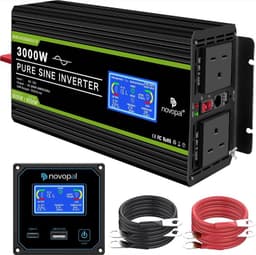
Work out the current before you crimp anything. As arithmetic, not a measurement, 3000W divided by 12V and by about 0.90 efficiency is roughly 280A. At 24V the same sum is about 140A. The fuse protects the cable. It goes on the positive conductor, close to the battery. Victron's own 12/3000 installation example uses 90 mm² up to 5 m and a 400A fuse. Renogy's UK page asks for 4/0 AWG, about 107 mm². Spark's listing says 70–95 mm² and at least 250A if you want full output. Use the manual for the unit in your hand when it disagrees. The leads in the carton are a check, not a gift you must use. Voltage and waveform, if you have not settled them, belong on the 3000W inverter buying guide.

Order of connection

Switch the inverter off, and still treat the battery lugs as live. A Renogy reviewer found the input could shock after the switch was off. A Novopal reviewer saw a spark on first connection even with the unit switched off. Fit the fuse holder at the battery end of the positive cable before that cable is landed on the battery. Connect the inverter negative to the battery negative, then the inverter positive to the fused positive. Do not leave the inverter in a sealed cupboard: fans on several of these listings only start around 45°C. If the cables warm up on a 1500W load, stop.

Sockets versus the consumer unit

Use the inverter's own UK sockets for a kettle, a charger or a tool, and stop there unless you are qualified to go further. One BS 1363 socket is about 13A, near 3000W at 230V, so one kettle can fill both the plug and the inverter. Do not plug the inverter into a house socket to feed the ring. Do not land the AC output on a consumer unit, a caravan hook-up inlet, or a transfer switch as a weekend project. The Electricity Safety, Quality and Continuity Regulations, regulation 21, stop you operating a generator or inverter in parallel with the mains as a switched alternative. A box that only feeds its own sockets is not a G98 application. Waveform still matters for what you plug into those own sockets, which is why the pure sine versus modified sine choice belongs upstream of the crimps.

When an RCD does nothing

A plug-in RCD needs a path that many of these inverters do not provide. A Novopal reviewer reported a floating earth, with no neutral-to-earth bond, and an RCD adapter that did not work. Do not invent a neutral-earth bond to make the RCD trip. A bond in the wrong place can put live voltage on the case. If you need RCD protection on a vehicle ring or a workshop radial, that is part of the electrician's design. The inverter's overload behaviour plus the fuse on the battery cable are not the same thing as a 30 mA RCD. If other people depend on the supply, stop and get it designed.

Common questions

What cable size should I use?
Use the manual for your inverter. As a planning range, named 12V 3000W examples sit around 70–107 mm²: Spark's listing says 70–95 mm², Victron's 12/3000 example uses 90 mm², and Renogy UK asks for 4/0 AWG. At 24V the current is about half, so the manual's 24V figure will be smaller. A 20 mm² lead in the box is not in that range.
What fuse, and where?
On the positive cable, as close to the battery as you can make it, sized to protect that cable. Victron's 12/3000 example uses 400A. That is one manufacturer's figure, not a fuse to copy onto every brand. If your cable is thinner, the fuse has to be smaller, and the inverter will not deliver 3000W through it.
Which lead do I connect first?
Fit the battery-end fuse first. Then connect negative, then positive, with the inverter switched off, and still expect a spark because the input can be live with the switch off. The first AC load should be a lamp, not the kettle.
Why does my plug-in RCD not trip?
The output may be floating, with no neutral-earth bond. A Novopal review describes exactly that, and an RCD adapter that did nothing. Do not add a bond yourself to force a trip. If you need that protection, an electrician has to design the earth.
Can I plug the inverter into a wall socket?
No. That backfeeds the building and can put voltage on a cable someone thinks is dead. Regulation 21 is the legal stop. Own sockets on the inverter are the DIY limit. Anything that joins a consumer unit, a hook-up, or a transfer switch is an electrician's job.
Can the DC lugs still be live after I switch off?
Yes. A Renogy review reports a shock from the battery input after switch-off, and a Novopal review reports a spark on connection with the unit off. Use a battery isolator if you need the cable ends dead. The rocker on the inverter is not that isolator.

Related pages

Sources

Public UK sources, last checked on 19 October 2026. Shelf prices, stars and review counts are the amazon.co.uk figures used for this comparison.

  1. Electrical Equipment (Safety) Regulations 2016 (retrieved 19 October 2026)
  2. GOV.UK: Electrical Equipment (Safety) Regulations 2016 (retrieved 19 October 2026)
  3. ESQCR 2002, regulation 21 (retrieved 19 October 2026)
  4. Professional Electrician: island mode for battery storage (retrieved 19 October 2026)
  5. IET Wiring Matters: island-mode automatic disconnection (retrieved 19 October 2026)
  6. National Grid: G98 connection procedures (retrieved 19 October 2026)
  7. Renogy UK: pure sine wave inverter (retrieved 19 October 2026)
  8. Victron: 12/3000 installation table (retrieved 19 October 2026)