Independent comparisons. We may earn from shop links. More info

3000W inverter buying guide

Updated: October 2026

You are looking at amazon.co.uk listings that all say 3000W, from a 760 g modified-sine box at £46.99 to a 6.72 kg pure-sine unit at £323.99. That title does not tell you whether the figure is continuous power, whether your battery is 12V or 24V, or whether the bank can supply the current. This 3000W inverter buying guide is the order of those checks before you add one to the basket. The [3000W power inverter comparison](/hub/electrical-equipment/3000w-power-inverter) holds the ASIN rows and the GBP prices. Shelf prices here are from those listings on 19 October 2026. A qualifying purchase can earn us a commission at no extra cost to you.

You are looking at amazon.co.uk listings that all say 3000W, from a 760 g modified-sine box at £46.99 to a 6.72 kg pure-sine unit at £323.99.

Our top picks

On this page

Continuous watts, not the peak

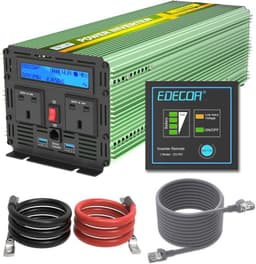
Buy the continuous watts your largest appliance needs, and treat a 6000W peak as a surge that lasts a fraction of a second unless the listing says otherwise. A UK kettle is often near 3000W on the plate, and it holds that draw for the minutes it takes to boil, so a peak rating will not boil it. EDECOA's older modified-wave listing states 6000W peak for under 10 ms. Read the appliance plate, then add a margin for a motor or a microwave. In this set the honest-looking rows separate 3000W continuous from 6000W peak. When the page cannot agree with itself, you do not have a continuous rating yet.

12V or 24V

Match the inverter to the bank you have. Every kept listing except the 24V Novopal is a 12V machine, and that Novopal, at £292.99, is not a 12V inverter with a clever setting. At the same AC watts, current from the battery is about half on 24V. As arithmetic, not a lab reading, 3000W divided by 12V and by about 0.90 efficiency is roughly 280A. The same sum at 24V is about 140A. Do not put a 12V inverter on a 24V bank.

Waveform in one screen

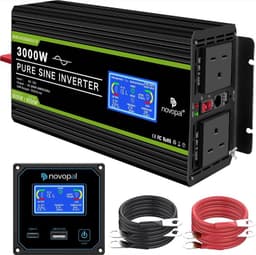
Pure sine in this set is Renogy, both Novopal listings, JARXIOKE and both TAGEEBLU listings. Modified sine is both EDECOA listings, Spark and Normodic. A kettle element is a resistor and usually does not care about the shape of the wave. A microwave, a compressor, a dimmer, audio gear and medical kit are the loads UK guides keep on the pure-sine side, though they do not all agree how badly a motor suffers. The longer explanation is on the pure sine versus modified sine page. If your only loads are a fan heater and lights, modified sine can be the cheaper tool. Two UK sockets do not mean 6000W. They share one inverter rating.

Battery current and the 13A socket

Roughly 280A at 12V is why the leads in the carton are the usual disappointment. Victron's own 12/3000 installation example uses 90 mm² and a 400A fuse. Renogy UK asks for 4/0 AWG, about 107 mm². Spark's listing says 70–95 mm² and at least 250A from the battery for full output. The manual for the unit you buy beats any of those figures. One BS 1363 socket is about 13A, so a single kettle can occupy the whole continuous rating. Cable size, the fuse and where you stop are on the how to connect a 3000W inverter page.

What this price band is buying

From about £185 to £225 you are in modified sine with a real review count: Spark at £184.99 (3.9 from 19), EDECOA at £208.99 (4.2 from 107) and the EDECOA Pro at £225 (4.1 from 103). From about £246 to £324 you are in heavier pure sine: JARXIOKE at £246.49, Renogy at £259.99, the 24V Novopal at £292.99 and the 12V Novopal at £323.99. Under £50, Normodic is 760 g with a peak that equals the continuous figure.

Common questions

Is 3000W the continuous figure or the peak?
On the clearer listings, 3000W is the continuous figure and 6000W is the peak. Check both fields, because Normodic writes 3000W for each, JARXIOKE's wattage field says 4000W, and one TAGEEBLU output field says 6000W. A kettle needs the continuous number for the minutes it boils.
Will a 3000W inverter run a UK kettle?
It can, if the kettle's plate is about 3000W or below, the inverter really holds its continuous rating, and the battery can supply roughly 250–300A at 12V for those minutes.
Should the battery be 12V or 24V?
Use the voltage you already have. A 12V inverter on a 24V bank is the wrong machine, and the 24V Novopal will not run on 12V. Current is the reason people move to 24V: the same 3000W is about 140A rather than about 280A, as a rule of thumb at 90 percent efficiency. Halving the current makes the cable and the fuse smaller. It does not change the AC watts.
Do two UK sockets mean 6000W?
No. Extra sockets share the inverter's continuous rating. Two sockets on a 3000W unit are two places to plug in, not two inverters. A kettle in one and a microwave in the other will trip or shut the unit down if the sum exceeds what it can hold.
Does a CE mark mean the van install is fine?
No. CE on a product bullet is a mark the seller claims for the appliance. It does not size your cable, place your fuse, or make a leisure-battery install compliant. If the AC output joins the van's existing 230V system or a hook-up inlet, that remains an electrician's job.
Can the output feed the house consumer unit?
Not by plugging the inverter into a wall socket, and not by paralleling it with the mains. Regulation 21 of the Electricity Safety, Quality and Continuity Regulations forbids that kind of switched alternative. G98 applies when equipment runs in parallel with the network, which a socket-only inverter is not doing. A proper island supply needs a changeover an electrician designs.

Related pages

Sources

Public UK sources, last checked on 19 October 2026. Shelf prices, stars and review counts are the amazon.co.uk figures used for this comparison.

  1. Electrical Equipment (Safety) Regulations 2016 (retrieved 19 October 2026)
  2. GOV.UK: Electrical Equipment (Safety) Regulations 2016 (retrieved 19 October 2026)
  3. ESQCR 2002, regulation 21 (retrieved 19 October 2026)
  4. Professional Electrician: island mode for battery storage (retrieved 19 October 2026)
  5. IET Wiring Matters: island-mode automatic disconnection (retrieved 19 October 2026)
  6. National Grid: G98 connection procedures (retrieved 19 October 2026)
  7. Renogy UK: pure sine wave inverter (retrieved 19 October 2026)
  8. Victron: 12/3000 installation table (retrieved 19 October 2026)