Independent comparisons. We may earn from shop links. More info

Pure sine vs modified sine wave inverter

Updated: October 2026

You are choosing between a cheaper EDECOA or Spark and a dearer Renogy or Novopal, and both sides of the shelf say 3000W. The difference that changes the appliance is the shape of the AC wave, not the number in the title. Modified sine can be the right tool for a simple heater. It is a poor match for a microwave, a lot of motors, and anything the listing itself tells you to keep away. This page is that choice. The [3000W power inverter comparison](/hub/electrical-equipment/3000w-power-inverter) holds the prices. The Products Compared editorial team used UK guides and the amazon.co.uk listings, not a distortion meter. A qualifying purchase can earn us a commission at no extra cost to you.

You are choosing between a cheaper EDECOA or Spark and a dearer Renogy or Novopal, and both sides of the shelf say 3000W.

Our top picks

On this page

What each waveform is

A pure sine inverter tries to reproduce the smooth rise and fall you get from a UK mains socket, fifty times a second. A modified sine inverter builds the same rough timing out of steps: the voltage sits high, then at zero, then high the other way. A resistor turns either shape into heat. A motor or an audio amplifier has to live with the steps, and that is where the buzz and the extra heat come from. Pumps and fans hum more on a stepped wave. REUK makes that point for inductive loads. Midsummer Energy is milder on motors and harder on laser printers, dimmers and audio hum. We have not measured the distortion of these listings. If it has a motor, a magnetron or a medical purpose, assume you want the smooth wave unless the appliance maker says otherwise.

Loads that usually cope

A kettle element, a fan heater, a toaster and a simple lamp are the loads that usually shrug. Energian and Midsummer both treat resistive heat as the comfortable case for modified sine. EDECOA's Pro bullets name kettles, toasters and LED lights. Reviews are narrower: a low-wattage camping kettle, and also a 2 kW kettle and a 1500W compressor that would not run. A modified-sine box that shuts down at 2000W has not become a kettle inverter because the element is a resistor.

Loads to keep on pure sine

UK guides do not speak with one voice about motors. Energian advises against modified sine for fridges, microwaves and most motors. REUK wants pure sine for inductive loads and expects pumps to buzz. Midsummer says many motors still run, noisier, and saves its hard warnings for laser printers, dimmers and audio. The overlap is microwaves, dimmers, audio and medical equipment. Spark writes the conservative line into its own listing. It says the inverter is not for laser printers, sensitive electronics, some motor-driven appliances, CPAP or devices with active power-factor correction. CPAP and other medical kit stay on pure sine unless the device maker has approved the inverter. Voltage and battery current are a different decision, covered in the 3000W inverter buying guide.

How that splits this set

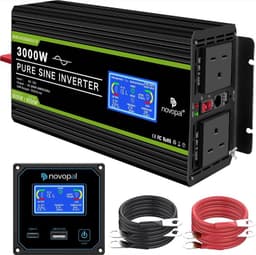
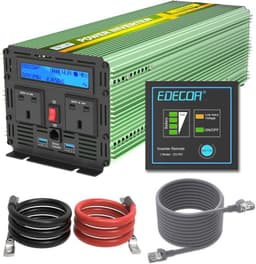
Pure sine in the kept listings: Renogy, both Novopal models, JARXIOKE and both TAGEEBLU units. Modified sine: both EDECOA units, Spark and Normodic. On the modified side, EDECOA at £208.99 and the EDECOA Pro at £225 are the reviewed cheaper tools. Spark at £184.99 is the listing that excludes CPAP in its own words. Normodic at £46.99 is modified sine in a 760 g case. Which of the pure-sine boxes to shortlist is the best 3000W pure sine wave inverter page.

Common questions

What is the actual difference in the waveform?
Pure sine is a smooth 50Hz curve, like the mains. Modified sine is a stepped wave that spends time at a high voltage and at zero. Heaters turn both into heat. Motors, microwaves, timers and audio gear notice the steps, as buzz, extra heat or odd behaviour. We have not measured how stepped any listing in this set actually is.
Will a kettle care?
The element usually will not. A simple kettle, toaster or heater is the load modified sine is bought for, which is why EDECOA's bullets lean on resistive appliances. The kettle still cares about continuous watts and about battery current. A modified-sine unit that shuts down near 2000W in reviews will not boil a 3 kW kettle just because the element is a resistor.
Will a fridge or a microwave care?
Often yes. Energian and MDS Battery put microwaves and fridges towards pure sine. Midsummer is softer on motors and harder on printers and dimmers. Spark excludes some motors and, in the same breath, claims microwaves are suitable. If the fridge or the microwave matters, buy pure sine unless that appliance's maker allows modified sine. A buzz you can live with is a different decision from food that does not cook.
Is modified sine always unsafe?
No. It is a poor match for some appliances, not a guarantee that every heater will catch fire. The unsafe cases in this set are separate: thin DC cables, a missing battery fuse, and one Spark review of a unit that burst into flames on first connection. Waveform does not excuse those. It also does not condemn a toaster on a modified-sine inverter that is properly cabled.
Why do pure-sine units cost more here?
In this set the heavier pure-sine listings are about £246 to £324, and the reviewed modified-sine listings are about £185 to £225. You are paying for the wave and, on the Renogy, for a stated transfer to shore power. The £47 and £140 boxes are not a third, cheaper kind of pure sine. They are light cases with little or no review history.
What about CPAP or a laser printer?
Keep both on pure sine unless the device maker says otherwise. Spark's listing excludes CPAP, laser printers, sensitive electronics and some motors by name. That is the clearest buyer-facing line in this comparison. A medical device is not the place to discover that a stepped wave was cheaper.

Related pages

Sources

Public UK sources, last checked on 19 October 2026. Shelf prices, stars and review counts are the amazon.co.uk figures used for this comparison.

  1. Electrical Equipment (Safety) Regulations 2016 (retrieved 19 October 2026)
  2. GOV.UK: Electrical Equipment (Safety) Regulations 2016 (retrieved 19 October 2026)
  3. ESQCR 2002, regulation 21 (retrieved 19 October 2026)
  4. Professional Electrician: island mode for battery storage (retrieved 19 October 2026)
  5. IET Wiring Matters: island-mode automatic disconnection (retrieved 19 October 2026)
  6. National Grid: G98 connection procedures (retrieved 19 October 2026)
  7. Renogy UK: pure sine wave inverter (retrieved 19 October 2026)
  8. Victron: 12/3000 installation table (retrieved 19 October 2026)