




A light and a socket in a shed
You are adding a garage or shed supply and an electrician will connect it. The Lifegogo 2-way lists a 40 A 30 mA RCD with 6 A and 16 A MCBs, at about £14.99. The review file is only nine ratings.
The best fuse boxes, compared.
Top pick: Pnoyws 6-way 12 V fuse box Best value: KAOLALI 12-way 12 V fuse box – Twelve circuits at about £14.57, £7.42 below the ENDARK 12-way, with 4.6 from 361 reviews. Score 77. Voltage on an empty terminal is still reported. Updated 22.10.2026.


On amazon.co.uk the words fuse box cover two products you must not swap. A consumer unit, still called a fuse box in everyday British English, is a 230 V assembly with an and miniature circuit breakers for a house, garage, shed or workshop. A 12 V or 24 V blade fuse box is a low-voltage block for a car, campervan, boat or leisure solar circuit, and it does not protect a mains installation. Voltage family and way count are set out in the [fuse box buying guide](/hub/electrical-equipment/fuse-box/sub/fuse-box-buying-guide). A 230 V AC consumer unit and a 12–32 V DC blade block do not substitute for each other. The blade blocks are 4-way, 6-way or 12-way / holders. A 2-way garage board suits a light and a socket radial. A camper often wants a 12-way blade block. On mains, look for a 30 mA or and an per circuit. A blown-fuse LED is a fault lamp, not shock protection. ISO 8820-3 covers medium blade fuse-links for road vehicles, typically 32 V.
On amazon.co.uk the words fuse box cover two products you must not swap.

42 products checked · 68 hrs invested · +24,600 readers
Swipe for more
1-2 of 12


Personal buying guide
Question 1 of 2
Which voltage are you protecting?
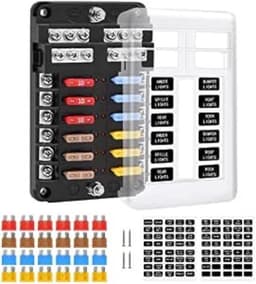
The Pnoyws 6-way holder is £10.49 with 4.7 from four reviews, and no review text was captured, so the star line is not evidence you can read. The bullets state ATC/ATO fuses, 32 V DC maximum, 30 A per circuit and a 100 A panel, then another field says 30 A maximum, and the weight is printed as 20 g. The box contents are eight fuses, screws, labels, a cover and a clip. Splash and dust protection is claimed without an IP number, and a negative bus is only implied by paired terminals. With no review body, you cannot see whether the fuses seat or the threads hold. It is the listing to skip when you are choosing on stars. It is a guess if you buy it because 4.7 looks higher than 4.6 from 652.
Pros
Cons
Best for: There is no reviewed job in this file to point you toward.
Less suitable: You are choosing from stars, or you need a review that describes a real install.
Specifications
Common questions
Does the listing accept standard blade fuses?
Yes. The bullets say it works with standard ATC/ATO blade fuses, at up to 32 V DC.
Is the cover described as waterproof?
The listing says a transparent PC cover blocks splashes and dust. It does not state an IP rating.
Are review comments available?
The listing shows 4.7 from 4 reviews. No review text was captured, so praise and complaints are not recorded.
The ENDARK 12-way board is £21.99 and carries 4.6 from 2,310 reviews, the largest count in this comparison. The title states ATC/ATO fuses, a red LED per circuit, 12 V to 32 V DC, 100 A maximum and 30 A per circuit, plus a negative bus, 24 fuses and a two-year limited warranty for factory defects. UK reviews use it for camper conversions, motorhomes and a caravan 12 V board, and several say the terminals and the through-bolt feel stronger than cheaper blocks. The listing also names CE, ISO 8820-3, RoHS, SAE J1284 and ABYC/USCG. Those last two are United States marine marks, not a UK consumer-unit approval. More than one reviewer found voltage still on the outputs with no fuse fitted, and one unit had an internal short across positive outputs. A loose internal connection showed up on another unit, and the cover is awkward to unclip. It is the block to open when you want twelve ways and a long review file, and the wrong one if you will treat an empty fuse position as isolated.
Pros
Cons
Best for: You want a 12-way camper or boat block and you will meter a terminal before you call an empty fuse position dead.
Less suitable: You only need six circuits, or you want the empty position to mean the wire is isolated.
Specifications
Common questions
What standards does the listing name?
The ENDARK listing names CE, ISO 8820-3, RoHS and SAE J1284, and also says ABYC/USCG. Those last two are not a UK consumer-unit approval.
What is the current limit?
100 A for the block and 30 A per circuit, at 12 V to 32 V DC, with a negative bus and a transparent cover.
What safety point repeats in reviews?
The listing shows 4.6 from 2,310 reviews. Many comments praise camper and caravan use. Several say a voltage is still present when no fuse is fitted.
The Tawveml 6-way block is £11.39 on amazon.co.uk, rated 4.6 from 652 reviews, and it is the strongest all-round listing in this set once tiny star samples are discounted. The page states 12 V to 32 V DC, 30 A per circuit and 100 A for the panel, with a negative bus, a clear cover and a fuse assortment of 20 A, 15 A, 10 A and 5 A. UK reviews describe it on campervan sockets and lights, a motorbike, a Hilux light bar, a van and a small boat, and one boat user said it passed that person's boat safety check. Screw terminals that tighten down, and the labels, are what reviewers repeat when the job is tidy accessory wiring. It is not waterproof: a review title says so, and the cover is only a splash and dust claim. Fuses that will not stay seated, a cover that is holding them in, cross-threaded bolts and light positive plates come up often enough that you should seat each fuse by hand before you load the circuit. It is the top pick here for a six-circuit 12 V board at this price, and a poor choice if you need twelve ways or a board you can leave in the rain.
Pros
Cons
Best for: You want a six-circuit 12–32 V blade block for a van or a small boat, and you will check that each fuse seats.
Less suitable: You need twelve ways, a box you can leave in the rain, or a 230 V garage consumer unit.
Specifications
Common questions
Is it listed as waterproof?
The listing claims a splash and dust cover. It does not state an IP rating. One review title says it is not waterproof.
What standard is stated?
The listing states CE. It does not state ISO 8820-3.
What fitting problems appear in reviews?
The listing shows 4.6 from 652 reviews. Captured comments include camper and bike use. Repeated complaints include fuses that fall out, cross-threaded bolts, and a cover that holds the fuses in.
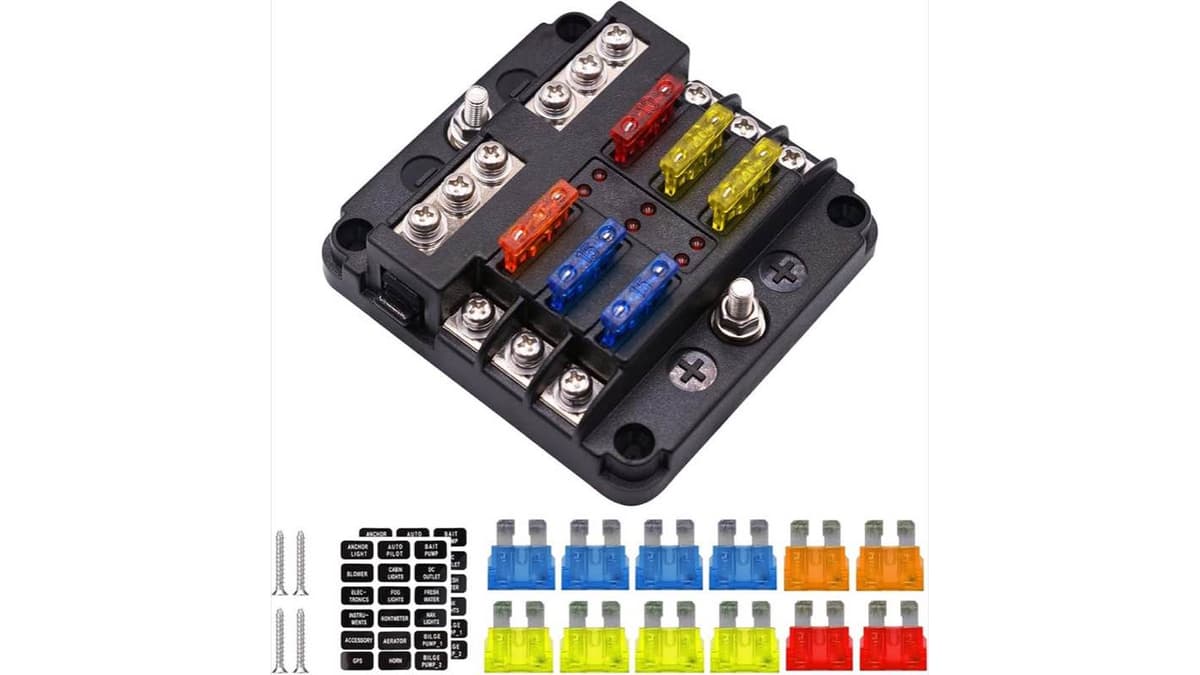
The KAOLALI 12-way block is £14.57, with 4.6 from 361 reviews, and it is the best value in this set for a twelve-circuit board because ENDARK asks £21.99 for the same way count. The listing states 12 V to 32 V, 100 A for the panel and 30 A per circuit, a negative bus, a red LED when a fuse opens, and 24 fuses from 5 A to 20 A. UK reviews put it in campervans, a van and a shed solar rig, and one reviewer measured about 50 A continuous on that shed board. The cover is described as damp-proof, which is not an IP rating, and it can block the way negative cables leave the box. One reviewer measured over 13 V in and 11.6 V out at the terminals, so a voltage drop is a recorded complaint. Another found power still present with a blown fuse, and a third saw open-circuit voltage on empty positions that fell to 0 V under load, which they blamed on the LED. You get twelve circuits for about £3 more than the six-way top pick, provided you treat a lit LED as a clue and not as proof the wire is dead.
Pros
Cons
Best for: You need twelve 12–32 V circuits and you will meter a terminal before you treat it as dead.
Less suitable: You only have six circuits, or you need a 230 V consumer unit.
Specifications
Common questions
What does the LED indicate?
The listing says a red LED means the fuse has opened and needs replacing. It does not say the LED isolates the circuit.
What current is listed?
100 A for the block and 30 A per circuit, from 12 V to 32 V, with a negative bus.
What do captured reviews measure?
The listing shows 4.6 from 361 reviews. Campervan use is common. One reviewer measured about 13 V in and 11.6 V out. Others report voltage on a terminal with the fuse removed.
The UCkasayfy 6-way board is £11.98, rated 4.6 from 301 reviews, and it ties the dearer 12-way ENDARK on this score because the current claims are consistent and the review themes are milder. The listing states 12 V to 32 V DC, 100 A for the panel, 30 A per circuit, a negative bus and a red LED when a fuse blows, with 16 blade fuses. UK reviews describe a caravan solar and USB setup, extra campervan accessories, a van and a greenhouse solar split, and they call the block compact. Busbar screws sit very close, so only small crimps fit, and the main positive and negative crimps stick out of the box. One post needed the case opened before a terminal would tighten, and at least one buyer received no directions. Stickers are a weak match for UK circuit names. It is a fair six-way alternative around this price if your crimps are small, and a frustrating fit if you are landing large lugs.
Pros
Cons
Best for: You want six 12–32 V circuits and your cable ends are small crimps rather than large lugs.
Less suitable: You need twelve ways, or the main cables are too bulky to sit inside the cover.
Specifications
Common questions
Will this replace a house consumer unit?
No. The listing is a 12 V to 32 V DC blade fuse board for vehicles and similar low-voltage circuits.
What current does the listing state?
100 A for the panel and 30 A per circuit, with an LED on each circuit.
What do UK reviews mention?
The listing shows 4.6 from 301 reviews. Captured UK comments include campervan and caravan solar use. Some mention cramped screws and crimps that stick out of the box.
The Lifegogo 2-way unit is £14.99, rated 4.6 from only nine reviews, so the star line is too thin to outrank boards with dozens of ratings. The listing states a 40 A 30 mA RCD, 6 A and 16 A MCBs, IP65, a clear window, pre-drilled holes and a one-year warranty, in a 15 × 9 × 15 cm ABS case at 500 g. The two captured reviews say it does the job, was easy to install and felt good value, and one of them calls the build a little flimsy. No RCD type and no BS EN 61439-3 line appear. It matches the small-garage pattern of a light and a socket on one 30 mA RCD, with the limit that nine reviews cannot show how the terminals behave after a year. Choose it when that pattern is your job and you accept a short review file. Skip it when you want the 48-review 4-way board, or a metal unit for a hallway.
Pros
Cons
Best for: You want a 6 A light and a 16 A socket in a damp shed, and you accept a nine-review sample.
Less suitable: You want a review count you can lean on, or a board for the house hallway.
Specifications
Common questions
What protection is listed?
The Lifegogo listing states a 40 A 30 mA RCD and 6 A and 16 A MCBs, in an IP65 enclosure with a clear window.
Is a warranty stated?
Yes. The listing states a 1 year product warranty.
What do the captured reviews say?
The listing shows 4.6 from 9 reviews. Two captured reviews call the price good and the install easy. One says the build was a little flimsy.
The QWORK 12-way block is £13.99, rated 4.4 from 73 reviews, and the price looks low until you read how the fuses sit. The listing states DC 12–32 V, a red LED when a fuse has blown, a cover, labels and an assortment of 20 A, 15 A, 10 A and 5 A fuses, in a 15 × 9.7 × 5 cm nylon and copper body at 290 g. It does not state a per-circuit amp limit or a negative bus. Reviewers say it is easy to wire as a vehicle or motorhome board, then report fuses that do not insert fully because the plastic is too thick, a blade contact of about 2 mm, and fuses that fall out. One reviewer says only the supplied fuses fit. Two reviews tie that shallow contact to heat, and one says the plastic melted. It is a 12-way listing to leave if those seating notes match what you can see, and only a candidate if you will reject any fuse that does not click home.
Pros
Cons
Best for: You might look at a cheap 12-way shape only if every fuse clicks fully home before you connect a load.
Less suitable: You need a stated 30 A circuit limit, or you will not tolerate fuses that drop out.
Specifications
Common questions
How many circuits are listed?
The QWORK listing states 12 circuits at DC 12–32 V, with a red LED that lights only when a fuse has blown.
Is a per-circuit amp limit stated?
No. The listing does not give a panel or per-circuit amp limit.
What seating problem do reviews describe?
The listing shows 4.4 from 73 reviews. Several captured reviews say the fuses barely enter, fall out, or only the supplied fuses fit. Two call that a heat risk.
The DIYI holder is £7.49, the cheapest listing in the set, rated 4.3 from 58 reviews, and it is a small 4-way ATO box at 86 × 53 × 42 mm rather than a six-circuit panel. The page states 12 V and 24 V, a 30 A figure, a snap cover and four fuses listed as 10 A, 20 A, 30 A and 30 A. Reviewers used it to replace torpedo fuses in a campervan and on a small solar install, and they say the blade fuses held more securely than the old ceramic ones, with spare ways left for spares. The listing does not state a negative bus. Spade connectors slip off and are difficult to fit, and one review calls the box flimsy. The item-count line also says four, while the title describes one box, so check the parcel. It is the budget step for four low-current 12 V or 24 V circuits, and the wrong object if you need a negative bus or a garage consumer unit.
Pros
Cons
Best for: You are replacing a few torpedo fuses on a 12 V or 24 V camper circuit and you can live with spade terminals.
Less suitable: You need a negative bus, six or twelve ways, or anything on 230 V.
Specifications
Common questions
How many circuits does the listing describe?
The title describes a 4-way box. The unit-count field says 4, and the bullets list four fuses: 10 A, 20 A, 30 A and 30 A.
Does it include a negative bus?
No negative bus is stated. Connections are side 6.3 mm blade terminals.
What do captured reviews say?
The listing shows 4.3 from 58 reviews. One long review used it to replace torpedo fuses in a campervan. Another says the spade connectors slip off, and one calls it flimsy.
The cupeohome unit is £22.99, rated 4.3 from 48 reviews, and it is the only 4-way 230 V board in this set. The title states a 63 A 30 mA RCD and an IP65 ABS enclosure, and it is described for garages, caravans and workshops. The MCB line is the problem: it lists 2 × 6 A, 10 A, 20 A and 32 A, which is five ratings against a 4-way count, and the page does not state BS EN 61439-3 or an RCD type. Reviewers report it wired and working in a workshop and call it neat for a garage or summer house. They also report very little room to route cables, knockouts that fight a 10 mm steel-wire-armoured supply, a short neutral bar and missing screws in the bars. One reviewer was told it was not a UK-standard board and returned it, and another says the plastic box is not what they were told BS 7671 expects for a new installation indoors. It is the listing to open when you need more than two ways in this set and a competent person will confirm the devices, and the wrong board for a house hallway.
Pros
Cons
Best for: You need more than two ways for a garage or workshop, and a competent person will check the breakers in the box.
Less suitable: You are replacing a house hallway consumer unit, or the supply cable is thick SWA.
Specifications
Common questions
Is this a 12 V blade fuse box?
No. The cupeohome listing is a 4-way consumer unit with a 63 A 30 mA RCD and MCBs, described for garages, caravans and workshops.
Does the listing state an IP rating?
Yes. The listing states IP65 and names ABS construction. It does not state BS EN 61439-3 or an RCD type.
What do the captured reviews say about fitting?
The listing shows 4.3 from 48 reviews. Captured comments include workshop and summer-house use. Several mention very little cable space, and one says screws were missing from the bars.
The Flintronic 6-way block is the lowest six-way price here at £9.99, with 4.3 from 35 reviews. It states 32 V DC maximum, 30 A per circuit, 100 A for the panel, a negative bus, a clear cover and 24 fuses from 5 A to 20 A. Reviewers used it on a 12 V project, a small solar split in a shed, and motorhome lights and USB, and they liked the negative bus for tidy wiring. The splash and dust claim has no IP number. An earth terminal was poor enough that one buyer repaired it, and some positive threads were inconsistent and had to be re-tapped. At £1.40 under the Tawveml you are buying a thinner review file and a terminal you may have to chase with a tap. It suits a light six-circuit job if you check every thread before you load it, and it is a weak pick if you want the larger review file instead.
Pros
Cons
Best for: You want six light 12 V circuits at the lowest six-way price here, and you will check the threads first.
Less suitable: You want a review count in the hundreds, or you will not re-tap a poor terminal.
Specifications
Common questions
What fuses are in the box?
The listing includes 24 fuses: six each of 5 A, 10 A, 15 A and 20 A, plus a cover and a negative bus.
Is an IP rating stated?
No IP number is stated. The listing says the cover is splash-proof and dust-proof.
What did reviewers change?
The listing shows 4.3 from 35 reviews. One captured review says the earth terminal and some positive threads needed repair.
The PATNFR 2-way unit is £13.89, the lowest mains price here, with 4.1 from 36 reviews. The listing is consistent where others are not: a 40 A 30 mA RCD, a 6 A MCB and a 16 A MCB, IP65, a clear cover, and a case of 15 × 10.9 × 8.9 cm at 690 g. Reviewers like the size for a shed or garage and use the cover to see the breakers, including a split between lighting and sockets. Two captured reviews say the wiring details transpose live and neutral, and another says the terminals did not grip the cables. One unit failed and had to be stripped out for a return, and a reviewer notes it is not pre-wired. No RCD type is stated. The price is the reason to look, and the diagram is the reason to ignore the insert and follow a competent person's drawing instead.
Pros
Cons
Best for: You want the cheapest 2-way garage pattern in this set, and the installer will not follow the insert diagram.
Less suitable: You need the instructions to be right, or you need more than two ways.
Specifications
Common questions
Which breakers does the listing include?
The PATNFR listing states a 40 A 30 mA RCD and two MCBs, 6 A and 16 A. It does not state the RCD type.
Is a transparent cover listed?
Yes. The bullets say a transparent cover lets you see the breaker status.
What do the captured reviews say about the instructions?
The listing shows 4.1 from 36 reviews. Two captured reviews say the wiring details transpose live and neutral. Another says the terminals did not grip the cables.
The JIODEKEYI 2-way unit is £15.45, rated 4.0 from seven reviews, and the listing disagrees with itself before you open a review. The title states a 40 A 30 mA RCD and IP65, while a current field says 20 A, and the highlight lists 6 A and 16 A MCBs. The dimension line is 5 × 5 × 8 cm against a weight of 710 g, which does not describe a normal garage enclosure. The only captured review says the fitting space is limited, the breakers seemed cheap, and the reviewer did not trust the supplied RCD or breakers and replaced them. There is no praise in that text, and no RCD type or BS EN line. At £15.45 it costs more than the PATNFR and the Lifegogo without a consistent current figure. Leave it unless a competent person has already checked the devices in the box.
Pros
Cons
Best for: You would only consider it after a competent person has checked the devices against the 40 A title.
Less suitable: You need one current figure you can design from, or a review file longer than seven ratings.
Specifications
Common questions
Do the current figures agree?
No. The title states a 40 A 30 mA RCD. A technical field says 20 A. The highlight lists 6 A and 16 A MCBs.
Is a clear cover listed?
Yes. The listing describes a clear hinged cover and DIN-rail mounting.
What does the captured review say?
The listing shows 4.0 from 7 reviews. The only captured review says fitting space is limited and that the reviewer replaced the RCD and breakers.
Twelve amazon.co.uk fuse-box listings were scored from the shelf on 20 October 2026, with review notes applied on 21 October 2026. This is not a lab test. A printed amp rating, IP code or standard name is a listing claim. A 230 V consumer unit and a 12–32 V blade block stay in one table, and a high star line cannot move a listing from one family to the other.
Amazon evidence
25%The amazon.co.uk star rating is divided by 5, then multiplied by 25 and by a count factor. The factor is 1.0 at 500 reviews or more, and it falls as the published count gets smaller. A count under eight with no review text uses 0.15.
Listing fit
40%A named voltage family, a way count that matches the devices, a stated per-circuit limit, and either an RCD plus MCB ratings or a blade type with a negative bus. Conflicting amp fields, a missing limit, or a marine mark treated as a UK consumer-unit approval lower this part.
Review outcome
20%UK review themes that describe the job the listing claims. Fuses that fall out, heat, voltage on an empty fuse position, a transposed live and neutral diagram, or terminals that do not grip, lower this part. No review text scores 0.
Value
15%Shelf price against the job the listing actually supports. The lowest price does not win when the sample is four stars with no text, or when the current fields conflict.
Start with the voltage family, then the number of ways, then the protection the listing actually names. Price comes after those three. The notes below follow that order for these 12 amazon.co.uk listings, checked on 20 October 2026. None of the scores is a lab test.
A fuse box on amazon.co.uk is not one product. In everyday British English it still means a consumer unit: a 230 V assembly with an RCD and miniature circuit breakers for a house, garage, shed or workshop. The same search also returns a 12 V or 24 V blade fuse box for a car, campervan, boat or leisure solar circuit. That block does not protect a mains installation. This page compares the 12 listings in the table.
The blade boxes here are 12 V, 24 V or up to 32 V DC. A garage ring is 230 V AC. Do not connect a 12 V blade box to 230 V. Use a consumer unit with a 30 mA RCD, and have a competent person install a new circuit.
IP65 is a dust and water-jet claim for a damp garage or a sheltered wall. Inside a dwelling, BS 7671 Regulation 421.1.201 expects a non-combustible enclosure. Steel is the example the IET gives. Electrical Safety First says that does not apply to a unit mounted outside the building.
The fuse or breaker has to match the cable, not only the device at the end. A diagram that swaps live and neutral, every house circuit on one RCD, or a blade box that stays live with the fuse out, are the faults to stop on. A lit LED is a fault lamp, not isolation.
Decide 230 V AC or 12–32 V DC before you compare prices. The four mains listings are IP65 garage consumer units. Three are 2-way boards around £14 to £15, with a 40 A 30 mA RCD and 6 A plus 16 A MCBs where the fields agree. The JIODEKEYI title says 40 A and a field says 20 A. The cupeohome is the only 4-way, at £22.99, and its MCB list does not match four ways. The blade blocks are one 4-way at £7.49, several 6-way holders around £10 to £12, and three 12-way holders from £13.99 to £21.99.
On a mains board, the useful line is a 30 mA RCD plus an MCB per circuit. On a blade block, it is ATC or ATO fuses, a per-circuit amp limit and a panel limit. QWORK does not state that per-circuit limit. Pnoyws prints both 30 A and 100 A. A negative bus is named on the Tawveml, KAOLALI, ENDARK, UCkasayfy and Flintronic. DIYI and QWORK do not state one. IP65 belongs on the garage units.
Three typical situations, each with a recommendation from this comparison.
You are adding a garage or shed supply and an electrician will connect it. The Lifegogo 2-way lists a 40 A 30 mA RCD with 6 A and 16 A MCBs, at about £14.99. The review file is only nine ratings.
You are splitting a leisure battery across lights, sockets and a small solar feed. The KAOLALI 12-way is about £14.57, with a negative bus and 30 A stated per circuit. Meter a terminal before you treat an empty fuse position as dead.
You want a six-circuit 12–32 V blade block and you will seat each fuse by hand. The Tawveml is about £11.39, with 4.6 from 652 reviews. The cover is a splash claim, not a box you can leave in the rain.
In this set of 12 amazon.co.uk listings, the top pick is the Tawveml 6-way blade fuse box at about £11.39, with 4.6 from 652 reviews and a score of 83. It states 30 A per circuit, 100 A for the panel and a negative bus. The best value is the KAOLALI 12-way at about £14.57, with 4.6 from 361 reviews and a score of 77, because twelve circuits cost £7.42 less than the ENDARK 12-way. Neither score is a lab test. A 12 V block does not replace a 230 V consumer unit, and a new circuit or a consumer-unit change is work for a competent person.

KAOLALI 12-way 12 V fuse box
Twelve circuits at about £14.57, £7.42 below the ENDARK 12-way, with 4.6 from 361 reviews. Score 77. Voltage on an empty terminal is still reported.
Editorial

Peter F. is the editor for DIY & tools at productscompared.co.uk. Comparisons in this category are checked against amazon.co.uk listings, review evidence and public UK sources.
Guides on what to look for, how to use a product, and common mistakes.
Public UK sources are listed below. Shelf prices and star lines are the amazon.co.uk figures checked on 20 October 2026.
Expert source (DIY & tools): Charlie White (Charlie DIYte) (external profile) – public expert commentary used as a research source, not as a contributor to our pages.
This page contains affiliate links to amazon.co.uk. If you buy through them, we may earn a commission at no extra cost to you. Prices, stars and review counts are from the UK listings checked on 20 October 2026. We did not lab-test these fuse boxes.