Independent comparisons. We may earn from shop links. Our editors compare products independently. Some links go to shops, and we may earn a commission. More info
Top pick: Sunshine seaweed 2.5 L – Highest card score: 5.0 from 5 reviews, scaled to 100, at about £16.99 and a listed 1:200. The file is thin and names no control body. Best value: Maxicrop seaweed 2.5 L – Soil Association named, 4.6 from 3,688 reviews, about £18.99 for 2.5 L. Not the highest star line, and not a declared NPK. Updated October 2026.
Organic liquid fertiliser is a liquid you dilute and apply to pots, beds, a greenhouse crop or a lawn. In the UK it is usually a brown concentrate mixed in a watering can or a sprayer, bought for containers, an allotment or turf through the growing season.
A suitable bottle is the job on the label. A multi-purpose seaweed product is a biostimulant. The Royal Horticultural Society treats plain seaweed as not a true fertiliser, so it sits beside a feed and does not replace one when a fruiting crop is hungry. A tomato, pepper, chilli or aubergine bottle should name that crop. A lawn bottle should name turf and how often to apply it. If an inspected plot needs an approved input, the listing should name a UK control body. A title that only says organic is not that mark. Use the dilution on the bottle you hold, because a strong mix and a weak concentrate are different products. Pack fields should agree with the stated volume. The checks are in the [organic liquid fertiliser buying guide](/hub/fertiliser-soil-and-bark-mulch/organic-liquid-fertiliser/sub/organic-liquid-fertiliser-buying-guide).
Organic liquid fertiliser is a liquid you dilute and apply to pots, beds, a greenhouse crop or a lawn.
Organic liquid fertiliser is a liquid you dilute and apply to pots, beds, a greenhouse crop or a lawn. In the UK it is usually a brown concentrate mixed in a watering can or a sprayer, bought for containers, an allotment or turf through the growing season.
A suitable bottle is the job on the label. A multi-purpose seaweed product is a biostimulant. The Royal Horticultural Society treats plain seaweed as not a true fertiliser, so it sits beside a feed and does not replace one when a fruiting crop is hungry. A tomato, pepper, chilli or aubergine bottle should name that crop. A lawn bottle should name turf and how often to apply it. If an inspected plot needs an approved input, the listing should name a UK control body. A title that only says organic is not that mark. Use the dilution on the bottle you hold, because a strong mix and a weak concentrate are different products. Pack fields should agree with the stated volume. The checks are in the [organic liquid fertiliser buying guide](/hub/fertiliser-soil-and-bark-mulch/organic-liquid-fertiliser/sub/organic-liquid-fertiliser-buying-guide).
Organic liquid fertiliser is a liquid you dilute and apply to pots, beds, a greenhouse crop or a lawn. In the UK it is usually a brown concentrate mixed in a watering can or a sprayer, bought for containers, an allotment or turf through the growing season. A suitable bottle is the job on the label. A multi-purpose seaweed product is a biostimulant. The Royal Horticultural Society treats plain seaweed as not a true fertiliser, so it sits beside a feed and does not replace one when a fruiting crop is hungry. A tomato, pepper, chilli or aubergine bottle should name that crop.
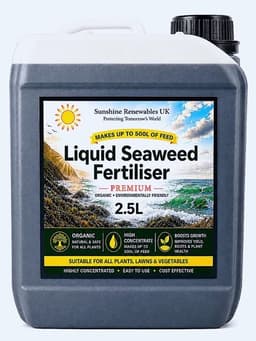
Sunshine seaweed 2.5 L is a seaweed concentrate at about £16.99, listed at 1:200, with a claim of up to 500 litres of made-up feed. Across 5 amazon.co.uk reviews the star line is 5.0, scaled to 100. That is the highest card score in this file, from a thin sample, not a laboratory ranking. Four written reviews in the file are one line each and do not describe a fault or a result. The listing does not mention iron; that sits on the 6 L Sunshine bottle. No control body is named. The top pick is that score, not proof this bottle outperforms Maxicrop seaweed 2.5 L on an allotment.
Pros
Highest card score: 100 from a 5.0 star line
2.5 L at about £16.99 with a printed 1:200
Made-up volume claim of up to 500 litres matches 2.5 times 200
Cons
Only five reviews sit behind the 5.0 line
Written reviews in the file are one line each
No control body named; iron is not on this listing
Best for: A smaller garden that wanted 2.5 L of Sunshine seaweed at 1:200 and accepted a five-review sample.
Less suitable: Anyone treating 5.0 from five reviews as a crop rank, or who needed a named certifier.
The Topline pack is two 1 L organic-titled seaweed bottles at about £16.99, listed at 1:10, with a United Kingdom origin field. Across 56 amazon.co.uk reviews the star line is 4.8, scaled to 96. The listing says to apply every 7-14 days from March to August on seedlings, plugs and growing plants, and it makes tomato and rose claims without printing an NPK. 1:10 is a much stronger mix than the 1:100 to 1:500 concentrates in this set, so you cannot copy a neighbour's cap onto this pack. No control body is named in the captured bullets. It is a twin-litre stimulant when you will use both bottles in one UK season, not a Soil Association mark or a tomato feed.
Pros
Two 1 L bottles at about £16.99
Score of 96 from a 4.8 star line on 56 reviews
Interval printed: every 7-14 days, March to August
United Kingdom origin named
Cons
Listed 1:10 is far stronger than the 1:100-1:500 bottles
No control body named
Tomato and rose claims sit on a bottle with no printed NPK
Best for: A UK season of seedlings and growing plants when you wanted two litres and a printed March-August interval.
Less suitable: Anyone who needed a named certifier, or who would copy a 1:200 cap onto this 1:10 pack.
Sunshine seaweed 5 L is a seaweed concentrate at about £25.99, listed at 1:200, with lawns and vegetables named on the role line. Across 128 amazon.co.uk reviews the star line is 4.7, scaled to 94. The manufacturer field is Sunshine Renewables UK; the brand field says Generic. The title says organic. The captured bullets do not name the Soil Association, OF&G, or another control body. How you apply it is not stated in the comparison block, so you still have to read the label in the bottle. It is a larger 5 L row when you already accept a title-only organic claim, not a named-body bottle for an inspected plot.
Pros
5 L at a printed 1:200
Score of 94 from a 4.7 star line on 128 reviews
Lawns and vegetables named on the role line
Cons
No control body named in the captured bullets
Brand field says Generic
Application method is not stated in the comparison block
Best for: A larger garden that wanted 5 L of seaweed at 1:200 and did not need a named certifier.
Less suitable: Inspected growers, or anyone who needed Soil Association or OF&G on the listing.
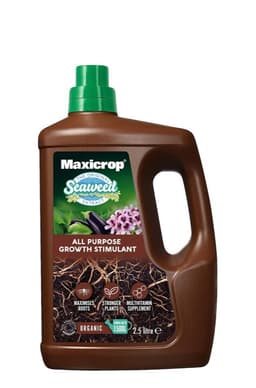
Maxicrop seaweed 2.5 L is a Soil Association-named seaweed stimulant at about £18.99, listed at 1:100 for flowers, shrubs, trees, fruit and vegetables. Across 3,688 amazon.co.uk reviews the star line is 4.6, scaled to 92. That is the deepest sample in this set, and still not a laboratory ranking. The listing does not print an NPK. SBM's support note treats Original as below 2 percent of each nutrient and not declared as a fertiliser. A maker label states 45 ml in 9 litres (1:200), so the Amazon 1:100 field and the brand rate stay side by side. Indoor use is asked on the page and not answered in the capture. It is the best value when you wanted a named body and a large UK review file at a mid-shelf price, not a tomato analysis or a 1:10 twin pack.
Pros
Soil Association named on the bullet
Deepest review file in this set: 4.6 from 3,688
2.5 L at about £18.99 in the mid band
Listing dilution 1:100 printed
Cons
No NPK on the listing; it is a stimulant, not a declared feed
Amazon 1:100 and the maker 1:200 stay unreconciled
Indoor use is unanswered in the capture
Best for: Mixed pots and allotment beds when you wanted a named Soil Association stimulant and a large review file.
Less suitable: Anyone who needed a tomato analysis, a lawn-only litre, or a single reconciled dilution.
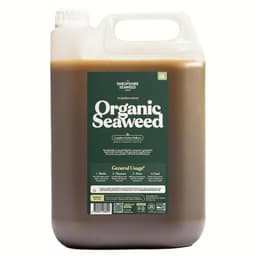
Shropshire Seaweed 5 L is a cold-pressed Ascophyllum nodosum concentrate at about £40.98, listed at 1:500, with OF&G named on the bullet. Across 1,026 amazon.co.uk reviews the star line is 4.6, scaled to 92. The listing claims up to 2,500 litres of ready-to-use feed from 5 litres, which is 5 times 500 arithmetic, not a measured solids test from this site. Harvest is described as hand-picked from Ireland's Atlantic coast. That is a listing claim. The bullets also say it suits vegan growers and is safe around children and pets as directed. There is no NPK on the listing. It is the species-named, OF&G row when you wanted a high-dilution 5 L, not the cheapest litre on this shelf.
Pros
OF&G named on the bullet
Ascophyllum nodosum and cold-pressed process named
1:500 on 5 L, with 1,026 reviews at 4.6
Vegan-grower wording on the listing
Cons
Highest capture price in this set, at about £40.98
The 2,500 litre claim is listing arithmetic, not a solids test
No NPK on the listing
Best for: Certified or vegan growers who wanted named Ascophyllum nodosum, OF&G, and a 5 L concentrate.
Less suitable: A first 1 L crop bottle, or anyone buying on shelf price alone.
Ascophyllum nodosum, cold-pressed rather than high-heat alkali extraction. Harvest is described as hand-picked from Ireland's Atlantic coast. That is a listing claim.
Which certifier is named?
The bullet names OF&G in the UK and the USDA in the US. It also says the feed is suitable for vegan growers and safe around children and pets as directed.
How far does 5 L go on the listing?
Dilution is 1:500, and the bullet says the bottle makes up to 2,500 litres of ready-to-use feed. There is no NPK on the listing. The 2,500 litre line is listing arithmetic.
Vitax organic liquid seaweed is priced at about £18.38, with root-drench or foliar-spray wording for flowers, fruit, vegetables, shrubs and trees. Across 541 amazon.co.uk reviews the star line is 4.6, scaled to 92. The title says 1 litre. Number of items is 2 and the liquid-volume field is 2 litres, so check the image and the label before you compare price per litre. The attribute block has no mixing ratio. One United Kingdom review says the rates are on the bottle and are not obvious. No control body is named. Skip it as a pack-size buy until the label in the box matches the title you clicked.
Pros
Root drench or foliar spray named on the listing
4.6 from 541 reviews, a mid-depth sample
Flowers, fruit, vegetables, shrubs and trees named
Cons
Title says 1 litre; items and volume fields say two litres
No mixing ratio in the attribute block
No control body named
Best for: Gardeners who already know the Vitax seaweed rate from a bottle in the shed and will check the pack size on arrival.
Less suitable: Anyone who needed a printed dilution or a settled litre count before buying.
The listing says a liquid root drench or a foliar spray on flowers, fruit, vegetables, shrubs and trees.
What dilution should you use?
The attribute block has no mixing ratio. One United Kingdom review says the rates are on the bottle label and are not obvious. Do not copy another brand's rate onto this listing.
Is the pack one litre or two?
The title says 1 litre. Number of items is 2 and the liquid-volume field is 2 litres. Check the image and the label before you compare price per litre.
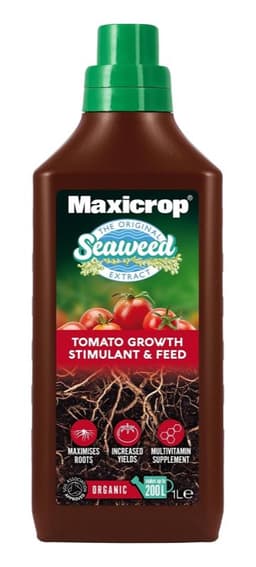
Maxicrop organic tomato 1 L is a tomato, pepper, chilli and aubergine feed at about £11.99, with added seaweed extract and a high-potassium highlight. Across 402 amazon.co.uk reviews the star line is 4.6, scaled to 92. The mixing-ratio field reads 4:2:6, which is not a 1:x water recipe. The letters NPK are not printed next to that string, so do not treat it as a confirmed analysis. The bullet names OF&G. The highlight names the Soil Association. Both strings sit in the file without a certificate. A repeated complaint is a spout that holds brown liquid and then leaks and stains. One reviewer linked dark green growth and blossom end rot to too much nitrogen. That is one report, not a trial. It is the fruiting-crop litre when you wanted a feed-shaped bottle, not a general stimulant.
Pros
Lowest capture price in this set, at about £11.99
Tomato, pepper, chilli and aubergine named
4.6 from 402 reviews
Cons
Repeated spout-leak and stain complaints
4:2:6 in the mixing field is not a confirmed NPK analysis
OF&G and Soil Association strings both sit in the file without a certificate
Best for: Greenhouse cooks feeding tomatoes, peppers, chillies or aubergines who wanted a 1 L organic-titled crop bottle.
Less suitable: A general tonic for mixed pots, or anyone who needed one settled control-body name and a leak-free spout.
No. It is a tomato feed with seaweed, and the highlight also names peppers, chillies and aubergines.
What does 4:2:6 mean on this capture?
That string is in the mixing-ratio field. The highlight says high potassium. The letters NPK are not printed next to 4:2:6, so do not treat it as a confirmed analysis.
What do reviewers say about the bottle?
A repeated complaint is a spout that holds brown liquid and then leaks and stains. One reviewer linked dark green growth and blossom end rot to too much nitrogen. That is one report, not a trial.
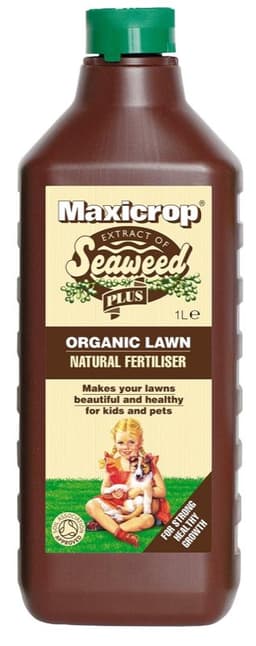
Maxicrop organic lawn 1 L is a lawn-only liquid at about £12.19, not the all-plants 2.5 L stimulant in this set. Across 98 amazon.co.uk reviews the star line is 4.4, scaled to 88. The listing says every 4-6 weeks in the growing season, and the mixing-ratio field reads 1:10 or 1:20. The bullet names OF&G. The item highlight names the Soil Association. The file contains both strings and does not show a certificate. It suits homes with children and pets as directed. It does not say to walk on wet feed. Use it on turf, not as a weekly pot tonic.
Pros
Lawn job named, with a 4-6 week interval
Entry price of about £12.19 for 1 L
1:10 or 1:20 printed on the listing
Cons
Not the all-plants Maxicrop 2.5 L row
OF&G and Soil Association strings both sit in the file without a certificate
Score of 88 from 98 reviews, thinner than the 2.5 L sibling
Best for: A UK lawn in the growing season when you wanted a 1 L organic-titled liquid on a 4-6 week interval.
Less suitable: Pots, tomatoes, or anyone who needed one settled control-body name.
Is this the same as the Maxicrop all-plants seaweed?
No. The title and item type are a lawn feed. The all-plants stimulant in this set is the 2.5 L Maxicrop bottle.
Which certifier should you trust on this capture?
The bullet names OF&G. The item highlight names the Soil Association. The file contains both strings and does not show a certificate.
How often is it applied?
Every 4-6 weeks during the growing season. The mixing-ratio field reads 1:10 or 1:20. The bullet says it suits homes with children and pets. It does not say to walk on wet feed.
Sunshine seaweed plus iron 6 L is seaweed plus chelated iron at about £29.99, listed at 1:400, for a watering can or sprayer. Across 8 amazon.co.uk reviews the star line is 4.4, scaled to 88. That is a thin sample, and four United Kingdom reviews sit in the file. One of those texts describes the container spilling when poured. The bullets name vegetables, flowers, lawns, shrubs, houseplants, fruit trees, seedlings and hydroponics. Iron is named. A full NPK is not. Pet safety is asked and not answered in the capture. Skip it if you needed a named control body or a review file deeper than eight ratings.
Pros
Chelated iron named on the bullet
6 L at a printed 1:400
Watering can or sprayer, with hydroponics named
Cons
Only 8 reviews support the 4.4 line
One United Kingdom review describes a spill when poured
No control body named; pet safety unanswered
Best for: Gardeners who specifically wanted seaweed plus chelated iron in a 6 L can and accepted a thin sample.
Less suitable: Inspected plots, or anyone who needed a deep review file before buying.
No. A bullet says it is enhanced with chelated iron for chlorophyll and greener foliage, as well as seaweed extract. A full NPK is not printed.
Where can you use it, according to the listing?
Vegetables, flowers, lawns, shrubs, houseplants, fruit trees, seedlings and hydroponics, by watering can or sprayer. Pet safety is asked and not answered in the capture.
How many reviews support the 4.4 score?
The listing line is 4.4 from 8 reviews. Four United Kingdom reviews are in the file, and one describes the container spilling when poured.
How we compared
Nine amazon.co.uk listings were read from the stored pages and the UK notes already on file. There is no laboratory test. The score on each card is the amazon.co.uk star rating scaled to 100. The top pick is the highest of those scores: Sunshine seaweed 2.5 L at 5.0 from 5 reviews. That file is thin, and the score is not a crop trial. The best value is a separate award in the same product file: Maxicrop seaweed 2.5 L, the Soil Association-named stimulant with the deepest review file, at a mid-shelf price. It does not also hold the top score. A 5.0 from five reviews is not treated as proof of a better allotment result than 4.6 from 3,688. The weights below are the reading checklist. They sum to 100. They are not a second total that moves the badges.
1
Star line on the card
40%
The amazon.co.uk star rating scaled to 100. Sunshine seaweed 2.5 L at 5.0 is the top of this block. The scaled figure is the card score and the top-pick assignment. It is not a measured yield.
2
Role and dilution
25%
A readable job, a dilution or a stated clash, and volume fields that agree. A 1:10 bottle is not scored as if it were a 1:500 concentrate. A missing mixing ratio, or a 4:2:6 field that is not an NPK, is recorded as printed.
3
Named control body
20%
Soil Association or OF&G named on the listing. A title that only says organic scores nothing here. Two Maxicrop litres name both bodies in different fields, with no certificate in the file, so that clash stays visible.
4
Review-file depth
15%
The count behind the star line. Maxicrop seaweed 2.5 L at 3,688 leads this block. Five reviews and eight reviews add little weight beside a 4.6 from hundreds or thousands. One written complaint is not a trial.
Independent review
Last updated: October 2026
8 sources checked
Organic liquid fertiliser buying guide
Match the job, the control body and the dilution before you match the star line. Prices below are the stored amazon.co.uk snapshot, not a live re-check. This is not a laboratory test.
What to match before you buy
Organic liquid fertiliser on amazon.co.uk, in the bottles kept for this comparison, is almost always a brown seaweed concentrate you dilute in a watering can. Six listings are multi-purpose seaweed stimulants. One adds chelated iron. One is a lawn liquid. One is a tomato liquid with a high-potassium highlight. The Royal Horticultural Society treats plain seaweed as not a true fertiliser. A biostimulant sits beside a feed and does not replace it on a hungry crop.
Best for
Mixed pots and allotment beds that need a seaweed stimulant beside a feed
An inspected plot that needs Soil Association or OF&G named on the listing
A greenhouse crop or a lawn when the bottle names that job
Not ideal for
Anyone treating 5.0 from five reviews as a rank over a file of thousands
A buyer who copies a 1:10 cap onto a 1:500 concentrate
Someone using a stimulant as the only tomato feed after fruit set
Mistakes to avoid
1
Copying one dilution onto another bottle
Listed ratios run from 1:10 to 1:500. Maxicrop seaweed 2.5 L is 1:100 on Amazon and 1:200 on the maker label. Follow the label in the bottle you hold.
2
Reading the title as a certificate
Sunshine, Topline and Vitax say organic and do not name a control body in the captured bullets. Soil Association and OF&G are named only where the listing actually names them.
3
Treating five stars as a crop trial
Sunshine seaweed 2.5 L is 5.0 from 5 reviews. Maxicrop seaweed 2.5 L is 4.6 from 3,688. The higher star line is the top-pick score. It is not evidence of a larger crop.
What to weigh up
Job, then the control body
High
Name the job first. Mixed pots and transplant shock want a seaweed stimulant. Fruiting tomatoes, peppers, chillies and aubergines want the tomato litre, which carries a high-potassium highlight and a mixing field of 4:2:6 that is not printed as NPK. A lawn wants the lawn litre every 4-6 weeks at 1:10 or 1:20. Chelated iron is named only on the 6 L bottle.
If you are inspected, the listing should name a UK control body. GOV.UK says food sold as organic needs one.
Dilution, pack and the review file
High
Use the rate on the bottle you hold. Topline is listed at 1:10. Maxicrop seaweed 2.5 L is 1:100 on the amazon field and 45 ml in 9 litres (1:200) on the maker label. Sunshine 5 L and Sunshine 2.5 L are 1:200. The iron bottle is 1:400. Shropshire is 1:500, and the claim of up to 2,500 litres is 5 times 500, not a solids test. Vitax has no mixing ratio in the attributes, and the title says 1 litre while the item and volume fields say 2 litres.
Which option suits you?
Three typical situations, each with a recommendation from this comparison.
🪴
Pots and an allotment
You want a brown seaweed stimulant for mixed pots and beds. Maxicrop seaweed 2.5 L is the best value at about £18.99, with the Soil Association named and 4.6 from 3,688 reviews. The amazon field says 1:100. The maker label for Original says 45 ml in 9 litres (1:200). It is not a declared NPK feed.
You need a control body an inspector can see, or vegan-grower wording, on a large concentrate. Shropshire Seaweed 5 L names OF&G and cold-pressed Ascophyllum nodosum, listed at 1:500, at about £40.98. It is 4.6 from 1,026 reviews. The 2,500 litre claim is listing arithmetic, not a solids test.
After fruit set you want a crop bottle, not only a stimulant. Maxicrop organic tomato 1 L is about £11.99, with 4.6 from 402 reviews, and the highlight names tomatoes, peppers, chillies and aubergines. The mixing field reads 4:2:6 without the letters NPK. Reviewers report a leaking spout. A lawn is a different litre.
Which organic liquid fertiliser is the top pick in 2026?
The top pick is Sunshine seaweed 2.5 L at about £16.99. The card score is the amazon.co.uk star line scaled to 100, and this listing is 5.0 from 5 reviews. Dilution is 1:200, with a claim of up to 500 litres. That matches 2.5 times 200 and is listing arithmetic, not a solids test. No control body is named. Four written reviews are one line each. Five reviews are not proof it outperforms a 2.5 L stimulant with thousands of reviews.
Which bottle is the best value?
The best value is Maxicrop seaweed 2.5 L at about £18.99. The bullet names the Soil Association. amazon.co.uk shows 4.6 from 3,688 reviews, the deepest file here, scaled to 92. The listing dilution is 1:100. A maker label for Original states 45 ml in 9 litres (1:200), so those rates stay side by side. There is no NPK. SBM's support note treats Original as below 2 percent of each nutrient and not a declared fertiliser. Choose it for mixed pots, not a tomato analysis.
Is seaweed extract a true fertiliser?
Plain seaweed extract is not a true fertiliser, according to the Royal Horticultural Society. It is a biostimulant you use beside a feed, not instead of one, once hungry crops are fruiting. In this set the tomato litre is the feed-shaped bottle, with a high-potassium highlight. The lawn litre is turf feed on a 4-6 week interval. A multi-purpose seaweed bottle does not replace either job.
Does organic on the title mean a UK control body?
No. A title that says organic is not a Soil Association or OF&G mark. GOV.UK says food sold as organic needs a UK control body. An OF&G approved input may be used in an organic system without itself being organic food. Here, one 2.5 L stimulant names the Soil Association and one 5 L concentrate names OF&G. The lawn and tomato litres name both bodies in different fields, with no certificate in the file. Other titles name no body. Check the live directory if an inspector will ask.
Why do the dilutions differ so widely?
Listed dilutions run from 1:10 to 1:500. A 1:10 mix is much stronger than a 1:500 concentrate, so you cannot pour one brand's cap into another bottle. One stimulant is 1:100 on the amazon field and 1:200 on the maker label. Follow the label in the bottle you bought. A field that reads 4:2:6 is not a 1:x water recipe, and NPK is not printed beside it. If the attributes have no mixing ratio, do not invent one.
What does 4:2:6 mean on the tomato listing?
On Maxicrop organic tomato 1 L the mixing-ratio field reads 4:2:6. The highlight says high potassium and names tomatoes, peppers, chillies and aubergines. NPK is not printed next to 4:2:6, so this comparison does not treat that string as a confirmed analysis. Reviewers often report a spout that holds brown liquid, then leaks and stains. One reviewer linked dark growth and blossom end rot to too much nitrogen. That is one report, not a trial. The bottle is about £11.99, with 4.6 from 402 reviews.
Can you use these bottles on a lawn, and when should you stop?
Only the lawn litre is sold as turf feed, every 4-6 weeks at 1:10 or 1:20. Pet-friendly lines mean as directed. They do not mean a pet may drink the concentrate, and they do not invite you to walk on wet feed. None of these bottles is a moss killer. Ask your inspector before you treat a bottle as an approved input, and contact the seller if a pack leaks. Wider lawn liquids are in the liquid lawn fertiliser comparison. This page did not run a crop trial.
Our verdict
The top pick is Sunshine seaweed 2.5 L at about £16.99. It has the highest card score because amazon.co.uk shows 5.0 from 5 reviews, scaled to 100, with a listed dilution of 1:200. That sample is five reviews, four of them one line, and no control body is named. The best value is Maxicrop seaweed 2.5 L at about £18.99: Soil Association on the bullet, 4.6 from 3,688 reviews, and a mid-shelf 2.5 L. It is a stimulant, not a declared NPK, and the amazon 1:100 field does not match the maker's 1:200 label. Shropshire Seaweed 5 L is the OF&G, species-named concentrate. The tomato litre and the lawn litre are separate jobs. None of these scores is a laboratory test.
Best overall
Sunshine seaweed 2.5 L
Highest card score: 5.0 from 5 reviews, scaled to 100, at about £16.99 and a listed 1:200. The file is thin and names no control body.
Peter F. is the editor for DIY & tools at productscompared.co.uk. Comparisons in this category are checked against amazon.co.uk listings, review evidence and public UK sources.
Updated: October 2026
8 sources checked
Guides to organic liquid fertilisers
Guides on what to look for, how to use a product, and common mistakes.
Public UK and maker sources from the research digest, used for this page in October 2026. Prices, stars and review counts are from the nine stored amazon.co.uk listings. A title that says organic is not a control-body certificate. The 4:2:6 tomato field is not an analysis from this site. Shropshire's 2,500 litre line and Sunshine's 500 litre line are listing arithmetic. A 5.0 from five reviews is not a crop trial.
This page contains affiliate links to amazon.co.uk (tag pcuk26-21). If you buy through them, we may earn a commission at no extra cost to you. Prices, stars and review counts are from the listings. This is not a laboratory test.