Independent comparisons. We may earn from shop links. Our editors compare products independently. Some links go to shops, and we may earn a commission. More info
Top pick: Baby Bio Houseplant Food 175 ml – Highest score: 4.7 from 21,941 reviews, 5–10 drops in half a litre poured onto the soil, about £3.99. Best value: Baby Bio organic 175 ml – Lowest shelf price among the 92-score bottles, about £3.99, at 4.6 from 829 reviews. The title says organic. No certifier is named. Updated October 2026.
A fertiliser for houseplants is a nutrient feed for plants growing in pots indoors. Compost in a pot runs out of nutrients, and the roots cannot reach garden soil, so you add a liquid. On amazon.co.uk the usual choice is a small concentrate you dilute, or a ready-to-use litre you pour on. A suitable bottle names houseplants, prints a dose you can follow, and fits the growing season. Drops into a measured jug, a 5 ml measure, or a clear pour-on line are the dose styles that hold up. Ignore a scraped ratio string that is not an analysis.
The Royal Horticultural Society advises feeding foliage houseplants about once or twice a month from March to October, or at quarter strength with every watering while they are growing, and not feeding dry compost. Keep winter feeds light, because the light is low. Orchids, cacti, citrus and ericaceous plants need their own labels. How to choose a concentrate, a pour-on or a specialist feed is set out in the [fertiliser for houseplants buying guide](/hub/fertiliser-soil-and-bark-mulch/fertiliser-for-houseplants/sub/fertiliser-for-houseplants-buying-guide).
A fertiliser for houseplants is a nutrient feed for plants growing in pots indoors. Compost in a pot runs out of nutrients, and the roots cannot reach garden soil, so you add a liquid.
A fertiliser for houseplants is a nutrient feed for plants growing in pots indoors. Compost in a pot runs out of nutrients, and the roots cannot reach garden soil, so you add a liquid. On amazon.co.uk the usual choice is a small concentrate you dilute, or a ready-to-use litre you pour on. A suitable bottle names houseplants, prints a dose you can follow, and fits the growing season. Drops into a measured jug, a 5 ml measure, or a clear pour-on line are the dose styles that hold up. Ignore a scraped ratio string that is not an analysis.
The Royal Horticultural Society advises feeding foliage houseplants about once or twice a month from March to October, or at quarter strength with every watering while they are growing, and not feeding dry compost. Keep winter feeds light, because the light is low. Orchids, cacti, citrus and ericaceous plants need their own labels. How to choose a concentrate, a pour-on or a specialist feed is set out in the [fertiliser for houseplants buying guide](/hub/fertiliser-soil-and-bark-mulch/fertiliser-for-houseplants/sub/fertiliser-for-houseplants-buying-guide).
A fertiliser for houseplants is a nutrient feed for plants growing in pots indoors. Compost in a pot runs out of nutrients, and the roots cannot reach garden soil, so you add a liquid. On amazon.co.uk the usual choice is a small concentrate you dilute, or a ready-to-use litre you pour on. A suitable bottle names houseplants, prints a dose you can follow, and fits the growing season. Drops into a measured jug, a 5 ml measure, or a clear pour-on line are the dose styles that hold up. Ignore a scraped ratio string that is not an analysis.
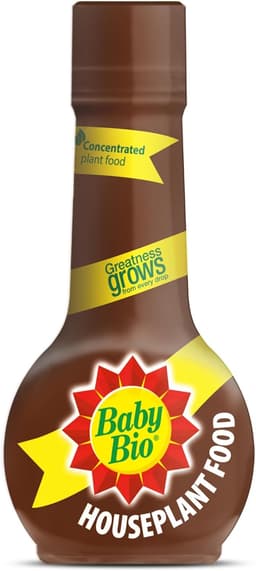
Baby Bio Houseplant Food 175 ml is about £3.99. The listing says add 5–10 drops to half a litre of water, then pour that onto the soil. amazon.co.uk shows 4.7 from 21,941 reviews, the largest file here and the only 4.7. Reviewers describe greener leaves and new growth on foliage and flowering houseplants, and several say the small bottle lasts because the dose is only drops. An item highlight says it makes up to 70 litres. The listing ratio field prints 1:0:0, which is not a readable NPK, so that string is not an analysis you can quote. Bayer Garden is the manufacturer, and the listing says the date on the bottle is a manufacturing date rather than an expiry. Reviewers use different drop counts, including every watering rather than one fixed mix, and the 175 ml bottle is still called small even when people say it lasts. It is the top pick for a mixed indoor collection when you will count drops. It is a poor fit if you need a printed analysis or a ready-to-pour litre.
Pros
5–10 drops in half a litre, poured onto the soil
4.7 from 21,941 reviews, the largest sample in this comparison
About £3.99, with an item highlight of up to 70 litres
Reviews cover foliage and flowering indoor plants
Cons
Listing ratio field 1:0:0 is not a readable NPK
Reviewers change the drop count, including every watering
175 ml is still described as small
Best for: A mixed indoor collection when you will count drops into half a litre.
Less suitable: Anyone who needs a printed analysis, a ready-to-pour litre, or a fixed millilitre dose in the bullets.
Miracle-Gro's all-purpose concentrate is an 800 ml pack of two at about £7.98, with the unit count printed as 1,600 ml, and 4.6 from 3,025 reviews. The bullets say you mix the concentrate with water for indoor houseplants and the garden, but they do not give a millilitre ratio, and the mixing-ratio field is empty. Reviewers who have used it for years mention greener growth indoors and outdoors, and one notes no smell. The complaints that recur are an 800 ml fill in a bottle that looks like a litre, mixing called fiddly, a price some reviewers dislike, and one person who saw no change after a month. It is a large concentrate if you already feed both the windowsill and outdoor pots from one liquid. It is not a houseplant-only bottle, and you still take the dose from the label on the pack rather than from these bullets.
Pros
800 ml times two, with a unit count of 1,600 ml, at about £7.98
4.6 from 3,025 reviews
Bullets name indoor houseplants and the garden
One review notes no smell
Cons
No dilution ratio in the bullets, and no mixing-ratio field
800 ml described as looking like a 1 litre bottle
Also sold for garden plants, so not a houseplant-only feed
Best for: You feed indoor plants and garden pots from one concentrate and will read the dose on the pack.
Less suitable: A windowsill-only buyer who wants a printed drop or millilitre dose in the listing bullets.
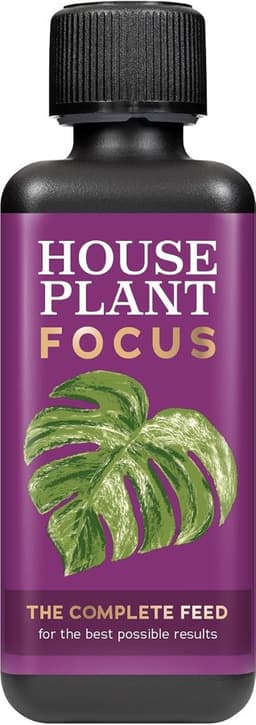
Growth Technology's Houseplant Focus is a 300 ml concentrate at about £7.44, with the country of origin listed as the United Kingdom, and 4.6 from 1,113 reviews. The bullets tell you to mix 5 ml in 1 litre of water, and they also say every other watering. The listing ratio field is 1:200, which is 5 ml in a litre. Kelp extracts, humic acid and fulvic acid are named in the bullets, and the listing calls the maker a British family business founded in 1985. Reviewers mention succulents, ferns and other indoor plants, a small amount per watering, and plants picking up, with half-strength use appearing in the texts. The faults are about the bottle rather than the dose line: one bottle described as watery and paler than earlier dark bottles, a lid seal that peeled, mould inside the lid on one arrival, and no dropper, so small doses are fiddly. It is the measured UK concentrate here if you will use a 5 ml measure. It is a poor match if you wanted a dropper and a seal that arrives intact.
Pros
5 ml in 1 litre, with a 1:200 field that matches that mix
United Kingdom origin, and kelp, humic acid and fulvic acid named
4.6 from 1,113 reviews
Used on succulents and ferns in the reviews
Cons
One bottle called watery and paler than earlier stock
Lid seal peeled, and mould inside the lid on one arrival
No dropper, so small doses are fiddly
About £7.44 for 300 ml, above the £3.99 concentrates
Best for: Indoor plants, including succulents and ferns, when you will measure 5 ml into a litre.
Less suitable: Anyone who wants a dropper, or who needs the bottle to arrive with a seal that has not peeled.
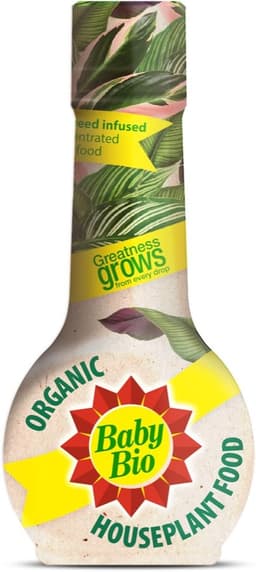
This Baby Bio 175 ml bottle is also about £3.99, with the same 5–10 drops in half a litre poured onto the soil, and 4.6 from 829 reviews. The title calls it an organic concentrated nitrogen feed. The listing names no certifier, so the word organic is not a certificate you can check. SBM Life Science Ltd is the manufacturer, and the model and part numbers on the listing do not match. Reviewers report new growth, including on a rescued monstera. The listing ratio field prints 1:10-20, which is a listing field only, not a confirmed analysis. Seaweed is not in the bullets, though reviews mention a seaweed-like smell. That smell is the complaint that repeats, including after mixing a large batch, and more than one review describes a leak or drip when the bottle stands upright. It is the best value if you wanted the other £3.99 concentrate and can live with the smell. It is a poor fit in a small room, or if you need a named organic certifier.
Pros
Same about £3.99 shelf and the same 5–10 drop dose
4.6 from 829 reviews
New growth reported, including on a rescued monstera
A cap is listed among the included components
Cons
No certifier is named behind the organic title
Strong smell, including after a large mixed batch
Leaks or drips when stood upright in more than one review
Listing ratio field 1:10-20 is not a confirmed analysis
Best for: You wanted the other £3.99 Baby Bio concentrate and can live with a strong smell.
Less suitable: A small room where a strong odour is a problem, or anyone who needs a named organic certifier.
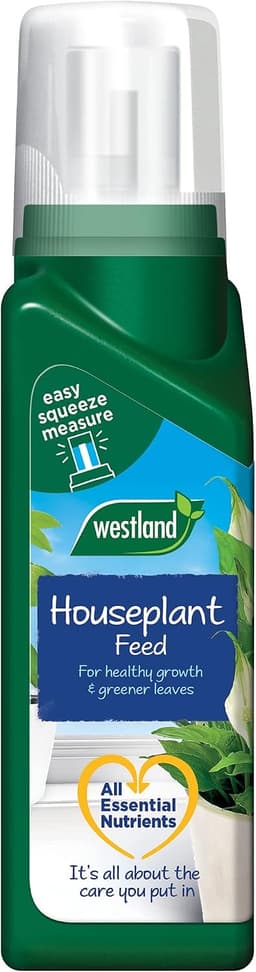
Westland's 200 ml houseplant concentrate is about £6.98, with the country of origin listed as the United Kingdom, and 4.6 from 719 reviews. The bullets advertise an easy measuring doser and a balanced formula for green leaves and flower growth, but they do not state millilitres per litre. The listing ratio field prints 6-4-7. The bullets do not spell that string out as an NPK, so you read the bottle rather than treat the scraped field as the analysis. Westland's own page states 5 ml per litre. Reviewers praise the squeeze doser, describe plants as lush and green, and one mentions flowering on a lily. A single arrival came with no top, leaked, and was half empty. Many of the reviews are one line, and one reviewer mixed the feed with a pest-control liquid, which is not a listing instruction. It suits a UK doser bottle when you will take the millilitre rate from the label in your hand.
Pros
Easy measuring doser on a 200 ml UK bottle at about £6.98
4.6 from 719 reviews
Reviews mention green growth and a lily that flowered
Concentrate described as economical in spring and summer
Cons
Bullets omit millilitres per litre
Listing ratio field 6-4-7 is not spelled out as an NPK in the bullets
One delivery arrived with no cap, leaked, and was half empty
Best for: Houseplants when you want a squeeze doser and will read the millilitre rate on the bottle.
Less suitable: A buyer who needs millilitres per litre written in the amazon.co.uk bullets.
This Miracle-Gro Baby Bio 175 ml listing is about £6.33, with 4.6 from 497 reviews, and the bullets do not state a dose. The only dose in the file is one review that says about 10 drops in 1 litre, which is a reviewer habit rather than a printed instruction. The listing ratio field is 1:0:0, which is not a readable NPK, and the manufacturer line is empty. Indoor plants are said to grow and look healthier, the liquid is described as concentrated, and one reviewer mentions an orchid. The texts are mostly a single line, and reviewers call this listing expensive next to the £3.99 Baby Bio concentrate. No repeated leak or mould complaint appears in the sample. It is a familiar name on a thin listing. Skip it if you need a printed dose, a manufacturer, or the lower shelf price.
Pros
175 ml liquid aimed at indoor plants
4.6 from 497 reviews
Reviewers describe it as concentrated, so a bottle lasts
One reviewer mentions an orchid
Cons
No dose in the bullets and no manufacturer
About £6.33 against the £3.99 Baby Bio concentrate
Listing ratio field 1:0:0 is not a readable NPK
Reviews are mostly one line
Best for: You already know a Baby Bio drop habit and accept a listing with no printed dose.
Less suitable: Anyone who needs a stated dose, a named manufacturer, or the £3.99 single bottle.
The Bayer twin pack is titled as two 175 ml bottles of Baby-Bio original plant food at about £10.18, with 4.6 from 74 reviews. The unit-count field prints 350 ml while the liquid-volume field prints 175 ml, so the page does not agree with itself about how much you receive. There is no dose in the bullets. A review says a few drops in about 1 litre. The listing ratio field shows 1:32 or 1:64, and the bullets do not explain that string. Buyers say plants look fuller and mention flowering, and they call it long-lasting, but the reviews are very short and the sample is far smaller than the single-bottle listing. The part number printed is ANICEMOON. It is two bottles only if the title is what arrives. It is a weak first buy if you wanted one agreed volume and a larger review file at a lower price.
Pros
Title is two 175 ml bottles for house plants
4.6 from 74 reviews
Reviewers mention fuller plants and flowering
Cons
175 ml, 350 ml and a two-bottle title disagree
No dose in the bullets, and the ratio field is unexplained
About £10.18 with only 74 reviews, against a £3.99 single bottle
Best for: You specifically wanted two Baby-Bio bottles in one order and will check the volume on arrival.
Less suitable: A first bottle, or anyone who needs one agreed pack size and a printed dose.
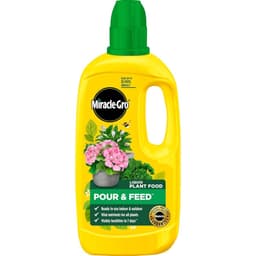
Miracle-Gro Pour and Feed is a 1 litre bottle at about £5.00, with 4.5 from 5,343 reviews. The title is a pour-on, the bullets give no dilution, and reviews treat it as ready mixed. The stated use lists ornamental plants, fruits and vegetables, with indoor use only as a listing question. The listing ratio field prints 0.02-0.02-0.02, which is not a confirmed NPK. A coverage line says 40 caps for 20 medium pots, and the number-of-packs field is 40, which conflicts with a 1 litre title. Reviewers pour it around the base of indoor plants and report greener leaves, stronger colour and, in some cases, more blooms. The mistake that repeats is buying it as a concentrate and using most of the bottle in one session, including one reviewer who used most of a litre on about 15 plants. Others call an already-mixed litre an expensive way to feed. It suits a few pots only when you already know the liquid is diluted.
Pros
1 litre ready to pour at about £5.00
4.5 from 5,343 reviews
Indoor use in reviews, with greener leaves and some extra blooms
No mixing if you treat it as ready to use
Cons
Bullets do not explain the dose, and indoor use is only a listing question
The coverage line of 40 caps conflicts with the 1 litre title
Buyers mistake it for concentrate and empty the bottle quickly
Listing ratio field 0.02-0.02-0.02 is not a confirmed NPK
Best for: A few pots when you will pour a ready-mixed litre and will not treat the bottle as concentrate.
Less suitable: A large collection, or anyone who wanted a concentrate that makes many litres.
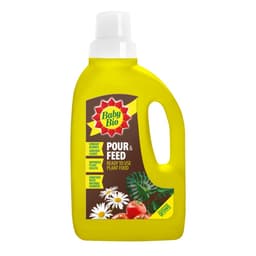
Baby Bio Pour and Feed is a 1 litre ready-to-use bottle at about £5.81, with seaweed extract named on the listing, and 4.5 from 1,365 reviews. The listing says it is a pre-made solution for houseplants and garden plants, with no dilution, and SBM Life Science is the manufacturer. The listing ratio field prints 2.5:1.05:0.45. The bullets do not call that string an NPK. Reviewers like the lack of measuring and describe indoor plants as healthier after a few doses. The same file is full of people who expected the concentrate: they call this a weak or watery version, notice a lighter colour, and say the litre does not last the way the 175 ml concentrate does. Several treat it as poor value beside that concentrate. The complaint is strength and coverage, not a cracked bottle or mould. It is the seaweed pour-on for a few plants. It is the wrong bottle if you thought a litre of Baby Bio meant a litre of concentrate.
Pros
1 litre, no dilution, with seaweed extract named
4.5 from 1,365 reviews at about £5.81
Clear pour-on use for houseplants and garden plants
Quicker than measuring drops, in the reviews
Cons
Buyers expected concentrate and found a ready-diluted feed
Called weak or watery next to the 175 ml concentrate
A litre is used up quickly
Listing ratio field 2.5:1.05:0.45 is not described as an NPK in the bullets
Best for: A small number of houseplants or patio pots when you want to pour and will not measure.
Less suitable: A large indoor collection, or anyone comparing cost per watering with the £3.99 concentrate.
The listing says it is a pre-made solution you pour on. It is not the drop-dose concentrate.
Does it contain seaweed?
Yes. The listing says seaweed extract.
Is it only for indoor plants?
The bullets say garden plants and houseplants.
How we compared
Nine amazon.co.uk listings were scored from the stored pages and the UK review notes already on file. Shelf date 21 October 2026. There is no laboratory feeding trial. The number on each product is the amazon.co.uk star rating times 20: 4.7 becomes 94, 4.6 becomes 92 and 4.5 becomes 90. Review counts are shown and do not change that number. Listing ratio fields are copied as scraped strings and are not treated as NPK. The highest score is the top pick. The best value is the lowest shelf price among the bottles at the next score. RHS, Gardeners' World and maker pages are context for dose and season. They are not a score for these packs. The weights below sum to 100.
1
Amazon star line
100%
The score is the amazon.co.uk star rating times 20. Baby Bio Houseplant Food 175 ml is 4.7 from 21,941 reviews, which is 94 and the only score at that level. Six bottles are 4.6 and score 92. The two pour-on litres are 4.5 and score 90. The size of the review file is reported beside the stars and does not move the score. A 4.6 from 74 reviews and a 4.6 from 3,025 reviews are the same score.
Independent review
Last updated: October 2026
8 sources checked
Fertiliser for houseplants buying guide
Buy the style before you buy the star line. A concentrate and a ready-to-use litre are not the same bottle. Prices below are amazon.co.uk shelf prices on 21 October 2026. This is not a laboratory test.
What to match before you buy
A fertiliser for houseplants is a nutrient liquid for plants in pots indoors. Compost in a pot runs out of feed, and the roots cannot search garden soil. UK buyers on amazon.co.uk are mostly choosing a small concentrate or a ready-to-use litre for foliage plants, not a sack. Quality means a bottle that names houseplants, prints a dose, and matches that dose to the growing season.
Two styles sit in this comparison. A concentrate has to be diluted.
Best for
A mixed indoor collection when you will count drops into half a litre
A few pots when you will pour a ready-mixed litre
Indoor plants when you will measure 5 ml into a litre
Not ideal for
Anyone who needs a named organic certifier
A large collection fed only from a ready-to-use litre
Orchids, cacti or citrus as the main plants
Mistakes to avoid
1
Buying the litre instead of the drops
Pour and Feed is a ready-mixed litre. The 175 ml Baby Bio is a concentrate. UK reviews show people emptying the litre because they expected the strong bottle.
2
Reading a scraped ratio as NPK
Strings such as 1:0:0, 0.02-0.02-0.02 and 1:10-20 are listing fields. They are not a nutrient analysis you can quote. Read the bottle, or a maker page that actually prints the analysis.
3
Feeding full strength all winter
RHS limits winter feeding because light is low. Westland's label still allows every fourth watering in winter. Feed will not fix a dark room, and a high-nitrogen feed weekly is a poor habit on cacti.
What to weigh up
Feed style and stated plants
High
Concentrate must be diluted. Ready to use is poured on, and a litre does not last. Name the plants on the bottle. Prefer a houseplant line unless you also feed garden pots. The Miracle-Gro 800 ml twin says indoor houseplants and the garden, and it gives no millilitre ratio. Miracle-Gro Pour and Feed lists ornamental plants, fruits and vegetables, and indoor use is only a listing question. Baby Bio Pour and Feed names houseplants and garden plants, and it names seaweed extract.
Dose, analysis and price per litre
High
A dose you can follow beats a slogan about greener leaves. The two £3.99 Baby Bio concentrates say 5–10 drops in half a litre. Houseplant Focus says 5 ml in 1 litre, and the listing ratio field 1:200 matches that mix. Westland's amazon bullets advertise a doser and omit millilitres per litre. Westland's own page states 5 ml per litre and prints 6-4-7. A Morrisons page for Baby Bio 175 ml declares 10.6% N, 4.4% P2O5 and 1.7% K2O. That is not the amazon field 1:0:0, and it is not a US analysis.
Which option suits you?
Three typical situations, each with a recommendation from this comparison.
🪴
Many indoor pots
A ready-to-use litre runs out when you have a lot of pots. Baby Bio Houseplant Food 175 ml is the top pick at about £3.99, with 4.7 from 21,941 reviews. The listing says 5–10 drops in half a litre, poured onto the soil. An item highlight says the bottle makes up to 70 litres. The listing ratio field 1:0:0 is not a readable NPK.
Miracle-Gro Pour and Feed is a 1 litre ready-mixed bottle at about £5.00, with 4.5 from 5,343 reviews. The bullets give no dilution, and reviews treat it as ready to pour. It suits a few pots. Buyers who treat it as concentrate use most of the litre in one go. The coverage line of 40 caps conflicts with the 1 litre title.
Houseplant Focus 300 ml tells you to mix 5 ml in 1 litre of water, and the country of origin is the United Kingdom. It is about £7.44, with 4.6 from 1,113 reviews. Kelp, humic acid and fulvic acid are named. There is no dropper, and one arrival had a peeled seal and mould inside the lid.
Common questions about fertilisers for houseplants
Which fertiliser for houseplants is the top pick in 2026?
The top pick is Baby Bio Houseplant Food 175 ml at about £3.99. It is the only listing at 4.7, from 21,941 amazon.co.uk reviews. The bullets say 5–10 drops in half a litre, poured onto the soil. An item highlight says up to 70 litres. The listing ratio field 1:0:0 is not a readable NPK. Reviewers change the drop count. Choose it when you will count drops for a mixed indoor collection. It is a poor fit if you need a printed analysis or a ready-to-pour litre.
Which bottle is the best value?
The best value is the organic-titled Baby Bio 175 ml, also about £3.99. It is 4.6 from 829 reviews, and it is the lowest shelf price among every bottle at that score. The dose is the same 5–10 drops in half a litre. The title says organic. The listing names no certifier, so that word is not a certificate you can check. Reviews mention a strong smell and drips when the bottle stands upright. It suits you if you wanted that other £3.99 concentrate and can live with the smell.
Should you buy a concentrate or a ready-to-use litre?
A concentrate is diluted, and a small bottle can make many litres. A ready-to-use litre is poured on and is used up quickly. UK reviews often show people buying Pour and Feed when they wanted the strong 175 ml Baby Bio. Miracle-Gro Pour and Feed is about £5.00 for 1 litre. Baby Bio Pour and Feed is about £5.81 and names seaweed extract. Neither listing tells you to dilute it. Use a pour-on only for a few pots. For many pots, buy a concentrate with a printed dose.
How often should you feed houseplants?
RHS guidance is about once or twice a month from March to October for foliage houseplants, or quarter strength at every watering while they are growing. Do not feed dry compost. Limit winter feeding because light is low. Gardeners' World describes a fortnightly foliage feed. Westland's own label still allows every fourth watering in winter and states 5 ml per litre, which the amazon bullets for the 200 ml bottle do not print. Feed will not fix a dark room.
Is the organic-titled Baby Bio certified organic?
No certifier is named. The amazon.co.uk title of that £3.99 bottle says organic concentrated nitrogen feed. The listing does not name a certifier or an NPK. Do not treat the title word as a certificate. Seaweed is not in the bullets, although reviews mention a seaweed-like smell. The dose on the bullets is still 5–10 drops in half a litre, poured onto the soil. If you need a named organic standard, this listing does not give you one.
Can one houseplant fertiliser feed orchids and cacti?
A general houseplant bottle is the wrong stop if orchids, cacti or citrus are the main plants. Those groups have specialist labels. Houseplant Focus says indoor plants, and reviews mention succulents and ferns, but the orchid question on that listing is unanswered. The same gap appears on the Baby Bio and Westland listings. A high-nitrogen feed used weekly on cacti is a common mistake. For the compost those pots sit in, see the houseplants compost comparison.
What if the bottle leaks or someone swallows the feed?
A leaking bottle that does not match its description is a Consumer Rights Act 2015 question with the seller. Storage lines say keep feed away from children, pets and food. Do not call any of these bottles non-toxic or safe for pets. If concentrate is swallowed, especially by a child, contact NHS 111, or 999 if the person is unwell, and have the bottle to hand. If eyes stay sore after rinsing, get medical help. A large spill to a drain is a local disposal question, not a dosing question.
Our verdict
The top pick is Baby Bio Houseplant Food 175 ml at about £3.99. The listing says 5–10 drops in half a litre, poured onto the soil, and amazon.co.uk shows 4.7 from 21,941 reviews, the only 94 in this comparison. The listing ratio field prints 1:0:0, which is not a readable NPK. The best value is the organic-titled Baby Bio 175 ml, also about £3.99, at 4.6 from 829 reviews. That is the lowest shelf price among the 92-score bottles. The title says organic. No certifier is named on the listing. The two ready-to-use litres sit at 90. Neither badge is a laboratory result, and neither means the best houseplant food in the UK.
Best overall
Baby Bio Houseplant Food 175 ml
Highest score: 4.7 from 21,941 reviews, 5–10 drops in half a litre poured onto the soil, about £3.99.
Peter F. is the editor for DIY & tools at productscompared.co.uk. Comparisons in this category are checked against amazon.co.uk listings, review evidence and public UK sources.
Updated: October 2026
8 sources checked
Guides to fertilisers for houseplants
Guides on what to look for, how to use a product, and common mistakes.
Public UK and maker sources from the research digest, used for this page in October 2026. Prices, stars and review counts are from the nine amazon.co.uk listings captured on 21 October 2026. Listing ratio fields are not treated as NPK. The organic word on one Baby Bio title is not a certifier. A maker analysis is the maker's statement, not an independent UK lab test.
This page contains affiliate links to amazon.co.uk (tag pcuk26-21). If you buy through them, we may earn a commission at no extra cost to you. Prices, stars and review counts are from the listings. This is not a laboratory test.