Independent comparisons. We may earn from shop links. Our editors compare products independently. Some links go to shops, and we may earn a commission. More info
Top pick: Sunshine Renewables seaweed 20 L – Highest star-scaled score: 4.7 from 9 reviews becomes 94. 20 L at 1:400, chelated iron on the title, about £59.99. Nine reviews are not a UK trial. Best value: Topline fish, blood and bone 8 kg – Lower shelf price per kilogram of the two animal-meal sacks with more than 100 reviews, about £2.37/kg at about £18.98. The mixing-ratio field is 1:0:0. Updated October 2026.
A natural fertiliser is a plant feed made from animal, plant or seaweed material, rather than a synthetic salt such as ammonium nitrate or a soluble mineral feed. You buy one in the UK for an allotment bed, a container, a tomato crop or a lawn, and you still have to match the job. Plant-based materials include seaweed, comfrey and nettles. Animal-based materials include fish, blood and bone, bone meal and poultry manure. Many seaweed products are biostimulants, not a guaranteed NPK feed.
You recognise a suitable pack by the job on the label, a declared analysis or a dilution you can measure, and whether organic wording is a control-body mark or only a slogan. Granules suit beds. Liquids suit pots. Animal meals are not a vegan choice. A pack that declares nutrients should show nitrogen, phosphorus and potassium, often as oxides. How a mark differs from a title that only says natural is set out in the [natural fertiliser buying guide](/hub/fertiliser-soil-and-bark-mulch/natural-fertiliser/sub/natural-fertiliser-buying-guide).
Most gardens do not need a routine feed. Liquid feeding of pots runs mainly from April to September.
A natural fertiliser is a plant feed made from animal, plant or seaweed material, rather than a synthetic salt such as ammonium nitrate or a soluble mineral feed.
A natural fertiliser is a plant feed made from animal, plant or seaweed material, rather than a synthetic salt such as ammonium nitrate or a soluble mineral feed. You buy one in the UK for an allotment bed, a container, a tomato crop or a lawn, and you still have to match the job. Plant-based materials include seaweed, comfrey and nettles. Animal-based materials include fish, blood and bone, bone meal and poultry manure. Many seaweed products are biostimulants, not a guaranteed NPK feed.
You recognise a suitable pack by the job on the label, a declared analysis or a dilution you can measure, and whether organic wording is a control-body mark or only a slogan. Granules suit beds. Liquids suit pots. Animal meals are not a vegan choice. A pack that declares nutrients should show nitrogen, phosphorus and potassium, often as oxides. How a mark differs from a title that only says natural is set out in the [natural fertiliser buying guide](/hub/fertiliser-soil-and-bark-mulch/natural-fertiliser/sub/natural-fertiliser-buying-guide).
Most gardens do not need a routine feed. Liquid feeding of pots runs mainly from April to September.
A natural fertiliser is a plant feed made from animal, plant or seaweed material, rather than a synthetic salt such as ammonium nitrate or a soluble mineral feed. You buy one in the UK for an allotment bed, a container, a tomato crop or a lawn, and you still have to match the job. Plant-based materials include seaweed, comfrey and nettles. Animal-based materials include fish, blood and bone, bone meal and poultry manure. Many seaweed products are biostimulants, not a guaranteed NPK feed.
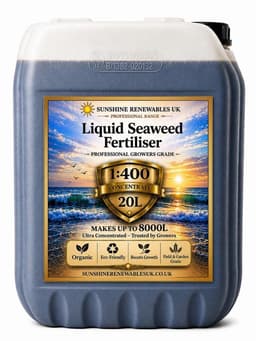
Sunshine Renewables’ 20 L seaweed with chelated iron is £59.99 and prints a 1:400 dilution for vegetables, flowers, lawns, shrubs, fruit, herbs, houseplants, greenhouses and raised beds. The title says organic liquid seaweed; the capture names no Soil Association or OF&G mark. The star line is 4.7 from 9 reviews, which scales to a score of 94, the highest number in this set, and only four short positive UK texts are in the file. Those texts mention greener growth, a sprayer, and fast delivery, and they do not repeat a defect. Nine reviews are not a UK trial, and the score is not a lab result. Compared with Maxicrop 2.5 L at 1:100 and 3,688 reviews, this tub is a volume buy with iron on the title, not a deeper evidence file. It carries the top-pick mark because 4.7 is the highest star line, not because it is the best natural fertiliser in Britain.
Pros
20 L at £59.99 with a printed 1:400 dilution
Title names chelated iron (Fe)
Highest star line in this set: 4.7 from 9
Four short UK texts mention greener growth and a sprayer
Cons
Only 9 reviews and four short UK texts
No Soil Association or OF&G mark in the capture
£59.99 is the dearest shelf price in this set
A concentrate, not a declared NPK soil meal
Best for: A large garden that already wants a 20 L 1:400 seaweed with iron and will accept a single-digit review file.
Less suitable: Anyone who needs a named control body, a deep UK review sample, or a printed soil-meal analysis.
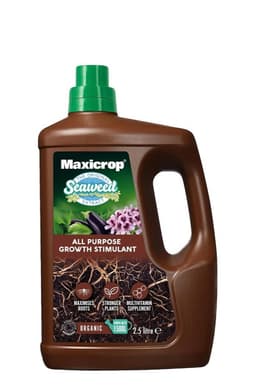
Maxicrop’s 2.5 L seaweed stimulant is £18.99, prints a 1:100 mixing ratio, and the bullets claim Soil Association approval for organic growing. It is sold for roots, transplant shock and drought stress on flowers, shrubs, trees, fruit and vegetables, not as a declared NPK soil meal. The amazon.co.uk line is 4.6 from 3,688 reviews, the deepest file in this capture, and 50 texts were read. Reviewers use it on lawns, pots and beds and report stressed plants putting on growth, including a frosted olive, though several mention a low-tide smell, a leaking cap, and a bottle that arrived bulging. Some call the liquid odourless, so the smell reports are split. The score of 92 is the star line scaled to 100. This is a tonic with a printed ratio and a large UK sample, not the best fertiliser in Britain.
Pros
Printed 1:100 dilution on a 2.5 L bottle at £18.99
Bullets claim Soil Association approval for organic growing
4.6 from 3,688 reviews, the deepest file in this set
Reviewers report stressed plants putting on growth
Cons
A stimulant, not a declared NPK soil meal
Cap leaks when pouring
Low-tide smell in several reviews, and a bulging bottle on arrival
Best for: A gardener who wants a seaweed tonic with a printed ratio and a large UK review sample.
Less suitable: Anyone who needs a declared soil-meal analysis or a tomato potash liquid as the only feed.
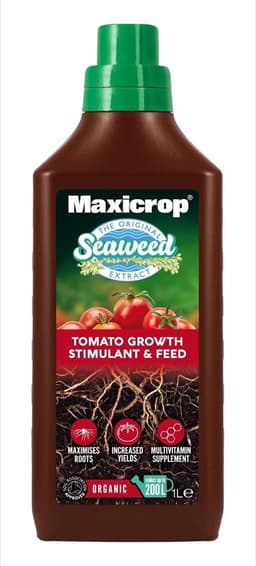
Maxicrop Organic Tomato Feed is 1 L at £11.99, with a mixing-ratio field of 4:2:6 and coverage that makes up to 200 L. The bullets name OF&G; the highlight also says Soil Association Approved. It is aimed at tomatoes and greenhouse crops, and the highlight also names peppers, chillies and aubergines. The star line is 4.6 from 402 reviews; 50 texts were read. Repeat buyers report higher tomato yield and greener plants, while the pouring spout leaks, the dark liquid stains drains and surfaces, and the smell is strong. The score of 92 is the star line scaled. It is the only listing in this set with a tomato analysis, not a lawn feed and not proof the fruit is certified organic food.
Pros
Printed 4:2:6 field and coverage up to 200 L at £11.99
OF&G named in the bullets for tomatoes and greenhouse crops
4.6 from 402 reviews; buyers report yield and greener plants
Highlight also names peppers, chillies and aubergines
Cons
Pouring spout leaks
Dark liquid stains drains and surfaces
Strong smell
A tomato liquid, not a bed meal or a lawn feed
Best for: Container tomatoes and greenhouse fruiting crops once you want a potash-leaning liquid from this set.
Less suitable: A lawn, an acer, or anyone who treats OF&G as a food logo for the fruit.
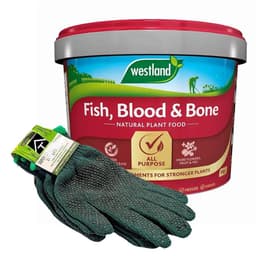
The Topline 8 kg fish, blood and bone tub is listed at £18.98 on amazon.co.uk and is sold as an all-purpose animal-meal soil feed for shrubs, vegetables, root crops and herbaceous plants. The listing says use it before sowing or planting, or as a top dressing, and water it in, and it warns not to exceed the rate. The mixing-ratio field is 1:0:0, which is not a usable analysis, and the capture names no Soil Association or OF&G mark. Across 191 reviews the star line is 4.6; of the 32 texts read, buyers praise little smell, a dry plastic tub, and a fine texture under tomato plugs, while at least one order arrived without the two pairs of gloves in the title. The 8 kg tub is heavy to handle. The score of 92 is 4.6 multiplied by 20, not a lab trial. At about £2.37 per kilogram it is the best value in this set for a bed job, not because the pack prints an NPK.
Pros
8 kg animal-meal granules at £18.98, about £2.37 per kilogram
Listing says water in before sowing or planting, or as a top dressing
4.6 from 191 reviews; 32 texts praise little smell and a dry tub
Fine texture that reviewers put under tomato plugs
Cons
Mixing-ratio field is 1:0:0, so this capture has no usable analysis
No Soil Association or OF&G mark in the file
At least one order arrived without the two pairs of gloves
The 8 kg tub is heavy to handle
Best for: A vegetable bed or allotment when you will handle an animal meal and read the rate on the sack itself.
Less suitable: Anyone who needs a printed NPK, a vegan feed, a named control body, or a light pack.
Is this fish, blood and bone sold as a natural feed?
The bullets call it an all-purpose natural feed made from blood, bones and fish-processing leftovers. The capture does not name Soil Association or OF&G.
How is it applied?
The listing says water it in, before sowing or planting or as a top dressing, and not to exceed the rate.
Are gloves in the box?
The title and bullets claim two pairs. At least one UK review says they were missing.
Topline’s 4 kg bone meal is £11.99 and is sold as a phosphorus-rich planting feed for trees, shrubs, herbaceous plants and vegetables. The listing says apply every 4–6 weeks from February until the end of October, work it into the soil, and water in dry weather, and it tells you to store it dry, frost-free, and away from children, pets and food. No control body is named, and the mixing-ratio field is empty. The star line is 4.6 from 115 reviews; 15 UK texts praise packaging, a useful bag size, and granules that are easy to spread, while one reviewer used it on a lawn and saw no result. That lawn use is the wrong job for a bone meal. The score of 92 is 4.6 times 20. This is a root and planting sack, not a fruiting tomato liquid or a vegan feed.
Pros
4 kg bone meal at £11.99 for a planting and root job
Listing interval every 4–6 weeks from February to the end of October
4.6 from 115 reviews; 15 texts praise packaging and easy granules
Names trees, shrubs, herbaceous plants and vegetables
Cons
No usable mixing ratio and no named control body
Animal-derived, so it is not a vegan or stockfree feed
One reviewer used it on a lawn and saw no result
Best for: Trees, shrubs or vegetable plants at planting when you want a bone-meal phosphorus sack.
Less suitable: A lawn, a fruiting tomato pot that needs potash, or anyone who will not store an animal meal away from pets.
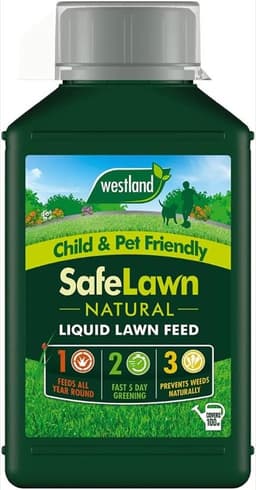
Westland Safelawn is a 1 L lawn liquid with seaweed at £8.90, with a printed dilution of 50 ml in 4.5 L of water to cover 5 square metres and about 100 square metres per bottle. The listing says spray every 1–2 weeks from March to October while grass is growing, and not when frost is expected. The bullets say 100% natural ingredients; they do not name Soil Association or OF&G. The star line is 4.4 from 134 reviews, and 26 texts were read. Some lawns are described as greener within about a week; others show no change after two to four weeks, so the average does not mean the grass will green. The score of 88 is the star line scaled up. It is the cheaper lawn liquid in this set if you will accept a slogan instead of a named control body.
Pros
Printed dose: 50 ml per 4.5 L, about 100 square metres per litre
£8.90, the cheaper lawn liquid in this set
Interval every 1–2 weeks from March to October, and not in frost
4.4 from 134 reviews, with some greener-in-a-week reports
Cons
No Soil Association or OF&G mark in the capture
Several reviews report no visible greening after two to four weeks
A lawn liquid, not a bed meal or a tomato feed
Best for: A summer lawn when you want a printed dilution and will accept a natural slogan without a named mark.
Less suitable: Anyone who needs OF&G or Soil Association in the file, or who is feeding after September.
Maxicrop’s 1 L organic lawn liquid is £12.19 and prints a mixing ratio of 1:10 or 1:20, with an interval of every 4–6 weeks in the growing season. The bullets name OF&G; the item highlight also says Soil Association Certified, and those two lines stay as printed rather than one logo. Coverage in the file is only Low, with no square metres. The star line is 4.4 from 98 reviews; the ten UK texts in the file praise colour, thicker grass, and ease of use, and they do not repeat a defect. The score of 88 is 4.4 multiplied by 20. Compared with Safelawn at £8.90, you pay more for a named mark and a longer interval, not for a larger proven review file.
Pros
Printed 1:10 or 1:20 ratio and a 4–6 week interval
OF&G named in the bullets at £12.19
4.4 from 98 reviews; ten UK texts praise colour and thicker grass
No repeated defect in the saved UK texts
Cons
Coverage is listed only as Low, with no square metres
Dearer than Safelawn for a smaller saved review sample
A lawn liquid, not a vegetable-bed meal
Best for: A lawn in the growing season when you want a named organic-growing mark on the bottle.
Less suitable: Anyone feeding after September, or anyone who only wants the cheaper Safelawn slogan.
Empathy’s 1 kg acer food is £7.85 and is sold as granules with rootgrow mycorrhizal fungi for acers, trees and shrubs in peat-free compost. The listing names no control body and prints no dilution. The star line is 4.4 from 68 reviews; only eight UK texts are in the file. Some owners report growth over about a month with regular watering and a powder that mixes into the root zone. Two reviewers say acers died after use, one after a change from another brand and one when used as instructed, and the smell is called awful. The score of 88 is the star line scaled, not evidence the fungi saved a tree. High nutrients can inhibit mycorrhizal fungi, so this is not a bag to pile under a heavy meal. It is the cheapest shelf price in the set, and it is still a specialist acer food.
Pros
1 kg at £7.85, the lowest shelf price in this set
Named for acers, trees and shrubs with rootgrow mycorrhizal fungi
Described as suitable for peat-free compost
Some owners report growth over about a month
Cons
Two UK reviews report acers that died after use
Smell described as awful
No control body and no printed rate in the capture
Wrong job for a vegetable bed or a tomato pot
Best for: An acer or shrub planting when you specifically want a mycorrhizal food and will not stack a heavy meal on the same hole.
Less suitable: A general bed, a tomato pot, or anyone who needs a large UK review file without plant-death reports.
Sunshine Renewables’ 6 L concentrated seaweed is £29.99 and prints a 1:400 dilution for a watering can or sprayer. The bullets say 100% natural and organic seaweed ingredients; they name no Soil Association or OF&G mark. The star line is 4.4 from 8 reviews, and only four UK texts are in the file. Those texts call the extract effective and the 6 L size well priced, while one praises the product and still rejects the bottle as hard to pour into a watering can. The score of 88 is 4.4 times 20 on a single-digit sample. A litre price that looks lower than Maxicrop 2.5 L is not a value claim until you use each label’s own ratio. This is a large-garden concentrate without a named control body.
Pros
6 L at £29.99 with a printed 1:400 dilution
Apply by watering can or sprayer
Reviewers who have four texts call the extract effective
Cons
4.4 from only 8 reviews; four UK texts in the file
No Soil Association or OF&G mark in the capture
Container described as hard to pour into a watering can
Best for: A large garden that already has a soil feed and wants a 1:400 seaweed concentrate in volume.
Less suitable: Anyone who needs a named control body or a review file deeper than single digits.
The mixing-ratio field is 1:400. The bullets say dilute with water and apply by watering can or sprayer.
Is a certification body named?
No. The bullets say 100% natural and organic seaweed ingredients.
How many reviews are in the file?
Eight stars on the listing line and four UK review bodies. One of those criticises the container.
How we compared
Nine amazon.co.uk listings were scored from the stored pages and the UK review notes already on file. Shelf date 19 October 2026. There is no laboratory test. The number on each card is the amazon.co.uk star rating multiplied by 20, so a 4.7 line is 94, a 4.6 line is 92 and a 4.4 line is 88. The top pick is the highest of those numbers. The best value is the lower shelf price per kilogram of the two animal-meal sacks with more than 100 reviews. Liquids stay out of that kilogram sum because a concentrate is not a kilogram of meal. Review-file size, a missing analysis and a certification line do not change the number. The weight below is 100 because the score is that star line.
1
Amazon star line
100%
The score on each card is the amazon.co.uk star rating multiplied by 20. A 4.7 line is 94, a 4.6 line is 92, and a 4.4 line is 88. The size of the review file does not change that number. A single-digit file can still hold the highest score.
Independent review
Last updated: October 2026
9 sources checked
Natural fertiliser buying guide
Buy the job before you buy the star line. A soil meal, a planting sack, a seaweed tonic, a tomato liquid and a lawn liquid are not one ladder. Prices below are amazon.co.uk shelf prices on 19 October 2026. This is not a laboratory test.
What to match before you buy
Natural fertiliser on amazon.co.uk means a plant feed sold on animal, plant or seaweed origin. A synthetic salt, a mineral NPK and a rooting powder are different products. You judge a pack by the job, a declared analysis or dilution, a real certification mark if you need one, and enough UK reviews to see smell, leaks and pack faults.
Work through the job first. A soil meal is for beds. A bone meal is a phosphorus feed at planting.
Best for
An allotment bed where you will handle an animal meal and read the rate on the sack
Tomatoes in pots once you want a liquid with a printed analysis
A plant-based tonic when you will not use fish, blood and bone
Not ideal for
Anyone who treats the word organic as a control-body mark or a vegan diet
A lawn after September if the bottle is a high-nitrogen summer feed
A buyer who copies one brand's grams per square metre onto a sack that does not print them
Mistakes to avoid
1
Treating a slogan as a certification
Natural or organic in a title is not Soil Association Approved Input and it is not OF&G. Those schemes list an input. They do not certify the crop you harvest, and they do not make an animal meal vegan.
2
Using a tonic as the only feed
Many seaweed products are biostimulants. They are not a guaranteed NPK feed. A tomato crop still needs a liquid with a declared analysis once fruit sets. A 1:400 concentrate is not automatically better value than a 1:100 bottle.
3
Copying a rate from another brand
Fish, blood and bone analyses differ. One maker page can print about 3% nitrogen, 9% P2O5 and 3% K2O, and another brand can print 5-5-6. A field of 1:0:0 is not a rate you can copy, and a summer lawn liquid is the wrong product after September.
What to weigh up
Job, analysis and origin
High
Name the job before the star line. A soil meal, a planting phosphorus sack, a seaweed tonic, a tomato liquid, a lawn liquid and an acer food with mycorrhizal fungi do different work. Do not buy a tonic when you need NPK. Fish, blood and bone NPK is not universal: Westland's page prints about 3% nitrogen, 9% P2O5 and 3% K2O, other brands print 5-5-6, and a 1:0:0 field is not a usable analysis. Animal meals are not vegan. Seaweed is the plant-based route, and some bottles are still blends.
Marks, form and cost per use
High
Soil Association Approved Input and OF&G are control-body schemes. OF&G is GB-ORG-02. The Approved Input symbol is not the organic food logo. Natural on a title is a slogan. Granules suit beds and liquids suit pots. Compare a 1:100 seaweed with a 1:400 seaweed by the ratio on each label, not by the price per litre. On 19 October 2026 the 8 kg animal meal was about £2.37 per kilogram and the 4 kg bone meal about £3.00 per kilogram. Liquids stay out of that kilogram sum.
Which option suits you?
Three typical situations, each with a recommendation from this comparison.
🥬
An allotment bed
You will handle an animal meal and read the rate on the sack. Topline fish, blood and bone 8 kg is about £18.98, about £2.37 per kilogram, with 4.6 from 191 reviews. The mixing-ratio field is 1:0:0, so the listing has no usable analysis. At least one order arrived without the gloves named in the title.
Once fruit sets you want a liquid with a printed analysis, not a seaweed tonic on its own. Maxicrop tomato 1 L is about £11.99, with a 4:2:6 field and coverage up to 200 L. amazon.co.uk shows 4.6 from 402 reviews. The bullets name OF&G. The spout leaks, the liquid stains, and the smell is strong.
If you will not use an animal meal, stay with seaweed and still read the ingredients. Maxicrop seaweed 2.5 L is about £18.99 at 1:100, and the bullets claim Soil Association approval for organic growing. It is 4.6 from 3,688 reviews. It is a stimulant, not a declared NPK soil meal, and reviewers report a leaking cap and a low-tide smell.
The top pick is Sunshine Renewables seaweed 20 L at about £59.99. amazon.co.uk shows 4.7 from 9 reviews, and the card score multiplies that star line by 20. The pack is 20 L at 1:400, and the title names chelated iron. The listing names no Soil Association or OF&G mark. Nine reviews are not a UK trial. Choose it for a large garden that will accept a thin review file.
Which pack is the best value?
The best value is Topline fish, blood and bone 8 kg at about £18.98, about £2.37 per kilogram. That is the lower shelf price per kilogram of the two animal-meal sacks with more than 100 reviews. amazon.co.uk shows 4.6 from 191 reviews. The mixing-ratio field is 1:0:0, so the listing has no usable analysis, and no Soil Association or OF&G mark is named. At least one order arrived without the gloves in the title. It suits a bed if you will read the rate on the sack itself.
What counts as a natural fertiliser?
A natural fertiliser is a plant feed sold on animal, plant or seaweed origin, rather than a synthetic salt such as ammonium nitrate or a soluble mineral feed. Plant-based materials include seaweed, comfrey and nettles. Animal-based materials include fish, blood and bone, bone meal and poultry manure. Many seaweed products are biostimulants, not a guaranteed NPK feed. Rooting powder, a mineral NPK and a classic soluble mineral feed are different products. Match the job on the label before you match the star line.
Does organic on the title mean the pack is certified?
No. Natural or organic in a title is not a control-body scheme. Soil Association Approved Input and OF&G are the marks that mean a certification body has listed the input. OF&G is control body GB-ORG-02. The Approved Input symbol is not the organic food logo, and it does not certify your crop. A bullet that says approved for organic growing is a listing claim about that pack. It is not a claim that the tomatoes or the lawn are certified organic food.
When should you choose seaweed instead of fish, blood and bone?
Choose seaweed when you want a plant-based tonic and the crop already has a feed. Many seaweed products are biostimulants, not a declared NPK meal. Choose fish, blood and bone when you will handle an animal meal on a bed, mix it into the soil, and read the rate on that sack. Bone meal is a planting feed, not a lawn greener. There is no single NPK for every fish, blood and bone, and a 1:0:0 field is not an analysis you can copy.
Are animal meals safe around dogs and grazing animals?
Westland and Garden World say dogs may eat fish, blood and bone, so you mix it into the soil and you do not leave granules on the surface. Bone-meal storage lines say keep the sack away from children, pets and food. Westland's grazing line is two months for pigs and three weeks for other farmed animals. That is maker wording, not a measured poison dose, and it is not printed on every sack. If a dog eats a large amount, call a vet.
When should you stop and ask a professional?
Ask a professional, APHA or your organic control body if you spread animal-derived fertiliser where livestock graze, if a certified organic holding must match an inputs directory, or if an acer keeps declining after several products. Category 1 animal by-products cannot be used as fertiliser. Retail gardening packs of 50 kg or less are exempt from the farm mixing-component rule. Liquid feeding of pots is mainly April to September. A separate liquid comparison is the organic liquid fertiliser comparison. A vet handles a dog that has eaten bone meal.
Why is a lower price per litre not always better value?
Compare concentrates with the ratio on that bottle. A 1:100 seaweed and a 1:400 seaweed are not the same cost per watering can, so a lower price per litre is not a value claim on its own. A field printed as 1:0:0 is not an analysis you can copy onto the garden. Do not use a high-nitrogen summer lawn feed after September, and do not double the dose because a lawn looks the same after a fortnight.
Our verdict
The top pick is Sunshine Renewables seaweed 20 L at about £59.99. The score is 94 because the amazon.co.uk line is 4.7 from 9 reviews, multiplied by 20, which is the highest number in this set. The pack prints 1:400 and the title names chelated iron. Four short UK texts do not repeat a defect, and the listing names no Soil Association or OF&G mark. The best value is Topline fish, blood and bone 8 kg at about £18.98, about £2.37 per kilogram, the lower price per kilogram of the two animal-meal sacks with more than 100 reviews. It is 4.6 from 191 reviews. The mixing-ratio field is 1:0:0, so the sack has no usable analysis. Neither result is a laboratory test, and neither pick is the best natural fertiliser in the United Kingdom.
Best overall
Sunshine Renewables seaweed 20 L
Highest star-scaled score: 4.7 from 9 reviews becomes 94. 20 L at 1:400, chelated iron on the title, about £59.99. Nine reviews are not a UK trial.
Lower shelf price per kilogram of the two animal-meal sacks with more than 100 reviews, about £2.37/kg at about £18.98. The mixing-ratio field is 1:0:0.
Peter F. is the editor for DIY & tools at productscompared.co.uk. Comparisons in this category are checked against amazon.co.uk listings, review evidence and public UK sources.
Updated: October 2026
9 sources checked
Guides to natural fertilisers
Guides on what to look for, how to use a product, and common mistakes.
Public UK sources from the research digest, used for this page in October 2026. Prices, stars and review counts are from the nine amazon.co.uk listings captured on 19 October 2026. The card score is the star rating multiplied by 20, not a laboratory test. Westland's published fish, blood and bone analysis is an example on the maker's page, not the analysis of every sack here. A dog that eats bone meal needs a vet. This page does not state a poison dose.
This page contains affiliate links to amazon.co.uk (tag pcuk26-21). If you buy through them, we may earn a commission at no extra cost to you. Prices, stars and review counts are from the listings. This is not a laboratory test.