Independent comparisons. We may earn from shop links. Our editors compare products independently. Some links go to shops, and we may earn a commission. More info
Top pick: GreenCare autumn lawn feed, 5 L – Highest stored score: 5.0 from 1 review, scaled to 100, with 5 ml per litre on lawn grass, at about £19.95. Best value: Doff Liquid Growmore, 1 L – Lowest shelf price in this comparison, about £6.55, for a 1 litre all-purpose concentrate with an integral measure. Updated October 2026.
Liquid fertiliser, in the bottles you meet for pots and borders in the UK, is usually a concentrate you dilute into a watering can and pour onto moist compost while the plant is growing. An all-purpose liquid declares an NPK analysis, a dose and an interval. A seaweed extract is a growth stimulant you use beside a feed, not instead of one. An autumn lawn liquid is a different job from a summer bottle for baskets.
You tell a suitable bottle by the label, not by the colour of the liquid. Read the nutrients, the measure, how often to apply it, and whether indoor, outdoor, edible or lawn use is allowed. Cap size is not standard, so an old memory of one cap is unsafe. Use the measure on the bottle you hold. An all-purpose concentrate is not an ericaceous feed, and tomatoes that are setting fruit usually need a high-potash tomato liquid instead.
How to read that label before you buy is set out in the [liquid fertiliser buying guide](/hub/fertiliser-soil-and-bark-mulch/liquid-fertiliser/sub/liquid-fertiliser-buying-guide).
Liquid fertiliser, in the bottles you meet for pots and borders in the UK, is usually a concentrate you dilute into a watering can and pour onto moist compost while the plant is growing.
Liquid fertiliser, in the bottles you meet for pots and borders in the UK, is usually a concentrate you dilute into a watering can and pour onto moist compost while the plant is growing. An all-purpose liquid declares an NPK analysis, a dose and an interval. A seaweed extract is a growth stimulant you use beside a feed, not instead of one. An autumn lawn liquid is a different job from a summer bottle for baskets.
You tell a suitable bottle by the label, not by the colour of the liquid. Read the nutrients, the measure, how often to apply it, and whether indoor, outdoor, edible or lawn use is allowed. Cap size is not standard, so an old memory of one cap is unsafe. Use the measure on the bottle you hold. An all-purpose concentrate is not an ericaceous feed, and tomatoes that are setting fruit usually need a high-potash tomato liquid instead.
How to read that label before you buy is set out in the [liquid fertiliser buying guide](/hub/fertiliser-soil-and-bark-mulch/liquid-fertiliser/sub/liquid-fertiliser-buying-guide).
Liquid fertiliser, in the bottles you meet for pots and borders in the UK, is usually a concentrate you dilute into a watering can and pour onto moist compost while the plant is growing. An all-purpose liquid declares an NPK analysis, a dose and an interval. A seaweed extract is a growth stimulant you use beside a feed, not instead of one. An autumn lawn liquid is a different job from a summer bottle for baskets. You tell a suitable bottle by the label, not by the colour of the liquid.
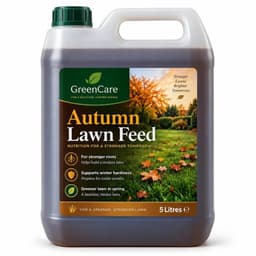
The GreenCare autumn lawn liquid is listed at about £19.95 as a 5 litre bottle with seaweed, aimed at lawn grass at 5 ml per litre. Across 1 amazon.co.uk review the star line is 5.0, scaled to 100. That is the highest score in this file, from one incomplete United Kingdom text, not a laboratory ranking. The title and weight say 5 litres and 5 kg. The unit count and liquid volume say 10,000 ml, and the listing does not reconcile them. NPK is not on the listing. No houseplant use is printed. The top pick here is that stored score, not proof this bottle outperforms an all-purpose concentrate on mixed pots. It is only the lawn-in-autumn row.
Pros
Highest stored score in this comparison, at 100
Printed lawn rate of 5 ml per litre
Watering can or suitable sprayer named on the bullets
Coverage line of 500 m² on the 5 litre wording
Cons
Only one incomplete United Kingdom text behind the 5.0 line
Title says 5 litres; volume fields say 10,000 ml
NPK is not on the listing
Lawn grass only; no indoor or pot use printed
Best for: An autumn lawn when you wanted a liquid at 5 ml per litre and accepted a one-review sample.
Less suitable: Houseplants, mixed pots, or anyone who needed a declared NPK and a settled pack size.
The title says 5 litres and the item weight is 5 kg. The unit count and liquid volume fields say 10,000 millilitres. The listing copies all three and does not reconcile them.
What dilution does the listing give?
The bullets and the mixing-ratio field say 5 ml per 1 litre, applied with a watering can or a suitable sprayer.
Can you use it on houseplants?
No houseplant use is printed. The target species is lawn grass.
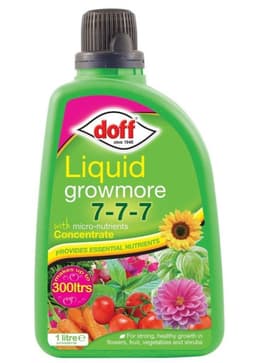
The Doff Liquid Growmore 1 litre bottle is an all-purpose concentrate at about £6.55, with a model field of 7:7:7 and an integral measure on the listing. Across 86 amazon.co.uk reviews the star line is 4.8, scaled to 96, from 17 United Kingdom texts. That is not a laboratory ranking. Reviewers quote one cap to 4.5 litres, or half a cap in 5 litres, while the mixing-ratio field is 1:466 and the brand page says 1 litre makes up to 300 litres of feed. The listing copies those figures and does not reconcile them. The bullets name all plants indoors, outside and in the greenhouse. You still have to read the cap on the bottle you hold rather than treat 1:466 as an NPK analysis. It is the best value here for mixed pots when you wanted a litre-class concentrate at the entry price, not a seaweed tonic or a lawn-only liquid.
Pros
Lowest price in this comparison, at about £6.55
4.8 from 86 amazon.co.uk reviews
Indoor, outdoor and greenhouse use named on the bullets
Integral measure printed on the listing
Cons
Only 17 United Kingdom texts sit in the stored file
Mixing field 1:466 disagrees with the brand page of up to 300 litres
Reviews quote two different cap-to-can recipes
NPK is not on the listing; 7:7:7 is the model field
Best for: Mixed pots, baskets and greenhouse plants when you wanted a cheap 1 litre all-purpose concentrate with a printed measure.
Less suitable: Anyone who needed a Soil Association tonic, an autumn lawn liquid, or a single reconciled dilution.
The title says 1 litre. The unit count is 1,000 millilitres. Liquid volume is 1 litre. Item weight is 1.18 kg.
What dilution does the listing give?
The bullets name an integral measure. The mixing-ratio field is 1:466. Reviews quote one cap to 4.5 litres, or half a cap in 5 litres. Doff's own page says 1 litre makes up to 300 litres of feed. Those figures are not reconciled.
Can you use it indoors?
The bullets say all plants indoors, outside and in the greenhouse.
The Miracle-Gro All Purpose 1 litre listing is a concentrate at about £8.94, titled for indoor and outdoor plants in pots, baskets and beds. Across 10,350 amazon.co.uk reviews the star line is 4.6, scaled to 92, from the first 50 United Kingdom texts. That is the deepest sample in this comparison, and it is not a combined rating with the other pack sizes. The mixing-ratio field is 1:200. Reviews quote a capful in a can weekly, or half a cap in a litre. One review says the seller sent 800 ml instead of 1 litre, so you should check the fill against the title. NPK is not on the listing. The brand PDF 7-3-5 sits outside that field. It is the 1 litre all-purpose row when you wanted indoor and outdoor named with a printed mixing field.
Pros
Deepest review sample here, 4.6 from 10,350
Mixing-ratio field prints 1:200
Indoor and outdoor use named, including pots and beds
Reviews quote a weekly can dose or half a cap in a litre
Cons
One review says the seller sent 800 ml instead of 1 litre
NPK is not on the listing
Reviews quote two different cap recipes
Must stay separate from the twin 800 ml and 2.5 litre star lines
Best for: Indoor and outdoor mixed plants when you wanted a 1 litre concentrate and a printed mixing field.
Less suitable: A buyer who needed a 2.5 litre fill with a can recipe on the bullets, or a lawn-only autumn bottle.
The title and liquid volume say 1 litre. The unit count field says 1.0 count. Item weight is 1.08 kg. One review says the seller sent 800 ml instead of 1 litre.
What dilution does the listing give?
The listing says diluted with water. The mixing-ratio field is 1:200. Reviews quote a capful in a watering can once a week, or half a cap in a litre.
Is it for indoor plants?
The bullets say indoor and outdoor plants. The coverage field says house plants and indoor gardens.
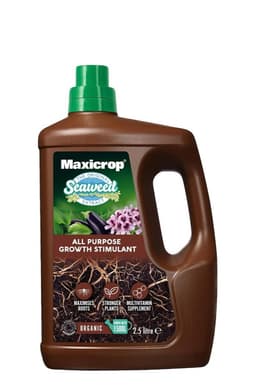
The Maxicrop 2.5 litre bottle is sold as a seaweed growth stimulant at about £18.99, with Soil Association approval for organic growing and no NPK printed on the listing. Across 3,688 amazon.co.uk reviews the star line is 4.6, scaled to 92, from the first 50 United Kingdom texts. The mixing-ratio field is 1:100. A maker label says 45 ml in 9 litres, which is 1:200, and those two figures stay side by side. Reviews describe a watering can, a foliar spray or a seed soak, and they name indoor plants as well as lawns and containers. The same sample talks about a fishy or low-tide smell, path stains, a pourer that leaks, blocked fine sprayers and the occasional bulging bottle. It is a tonic you use beside a feed, not a 7-3-5 substitute.
Pros
2.5 litre seaweed stimulant with Soil Association organic-growing approval
4.6 from 3,688 amazon.co.uk reviews
Reviews cover watering-can, foliar and seed-soak use
Home, garden or allotment named on the bullets
Cons
NPK is not on the listing; it is not a declared fertiliser analysis
Listing rate 1:100 sits next to a maker line of 1:200
Reviews name smell, stains, leaks and blocked fine sprayers
Does not replace an all-purpose NPK concentrate
Best for: Organic growers and anyone potting on cuttings who already have a separate NPK feed.
Less suitable: Anyone who wanted this bottle to stand in for an all-purpose concentrate as the only feed.
The item type name is organic plant growth stimulant. NPK is not on the listing. The bullets say Soil Association approval for organic growing. The maker's advisory line says there is no declarable NPK.
What dilution does the listing give?
The mixing-ratio field is 1:100. The listing says apply to soil or plants. Reviews describe a watering can, a foliar spray or a seed soak. A maker label says 45 ml in 9 litres, which is 1:200.
Can you use it on indoor plants?
The bullets name the home, garden or allotment. Reviews name indoor plants as well as lawns and containers.
The Miracle-Gro All Purpose twin pack is two 800 ml bottles, 1.6 litres in total, listed at about £7.98 for garden and indoor houseplants. Across 3,025 amazon.co.uk reviews the star line is 4.6, scaled to 92, from the first 50 United Kingdom texts. That count stays separate from the 1 litre and 2.5 litre listings. The mixing-ratio field is not stated. Reviews quote a half or a quarter into 1 litre. One review says 800 ml is sold in a 1 litre bottle, so the carton size is not proof of the fill. NPK is not on the listing. A Miracle-Gro UK label PDF for this range prints 7-3-5, which is a brand document, not a result measured for this page. It is a sensible twin pack when you will mix through the season and wanted indoor use named.
Pros
Two 800 ml bottles, 1.6 litres in total, at about £7.98
4.6 from 3,025 amazon.co.uk reviews
Garden and indoor houseplants named on the bullets
Reviews quote a half or quarter cap into 1 litre
Cons
Mixing-ratio field is not stated
One review says 800 ml arrived in a 1 litre bottle
NPK is not on the listing
Star count must stay separate from the other Miracle-Gro sizes
Best for: A season of mixed pots and houseplants when you wanted two bottles and indoor use named.
Less suitable: Anyone who needed a printed mixing field before buying, or a Soil Association stimulant.
Yes. The bullets call it a concentrated formula that mixes with water. The mixing-ratio field is not stated. One review describes measuring a half or a quarter into 1 litre.
Can you use it indoors?
The bullets say garden and indoor houseplants.
What pack do you get?
The title is 800 ml, pack of 2. Unit count and liquid volume are 1,600 ml. Item weight is 1.82 kg. One review says 800 ml is sold in a 1 litre bottle.
The Miracle-Gro All Purpose 2.5 litre bottle is the larger concentrate at about £18.72, with unit count and liquid volume both at 2.5 litres. Across 72 amazon.co.uk reviews the star line is 4.6, scaled to 92, from 16 United Kingdom texts. That is a thinner sample than the 1 litre listing, and it is not the same listing. The bullets are almost empty. The mixing-ratio field is 2:1:2, which is not a watering-can dose. Where-to-use and indoor listing questions are unanswered. One review used it on garden plants. You get more liquid than a 1 litre bottle, and you do not get a printed cap-to-can recipe in the stored file. Skip it if you need a dose on the listing before you buy.
Pros
Largest titled Miracle-Gro liquid in this comparison, at 2.5 litres
Same 4.6 star line as the smaller sizes, from 72 reviews
Unit count, liquid volume and weight all say 2.5
Cons
Bullets almost empty; no printed can dose
Mixing field 2:1:2 is not a watering-can dilution
Indoor and where-to-use questions unanswered
Only 16 United Kingdom texts in the stored file
Best for: A long outdoor season when you already know the Miracle-Gro liquid rate from another bottle.
Less suitable: Anyone who needed a printed dilution, an indoor claim, or a first-time dose on the listing.
The title, unit count and liquid volume all say 2.5 litres. Item weight is 2.5 kg.
Does the listing give a dilution rate?
No. The bullets do not print a dose. The mixing-ratio field is 2:1:2, which is not a watering-can dilution.
Can you use it indoors?
That listing question is unanswered. One review used it on garden plants.
How we compared
Six amazon.co.uk listings were scored from the stored pages. The number on each row is the star line scaled: 5.0 becomes 100, 4.8 becomes 96, and 4.6 becomes 92. There is no laboratory test, and a one-review file is not reduced. The top pick is the highest of those scores. The best value is the lowest shelf price, Doff Liquid Growmore 1 litre. A dose clash, a missing NPK line or a pack-size clash stays in the text. It does not change the stored score. The weights below sum to 100.
1
Amazon star line
50%
Star rating on amazon.co.uk, scaled to the stored score. GreenCare is 5.0 from 1 review, so the score is 100. Doff is 4.8 from 86, so the score is 96. The four 4.6 listings score 92. The Miracle-Gro counts stay on their own listings: 3,025, 10,350 and 72. They are not added together. A file of one text is not treated as a larger file.
2
Listing clarity
25%
A named job, a rate, a pack size that agrees with itself, and a place you may use it. Doff's 1:466 field, the review cap recipes and the brand page of up to 300 litres are copied and not reconciled. Miracle-Gro 2.5 litres prints 2:1:2, which is not a watering-can dose. GreenCare's title says 5 litres and the volume fields say 10,000 millilitres. Maxicrop's listing field is 1:100 beside a maker line of 1:200.
3
Value
25%
Shelf price for the job you actually need. Doff at about £6.55 is the lowest price and the best value for a litre of all-purpose concentrate. A 2.5 litre bottle near £19 is a saving only if you will finish it. A weekly pence figure is not scored, because cap size is not standard.
Independent review
Last updated: October 2026
8 sources checked
Liquid fertiliser buying guide
Buy the job before you buy the star line. An all-purpose concentrate, a seaweed stimulant and an autumn lawn liquid are not one list. Prices below are the stored amazon.co.uk shelf prices. This is not a laboratory test.
What to match before you buy
Liquid fertiliser on amazon.co.uk is usually a concentrate you dilute and pour onto moist compost while the plant is growing. Quality is the declaration on the label: nutrients, dose, interval, and where you may use it. A star line does not settle that.
Five checks come first. Mixed pots and baskets need a declared NPK liquid. Transplanting and stress are where a seaweed stimulant earns a place, alongside a feed.
Best for
Container and basket gardeners who will measure a cap through spring and summer
Organic growers who already fertilise, and people potting on cuttings
Someone feeding a lawn after summer who has read the nutrient line
Not ideal for
A buyer who treats a seaweed stimulant as the only NPK feed
Tomatoes that are setting fruit and need a high-potash tomato liquid
Anyone who wants an ericaceous feed, which these listings are not
Mistakes to avoid
1
Reading the powder analysis as the liquid
An all-purpose soluble powder can carry a 24-8-16 style declaration. The Miracle-Gro liquid label in the UK PDF is 7-3-5. They are different products.
2
Using seaweed as the only feed
Maxicrop Original is a growth stimulant. Soil Association approval means it may be used in an organic growing system. The advisory line says it has no declarable NPK.
3
Feeding houseplants weekly in winter
The Royal Horticultural Society limits winter feeding of houseplants to about once a month, and says cacti get none. A summer interval of 7 to 14 days is the growing-season rate.
What to weigh up
Job and where the label allows use
High
Name the job first. Mixed pots and baskets need a declared NPK liquid. A seaweed stimulant earns a place at transplanting and under stress, alongside a feed. A lawn in September needs a product labelled for autumn lawn use. Indoor, outdoor, edible and lawn are different lines. None of these listings is an ericaceous feed. Tomatoes that are setting fruit usually move to a high-potash tomato liquid, which is outside this comparison.
Organic wording is a separate check.
Dose you can follow, and pack size
High
Cap size is not standard. Miracle-Gro's UK liquid label says half a cap per litre, every 7 to 14 days from early spring to late summer, at 7-3-5. That is the maker's PDF. On amazon.co.uk the 1 litre listing prints 1:200, the twin pack prints no mixing field, and the 2.5 litre listing prints 2:1:2, which is not a watering-can dose. Doff's mixing field is 1:466, reviews quote one cap to 4.5 litres or half a cap in 5 litres, and Doff's page says 1 litre makes up to 300 litres.
Which option suits you?
Three typical situations, each with a recommendation from this comparison.
🪴
Pots, baskets and bedding
You will measure a cap through spring and summer. Doff Liquid Growmore, 1 litre, is the best value at about £6.55, with 4.8 from 86 reviews. The bullets name indoors, outside and the greenhouse. The model field is 7:7:7. The mixing field, the reviews and the brand page do not agree, so use the cap on the bottle.
You already fertilise, and you want a stimulant when potting on. Maxicrop Original, 2.5 litres, is about £18.99, with 4.6 from 3,688 reviews and Soil Association approval for organic growing. NPK is not on the listing. Use it beside a feed, not as the feed.
You are feeding lawn grass, not baskets. The GreenCare autumn lawn liquid is about £19.95, with a printed rate of 5 ml per litre. amazon.co.uk shows 5.0 from 1 review. The title says 5 litres and the volume fields say 10,000 ml. NPK is not on the listing. Read that clash before you buy.
The top pick is the GreenCare autumn lawn liquid at about £19.95. It has the highest stored score, 100, because amazon.co.uk shows 5.0 from 1 review. That file is one incomplete UK text, not a laboratory ranking, and it does not show the bottle beats an all-purpose concentrate on pots. The bullets say 5 ml per litre on lawn grass. The title says 5 litres and the volume fields say 10,000 millilitres. NPK is not on the listing. Choose it for an autumn lawn.
Which bottle is the best value?
The best value is Doff Liquid Growmore, 1 litre, at about £6.55. It is the lowest shelf price here, with 4.8 from 86 reviews, and the bullets name all plants indoors, outside and in the greenhouse. The model field is 7:7:7. NPK is not printed as an analysis. The mixing field is 1:466, reviews quote other cap recipes, and Doff's page says 1 litre makes up to 300 litres. Use the measure on the bottle you hold.
Is a seaweed extract the same as a liquid fertiliser?
No. Maxicrop Original, 2.5 litres at about £18.99, is sold as a seaweed growth stimulant with Soil Association approval for organic growing. The listing does not print an NPK analysis, and the maker's advisory line says it has no declarable NPK. It does not replace a 7-3-5 feed. The amazon mixing field is 1:100. A maker label says 45 ml in 9 litres, which is 1:200. Use it beside a fertiliser. Bottles sold as organic feeds are in the organic liquid fertiliser comparison.
What dilution should you follow?
Follow the bottle you hold. Cap size is not standard. Miracle-Gro's UK liquid label for this all-purpose concentrate is NPK 7-3-5, half a cap per litre, every 7 to 14 days from early spring to late summer. That is the maker's label PDF. The 1 litre listing prints 1:200. The 2.5 litre listing prints 2:1:2, which is not a watering-can dose. The twin pack has no mixing field. Where figures disagree, the cap on your bottle wins.
Can you use these liquids on houseplants in winter?
Some listings name indoor plants. The Royal Horticultural Society limits winter feeding of houseplants to about once a month, and says cacti get none. Do not treat a summer basket interval of 7 to 14 days as a dark UK winter rate. Do not feed dry compost, because that can burn roots. Water the compost first, then apply the diluted feed. A fine sprayer is a poor tool for viscous seaweed. Reviewers say it blocks nozzles.
Why do the Miracle-Gro star lines stay separate?
The 800 ml twin pack, the 1 litre bottle and the 2.5 litre bottle are three amazon.co.uk listings. The twin pack is 4.6 from 3,025 reviews, the 1 litre is 4.6 from 10,350, and the 2.5 litre is 4.6 from 72. Those counts are not one combined rating. Check the fill against the title: one twin-pack review says 800 ml arrived in a 1 litre bottle. A claim such as twice as big was not measured for this page.
What should you avoid when you apply a concentrate?
Do not add an extra cap for luck. Wash splashes off, store the bottle away from children, and do not pour concentrate down a drain. A pet-friendly line means as directed, not that the concentrate is a drink. Do not reuse a watering can that held weedkiller. Call the seller if a bottle is bulging or has leaked and you need a Consumer Rights Act remedy, or if irritation continues after washing. This is not a medical protocol.
Our verdict
The top pick is the GreenCare autumn lawn liquid at about £19.95. It holds the highest stored score, 100, from a 5.0 line on 1 review. That is one incomplete UK text. The bullets say 5 ml per litre on lawn grass, and the title says 5 litres while the volume fields say 10,000 millilitres. It is not a declared NPK feed for pots. The best value is Doff Liquid Growmore, 1 litre, at about £6.55, with 4.8 from 86 reviews and indoor, outdoor and greenhouse use named. The model field is 7:7:7 and the dilution lines are not reconciled. Miracle-Gro 1 litre prints a 1:200 field and has 4.6 from 10,350 reviews, kept separate from the other pack sizes. Maxicrop is a seaweed stimulant, not a 7-3-5 substitute. None of these scores is a laboratory test.
Best overall
GreenCare autumn lawn feed, 5 L
Highest stored score: 5.0 from 1 review, scaled to 100, with 5 ml per litre on lawn grass, at about £19.95.
Peter F. is the editor for DIY & tools at productscompared.co.uk. Comparisons in this category are checked against amazon.co.uk listings, review evidence and public UK sources.
Updated: October 2026
8 sources checked
Guides to liquid fertilisers
Guides on what to look for, how to use a product, and common mistakes.
Public UK and maker sources listed below, used for this page in October 2026. Prices, stars and review counts are from the six amazon.co.uk listings in the stored files. The star line is not a laboratory test. A Soil Association line means the product may be used in an organic growing system. It is not an NPK analysis. GreenCare's pack size is not reconciled.
This page contains affiliate links to amazon.co.uk (tag pcuk26-21). If you buy through them, we may earn a commission at no extra cost to you. Prices, stars and review counts are from the listings. This is not a laboratory test.