Independent comparisons. We may earn from shop links. Our editors compare products independently. Some links go to shops, and we may earn a commission. More info
Top pick: Guanokalong bat guano, 3 kg – Highest scaled score: 5.0 from 3 reviews becomes 100. One UK sentence is in the file. No NPK, dose or plant list on the listing. About £29.96. Best value: Flower guano sticks, 20 – Lowest snapshot price that still has a star line, about £5.97, 4.0 from 23. The 25 kg sack is cheaper per kilogram only with dry storage and a plot. Updated October 2026.
Guano fertiliser is a feed made from the excrement of bats or wild sea birds. GOV.UK uses that definition when it treats the material as an animal by-product. On amazon.co.uk the same words also cover powder, granules, a liquid and sticks, and some packs say guano without naming the animal. You buy it in the UK for a few pots, a palm or other houseplant, or a vegetable bed, when you want a phosphorus-leaning feed and you will read the pack for the analysis it actually prints.
Powder or granules suit a mix or a tea. Sticks suit an insert. A liquid suits you when the bottle prints a mix you can follow. A large sack suits you when you have dry storage and a plot that will use it. Read whether the label says bat, seabird or neither, then the pack size, then whether a dose or an analysis is printed. A mixing field of all zeros is not a rate. Those checks are set out in the [guano fertiliser buying guide](/hub/fertiliser-soil-and-bark-mulch/guano-fertiliser/sub/guano-fertiliser-buying-guide).
Guano fertiliser is a feed made from the excrement of bats or wild sea birds. GOV.UK uses that definition when it treats the material as an animal by-product.
Guano fertiliser is a feed made from the excrement of bats or wild sea birds. GOV.UK uses that definition when it treats the material as an animal by-product. On amazon.co.uk the same words also cover powder, granules, a liquid and sticks, and some packs say guano without naming the animal. You buy it in the UK for a few pots, a palm or other houseplant, or a vegetable bed, when you want a phosphorus-leaning feed and you will read the pack for the analysis it actually prints.
Powder or granules suit a mix or a tea. Sticks suit an insert. A liquid suits you when the bottle prints a mix you can follow. A large sack suits you when you have dry storage and a plot that will use it. Read whether the label says bat, seabird or neither, then the pack size, then whether a dose or an analysis is printed. A mixing field of all zeros is not a rate. Those checks are set out in the [guano fertiliser buying guide](/hub/fertiliser-soil-and-bark-mulch/guano-fertiliser/sub/guano-fertiliser-buying-guide).
Guano fertiliser is a feed made from the excrement of bats or wild sea birds. GOV.UK uses that definition when it treats the material as an animal by-product. On amazon.co.uk the same words also cover powder, granules, a liquid and sticks, and some packs say guano without naming the animal. You buy it in the UK for a few pots, a palm or other houseplant, or a vegetable bed, when you want a phosphorus-leaning feed and you will read the pack for the analysis it actually prints. Powder or granules suit a mix or a tea. Sticks suit an insert.
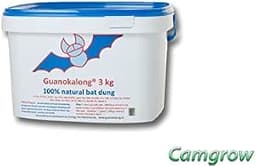
Guanokalong’s 3 kg pack is sold as bat guano at about £29.96, and that is almost all the saved listing gives you. The title says granular; the item-form line says powder, and the listing does not resolve it. There are no bullets, no NPK, no dose, and no plant list. Organic, indoor use, and which plants benefit are questions on the page, not answers. The star line is 5.0 from 3. One United Kingdom review says it will make fruit taste and smell better, and there is no criticism in that single text. About £10 per kilogramme by division sits between the VitaLink 3.5 kg snapshot and Flower’s 2 kg granules. The score of 100 is the 5.0 star line scaled up from three reviews, not a tested result, which is why the badge is a machine value on the highest score and not a UK award.
Pros
Bat guano stated on a 3 kg pack
Highest scaled score in the set (5.0 from 3)
One UK review text is present
About £10/kg on the snapshot, mid-pack among the tubs
Cons
No bullets, no NPK, and no dose in the saved listing
Powder versus granular is unresolved
Only three reviews, with a single UK sentence
No plant list on the listing
Best for: A shopper who already knows this brand and only needs the 3 kg bat-guano listing
Less suitable: Anyone who needs a printed analysis, a method, or a review sample larger than three
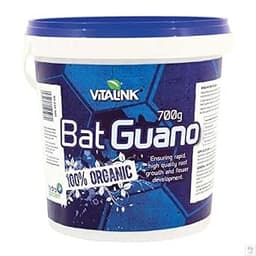
This second VitaLink listing is another 3.5 kg bat-guano powder, at about £30.46, so it is the dearer twin of B01ARR7GVG rather than a second product family. The bullets say indoor and outdoor use in coco, compost, or soil, including seedbeds and lawns, and they describe the product as highly phosphorus. You can apply the powder on soil or mix it with water as a guano tea; no spoon rate is in the saved listing. The title’s 0.7 is not defined. The star line is 5.0 from 2, and the saved listing contains no review text, so praise and complaints are n/a. At about £30.46 you pay more than the about £26.25 tub that already has 517 United Kingdom reviews. The score of 100 is those two stars scaled up, not a reason to prefer this ASIN over the cheaper VitaLink listing.
Pros
Bat guano stated, with indoor and outdoor use printed
Powder or a tea is named on the bullets
Seedbeds, lawns, coco, compost, or soil are listed
Highly phosphorus is stated, even without a numeric NPK
Cons
About £30.46 is dearer than the other 3.5 kg VitaLink tub
5.0 from 2 with no review text
No spoon rate in the saved listing
The 0.7 in the title is unexplained
Best for: Someone who specifically wants this ASIN’s indoor-and-outdoor tea wording and will still read the tub
Less suitable: Anyone who can buy the cheaper VitaLink 3.5 kg listing that already has UK review texts
The title reads VitaLink Bat Guano 0.7 3.5 kg. The saved listing does not define 0.7. The unit count and item weight are both 3.5 kg.
Where can it be used?
The bullets say indoor and outdoor use in coco, compost, or soil, including seedbeds and lawns. Apply as powder or mix with water to make a guano tea. No spoon rate is in the saved listing.
What do reviewers say?
The star line is 5.0 from 2. The saved listing contains no review text, so praise and complaints are n/a
The CULTIVERS 1 kg granules sit at about £13.17 and name orchard and garden on the amazon.co.uk listing, with a bullet that claims a high NPK without printing nitrogen, phosphorus, or potassium figures. Indoor use is not answered. The star line is 4.8 from 8. Three saved texts are from Spain and mention happier plants, easy application, and no smell; there is no repeated defect in those texts. One bullet says the product is harmless for animals and plants, while a separate pet-safety question on the page is not answered as its own line. At one kilogramme the pack is a mid-price bag rather than a plot sack, though you still have no numeric analysis and no United Kingdom review sample. The score of 96 is the 4.8 star line scaled up from eight reviews.
Pros
1 kg granules at about £13.17
Orchard and garden named on the listing
4.8 from 8, with no repeated defect in the saved texts
Harmless-for-animals line is printed, as a seller claim
Cons
High NPK is claimed with no numbers
Saved texts are from Spain, not the UK
No application method in the saved listing
Indoor use is unanswered
Best for: A small orchard or garden bed when 1 kg is enough and you can live without a printed NPK
Less suitable: Pots that need a stick, a vegetable listing that says vegetables, or UK review texts
No. The bullet says a high concentration of NPK, organic matter, and humic substances. It does not print nitrogen, phosphorus, or potassium figures.
What does the listing say about pets?
One bullet says the product is harmless for animals and plants. The question “is this fertiliser safe for pets?” is on the listing and is not answered as a separate line.
What do the saved reviews say?
Three texts are from Spain. They mention happier plants, easy application, and no smell. There is no repeated defect in those texts. The star line is 4.8 from 8.
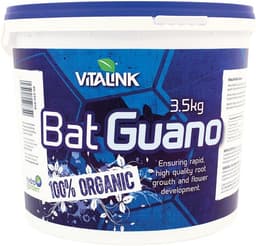
VitaLink’s 3.5 kg tub is bat-guano powder at about £26.25, described as a soil builder and compost activator, and it is the only pack in this set with a large United Kingdom review sample. The star line is 4.6 from 517, and fifty saved texts are from the UK. Reviewers repeat faster or healthier growth on tomatoes, chillies, and other plants, stronger roots, and repeat buys. They top-dress or mix a paste; the bullets do not print a spoon rate, and indoor use is not answered there. Smell reports disagree: some find little smell when the powder is dry, one reports ammonia when mixing a paste, and one reports a smell in a grow room after top dressing. Complaints in the sample also include a missing scoop, hard lumps in one tub, price, and one order that did not arrive. The specification table has no NPK; one UK review states 3-10-1, which is a review, not a technical-details line. About £7.50 per kilogramme is arithmetic on the snapshot, not a live unit price.
Pros
Bat guano stated on a 3.5 kg powder tub
4.6 from 517 with saved United Kingdom review texts
Reviewers name tomatoes, chillies, fruit, and stronger roots
Soil-builder and compost-activator lines are printed
Cons
No NPK on the specification table
No spoon rate in the bullets
Smell reports in the UK sample disagree
One tub had hard lumps, and a scoop is mentioned only in reviews
Best for: Someone who wants a measured bat-guano powder and will read UK reviews before they mix it
Less suitable: A palm that only needs a stick, a buyer who will not store 3.5 kg, or anyone who needs a printed NPK
The specification table does not. One UK reviewer writes that the NPK is 3-10-1. That figure is a review, not a technical-details line.
Can it be used indoors, and does it smell?
Both questions are on the listing and are not answered in the bullets. UK reviews disagree: some report little smell when the powder is dry, one reports ammonia when mixing a paste, and one reports a smell in a grow room after top dressing.
What do UK reviewers repeat?
Faster or healthier growth on tomatoes, chillies, and other plants, stronger roots, and repeat buys. Complaints in the sample are smell while mixing, a missing scoop, hard lumps in one tub, price, and one order that did not arrive. The star line is 4.6 from 517.
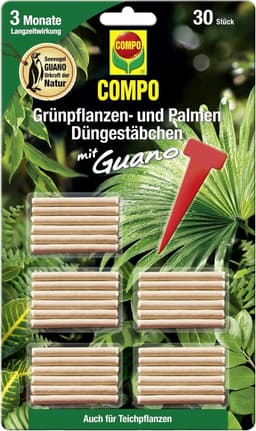
COMPO’s 30-stick pack is the only listing in this set that names seabird guano, and the bullets point it at green plants, palms, ferns, and pond plants for up to three months from March to October. You push a stick into a hole 5–6 cm from the stem, use the number on the back of the pack, and cover it; English on that pack is not guaranteed. The star line is 4.5 from 2,853. None of the 50 saved texts is from the United Kingdom, so that count is not UK opinion. Reviewers describe easy insertion and the three-month interval; some report a damaged blister and missing sticks, and one says the pack dose did not match a dose they had seen elsewhere. Country of origin is Germany. The mixing field reads 11:4:8 and is not printed as an NPK analysis in the saved listing. At about £15.78 it is a mid-price insert, not a tub of bat powder.
Pros
Seabird guano named on the listing
Green plants, palms, ferns, and pond plants stated
Insert 5–6 cm from the stem and replace about every 3 months
March to October season is printed
Cons
Saved review texts are not from the UK
English on the pack is not guaranteed
Reviewers report damaged blisters and missing sticks
Not a vegetable-bed product and not pure bat powder
Best for: Palms, ferns, pond plants, or other green plants when you want a three-month seabird stick
Less suitable: A vegetable plot, a buyer who needs UK review texts, or anyone who wanted a tub of bat powder
The bullets say to use the number on the back of the pack, push a stick into a hole 5–6 cm from the stem, and cover it. English on the pack is not guaranteed. Replace every three months from March to October.
Is this pure bat guano?
No. The title is green plant and palm fertiliser sticks with guano. The bullet says natural seabird guano. It is a stick feed, not a tub of bat powder.
What do the saved reviews report?
None of the 50 saved texts is from the United Kingdom. Reviewers describe easy insertion and a three-month interval. Some report a damaged blister and missing sticks, and one says the pack dose did not match a dose they had seen elsewhere. The star line is 4.5 from 2,853.
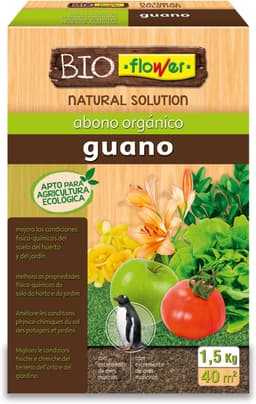
Flower’s 2 kg granules are about £28.53 on the snapshot and tell you to incorporate the product into the ground, with a bullet that 2 kg equals 40 m². The included-components line reads NPK fertilizer 3 - 1,5 - 1,5, while the mixing-ratio field is 1:0:0 and is not a dose. Stated plants are roses, hydrangeas, phalaenopsis, and acid plants, not a vegetable plot. Bat or seabird is not stated, and indoor use is unanswered. The star line is 4.5 from 106. None of the 25 saved texts is from the United Kingdom; reviewers mention tomatoes, vegetables, colour, and flowers, and one says 2 kg is not much for a vegetable plot. No repeated defect appears in that sample. About £14 per kilogramme by division makes this the dearest granules-per-kilo pack in the set.
Pros
A printed area claim: 2 kg = 40 m²
NPK line 3-1.5-1.5 on the components field
Application method is to incorporate into the ground
Roses, hydrangeas, phalaenopsis, and acid plants named
Cons
Saved review texts are not from the UK
Animal source is not stated
About £14/kg on the snapshot, the dearest granules by weight
One non-UK review says 2 kg is small for a vegetable plot
Best for: An ornamental bed where 40 m² and a 3-1.5-1.5 line are the figures you wanted
Less suitable: A vegetable listing, a named animal, or a cheaper-per-kilo sack
The included-components line reads NPK fertilizer 3 - 1,5 - 1,5. The mixing-ratio field is 1:0:0, which is not a usable dose. Bat or seabird is not stated.
How much ground does 2 kg cover?
The bullet says 2 kg = 40 m² and the application method is to incorporate it into the ground. Indoor use and a use-by date are questions on the listing with no bullet answer.
What do the saved reviews say?
None of the 25 saved texts is from the United Kingdom. Reviewers mention tomatoes, vegetables, colour, and flowers. One says 2 kg is not much for a vegetable plot. No repeated defect appears in the sample. The star line is 4.5 from 106.
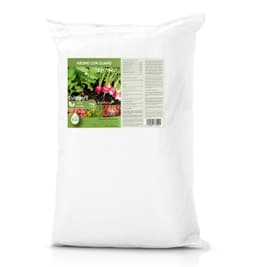
The CULTIVERS 25 kg sack is the only listing in this set that names a vegetable garden, at about £50.31, which is about £2 per kilogramme by division of the snapshot. The form is powder. High NPK is claimed with no numbers, and the mixing field reads 1:1:1, which is not an analysis. The animal is not stated, and indoor use is unanswered. The star line is 4.4 from 65. Twenty-one saved texts are from Spain and France, not the United Kingdom. Several mention a strong or sea-like smell; others say the grains barely smell. Reviewers also report repeat buys for fruit trees and vegetable plots, and one says fine grain acts faster than coarser manure, which is a review, not a bullet. You need dry storage and a plot; a few pots will not finish 25 kg.
Pros
25 kg at about £2/kg on the snapshot
Vegetables and garden plants named
Fine powder that reviewers treat as a plot feed
Repeat buys for fruit trees appear in the saved texts
Cons
No numeric NPK and no named animal on the UK saved listing
Saved texts are from Spain and France, not the UK
Smell reports in that sample disagree
Too large for pots, and indoor use is unanswered
Best for: A vegetable or fruit plot with dry storage when 25 kg is the size you can use
Less suitable: Houseplants, a buyer who needs a named animal or a printed NPK, or anyone without space for a sack
The listing asks that and does not answer it. The item form is powder. Reviews describe fine grains. One review says fine grain acts faster than coarser manure. That is a review, not a bullet.
Can it be used indoors?
Indoor use is an unanswered question. The listing names a vegetable garden and garden plants.
What do the saved reviews say about smell?
Texts are from Spain and France, not the United Kingdom. Several mention a strong or sea-like smell. Others say the grains barely smell. Reviewers also report repeat buys for fruit trees and vegetable plots. The star line is 4.4 from 65.
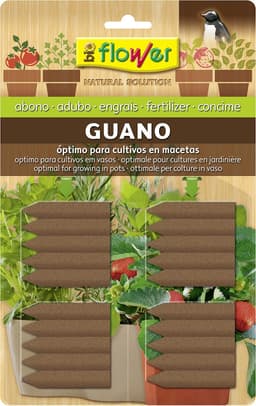
The Flower blister puts 20 guano sticks on the amazon.co.uk listing at about £5.97 and names flowers as the target, without a replacement interval or a stick count per pot in the bullets. The mixing-ratio field reads 1:0:0, which is not a usable rate, and indoor use is an unanswered listing question. The star line is 4.0 from 23. The seven saved texts are from Spain and describe sticks that snap, packs that arrived already broken or short, one pack that did not match the photo, and one pack dated 2022. That sample is not United Kingdom opinion, and the listing never says bat or seabird. At this price it is the cheapest pack in the set with a star line, though you still have no dose until you read the blister itself. The score of 80 is the 4.0 star line scaled up, not a trial of how long a stick lasts in a pot.
Pros
20 sticks at the lowest snapshot price, about £5.97
Flowers named as the target species
Small blister if you only have a few pots
Cons
No dose or replacement interval in the bullets
Saved review texts are from Spain, not the UK
Reviewers describe broken, short, or mismatched packs
Animal source is not stated
Best for: A few flower pots when you will accept a cheap stick blister without a printed dose
Less suitable: Anyone who needs a named animal, a UK review sample, or a rate before they buy
The listing asks how often to apply and does not answer it. There is no dose in the bullets. The mixing-ratio field reads 1:0:0, which is not a usable rate.
Can they be used indoors?
Indoor use is one of the unanswered questions on the listing. The target-species line says flowers.
What do the saved reviews say about the sticks?
Seven texts are from Spain. Reviewers describe sticks that snap, packs that arrived already broken or short, one pack that did not match the photo, and one pack dated 2022. The star line is 4.0 from 23.
Fertiberia’s 1 L bottle is sold as liquid guano at about £8.49, and the bullets claim leaf growth, flowers, and results in one week without naming a plant list or an analysis. The saved listing prints a mixing ratio of 1:3 and does not say whether that is fertiliser to water or which crop it is for. There is no customer-review line and no review text, so the score of 0 records that gap rather than a poor rating. Bat or seabird is not stated, and indoor use is not answered. At this size it is an entry-price liquid in the set, though you still have no verified rate and no UK shopper sample to weigh against the week-one claim. The listing is thinner than the powder tubs and the COMPO sticks on every check that is not volume.
Pros
1 L liquid at about £8.49
A mixing field is printed (1:3)
Title at least names guano
Cons
No star line and no review text in the saved listing
1:3 does not say which part is water or name a crop
No NPK and no animal on the bullets
Results-in-one-week is a seller claim, not a measured result
Best for: A buyer who already wants a litre of liquid and will read the bottle before mixing
Less suitable: Anyone who needs a star rating, a named animal, or a complete dose
It does not. The title is Liquid Fertiliser Guano Fertiberia 1 L. The bullets claim leaf growth, flowers, and results in one week, with no analysis and no plant list.
What is the mixing figure?
The saved listing prints a mixing ratio of 1:3. It does not say whether that is fertiliser to water, and it does not name a crop.
Are there reviews in the saved listing?
No. There is no customer-review line and no review text.
How we compared
Nine amazon.co.uk listings were scored as the star rating multiplied by 20. A listing with no star line scores 0. There is no laboratory test. Review counts stay beside the stars. No extra deduction was applied. A score of 100 from two or three reviews is that star line scaled up, not a UK trial. The top pick is the highest of those scores: Guanokalong at 5.0 from 3. The best value is the lowest shelf price that still has a star line, the 20-stick blister at about £5.97. The 25 kg sack is cheaper per kilogram only with dry storage and a plot. Prices are the snapshot in the saved files, not a live scrape. The weights below sum to 100 and split the written checks. They did not change the star score.
1
Form and job
25%
Powder or granules if you will mix or make a tea. Sticks if you want an insert. A liquid only when the listing is thin and you will read the bottle. A 25 kg sack only with dry storage and a plot. The number on the card is still the star line times 20.
2
Animal on the label
20%
Bat is stated for VitaLink and Guanokalong. Seabird is stated for the COMPO sticks. Flower, CULTIVERS and Fertiberia say guano without naming the animal in the saved bullets. The source column did not change the star score.
3
Pack against the job
15%
The 2 kg granules claim 2 kg equals 40 m². COMPO is 30 sticks. The bat tubs are about 3 to 3.5 kg. CULTIVERS is 1 kg or 25 kg. A few pots do not finish 25 kg.
4
Declared analysis
20%
Prefer a readable NPK or a plant list over 100% organic with no certifier. Ignore a mixing field of 1:0:0. A results-in-one-week line is a seller claim. VitaLink’s 3-10-1 appears in one UK review, not on the specification table.
5
Where the reviews were written
20%
Prefer texts marked Reviewed in the United Kingdom. COMPO at 4.5 from 2,853 and the Flower 2 kg pack at 4.5 from 106 are large counts whose saved texts are not from the UK. A 5.0 from two or three reviews is the star line scaled up. Counts were not used as a deduction.
Independent review
Last updated: October 2026
8 sources checked
Guano fertiliser buying guide
Match the form, the animal on the label and the pack size before you match the star line. Prices below are the amazon.co.uk snapshot in the saved files. This is not a laboratory test.
What to match before you buy
Guano, on GOV.UK, is excrement from bats or wild sea birds. On amazon.co.uk the same word covers bat-guano powder, granules, a liquid, sticks that name seabird guano, and a large sack. You usually want a phosphorus-leaning feed for pots or vegetables, or a stick for a palm or houseplant. Judge a pack by its form, whether the label says bat, seabird or neither, the pack size, and a dose printed on that pack. Most of these listings have no numeric NPK.
Best for
A few flower pots when a small stick blister is enough and you will read the pack for a dose
A palm, fern or pond plant when the label names seabird guano and a replacement interval
A vegetable plot with dry storage, or a buyer who wants bat guano and United Kingdom review texts
Not ideal for
Anyone who reads a large star count as United Kingdom opinion when the saved texts are from another country
A buyer who wants one NPK and one dose for every pack labelled guano
A few pots, when the pack in front of you is 25 kg
Mistakes to avoid
1
Treating a with-guano stick as bat powder
The COMPO sticks name seabird guano and a three-month insert for green plants, palms, ferns and pond plants. They are not a tub of bat powder.
2
Copying one retailer's dose onto another brand
UK retailer pages for Guanokalong do not match each other. A figure on Hyjo or GroWorks is not a dose for VitaLink, Flower or CULTIVERS. Use the pack in your hand.
3
Reading a large star count as UK opinion
COMPO’s 4.5 from 2,853 and the Flower 2 kg pack’s 4.5 from 106 are large counts. The saved texts for those listings are not from the United Kingdom.
4
Trusting 1:0:0 or an organic line
A mixing field of 1:0:0 is not an analysis. A 100% organic line on these listings names no control body and is not a certificate.
What to weigh up
Form, animal and pack size
High
Decide the job before the brand. Powder or granules are for mixing or a tea. Sticks are an insert, and only a printed interval tells you when to replace them. The COMPO sticks say up to three months, from March to October, pushed 5–6 cm from the stem. A liquid is worth buying when you can follow the mix on the bottle. Fertiberia prints 1:3 and does not say which part is water or name a crop. A 25 kg sack needs dry storage and a plot.
Then read the animal. VitaLink and Guanokalong say bat.
Analysis, dose and review origin
High
A readable NPK or a plant list beats a slogan. The Flower 2 kg components line prints 3-1.5-1.5 and names roses, hydrangeas, phalaenopsis and acid plants. CULTIVERS claims a high NPK and prints no numbers. VitaLink’s table has no NPK. One UK review states 3-10-1, which stays a review. Ignore 1:0:0. Ignore a results-in-one-week claim as a measured result.
Then check where the reviews were written. VitaLink 3.5 kg at about £26.25 has 4.6 from 517 with saved United Kingdom texts.
Which option suits you?
Three typical situations, each with a recommendation from this comparison.
🪴
A few flower pots
You have a handful of pots and you want a small blister. Flower guano sticks, 20, are about £5.97, the lowest snapshot price that still has a star line: 4.0 from 23. The saved texts are from Spain and describe broken or short packs. Flowers are the stated target, and the bullets do not print a dose.
You already use organic manures and you can store a sack that a few pots will not finish. CULTIVERS guano, 25 kg, is about £50.31 and names a vegetable garden. High NPK is claimed with no numbers, the animal is not stated, and the saved texts are from Spain and France. About £2 per kilogram is division of that snapshot.
You want the label to say bat, and you want review texts from the United Kingdom before you mix. VitaLink bat guano, 3.5 kg, is about £26.25, with 4.6 from 517 and UK texts in the file. The specification table has no NPK, the bullets have no spoon rate, and smell reports in that sample disagree. The dearer 3.5 kg listing has no review text.
The top pick is Guanokalong bat guano, 3 kg, at about £29.96. It has the highest score because amazon.co.uk shows 5.0 from 3 reviews, which scales to 100. One UK review says fruit will taste and smell better. The title says granular and the item-form line says powder. There is no NPK, no dose and no plant list. That score is the star line scaled up, not a laboratory test and not a UK award. Choose it if you already know the brand and can accept a thin listing.
Which pack is the best value?
The best value is Flower guano sticks, 20, at about £5.97. That is the lowest snapshot price that still has a star line, 4.0 from 23 reviews. Flowers are the stated target. The bullets do not print a dose or a replacement interval, and the saved texts are from Spain. Reviewers describe sticks that snap and packs that arrived broken, short or mismatched. The 25 kg sack is cheaper per kilogram only when you have dry storage and a plot that will use it.
What is guano fertiliser?
Guano fertiliser is a feed made from the excrement of bats or wild sea birds. GOV.UK uses that definition for animal by-products. On amazon.co.uk the word also appears on powder, granules, liquid and sticks, including packs that say guano and do not name the animal. It is not one analysis. Most of these listings print no numeric NPK, and UK retailer pages that give a rate do not agree, so you follow the label on the pack you buy.
How can you tell bat guano from seabird guano?
Read the label for the animal. Bat is stated on the VitaLink tubs and on Guanokalong. Seabird is stated on the COMPO sticks, which are a feed for green plants, palms, ferns and pond plants. Flower, CULTIVERS and Fertiberia say guano without naming the animal in the saved bullets. A stick sold with guano is a stick feed. Other pot inserts are in the fertiliser sticks comparison.
Does organic on the label mean the pack is certified?
No control body is named on these listings. A line that says 100% organic or organic farming is a seller claim. None of these packs is shown here as a Soil Association input. Annex I of Regulation (EC) No 889/2008 lists guano among authorised materials on legislation.gov.uk. That list does not certify any amazon.co.uk listing in this set. Treat organic as a word on the label until the pack names a certifier.
Can you take droppings from a UK bat roost to use as fertiliser?
All UK bats and their roosts are protected. Do not enter a roost to collect droppings. GOV.UK sets out the offences in England. The Bat Conservation Trust says small amounts of UK loft droppings can go on a compost heap if the bats are absent, usually from September to April, and that histoplasmosis is not associated with UK bats. Do not apply that advice to imported cave guano in a sealed tub. If building work may affect a roost, call a professional before you start.
Why is there no single NPK or dose for guano?
There is no single NPK for every pack labelled guano. The Flower 2 kg components line prints 3-1.5-1.5. The VitaLink specification table does not print an NPK. One UK review states 3-10-1 for that tub, and that figure is a review. A mixing field of 1:0:0 is not a dose. Retailer pages for one bat-guano brand do not match each other and are not the amazon.co.uk file. The RHS says organic fertilisers are usually slower and less concentrated than mineral feeds. Follow the pack you hold.
Our verdict
The top pick is Guanokalong bat guano, 3 kg, at about £29.96. amazon.co.uk shows 5.0 from 3 reviews, so the scaled score is 100, the highest in the set. One UK review says fruit will taste and smell better. The title says granular and the item-form line says powder. There are no bullets, no NPK, no dose and no plant list. The same scaled score of 100 sits on the dearer VitaLink 3.5 kg listing, which has 5.0 from 2 and no review text, so that listing takes no badge. The best value is Flower guano sticks, 20, at about £5.97, the lowest snapshot price with a star line, 4.0 from 23. Flowers are named. The saved texts are from Spain and describe broken or short packs, and the bullets print no dose. None of these scores is a laboratory test.
Best overall
Guanokalong bat guano, 3 kg
Highest scaled score: 5.0 from 3 reviews becomes 100. One UK sentence is in the file. No NPK, dose or plant list on the listing. About £29.96.
Peter F. is the editor for DIY & tools at productscompared.co.uk. Comparisons in this category are checked against amazon.co.uk listings, review evidence and public UK sources.
Updated: October 2026
8 sources checked
Guides to guano fertilisers
Guides on what to look for, how to use a product, and common mistakes.
Public UK sources from the research digest, used for this page in October 2026. Prices, stars and review counts are from the nine amazon.co.uk listings in the saved files. A 100% organic line names no certifier. A star count whose saved texts are not from the United Kingdom is not UK opinion. This is not a laboratory test. Do not collect droppings from a bat roost.
This page contains affiliate links to amazon.co.uk (tag pcuk26-21). If you buy through them, we may earn a commission at no extra cost to you. Prices, stars and review counts are from the listings. This is not a laboratory test.