


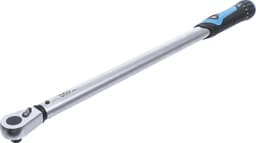
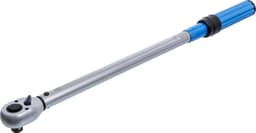


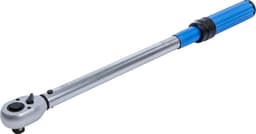


Bicycle and small fasteners
You need a figure under 30 Nm and a 1/4 inch square. A car-wheel wrench starts too high for that job. The 7181 is scaled from 6 to 30 Nm, with a case and a certificate in the bullets, and it clicks clockwise only.
The best BGS torque wrenches, compared.
Top pick: BGS 7532 10–50 Nm set Best value: BGS 961 20–110 Nm – Highest value score that is not the top pick, at about £24.44 with 227 ratings and a UK review at 40 Nm. Updated October 2026.

A torque wrench lets you set a newton-metre value, pull until the mechanism releases, and stop. In the UK you buy one when a handbook gives a figure for a bolt: a bicycle fastener, a motorcycle or small-engine fixing, or the wheel nuts on a car. A suitable example matches the square drive to the socket, and the marked range has to contain that handbook number with a margin. A range that starts too high, or stops too low, cannot do the job even if the drive looks right. Check which way the click works. A reversible ratchet head is not the same as a release on a left-hand thread. Many click wrenches are clockwise only. Look for a stated release figure, a scale you can read, a lock that holds the setting, and a case. A sheet in the box is a factory document, not automatically a UKAS calibration. Use the [guide to drive and range](/hub/hand-tools/bgs-torque-wrench/sub/bgs-torque-wrench-buying-guide) before you expect one tool to cover a bicycle and a car wheel.
A torque wrench lets you set a newton-metre value, pull until the mechanism releases, and stop.

42 products checked · 61 hrs invested · +24,100 readers
Swipe for more
1-2 of 12


Personal buying guide
Question 1 of 2
Where does the handbook figure sit?
The BGS 7532 is a 315 mm insert wrench for 9 x 12 mm tools, scaled from 10 to 50 Nm, with open-end heads from 7 mm to 14 mm and a switchable 1/4 inch ratchet head. The listing shows 5.0 from only two amazon.co.uk ratings, and both review texts are from Germany, so that star line is not a reliability sample. One German review praises the quality, a stable plastic box, metal catches and the foam. The bullets state a right-hand thread, 48 teeth, a viewing window, a handle lock, a ±3% claim, a certificate and a fine scale of 2.5 Nm, which is a coarse step on a 10–50 Nm body. At about £131.59 the price is for the head set. The file has no UK buyer, and 50 Nm does not cover car wheel nuts. The 5.0 from two reviews does not win, because the sample is too small.
Pros
Cons
Best for: You need 7–14 mm open ends on a 10–50 Nm insert wrench and you accept a two-review listing.
Less suitable: Car wheel nuts, left-hand threads, or a first wrench chosen from a large UK review sample.
Specifications
Common questions
What heads are in the BGS 7532 box?
Open-end inserts from 7 mm to 14 mm, plus a switchable 1/4 inch ratchet head. The body takes 9 x 12 mm inserts.
Is 5.0 from two reviews a reason to buy it?
No. The listing shows 5.0 from two reviews, both not marked as United Kingdom in the saved listing.
What range is it?
10–50 Nm, fine scale 2.5 Nm, stated accuracy ±3%, right-hand thread.
The BGS 2806 is a 604 mm, 1/2 inch click wrench from 60 to 340 Nm, and it is the only model here whose listing says it suits both right-hand and left-hand threads. It has 4.8 from 93 amazon.co.uk ratings, with no review text marked United Kingdom. The bullets give 48 teeth, a 1 Nm fine scale, a viewing window, a ±4% resolution and a test certificate, and the technicals list Taiwan and 1.88 kg. A US review calls it easy to set and robust, and a German review calls it expensive and well finished. An Italian review finds the adjustment slow. A French review calls the storage tube impractical, and the bullets do not name a blow-mould case. The 4.8 does not make it the top pick: there is no UK text, and the price sits in the lowest value band for a 1/2 inch wrench in this set.
Pros
Cons
Best for: You need one 1/2 inch wrench for 60–340 Nm and the listing must say it works on left-hand threads.
Less suitable: A typical car wheel under 60 Nm, or a buyer who wants UK review text and a cheaper clockwise-only wrench.
Specifications
Common questions
Will the BGS 2806 click on a left-hand thread?
This listing says the wrench suits right- and left-hand threads. That is the only model in this set that states both.
What is the range?
60–340 Nm, fine scale 1 Nm, stated resolution ±4%, length 604 mm.
Does the box include a certificate?
The bullets say a test certificate is included. They do not call it a UKAS certificate.
The BGS 2829 is a 585 mm, 1/2 inch click wrench scaled from 60 to 330 Nm, which puts many car wheel figures and some higher fasteners on one clockwise scale. It shows 4.8 from 30 amazon.co.uk ratings. The UK review in the file calls the adjustment smooth and recommends it when you do not want to spend more. The bullets state a 72-tooth head, a 1.5 Nm fine scale, a handle lock, a round plastic box and a ±3% release, clockwise only. An Italian review describes it as looking robust. A French review reports a little play between the two parts and treats that as acceptable for occasional use. The listing weight of 40 g is not a credible figure for this length, so the weight is treated as unknown. A calibration certificate is not in these bullets.
Pros
Cons
Best for: Your handbook wheel figure sits between 60 and 330 Nm and you tighten clockwise.
Less suitable: Left-hand threads, figures under 60 Nm, or anyone who needs a stated certificate and a believable weight.
Specifications
Common questions
Can I use the BGS 2829 anti-clockwise?
No. The listing sets trigger clockwise to yes and trigger counter-clockwise to no.
Does it cover car wheel nuts?
The scale is 60–330 Nm. Many car wheel figures sit inside that, but the handbook number is the one to use.
What does it weigh?
The listing says 40 g. That is not a credible weight for a 585 mm wrench, so treat the weight as unknown.
The BGS 7181 is a 250 mm, 1/4 inch click wrench scaled from 6 to 30 Nm in 0.2 Nm steps, for bicycle bolts and other small fasteners. Across 63 amazon.co.uk ratings it sits at 4.6, and the one UK review in the file calls the quality decent for the price and reports no complaint in use. The bullets state a clockwise click, a 72-tooth head, a ±3% release claim, a blow-mould case with a hard foam tray and a calibration certificate. German reviews in the sample describe it as easy to set and comfortable in the hand. A Spanish review says the scale numbers are very small and hard to see, which is the concrete criticism in the extract. The listing does not say the click works anti-clockwise. It is the top pick because it is the only score at 82. The 6–30 Nm scale is the limit, and this was not a lab test.
Pros
Cons
Best for: You set bicycle bolts and other fasteners between 6 and 30 Nm and want a cased 1/4 inch wrench with a certificate in the listing.
Less suitable: Car wheel nuts, or any fastener you have to tighten anti-clockwise.
Specifications
Common questions
What torque range does the BGS 7181 cover?
The listing says 6–30 Nm on a 1/4 inch square, with a 0.2 Nm fine scale and a stated release accuracy of ±3%.
Does it click anti-clockwise?
The listing says the trigger is clockwise. It does not say the click works anti-clockwise.
Is a case included?
Yes. The bullets describe a blow-mould case with a hard foam tray and a calibration certificate.
The BGS 2825 is a 250 mm, 1/4 inch click wrench from 5 to 25 Nm in 0.25 Nm steps, for bicycle bolts and other low-torque fasteners. It has 4.6 from 63 amazon.co.uk ratings, and none of the review texts is marked United Kingdom. An Italian review uses it on bikes, motorcycles and low-torque car work, and a Spanish review likes the click at this price. The listing is clockwise only, with 72 teeth, a serrated steel handle, a round plastic box and a ±3% claim. Another Spanish review gives three stars because the numbers are tiny and the blue finish rubs off, and a further review says one unit did not behave at a 10 Nm setting. The weight field says 0.1 g, which cannot be the tool, so the weight is unknown.
Pros
Cons
Best for: You set 5–25 Nm clockwise on a 1/4 inch square for a bike or similar small fasteners.
Less suitable: Wheel nuts, anti-clockwise threads, or a buyer who wants a credible weight and a UK review.
Specifications
Common questions
What is the BGS 2825 for?
The scale is 5–25 Nm on a 1/4 inch square. That is bicycle and small-fastener territory, not car wheel nuts.
Will it click anti-clockwise?
The listing says clockwise yes and counter-clockwise no.
Why is the weight odd?
The listing says 0.1 g. That cannot be the tool weight, so the weight is unknown.
The BGS 2843 is a 415 mm, 3/8 inch click wrench from 7 to 105 Nm in 0.25 Nm steps, which reaches some car and motorcycle fasteners and stops short of many wheel-nut figures. It has 4.6 from 39 amazon.co.uk ratings, with no review text marked United Kingdom. A German review likes the hand feel and the lock, and a Spanish review used it for car repair and found the tube case practical. The bullets state clockwise only, 72 teeth, a slide-ring lock, a round plastic box and ±3%. A French review mentions a calibration certificate that is not in the short bullets, and says the torque cannot be checked at home. The sampled reviews do not describe a repeated breakage.
Pros
Cons
Best for: You work between 7 and 105 Nm on a 3/8 inch socket and tighten clockwise.
Less suitable: Wheel nuts above 105 Nm, anti-clockwise work, or a job that needs a certificate printed in the bullets.
Specifications
Common questions
Is the BGS 2843 a wheel-nut wrench?
It stops at 105 Nm. Use it only if your handbook figure is inside 7–105 Nm. Many car wheels sit above that.
Which way does it click?
Clockwise only. Counter-clockwise trigger is set to no.
What drive is it?
10 mm, which is 3/8 inch, length 415 mm, 72 teeth.
The BGS 2827 is a 525 mm, 1/2 inch click wrench from 40 to 220 Nm, so a handbook wheel figure in that band can be set on a clockwise scale. It has 4.5 from 28 amazon.co.uk ratings, and none of the review texts is marked United Kingdom. German reviews call the scale readable, the click clear and the wrench suitable for private wheel work. The listing is clockwise only, with 72 teeth, a 1 Nm fine scale, a handle lock, a serrated steel handle, a round plastic box and a ±3% claim. A German reviewer still finds the figures small enough that older eyes want glasses. One Spanish review is dissatisfied and does not name the fault, and no certificate appears in these bullets.
Pros
Cons
Best for: Your wheel figure sits between 40 and 220 Nm and you tighten clockwise.
Less suitable: Anti-clockwise threads, figures under 40 Nm or over 220 Nm, or a buyer who wants a UK review and a printed certificate.
Specifications
Common questions
Does the BGS 2827 cover car wheel nuts?
The scale is 40–220 Nm, so many handbook wheel figures sit inside it. Use your own figure, and it clicks clockwise only.
Which way does it release?
Clockwise yes, counter-clockwise no, 72 teeth, stated ±3%.
Is a certificate listed?
Not in these bullets. The case is a round screwable plastic box.
The BGS 961 is a 280 mm, 3/8 inch click wrench marked 20–110 Nm, and the box includes an adaptor so a 1/2 inch socket can go on the same scale. It has 4.4 from 227 amazon.co.uk ratings, the second-largest count in this set, with one clear UK review. That UK reviewer used it at 40 Nm on a folding e-bike, heard a clear click and found a calibration sheet. A French review says the engraved range really is 20–110 Nm, and other reviewers mention motorcycles and a first-pass cylinder-head tighten. The bullets lock the setting with a stop screw and quote 45 teeth and ±4%, but they do not say whether the click works both ways. An Italian review says the lock screw moves and makes the adjusting collar stiff. At the top of the scale the 280 mm body is short. It is the best value because its value score is the highest that is not the top pick. The adaptor does not raise the scale.
Pros
Cons
Best for: You torque motorcycle, e-bike or similar fasteners between 20 and 110 Nm and want a 1/2 inch socket on a 3/8 inch wrench.
Less suitable: Car wheel nuts above 110 Nm, or jobs where you must know the click works anti-clockwise.
Specifications
Common questions
Does the adaptor make this a 1/2 inch high-torque wrench?
No. The adaptor lets you use 1/2 inch sockets. The scale stays 20–110 Nm.
How long is it?
280 mm. A UK reviewer used it at 40 Nm on an e-bike and mentioned a calibration sheet.
Does the listing say it clicks both ways?
No. Direction is not stated. The set torque is locked by a stop screw.
The BGS DIY 9576 is an 830 mm, 3/4 inch click wrench scaled from 140 to 980 Nm and listed at 5.01 kg, for high fasteners rather than a handbook figure below 140 Nm. It has 4.4 from 184 amazon.co.uk ratings, and several of the review texts are from the UK. UK reviews call it solid, mention the blow-mould case and a certificate, and one from a Snap-on dealer background calls it well made for occasional use. The bullets say right-hand thread, a reversible ratchet and a lock for the set value, with no ± figure and no tooth count. A UK review says it torques one way only and would have preferred a push-through square, and another says the brass slider that shows the setting came out. An Italian review reports an insert that sheared while tightening at 800 Nm. A reversible ratchet on this listing is not a two-way click.
Pros
Cons
Best for: You already know the fastener is between 140 and 980 Nm on a 3/4 inch square and you tighten clockwise.
Less suitable: Ordinary car wheel nuts below 140 Nm, anti-clockwise work, or a light tool you want to carry often.
Specifications
Common questions
Can I torque a normal car wheel with the 9576?
The scale starts at 140 Nm. A handbook figure below that is outside this wrench.
Does it work anti-clockwise?
The bullets say right-hand thread. A UK review says it torques one way only.
What did UK reviewers say?
They mention a solid tool, a case and a certificate. One says the brass scale slider came out.
The BGS 960 is a 280 mm, 1/4 inch click wrench marked 5–25 Nm with a 24-tooth head and a stop screw that locks the setting. It has 4.4 from 100 amazon.co.uk ratings, and none of the review texts is marked United Kingdom. French and Spanish reviews use it for small torque, some buyers say they repeat-buy BGS, and a German review mentions bicycle bolts. A French review says it suits spark plugs and not wheel nuts. The bullets do not state a ± figure or which way the click works, and the case is listed as a plastic case from Taiwan. An Italian review questions the precision and attaches no measurement, so that complaint stays an assertion.
Pros
Cons
Best for: You set bicycle bolts or spark plugs between 5 and 25 Nm and can accept an unstated click direction.
Less suitable: Car wheel nuts, or a tight space where 24 teeth means too much swing.
Specifications
Common questions
What is the BGS 960 for?
5–25 Nm on a 1/4 inch square. Reviewers mention bicycles and spark plugs, not car wheels.
How many teeth does it have?
24. The set torque is locked by a stop screw. A ± figure is not in the bullets.
Does it say which way it clicks?
No. Direction is not stated.
The BGS DIY 987 is a 275 mm, 1/4 inch click wrench with an effective length of 200 mm, titled 2–24 Nm and sold with a blow-mould case for about £28.60. It has 4.2 from 745 amazon.co.uk ratings, the largest count here, and the two UK reviews in the sample disagree. One says it works for a bike. The other says the torque does not work, the tool behaves as a plain ratchet, and calls that dangerous. A separate item-torque field says 13 Nm, which contradicts the title, so the range to read is 2–24 Nm. The bullets say right-hand thread and a lock, with no ± figure and no tooth count. An Italian review mentions poor contrast on the scale. Those 745 ratings include a UK report that the mechanism never clicked, so the average is not a clean pass.
Pros
Cons
Best for: You want a 2–24 Nm wrench for a bike and you can check that the one you receive actually clicks.
Less suitable: Wheel nuts, left-hand threads, or any fastener where a silent ratchet would be a problem.
Specifications
Common questions
What range should I trust on the 987?
The title says 2–24 Nm. A separate item-torque field says 13 Nm. Use 2–24 Nm and ignore 13 Nm.
Do the reviews agree it clicks?
No. A UK review says it never clicks and behaves as a plain ratchet. Another UK review says it works for a bike.
Is it for wheel nuts?
No. 24 Nm is far below a car wheel. The listing is a 1/4 inch right-hand wrench.
The BGS 2841 is a 245 mm, 3/8 inch click wrench that only runs from 5 to 25 Nm, so the square is larger than the scale you can set. It has 3.9 from 12 amazon.co.uk ratings, the lowest star line in this set, and none of the review texts is marked United Kingdom. The bullets claim a clockwise click, 72 teeth, a 0.25 Nm scale, a slide-ring lock, a steel handle, a round plastic box and ±3%, at about £38.74. A Belgian review heard no click at 5 Nm, only a visual signal, and says no case arrived. A German review passes on a mechanic’s advice to avoid it. Other reviewers still describe it as precise enough or better made than wrenches around £25–£30, so the small sample is split. The range stays 5–25 Nm even though the drive is 3/8 inch.
Pros
Cons
Best for: You already want a 3/8 inch square for 5–25 Nm clockwise and you can return a unit that does not click.
Less suitable: Anyone choosing a first 5–25 Nm wrench on stars, price and a case that arrives with the tool.
Specifications
Common questions
Why a 3/8 inch drive for only 25 Nm?
The listing is 5–25 Nm on a 10 mm square. The range is the limit, not the drive size.
What is the star rating?
3.9 out of 5 from 12 reviews, the lowest star line in this set.
Does every buyer hear a click?
The bullets say an audible release. One review says that at 5 Nm there was no click, only a visual signal.
We scored twelve BGS click-wrench listings on amazon.co.uk. Shelf prices, stars and review counts are those listings. There was no torque bench and no lab test. The score is 0–100: stars out of 35, the size of the review sample out of 25, how clearly the listing states direction, release, scale, teeth, case and certificate out of 25, and value inside this set out of 15. A stated fault in the reviews can deduct up to 15. The highest score is the top pick, once. The highest value part that is not the top pick is the best value, once.
Star rating
35%The amazon.co.uk star line, scaled so 5.0 is 35 points. Stars are not a measure of torque deviation.
Review sample
25%How many ratings the listing shows, and whether a UK review text is in the file. A missing UK text is already counted here.
Listing clarity
25%Whether the bullets state direction, a release figure, a fine scale, the tooth count, a case, a certificate, and a credible length and weight.
Value in this set
15%Price against what this set of listings actually offers: range, case, certificate, review evidence and drive. The first matching band only.
You match a click wrench to a handbook figure, a square drive and a direction. One range does not cover a bicycle bolt and a car wheel. The prices on this page are the amazon.co.uk shelf prices for the twelve listings. Stars and review counts come from those same listings. There was no torque bench. A ±3% bullet is a manufacturer claim. A sheet in the box is not automatically a UKAS certificate. Read the range before the price, and stop when the wrench clicks.
A click torque wrench is a hand tool you set to a newton-metre value. You pull until it releases, then you stop. UK buyers mostly match a drive and a range to a job, then check whether the click works clockwise only. On a listing, the useful signs are the stated release figure, a scale you can read, a range that covers the handbook number with margin, and a certificate you understand as a factory sheet rather than a UKAS calibration. The handbook figure has to sit inside the marked range.

A 5–25 Nm wrench cannot do a car wheel. A wrench that starts at 60 Nm cannot do a 10 Nm bolt. Match the handbook figure to the marked range before you look at the price.
A reversible ratchet head turns the square both ways. It does not mean the click releases on a left-hand thread. Only a listing that says both directions supports that job.
A ±3% or ±4% bullet is a manufacturer claim, not a UKAS result, and it does not last by itself. An adaptor does not raise the scale. A 40 g or 0.1 g weight field, or a 13 Nm field against a 2–24 Nm title, is not a figure to trust. Stars do not measure torque deviation.
The marked range is the first filter, and the drive is the second. The handbook torque has to sit inside the scale, not at a guessed close enough. A 5–25 Nm wrench cannot do a car wheel. A wrench that starts at 60 Nm cannot do a 10 Nm bolt. Leave margin rather than living on the last mark, because the top of a short body is a hard pull.
Direction decides whether the click exists for the thread you are tightening. Several listings are described as clockwise or right-hand only. One 1/2 inch listing says right and left. Two older lock-screw wrenches do not state a direction. A reversible ratchet head is not a dual-direction click. If the job is a left-hand thread, buy the listing that says so. The stated release is the next line to read. ±3% or ±4% is the manufacturer claim on that listing.
Three typical situations, each with a recommendation from this comparison.
You need a figure under 30 Nm and a 1/4 inch square. A car-wheel wrench starts too high for that job. The 7181 is scaled from 6 to 30 Nm, with a case and a certificate in the bullets, and it clicks clockwise only.
You refit wheels and the handbook figure sits between 40 and 220 Nm. You tighten clockwise. The 2827 is the 1/2 inch wrench in this set whose scale starts low enough for many of those figures and still reaches 220 Nm.
You need the listing to say the click works on a left-hand thread. A reversible ratchet is not that. The 2806 is the only wrench here whose listing says both right-hand and left-hand threads, on a 60–340 Nm scale.
The top pick is the BGS 7181. It is the only score at 82: about £15.98, a stated 6–30 Nm scale, a case, a certificate in the bullets, and a UK review with no fault. It is a 1/4 inch wrench, so it does not cover a car wheel. The best value is the BGS 961, which has the highest value score that is not the top pick. It is about £24.44, with 4.4 from 227 ratings and a UK review at 40 Nm on an e-bike. The adaptor does not raise its 20–110 Nm scale. This was not a lab test.
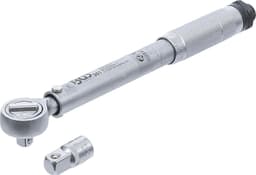
BGS 961 20–110 Nm
Highest value score that is not the top pick, at about £24.44 with 227 ratings and a UK review at 40 Nm.
Editorial

Peter F. is the editor for DIY & tools at productscompared.co.uk. Comparisons in this category are checked against amazon.co.uk listings, review evidence and public UK sources.
Guides on what to look for, how to use a product, and common mistakes.
Sources for this comparison, last checked on 22 October 2026.
This article contains affiliate links. If you buy through them, we may earn a commission at no extra cost to you. Listings, review counts and public sources still decide the comparison. We did not run a lab test.