Independent comparisons. We may earn from shop links. More info

How to set a click torque wrench and stop at the click

Updated: 22 October 2026

You are on the drive with a BGS click wrench and a handbook figure, and the handle will not turn until the lock is released. How to set a click torque wrench is that order: unlock, line up the main mark and the fine mark, lock again, pull until it clicks, and stop. Pulling past the click adds load the scale did not ask for. Spans and prices stay on the [BGS torque wrench comparison](/hub/hand-tools/bgs-torque-wrench). Peter F. wrote this from those amazon.co.uk listings and from public UK instruction sheets, on 21 October 2026. We did not calibrate a wrench. A qualifying purchase through our links can earn a commission at no extra cost to you.

You are on the drive with a BGS click wrench and a handbook figure, and the handle will not turn until the lock is released.

Our top picks

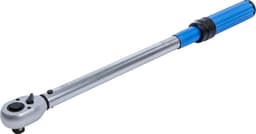
BGS BGS 7181 6–30 Nm

Best overall

BGS BGS 7181 6–30 Nm
8.2/10about £15.98
BGS BGS 2827 40–220 Nm

Rank 2

BGS BGS 2827 40–220 Nm
6.9/10about £54.98
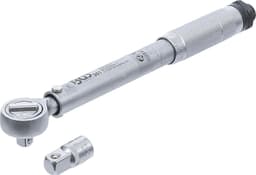
BGS BGS 961 20–110 Nm

Best value

BGS BGS 961 20–110 Nm
6.7/10about £24.44
On this page

Unlock and set the number

Two locks show up in this set. On the 960 and the 961 a stop screw holds the setting: loosen it, turn to the number, then nip the screw. On the 2841, the 2843, and the newer family the lock is a slide ring or a handle collar that you pull or slide, turn, and let it seat again. If the listing only says “handle lock” or “locks the set value”, the sheet in the box decides. A stiff stop screw is not a higher setting. The number is a split reading, the same idea Sealey prints on the STW915B sheet as 50 plus 2. Fine steps here are 0.2 N·m on the 7181, 0.25 N·m on the 2825 and the 2841, 1 N·m on the 2827 and the 2806, 1.5 N·m on the 2829, and 2.5 N·m on the 7532. Most of these wrenches state a clockwise click only. The 2806 states both directions. A reversible ratchet does not add a left-hand click. Model notes are on the BGS torque wrench clockwise only page. If the wrench has sat unused, Sealey’s sheet says to click it a few times at a low setting so the grease moves. That is usual practice from that sheet, not a line BGS prints on every listing.

Pull until it clicks, then stop

Seat the socket square and pull smoothly from the centre of the handle, at a right angle to the wrench. Tohnichi treats that handle-centre pull as the position the scale assumes. A hand up by the head shortens the lever the spring was marked for. On the 987 the effective length is 200 mm, so a tube over the handle changes the result and you do not add one. If the top of the scale is too heavy for a normal pull, the range is wrong, which is the choice on the BGS torque wrench buying guide. Stop when it clicks. Laser’s 5623 sheet says a steady pull, then stop, and do not use the wrench as a breaker bar. Sealey’s STW915B says you stop when it releases. Pulling on past the click loads the fastener past the number you set. If the nut was still slack, snug it with a ratchet or the wheel brace first, then finish with the torque wrench. The wrench only does that last movement.
BGS BGS 7181 6–30 Nm

Testsieger

BGS BGS 7181 6–30 Nm
8.2/10about £15.98

You do not crack a fastener loose

You do not crack a fastener loose with it. A stuck nut needs a breaker bar or the brace. A soft tick near the bottom of the scale is still the stop, because a release near the lowest mark can feel quieter than one at the top.

Put it away

These amazon.co.uk listings do not share one BGS storage sentence, so the sheet in your box comes first. Where that sheet is silent, Sealey and Laser both say to set the lowest marked value after use, and not to wind below it. AWS, a UK torque firm, says the spring takes a set if you leave a high value on for days. Leaving the top of the scale wound up is the habit that note is aimed at. Going below the lowest engraved mark leaves the spring with no marked stop. Return it that way every time, unless your own sheet names another rest position. If the 961 stop screw has gone stiff, that is one shopper’s report, not a rate for every 961. Ease the screw rather than forcing the collar. A slide ring that will not move is usually still locked. If it never clicks, stop using it on that fastener. A UK review of the 987 says that sample never clicked, and a Belgian review of a 2841 at 5 N·m reported no click. Those reports are about those samples, not every BGS tool. Do not keep pulling, and do not add a bar to force a click. Finish with a wrench that does release, or return the silent one.

Common questions

How do I set 110 N·m if the fine scale is 1 N·m?
On the 2827 and the 2806 the fine scale steps in 1 N·m. Set the main scale on the last full mark at or below 110, then add the remainder on the fine collar. Ten steps of 1 N·m carry 100 up to 110. If 110 is already a main mark, leave the fine collar on zero. The 2829 steps in 1.5 N·m and will not land on 110 exactly.
Can I loosen a wheel nut with it?
No. The click wrench finishes a fastener and does not break one loose. Laser’s sheet says not to use the tool as a breaker bar, and Sealey says to stop when it releases. A wheel nut that will not move needs the brace or a breaker bar. The figure for refitting the wheel comes from the vehicle handbook.
Why does the 961 collar go stiff?
The 961 locks with a stop screw, and one review describes that screw going stiff. That is a single report, not a failure rate. Loosen the screw, set the number, and nip it back without forcing the collar. If it stays tight after the screw is backed off, check the sheet rather than leaning on the handle. A stiff collar is a lock problem, not a reason to set a higher figure.
What if there is no click at all?
Stop. Do not keep turning the fastener, and do not add a bar to force a click. A UK review says one 987 never clicked, and a Belgian review of a 2841 at 5 N·m reported no audible release. Those reports describe those samples, not every BGS wrench. Put the silent one aside and finish the bolt with a wrench that does release.

Related pages

Sources

Sources for this comparison, last checked on 22 October 2026.

  1. ISO 6789-1:2017 sample, deviation by type and maximum torque (retrieved 22 October 2026)
  2. ISO 6789-2:2017 sample, interval of 12 months or 5,000 cycles (retrieved 22 October 2026)
  3. Avon Dynamic ADCF112, UKAS calibration guidance (retrieved 22 October 2026)
  4. AWS white paper on ISO 6789:2017 (retrieved 22 October 2026)
  5. BGS technic torque wrench product page (retrieved 22 October 2026)
  6. Barum, tightening wheel nuts (retrieved 22 October 2026)
  7. Ingersoll Rand UK, how much torque you need (retrieved 22 October 2026)
  8. HSE L22, PUWER 1998 (retrieved 22 October 2026)