Independent comparisons. We may earn from shop links. More info

Torque wrench for wheel nuts UK, set to the handbook figure

Updated: 22 October 2026

Beside a wheel in a UK lay-by, the nuts are up and the last car’s figure may not be this car’s. A torque wrench for wheel nuts in the UK finishes that job: the handbook number, on a scale that contains it, in a star or a cross, until the wrench clicks. An impact gun or a remembered 120 N·m can stretch a stud or leave a wheel loose. Ranges and prices stay on the [BGS torque wrench comparison](/hub/hand-tools/bgs-torque-wrench). Peter F. wrote this from those amazon.co.uk listings and from public UK sources, including the Department for Transport torque note and Continental’s UK retorque page, on 21 October 2026. We did not torque a wheel or calibrate a wrench. A qualifying purchase through our links can earn a commission at no extra cost to you.

Beside a wheel in a UK lay-by, the nuts are up and the last car’s figure may not be this car’s.

Our top picks

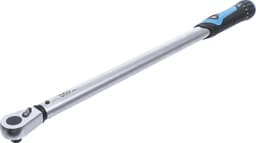
BGS BGS 2806 60–340 Nm

Best overall

BGS BGS 2806 60–340 Nm
7.2/10about £106.76
BGS BGS 2829 60–330 Nm

Rank 2

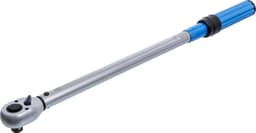
BGS BGS 2829 60–330 Nm
6.8/10about £50.15
BGS BGS 2827 40–220 Nm

Rank 3

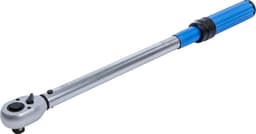
BGS BGS 2827 40–220 Nm
6.9/10about £54.98
On this page

Get the figure from the car, not from a table

The number is in the handbook for that model and that wheel. Barum’s UK tyre advice says the manual wins, and that a typical car is often around 110–120 N·m. Ingersoll Rand UK puts many cars around 108–135 N·m. Those bands are a size check, not a collar setting. A published contrast shows Astras at 110 N·m against 140 N·m, and BMWs at 120 N·m against 140 N·m, so a similar car is not a source. Write the number down before the wheel is off. If the book is at home, snug the nuts with the brace in a cross or a star and drive gently to somewhere you can read it. Setting 120 N·m because it sounds like a normal car is the mistake this page is for. A small hatch on alloys and a van on steel wheels can sit well apart. Lubricant on the threads changes the clamp from the same number, so follow the handbook on dry or lightly oiled threads. The Department for Transport discusses lubrication as commercial-vehicle practice, which is not a reason to oil a clean alloy stud at the roadside. Oil a thread the book says should be dry, and the click arrives at a higher clamp than the maker allowed. Lining up the scales is on the how to set a click torque wrench page.

Which BGS range can do that figure

A click wrench only reports a number between its lowest and highest marks. Three 1/2 inch models in this set cover a normal car wheel. The BGS 2827 is marked 40–220 N·m and listed at about £55. The 2829 is marked 60–330 N·m, about £50. The 2806 is marked 60–340 N·m, about £107. A handbook figure of 110 N·m or 140 N·m sits inside all three. The 2827 and the 2829 click clockwise only, which suits a normal right-hand wheel nut. The 2806 clicks both ways. If your nuts are right-hand, the cheaper clockwise wrench does the same final pass, and the extra on the 2806 buys a left-hand click you are not using. The 961 is a 3/8 inch wrench marked 20–110 N·m, 280 mm long, with an adaptor to 1/2 inch. The adaptor fits the socket. It does not raise the scale, and 110 N·m is the last mark. A handbook figure of 120 N·m or 140 N·m cannot be set. The 2843 stops at 105 N·m, under the band Barum gives for many cars. The 9576 is a 3/4 inch wrench from 140–980 N·m, so 110 N·m or 120 N·m is below its first mark, and 140 N·m is only the bottom of a much higher scale. Bikes and trim stay on the BGS torque wrench buying guide. The scale has to contain the handbook figure, and a clockwise click is enough for a normal right-hand nut.
BGS BGS 2806 60–340 Nm

Testsieger

BGS BGS 2806 60–340 Nm
7.2/10about £106.76

Pattern, clean faces, and a second check

Bring the nuts up with the brace before the torque wrench moves. Chicago Pneumatic’s UK note says you finish with a torque wrench, in a star, and you do not shock-load it. The Department for Transport says that last pass is a calibrated wrench, not power tools or a long bar. If you use an impact gun at all, stop while the nut is still short of tight, then finish with the click. Continental’s UK guidance uses a star on five studs and a cross on four: half the figure, then the full figure. On five studs, skip a neighbour so two adjacent nuts are never next. On four studs, take one nut, then the opposite, then the other pair. Do that with the tyre on the ground. A wheel still on the jack can rotate, and the click arrives late. If the handbook names another order, follow that. Wipe the hub and the nut seats first. The Department for Transport asks for clean faces and treats a thin film of paint as something that still lets them meet. A ring of grit can make a nut feel tight while the wheel is still proud of the hub.

Check again after the first miles

Check again after the first miles. Continental UK says about 30 miles or 50 km. The Department for Transport says 25 to 50 miles, because the joint relaxes. Use the same wrench, figure, and pattern. A nut that turns before the click needs the whole pattern again. A crossed stud, a stretched thread, or a wheel that will not sit flat is a tyre-shop job, not another pull.

Common questions

What N·m should I use on the wheel nuts?
Use the handbook figure for that car and that wheel. Barum says the manual wins, and many cars fall around 110–120 N·m. Ingersoll Rand UK describes about 108–135 N·m for many cars. Published contrasts put an Astra at 110 N·m or 140 N·m, and a BMW at 120 N·m or 140 N·m, so a family number is not your setting. If the book is not with you, snug the nuts and read it before you set the wrench.
Is 110 N·m on the 961 enough for wheel nuts?
Only if the handbook figure is 110 N·m or lower. The 961 is marked 20–110 N·m on a 280 mm 3/8 inch wrench, and 110 N·m is the top mark. A 1/2 inch adaptor fits the socket and does not extend the scale. A book that says 120 N·m or 140 N·m is above it. The 2827, at 40–220 N·m, holds 110 N·m in the middle of the scale.
Should I torque the nuts in the air or on the ground?
Do the final passes with the tyre on the ground, unless the handbook names another method. A wheel still on the jack can rotate as you pull, and the click comes late. Snug the nuts enough to centre the wheel while it is raised, then lower the car. After that, go to about half the figure, then to the full figure, with the click wrench.
What pattern do I use for four studs and five studs?
Continental’s UK guidance uses a cross on four studs and a star on five. Four studs means one nut, then the opposite nut, then the remaining pair. Five studs means you skip a neighbour each time. Go to about half the handbook figure on the first round, then to the full figure on the second, and stop when the wrench clicks.
Can an impact gun do the final tighten?
No. The Department for Transport says the final tighten is a calibrated torque wrench, not power tools or a long bar. Chicago Pneumatic’s UK note says the same and warns against shock-loading the wrench. An impact gun does not stop at 110 N·m or at 140 N·m. Leave the nut short of tight, then finish with the click wrench and stop when it clicks.

Related pages

Sources

Sources for this comparison, last checked on 22 October 2026.

  1. ISO 6789-1:2017 sample, deviation by type and maximum torque (retrieved 22 October 2026)
  2. ISO 6789-2:2017 sample, interval of 12 months or 5,000 cycles (retrieved 22 October 2026)
  3. Avon Dynamic ADCF112, UKAS calibration guidance (retrieved 22 October 2026)
  4. AWS white paper on ISO 6789:2017 (retrieved 22 October 2026)
  5. BGS technic torque wrench product page (retrieved 22 October 2026)
  6. Barum, tightening wheel nuts (retrieved 22 October 2026)
  7. Ingersoll Rand UK, how much torque you need (retrieved 22 October 2026)
  8. HSE L22, PUWER 1998 (retrieved 22 October 2026)