Independent comparisons. We may earn from shop links. More info

Torque wrench clockwise only: the flip lever is not the click

Updated: 22 October 2026

You are on the drive with a wheel to refit, or you are threading the left pedal onto a bike, and the BGS ratchet lever flips both ways. That lever freewheels the square drive so you can reset your hand. A torque wrench clockwise only still releases in the direction the amazon.co.uk listing states. This page stays inside the [BGS torque wrench comparison](/hub/hand-tools/bgs-torque-wrench) and separates a reversible head from a two-way calibration. You should finish knowing which listings state one direction, which one states both, and which two leave the direction unstated. Peter F. read those direction lines on 21 October 2026. We did not run a lab calibration. A qualifying purchase through our links can earn a commission at no extra cost to you.

You are on the drive with a wheel to refit, or you are threading the left pedal onto a bike, and the BGS ratchet lever flips both ways. That lever freewheels the square drive so you can reset your hand.

Our top picks

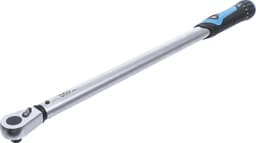
BGS BGS 2806 60–340 Nm

Best overall

BGS BGS 2806 60–340 Nm
7.2/10about £106.76
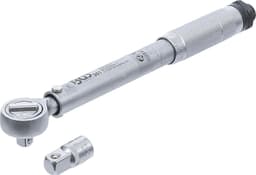
BGS BGS 7181 6–30 Nm

Rank 2

BGS BGS 7181 6–30 Nm
8.2/10about £15.98
BGS BGS 961 20–110 Nm

Best value

BGS BGS 961 20–110 Nm
6.7/10about £24.44
On this page

The ratchet switch is not the click

The flip lever and the click are two mechanisms in one handle. The lever changes which way the head ratchets, so you can swing back for the next bite without undoing the nut. The click is the calibrated cam and spring that lets go at the number you set. On a torque wrench clockwise only, that release is specified in one direction. A head that turns both ways can still be a one-way calibration. Workshop notes draw the same line before you load a left-hand thread. Vehicle Service Pros records that the ratchet switch is the head’s freewheel, and that a clockwise-only micrometer wrench can be damaged if you load it anti-clockwise. Forum owners describe a flip lever that still clicks only clockwise, which is a mechanism note from other brands. These BGS direction lines come from the amazon.co.uk listings. Torque-Expo’s line is to check the specification before an anti-clockwise thread. Picture a normal right-hand wheel stud on a UK car. You set the handbook figure, pull smoothly clockwise, and the click is the stop. The same load anti-clockwise on a left-hand nut drives the spring the way a clockwise listing did not specify, while the head still seems to turn. Leave a BGS square-drive head as it is, and use a turn-over method only when that model’s own sheet describes it. Only the 2806 in this set states both directions, and the collar setting on the how to set a click torque wrench page leaves that printed direction unchanged.

What these BGS listings actually say

Read the trigger direction on the listing before the star rating. In this amazon.co.uk set, the 7181, 2825, 2827, 2829, 2841 and 2843 state clockwise only. The 9576 is stated as right-hand, and a UK review of that model describes one direction only, “righty tighty”. The 987 and the 7532 are listed as right-hand too, clockwise on a normal thread as you look along the bolt. Set against the 2806, these nine suit ordinary right-hand fasteners, though they are the wrong assumption once the thread runs the other way. The 2806 states both directions, right and left, at £106.76, on a scale of 60–340 N·m. It is the only both-directions line among these twelve. Choose it when the fastener is left-hand and sits inside that scale. Below 60 N·m, or above 340 N·m, the direction can be right and the range still wrong, which is the choice on the BGS torque wrench buying guide. The 960 and the 961 leave the direction unstated, so treat it as unknown until a sheet says otherwise. For a normal right-hand thread, a listing that states clockwise is the clearer buy. For a left-hand thread, leave those two and use the 2806, or another wrench whose sheet you have read. Avon Dynamic, a UK calibration firm, describes a UKAS calibration as clockwise unless you pay for both directions. Where a tool is specified in both directions, ISO 6789-1 expects the stated deviation to be checked in each.
BGS BGS 2806 60–340 Nm

Testsieger

BGS BGS 2806 60–340 Nm
7.2/10about £106.76

When you need the other direction

The job that exposes a one-way wrench is usually a single fastener. Some vehicles use a left-hand wheel nut on one side so the nut does not loosen as the wheel turns. The other side is often a normal thread, so check the handbook or the nut, because the corner of the car does not tell you the thread. The left bicycle pedal is the other case in a UK shed, a left-hand thread so pedalling does not unwind it. A clockwise-only click will not confirm the tightness of that pedal. The 2806 states both directions inside 60–340 N·m, which is the scale to set against that pedal. Pedal figures often sit below 60 N·m, so the 2806 can be the right direction and still the wrong scale, and a figure above 340 N·m misses at the top. A second direction never stretches the engraved marks. On ordinary right-hand wheel studs, a clockwise listing is enough when the scale covers the handbook figure and you stop at the click. An anti-clockwise pull, just to test a left-hand nut, is the load Vehicle Service Pros warns can damage a clockwise-only mechanism. When the thread is left-hand and the figure sits inside 60–340 N·m, the 2806 is the model here that states a click both ways, at £106.76. Use a clockwise model when that reverse click would stay unused. Hand the job to a garage if the handbook is missing, the nut is damaged, or the thread direction is unclear.

Common questions

If the ratchet flips, why will it not click the other way?
The flip lever changes which way the ratchet head freewheels so you can reset your hand. The click is a separate release, specified one way on a clockwise listing. A lever that still clicks only clockwise, reported on other brands, shows the switch and the calibration as different mechanisms. On a BGS 2827 that flip repositions your hand on a right-hand stud. The listing still states clockwise only.
Which models in this set state both directions?
Only the BGS 2806 states both directions, right and left, at £106.76 on a 60–340 N·m scale. The other eleven either state one direction or leave it unstated. Choose the 2806 when the thread is left-hand and the fastener sits inside that scale. Under 60 N·m the range is still wrong, and the buying guide sorts span.
What about the 960 and 961, which do not state a direction?
The 960 and the 961 do not state a direction, so it stays unknown. Neither a clockwise limit nor a two-way click is proven from those fields. For a right-hand thread, choose a listing that states clockwise. For a left-hand thread, use the 2806 or a wrench whose sheet you have read. A certificate that never names the second direction leaves the gap open.
Will anti-clockwise use damage a clockwise-only wrench?
Vehicle Service Pros warns that loading a clockwise-only micrometer wrench anti-clockwise can damage it. The ratchet can still turn, so the head feels normal while the calibrated part is driven the wrong way. We did not reproduce that on a BGS sample. Skip the pull on a left-hand nut, and use the 2806 when its scale covers the figure.
Are left-hand wheel nuts a real case in the UK?
Some vehicles use a left-hand wheel nut on one side, so the nut does not loosen as the wheel rotates, and the other side is often right-hand. The corner of the car does not decide the thread. The left bicycle pedal is the other common left-hand thread, often below the 60 N·m start of the 2806. Check the handbook, then match direction and scale.
Does a factory certificate cover both directions?
A certificate covers the direction it names. Avon Dynamic notes that a UKAS calibration is clockwise unless you pay for both directions. ISO 6789-1 checks the stated deviation in each direction when a tool is specified both ways. Clockwise-only paperwork is evidence for clockwise. On the 960 or the 961, a blank listing direction stays unknown.

Related pages

Sources

Sources for this comparison, last checked on 22 October 2026.

  1. ISO 6789-1:2017 sample, deviation by type and maximum torque (retrieved 22 October 2026)
  2. ISO 6789-2:2017 sample, interval of 12 months or 5,000 cycles (retrieved 22 October 2026)
  3. Avon Dynamic ADCF112, UKAS calibration guidance (retrieved 22 October 2026)
  4. AWS white paper on ISO 6789:2017 (retrieved 22 October 2026)
  5. BGS technic torque wrench product page (retrieved 22 October 2026)
  6. Barum, tightening wheel nuts (retrieved 22 October 2026)
  7. Ingersoll Rand UK, how much torque you need (retrieved 22 October 2026)
  8. HSE L22, PUWER 1998 (retrieved 22 October 2026)