


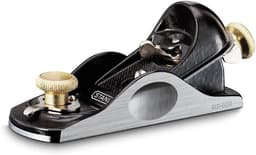


Door fitting
You are easing a sticking internal door and want a cutter wide enough for the edge, with a mouth you can set. The CBP95 bullets state 42 mm and an adjustable mouth, and the review file names door and site-plane work.
The best block planes, compared.
Top pick: Stanley 220 block plane Best value: Spear & Jackson CBP65 – Highest value score among the other listings, with a 35 mm cutter and a moving mouth at about £16.20. Updated 22.10.2026.

A block plane is a short metal hand plane you work with one hand. In the UK you use a block plane to trim end grain, cut a chamfer, flush a plug or an edge strip, and ease a door that sticks. The iron is bedded bevel-up. It is not a longer smoothing plane, not a Japanese pull plane, and not a rasp-style shaper. The sole has to meet the wood. The iron has to sit square and take a sharp edge. The mouth and the depth adjuster have to hold that setting. UK pattern notes put a low-angle bed at about 12–13°, often with an iron around 35 mm, and a standard bed at about 20–21°, often with an iron around 40 mm. With a 25° bevel those beds cut at about 37° and about 45°. A carpenter’s block plane is usually about 150–180 mm long. A pattern name such as 9½ is not the body length. The checks, in order, are in our [block plane buying guide](/hub/hand-tools/block-plane/sub/block-plane-buying-guide).
A block plane is a short metal hand plane you work with one hand. In the UK you use a block plane to trim end grain, cut a chamfer, flush a plug or an edge strip, and ease a door that sticks. The iron is bedded bevel-up.

28 products checked · 61 hrs invested · +18,600 readers
Swipe for more
1-2 of 8


Personal buying guide
Question 1 of 2
What are you planing?
The Stanley 220, catalogue 1-12-220, is about £29.43, and the bullets put the cutter at 21° with manual depth adjustment and no moving mouth. Across 2,567 amazon.co.uk reviews the line is 4.5, the largest sample in this set. In the first 50 reviews, people trim sticky doors and do small craft work, and some say the adjustments are smooth after a light hone and that they have no complaint about the sole. The frequent criticism is a sole that is poor, concave, or touching on only two corners of a flat plate, including an indent at the mouth that stayed after hours of lapping. One retired carpenter returned a plane because the mouth was finished on an angle and the blade could not be squared. The iron is called soft and quick to dull, and one review cites about 2.5 to 3 mm of side movement in the mouth. Stanley UK lists a 40 mm iron for this catalogue number, while the amazon cutting-width line says 77 mm, so that 77 mm figure is not the iron width. It is the largest review file here for a stated 21° plane, and the sole is why it does not lead the score.
Pros
Cons
Best for: Cross-grain and light door work if you will lap the sole and you do not need a sliding toe.
Less suitable: A first plane where a moving mouth is the point, or anyone treating 77 mm as the cutter width.
Specifications
Common questions
What angle does the listing state?
The bullets say the cutter rests at 21°, for cross-grain planing, and that the plane is manually adjustable.
Does this listing include an adjustable mouth?
No. The bullets do not mention a moving mouth. One reviewer could not square the iron because the mouth was machined on an angle.
Which cutter width is on the page?
The cutting-width line says 77 mm. The included-components line says 1.5/8 inch. Those two figures conflict, so the width is not treated as settled. Stanley UK lists a 40 mm iron for 1-12-220.
The Stanley 5-12-020 with pouch is the dearest row in this capture at about £50.42. The bullets state 21° and also call the plane low angled, the cutting-width line says 40 mm, and a storage pouch is included. Across 783 amazon.co.uk reviews the line is 4.5. In the first 50 reviews, some buyers needed about 30 minutes on emery to flatten the sole, and some irons arrived sharp with adjusters that felt precise, including one-handed trimming. Other reviews cite about 1 mm of bow across the width and about 2 mm of cup along the length, a sliding toe that is not flush with the sole, and an iron that arrived out of square and blunt. Buyers who paid toward the higher indicated price called that finish unacceptable. A 21° bed is the standard angle in the UK pattern notes used here, so the words low angled on this listing do not make it a 12–13° plane. It is the pouch and the stated degree if you will lap the sole, not a flat sole bought by the highest price.
Pros
Cons
Best for: A Stanley with a pouch and a stated 21° bed, if you will spend time on the sole.
Less suitable: A 12–13° low-angle bed, or a buyer who expects the highest price to mean a flat sole out of the box.
Specifications
Common questions
What angle is printed?
The bullets say the plane is positioned at 21° and they also call it low angled. The cutting-width line says 40 mm. A 21° bed is the standard angle, not a 12–13° low-angle bed.
Is a pouch included?
Yes. The title, the bullets and the included-components line all name a storage pouch.
What do reviews say about the sole?
Some buyers flatten it in about half an hour. Others describe a cupped sole, poor machining, and a front plate that is not flush with the sole.
The Spear & Jackson CBP65 is a No. 6½ block plane at about £16.20, with a 35 mm cutter and a fully adjustable mouth in the bullets, and a cast-iron body around 700 g. Across 728 amazon.co.uk reviews the line is 4.5. In the first 50 reviews, buyers call it usable after a hone, often with less fettling than they expected, and they set the brass adjuster easily. More than one review still calls the iron the weak part even when the body is liked, and more than one sole is close to flat but still wants a lap. One first delivery had a jammed front mouth plate and was replaced. One reviewer found it heavy for prolonged one-handed use, and the logo in the thumb recess is a sticker. It is the best-value score in this set: a real adjustable plane at the low end, with the iron as the part you should budget to hone.
Pros
Cons
Best for: A first adjustable block plane for small work and a light trim, if you will hone the iron.
Less suitable: A 42 mm pass on a door edge, or a buyer who wants the iron to be the strong part out of the box.
Specifications
Common questions
Is the mouth adjustable?
The bullets say a fully adjustable mouth and a 35 mm cutter, with a brass adjusting screw.
Does the listing say it is for one hand?
Yes. The bullets say end grain and single-handed operation. One reviewer found this example heavy for one hand.
What do reviews repeat about the iron?
Buyers hone it before use. More than one calls the iron the weak part while describing the body as decent.
The Spear & Jackson CBP95 is a No. 9½-pattern block plane at about £23.85, with a 42 mm cutter and an adjustable mouth in the bullets, and a body listed at 17.5 × 7 × 4.5 cm. Across 547 amazon.co.uk reviews the line is 4.5. In the first 49 review blocks, buyers use it one-handed on doors and as a site plane so a better plane stays on the bench, and some irons cut a shaving straight from the box. The sole is described as reasonably flat, if a bit rough, so a lap still comes up. The depth adjuster is called fiddly, and on one plane the depth-adjuster screw broke in two during reassembly after fettling. At 898 g the weight helps some buyers and is simply heavy for others. It is the highest score in this set for a door-width cutter with a moving mouth, not a measured 12° bed and not a plane you can skip tuning.
Pros
Cons
Best for: Fitting a couple of internal doors or site edges when you want about 42 mm of iron and a moving mouth.
Less suitable: A measured 12–13° bed, or a palm-sized plane for a cramped cupboard.
Specifications
Common questions
How long is the body?
The dimension line says 17.5 × 7 × 4.5 cm. A UK reviewer says 9½ is the model name, not a 9.5 inch length.
What cutter width is stated?
The bullets say 42 mm. The cutting-width line says 1.63 inches. The mouth is described as fully adjustable.
What broke in one review?
The depth-adjuster screw broke in two while the buyer was reassembling the plane after fettling.
The Robert Sorby RS-CBP95 is about £32.99, titled as a No. 9½ with a 35 mm cutter, an adjustable mouth and a cast-iron body, listed at 900 g and 17.5 × 4.5 × 7 cm, with India as the origin. Across 24 amazon.co.uk reviews the line is 4.3, and all 24 blocks were in the file, so the themes rest on fewer voices than the other rows. Several of those reviews call it sharp on arrival, easy to adjust, and a good size in the palm, and one buyer took a little off a door bottom. The blade clamp is the weak detail, the finish is rougher than the Robert Sorby name led one buyer to expect, and at least one sole needed more than a light lap. A spare blade is described as available, not as included. The power-source line says Battery Powered, which does not belong on a hand plane. It is a short UK sample of a 35 mm adjustable plane, not evidence that the name changes the casting.
Pros
Cons
Best for: A first adjustable plane in the hand if you accept a 24-review sample and will check the clamp and the sole.
Less suitable: Anyone who needs a large UK review file, or a cutter nearer 42 mm.
Specifications
Common questions
Is the mouth adjustable?
Yes. The title and the bullets say an adjustable mouth, a 35 mm cutter and a brass adjusting screw.
Does a spare blade come in the box?
The bullets say a blade is supplied and that a spare is available. They do not say a spare is included.
What do the 24 reviews repeat?
Several call it sharp, a good size in the hand, and easy to adjust. Criticism names the blade clamp, a rough finish, and a sole that needed more than a light lap.
The Jorgensen 70700 is a palm-sized adjustable plane at about £14.99, listed at 9 × 3.2 × 5 cm and 250 g, with a 1.25 inch cutting-width line and an O1 blade in the bullets. Across 2,258 amazon.co.uk reviews the line is 4.2, the second-largest sample here. In the first 50 reviews, door edges and sticking doors are the usual job, often with the door left on the hinges, and several buyers found the sole flat and the blade sharp on arrival. The same file says the cutter is narrower than a door edge, so a full-width shaving takes longer, and the size is fiddly to hold and to set. One buyer could not get the blade to sit square, so the cut was one-sided. It scores just behind the wider Spear & Jackson rows: useful on a small rub, not a stand-in for a 40 mm iron.
Pros
Cons
Best for: A small rub on a door edge, a cupboard edge or thin ply, when you accept several passes.
Less suitable: One pass across a full door edge, or a buyer who needs a stated bed angle.
Specifications
Common questions
How big is this plane?
The dimension line says 9 × 3.2 × 5 cm and 250 g. The cutting-width line says 1.25 inches.
What do the reviews use it for?
Door edges and small touch-up work. Several reviewers also say it is narrower than a door edge and slow because of that.
What blade does the listing name?
The bullets say an O1 tool steel blade. The included-components line says Saw Blades.
The Stanley 1-12-020 is about £43.98 in the saved listing, made in Mexico, listed at 872 g and 20 × 7 × 13.5 cm, with bullets for adjustable depth, mouth and angle and a 40 mm cutting-width line. Across 1,539 amazon.co.uk reviews the line is 4.2. Many of the first 50 reviews are one-line praise for small DIY jobs, and the adjustable mouth is called handy. Where the criticism is specific, the lever-cap screw will not stay tight, so the plane comes apart in use, and one unit arrived looking used with the adjuster wheel rusted solid. The sole is called curved, with dips at the edges that remained after four hours of sanding from 100 to 800 grit, and the blade showed deep machining marks. The title says 9.5in, which is pattern wording rather than a measured 9.5 inch body. It is the adjustable Stanley with the larger review file in this set, and the sole and the lever cap keep the score below the Spear & Jackson rows.
Pros
Cons
Best for: A Stanley with a moving mouth and a 40 mm iron, if you will check the sole and the lever cap before you rely on it.
Less suitable: A buyer paying extra to avoid fettling, or anyone reading 9.5in as the body length.
Specifications
Common questions
What can you adjust?
The bullets say depth, mouth width and angle, and they describe one-hand operation. The cutting-width line says 40 mm.
Where does the listing say it was made?
Country of origin Mexico. The weight line says 872 g and the dimension line says 20 × 7 × 13.5 cm.
What do the critical reviews name?
A lever-cap screw that will not stay tight, a curved sole, machining marks on the iron, and one unit that arrived looking used with a rusted adjuster.
The ChongYue CYAPDGJ is the cheapest sticker in this capture at about £7.69, and the title calls it a block plane for door trimming. The bullets say 13.5 × 4 cm and a screw for blade depth. The dimension line says 10 × 2 × 1 cm and the weight line says 20 g, against a cast-iron base in the materials line. The saved listing has no customer-review line and no review text, so there is no star rating to scale. The included-components line says Block, and a spare iron is not listed. It is a listing with two sizes and no UK review file, not a plane you can choose for a door from the evidence here.
Pros
Cons
Best for: Only if you already know this part number and can check the size in your hand before you rely on it.
Less suitable: A first block plane, a door edge, or any buy that depends on reviews or a stated bed angle.
Specifications
Common questions
What size does the listing give?
The bullets say 13.5 × 4 cm. The dimension line says 10 × 2 × 1 cm and the weight line says 20 g. Those lines disagree, so neither size is treated as settled.
Does the listing include an adjustable blade?
The bullets describe a screw adjustment for blade depth. A spare iron is not listed. The included-components line says Block.
Is there a review count?
The saved listing has no customer-review line and no review text, so there is no star rating and no review count to show.
Eight amazon.co.uk block-plane listings are scored here from a wider set of shelf files. Points come from the star rating, the size of that review file, whether the reviews name a job and a sole or iron fault, and value signals printed on the listing. There is no lab measurement of the sole. Prices are the captured shelf prices in GBP, not a live offer.
Amazon stars
35%The amazon.co.uk star rating, scaled to 35 points. A missing rating line scores 0. This is not a lab score.
Review sample
20%Larger review files score more, up to 20 points at 1,000 ratings or more. A file with no rating line scores 0.
Use in the reviews
30%Up to 30 points from whether the reviews name a job, and from repeated sole, mouth and iron faults in those notes. A sole called close to flat is not treated as a cupped sole.
Value in this set
15%Up to 15 points from the shelf price, a single printed cutter width, a clear contents line, a pouch, a material line and the size of the rating file. A rating under 4.0, or a repeated sole or crooked-blade note, reduces it.
Choose a block plane by the cut you actually make, then by whether the mouth, the iron and the sole can hold that cut. A low-angle bed and a standard bed are different tools. A pattern name on the title is not a measurement. The notes below follow UK pattern sources and the faults that repeat in amazon.co.uk reviews. They are not a lab test of any sole.
A block plane is a short, one-handed metal plane with a single iron bedded bevel-up. In the UK you use it to trim end grain, cut a chamfer, flush a plug or an edge strip, and ease a sticking door. It is not a No. 4 smoothing plane, not a Japanese kanna, and not a Surform. You judge one by a sole that meets the wood, an iron that can be made square and sharp, and a mouth and depth adjuster that hold their setting.

In these titles, 9½ and 9.5 inch are often the pattern name. Check the dimension line. A carpenter’s block plane here is about 150–180 mm, and one reviewed body is 17.5 cm.
A low-angle bed is about 12–13°. A standard bed is about 20–21°. A listing that pairs the words low angle with 21° is still a standard bed.
A sliding toe is for matching the mouth to the shaving. Close it for a fine cut. Open it before you try to take a thick one, or the mouth chokes.
End grain and laminates favour a low effective angle, about 37° when a 12–13° bed meets a 25° bevel. A long-grain chamfer favours about 45°, from a 20–21° bed or from a steeper second iron. A door edge is a width problem as well as an angle problem: the cutter has to cover the edge if you want one pass. UK notes put the low-angle 60½ pattern near 150 mm with about a 35 mm iron, and the standard 9½ pattern near 160 mm with about a 40 mm iron.
UK Workshop treats a sliding toe as worth having on a first plane, because you open the mouth for a thicker cut and close it for a fine one. Some listings state depth and lateral adjustment and a 21° cutter, and do not list a moving mouth. Budget a hone before you judge the iron. Review files include irons that cut on arrival and irons that are soft, out of square, or held in a mouth machined on an angle. A sole has to meet the wood.
Three typical situations, each with a recommendation from this comparison.
You are easing a sticking internal door and want a cutter wide enough for the edge, with a mouth you can set. The CBP95 bullets state 42 mm and an adjustable mouth, and the review file names door and site-plane work.
You want a screw adjuster and a moving mouth without paying the top of this set. The CBP65 carries the best-value score: a 35 mm cutter, an adjustable mouth and a cast-iron body, with the iron as the part reviewers hone.
You only need a small rub on a door edge, a cupboard edge or thin ply, and you will make several passes. The Jorgensen is listed at 9 × 3.2 × 5 cm. It is the wrong plane if you need one pass across a full door edge.
The top pick is the Spear & Jackson CBP95. It has the highest score in this set, from amazon.co.uk stars, the size of the review file, named door and site-plane use, and value points for a single printed cutter width. The bullets state a 42 mm cutter and an adjustable mouth, and the sole notes do not repeat an unflat sole. One depth-adjuster screw did break during reassembly. The best value is the Spear & Jackson CBP65, which has the highest value part among the other listings, at about £16.20, with a 35 mm cutter and a moving mouth. Reviewers still call that iron the weak part. A higher price in this set does not bring a higher star rating, and none of these scores is a lab test.
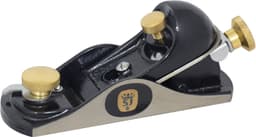
Spear & Jackson CBP65
Highest value score among the other listings, with a 35 mm cutter and a moving mouth at about £16.20.
Editorial

Peter F. is the editor for DIY & tools at productscompared.co.uk. Comparisons in this category are checked against amazon.co.uk listings, review evidence and public UK sources.
Guides on what to look for, how to use a product, and common mistakes.
Public UK sources and amazon.co.uk listing files. Checked on 22 October 2026.
This page contains affiliate links. If you buy through them we may earn a commission at no extra cost to you. Prices, stars and review counts are from amazon.co.uk listings. We did not run a lab test.