Independent comparisons. We may earn from shop links. More info

Best block plane UK: what to check first

Updated: 22 October 2026

You are about to order one block plane from amazon.co.uk, and the titles treat 9½, low angle and 9.5 inches as the same fact. The best block plane UK shoppers can judge from this set is the one whose job, mouth and length match the cut, not the row with the most stars. This page puts that decision in order before you compare brands. The model rows, star lines and captured prices sit on the [block plane comparison](/hub/hand-tools/block-plane). A qualifying purchase can earn us a commission at no extra cost to you. Peter F. checked those listings, UK maker pages and public woodworking notes on 22 October 2026. He did not lap these soles.

You are about to order one block plane from amazon.co.uk, and the titles treat 9½, low angle and 9.5 inches as the same fact.

Our top picks

On this page

What you are actually buying

A block plane is a short metal plane you can push with one hand. The single iron sits bevel-up, with no chipbreaker, which is why it suits end grain, a chamfer, a plug or a door edge better than it suits flattening a tabletop. A No. 4 smoothing plane is a two-handed bench tool. A Japanese kanna is a different bed and a different grip. A Surform is a rasp. On the Block Planes browse node, Surform planes were sitting in the visible best-seller spots, so that list will not choose this tool for you. The job splits before the brand does. End grain and a laminate edge want a lower cutting angle. A long-grain chamfer is kinder nearer 45°. A door edge wants a cutter wide enough to meet that edge, which a 9 cm mini does not do in one pass.

Angle, mouth, then hand

Find My Tool’s Stanley 60½ review puts a low-angle bed at 13°, with a 35 mm iron and a body around 150 mm, against a 9½ nearer 20°, about 40 mm and about 160 mm. None of the eight listings kept here prints a measured 12° or 13° bed. The Spear & Jackson CBP65 and CBP95 bullets say low angle and give no degree. The Stanley 5-12-020 bullets say 21° and also say low angled. Those phrases are not the same plane. John Lloyd’s account is that one low-angle body, plus a second and steeper iron, can cover both cuts if you do not grind under 25°. The hone sums are on low angle vs standard block plane. UK Workshop contributors treat a sliding toe as worth having on a first plane. You open the gap for a thicker shaving and close it for end grain, and the same thread warns you off a plane with no screw feed. Stanley UK’s page for the 1-12-220 lists a 21° cutter, depth and lateral adjustment, and a 40 mm iron. It does not list a moving mouth. The CBP65 and CBP95 bullets do. Setting that screw is how to use a block plane. A carpenter’s block plane in this set is about 150–180 mm long. The Jorgensen mini is listed at 9 × 3.2 × 5 cm and 250 g, a palm tool for a corner, not a short 160 mm plane. The CBP95 dimension line says 17.5 × 7 × 4.5 cm. A UK reviewer notes that 9½ is the model name, not a 9.5 inch body.
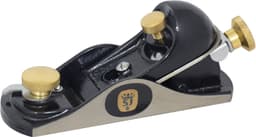
Stanley Stanley 220 block plane

Testsieger

Stanley Stanley 220 block plane
7.5/10about £29.43

What the amazon.co.uk prices buy

These shelf prices are the figures in this category’s saved listings, not a promise of today’s offer. The ChongYue listing is £7.69 and has no customer-review line. The bullets say 13.5 × 4 cm, while the dimension line says 10 × 2 × 1 cm and 20 g beside a cast-iron base. Those cannot all be the plane in the box. The Jorgensen mini is £14.99, with 4.2 from 2,258 reviews and a 1.25 inch cutting-width line. The CBP65 is £16.20, with 4.5 from 728 reviews, a 35 mm cutter and an adjustable mouth. Buyers hone that iron, and more than one calls it the weak part. The CBP95 is £23.85, with 4.5 from 547 reviews and a 42 mm cutter. The Stanley 220 is £29.43, with 4.5 from 2,567 reviews and a 21° bullet. Its amazon cutting-width line says 77 mm, and Stanley UK lists a 40 mm iron for 1-12-220, so 77 mm is not the blade to shop by. The Robert Sorby RS-CBP95 is £32.99, with 4.3 from 24 reviews and a 35 mm cutter. The Stanley 1-12-020 is £43.98 in the saved listing, 4.2 from 1,539, with a 40 mm line. On 21 October 2026 the public page showed £44.36. The 5-12-020 with pouch is £50.42, 4.5 from 783, and the bullets pair 21° with low angled. A higher price here does not buy a higher star line or a sole the reviews agree is flat.

A short decision

If you can buy only one plane and the work is end grain, look for a low-angle pattern with an adjustable mouth, and accept that this set does not print a 12–13° figure. The CBP65 states 35 mm and a moving mouth at £16.20, which is that shape without a degree you can check. If the work is a door edge, a cutter nearer 40 mm is the more direct match: the CBP95 states 42 mm, and the Stanley 1-12-020 and 5-12-020 state 40 mm. The 9 cm Jorgensen will take a small rub, and reviewers say it takes longer because it does not cover the thickness. If a fixed mouth is acceptable and you want a stated 21°, the Stanley 220 is the large review file, with the sole and the mouth geometry as the risk. If the listing prints two sizes and no reviews, leave it. Lie-Nielsen and Veritas are names people mention once they want a different iron and a different sole. They are not priced in this set. Take the job, then the mouth, then the centimetres, then the price.

Common questions

What should I buy if I can only afford one block plane?
Buy for the cut you will actually make. End grain points you toward a low-angle pattern with an adjustable mouth, and in this set that shape is a 35 mm cutter with a moving mouth, not a printed 12° figure. A door edge points you toward a cutter nearer 40–42 mm, which the CBP95 and the two wider Stanleys state. A £15 mini is the right single tool only when the rub is small and you will take several passes.
Do I need an adjustable mouth?
On a first plane, yes, if you can get one. UK Workshop contributors treat a sliding toe as worth having, because you open it for a thicker shaving and close it for end grain. The Stanley 220’s UK product page lists depth and lateral adjustment at 21°, and it does not list a moving mouth. The CBP65 and CBP95 bullets do include one. A fixed mouth is still usable if you already know you will take light cuts.
Is a 9½ nine and a half inches long?
No. In this pattern, 9½ is the model name. The CBP95 dimension line says 17.5 × 7 × 4.5 cm, which is about 6.9 inches long, and a UK reviewer says the same thing in plain words. The Stanley 1-12-020 title says 9.5in while the dimension line says 20 × 7 × 13.5 cm. Read the centimetre field. If the title and the dimension line describe different objects, do not average them.
Is the Stanley 220 enough, or do I want a moving mouth?
The 220 is enough when you want a stated 21° bed, a large review file, and you will lap a sole that many of the first 50 reviews call concave. It is not enough when the reason you are buying is the sliding toe. Stanley UK does not list a mouth adjustment for 1-12-220, and one reviewer could not square the iron because the mouth was machined on an angle. A mouth you never close does not improve the cut.
Is a £15 mini the same tool as a 160 mm plane?
No. The Jorgensen at £14.99 is listed at 9 × 3.2 × 5 cm and 250 g, with a 1.25 inch cutting-width line. A 9½-pattern body in the Find My Tool comparison is about 160 mm, with an iron around 40 mm. Reviewers do trim door edges with the mini, and they also say the narrow cutter makes that edge slow. Use it in a corner, on thin ply, or on a rub already smaller than the iron.
Does a higher price in this set mean a flatter sole?
No. The dearest listing here, the Stanley 5-12-020 at £50.42, still draws reviews that cite about 1 mm of bow and about 2 mm of cup, beside other buyers who flattened a sole in about 30 minutes. The Stanley 220 at £29.43 has the largest sample and a repeated concave-sole note. The CBP95 at £23.85 is described as reasonably flat and still a bit rough. Price in this capture buys a name, a pouch or a stated degree.

Related pages

Sources

Public UK sources and amazon.co.uk listing files. Checked on 22 October 2026.

  1. John Lloyd, Top of the Blocks (retrieved 22.10.2026)
  2. UK Workshop: low-angle vs standard-angle block plane (retrieved 22.10.2026)
  3. UK Workshop: first block plane advice (retrieved 22.10.2026)
  4. Find My Tool: Stanley 60½ block plane (retrieved 22.10.2026)
  5. Stanley Tools UK: 220 adjustable block plane (retrieved 22.10.2026)
  6. HSE WIS23: wood dust (retrieved 22.10.2026)
  7. Consumer Rights Act 2015, section 9 (retrieved 22.10.2026)
  8. GOV.UK: General Product Safety Regulations 2005 (retrieved 22.10.2026)