Independent comparisons. We may earn from shop links. More info

Low angle vs standard block plane

Updated: 22 October 2026

You are looking at two amazon.co.uk titles that both say low angle, and one of them also prints 21°. Low angle vs standard block plane is the difference between a bed of about 12–13° and a bed of about 20–21°, plus the bevel you hone on the iron. The bed is the casting. The bevel is the edge you can still change. By the end you should know which bed you are being sold, when one iron is enough, and when the word on the bullet is only a word. The listings themselves are on the [block plane comparison](/hub/hand-tools/block-plane). A qualifying purchase can earn us a commission at no extra cost to you. Peter F. wrote this on 22 October 2026 from UK furniture and tool sources. He did not measure the bed angle of any plane in this set.

You are looking at two amazon.co.uk titles that both say low angle, and one of them also prints 21°.

Our top picks

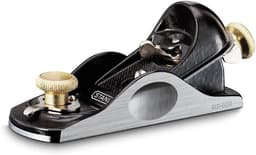
Stanley Stanley 220 block plane

Best overall

Stanley Stanley 220 block plane
7.5/10about £29.43
On this page

Two beds, not two brands

A block plane carries one iron, bevel-up. The cutting angle is the bed plus the bevel you honed, because the back of the iron is the face that meets the wood. Find My Tool’s comparison of a current Stanley 60½ with a 9½ puts the low-angle plane at 13°, a 35 mm iron and about 150 mm long, and the standard plane at about 20°, a 40 mm iron and about 160 mm long. Paul Sellers, in a 2011 review of the same pair, uses 12½° for the 60½ and 21° for the 9½, and he treats both as useful. Owning both is not required. The names travel with the iron width more often than with a degree printed on a carton. A 60½-pattern plane is the narrower, lower bed, commonly 35 mm. A 9½-pattern plane is the wider, steeper bed, commonly about 40 mm. Those millimetres are the Find My Tool figures for those Stanley patterns. They are not a measurement of the Spear & Jackson or Stanley listings below. A 35 mm iron on a plane that never states its bed is a clue, not a proof of 13°. If the page gives you only the words low angle, you do not yet know which of these two beds is in the box.

Add the bevel you actually hone

John Lloyd’s figures are the ones to use if you hone at 25°, which is also his floor: do not grind under 25°. A 12° or 12½° bed plus a 25° bevel is about 37°. A 20° bed plus the same 25° bevel is 45°. A second iron, honed at 33° and seated on the low bed, lands near 45° as well. UK Workshop’s March 2021 thread uses that same pair, 12 plus 25 and 12 plus 33. One low-angle body can therefore imitate the standard cut, if you keep a second iron and you do not mix the bevels up. Axminster’s Rider explainer uses a different hone, about 30°. On their numbers a 60½ bed at 13½° plus 30° is 43½°, and a 9½ bed at 20° plus 30° is 50°. Those totals are real for a 30° bevel. They are not a correction of Lloyd’s 37° and 45°. If you paste 43½° onto a 25° iron, you have invented a cutting angle nobody measured. Decide which bevel you will actually grind, then add that number to the bed once. About 37°, assuming Lloyd’s 25°, slices end grain and laminates with less resistance, and it is more willing to tear long grain that runs out. About 45° is closer to a small smoothing plane and is kinder along the grain. A 33° iron on the low bed is how you get that kinder cut without buying the second body. Leave the steep iron in and you lose the low-angle advantage.
Stanley Stanley 220 block plane

Testsieger

Stanley Stanley 220 block plane
7.5/10about £29.43

End grain, long grain, one plane

Choose the low bed, about 12–13°, when the work is end grain, a plywood edge or a laminate, and you will keep the bevel near 25°. That is the 60½ pattern in the Find My Tool and Lloyd accounts: shorter, often 35 mm, and dependent on a sharp iron. A dull 37° edge still tears. The mouth still has to match the shaving. The bed does not rescue a blunt iron, which is why setup stays on how to use a block plane. Choose the standard bed, about 20–21°, when most of the work is long grain, a chamfer along a stile, or you want one iron and no spare to mix up. Find My Tool’s 9½ is the wider iron, about 40 mm, which also covers more of a door edge. You do not have to own both if your work sits on one side of that split. A second iron at about 33° is the cheaper way to cover the other side, and only if the low-angle body is the one you bought first. A 21° plane plus a steeper iron goes higher than 45°, which is a scraping cut, not a way back to 37°. If you truly do both jobs every week, two planes are simpler than two irons you will swap under a cap with cold fingers. If you do end grain on Saturday and a chamfer rarely, one low-angle body and a second iron is the Lloyd route. Price and which row even offers a mouth come after that choice, on the block plane buying guide.

What the amazon titles do with the words

The Stanley 5-12-020 bullets say the plane is positioned at 21° and they also call it low angled. Twenty-one degrees is the standard bed in the sources above, whether you use Lloyd’s 20°, Find My Tool’s 20°, Axminster’s 20°, or Sellers’ 21°. Calling it low angled does not move the casting to 12°. The cutting-width line on that listing is 40 mm, which matches the standard pattern’s iron better than it matches a 35 mm 60½. Shop it as a 21° plane with a pouch, and ignore the low-angle wording. The Stanley 220 is the honest version of the same bed. Its bullets say 21° and do not say the mouth moves. Stanley UK lists a 40 mm iron for 1-12-220. That is a standard-angle block plane with a clear degree. It is not a low-angle plane that forgot to print 12°. The Spear & Jackson CBP65 and CBP95 bullets say low angle and give no degree at all. The CBP65 states a 35 mm cutter, which is the width associated with the low-angle pattern, and the CBP95 states 42 mm, which is the width associated with a 9½. Width is not a protractor. No ASIN in this set is a measured 12° plane. You can buy the CBP65 as a 35 mm plane with a moving mouth. You cannot claim, from the listing, that its bed is 13°. The Robert Sorby title says No. 9½ and 35 mm together, and it also says low angle with no degree. Read the cutter width you can check, and treat the angle as unstated. If end grain is the job and you will hone near 25°, you want a low bed, and this set does not prove you are getting one. If long grain is the job, a stated 21° plane is the standard bed, and the 220 and the 5-12-020 are the listings that actually print 21°. A second iron changes the cut only on the lower bed, and only if you hone it steeper on purpose.

Common questions

What is the degree difference that matters?
About eight or nine degrees of bed, from roughly 12–13° up to roughly 20–21°. With a 25° bevel, Lloyd’s arithmetic turns that into a cutting angle near 37° against a cutting angle of 45°. That is the gap that changes how end grain feels. A catalogue nickname, or the words low angle with no number, are not a difference you can plane to. If the listing prints 21°, you are on the standard side of the gap, whatever else the bullet says.
Is 21° a low angle?
No. In the UK sources used here, 21° is the standard block-plane bed, the 9½ side of the pair. Low angle means about 12°, 12½° or 13°, the 60½ side. The Stanley 5-12-020 listing puts both phrases on one plane. The number wins. A 21° bed plus a 25° bevel cuts at about 46°, which is the ordinary angle, not the 37° end-grain cut. Buying it because the title said low angled will disappoint you on end grain and will be fine on a chamfer.
Can I hone a second iron instead of buying two planes?
Yes, if the body you own is the low-angle one. Lloyd and the UK Workshop thread both put a 33° bevel on a 12° bed and land near 45°, which is what a standard bed gives you with a 25° iron. You then have two cutting angles and one sole. It fails if you grind the spare under 25°, if you mix the irons up, or if the only plane you own is already at 21°. A steeper iron on a 21° bed does not recreate 37°. It only makes the cut steeper.
Which is better on end grain?
The lower bed, with the bevel kept near 25°, so the cutting angle stays around 37° rather than 45°. That is the low-angle pattern, often a 35 mm iron around 150 mm long. It is better only while the iron is sharp and the mouth is just wider than the shaving. A blunt low-angle plane loses to a sharp 21° plane. In this amazon.co.uk set, no listing gives you a measured 12–13° bed to point at, so better on end grain is a pattern to shop for, not a row verified with a protractor.
Is a 35 mm iron the low-angle pattern and 40–42 mm the standard pattern?
As a rule of thumb from the Stanley patterns, yes. Find My Tool pairs 35 mm with the 13° 60½ and about 40 mm with the 20° 9½. The CBP95’s 42 mm bullet sits with the wider pattern, and the CBP65’s 35 mm bullet sits with the narrower one. The rule fails when a title mixes them, as the Robert Sorby listing does with No. 9½ and 35 mm. Width is printed. Angle, on those two Spear & Jackson pages, is not. Use the width for the door edge, and do not pretend it proved the bed.
Why do two UK articles give different cutting angles for the same beds?
Because they add different bevels. Lloyd and UK Workshop add 25°, and a second iron at 33°, and they get about 37° and about 45°. Axminster’s Rider page adds about 30°, and gets about 43½° and 50° from beds at 13½° and 20°. Both can be right for the hone they assume. They cannot both be the cutting angle of your iron unless you honed it twice. Read the bevel in the article before you copy the total onto your plane.

Related pages

Sources

Public UK sources and amazon.co.uk listing files. Checked on 22 October 2026.

  1. John Lloyd, Top of the Blocks (retrieved 22.10.2026)
  2. UK Workshop: low-angle vs standard-angle block plane (retrieved 22.10.2026)
  3. UK Workshop: first block plane advice (retrieved 22.10.2026)
  4. Find My Tool: Stanley 60½ block plane (retrieved 22.10.2026)
  5. Stanley Tools UK: 220 adjustable block plane (retrieved 22.10.2026)
  6. HSE WIS23: wood dust (retrieved 22.10.2026)
  7. Consumer Rights Act 2015, section 9 (retrieved 22.10.2026)
  8. GOV.UK: General Product Safety Regulations 2005 (retrieved 22.10.2026)